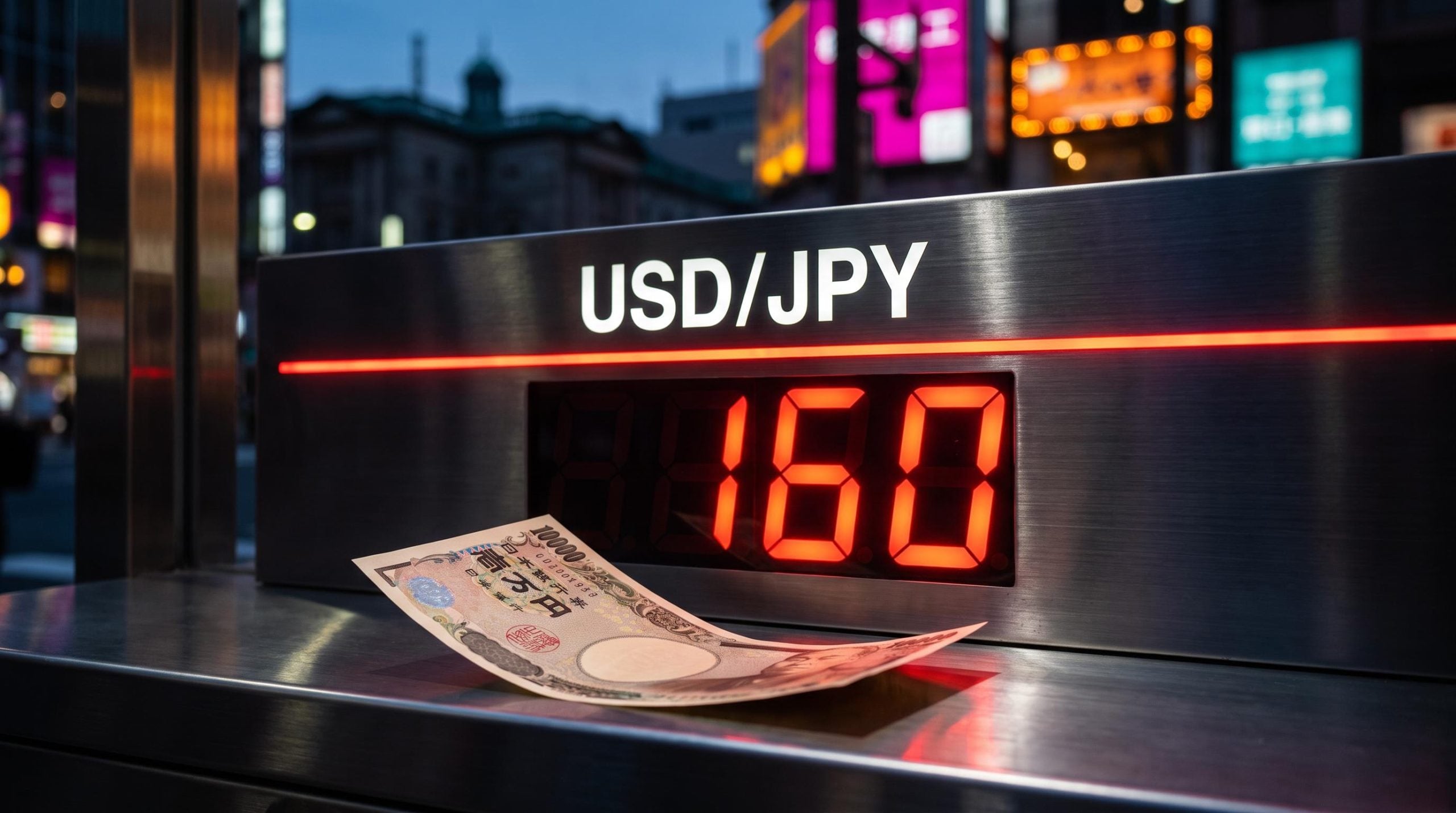
The Bank of Japan (BoJ) has its policy rate at 1.25%, the highest since 1995, and the yen keeps weakening. USD/JPY sits near 158 and has tested 160 repeatedly this year. Higher Japanese rates have not produced a stronger yen, and that gap is the starting point for any serious yen outlook.
Markets see little chance of a BoJ move at the 30 October meeting and are looking to December instead. Rabobank Senior FX Strategist Jane Foley still holds a three-month USD/JPY target of 155.00.
Three forces decide whether that call holds: BoJ timing, Fed pricing and intervention risk. Below is how they interact, and what would make Foley’s 155 target right or wrong.
Why is the market looking past October 30 and pricing a December BoJ hike?
The next BoJ meeting is a little over three weeks away, and traders are largely ignoring it. The reason is the pace of the bank’s recent hikes.
The BoJ raised its rate to 1% in June 2026, then moved again on 18 September, taking it from 1.00% to 1.25%, effective 24 September. Markets had expected the hike. According to Reuters, the BoJ has historically been reluctant to raise rates more than once every six months, partly because of weak growth. A three-month gap between hikes was already fast by its standards.
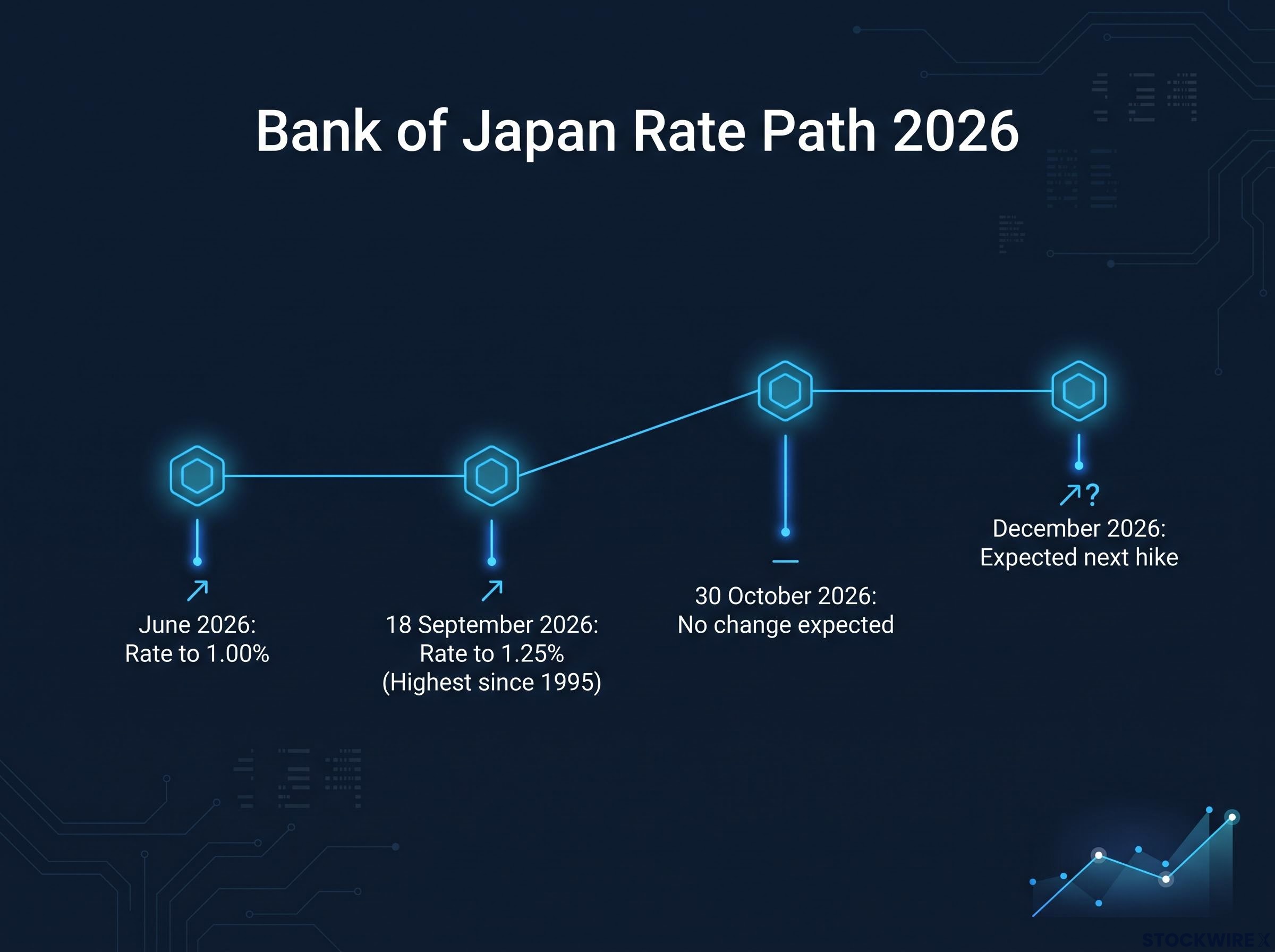
| Date | Rate after move | Gap since prior hike | Market read |
|---|---|---|---|
| June 2026 | 1.00% | Not reported in research | Futures later pointed to an October follow-up |
| 18 September 2026 | 1.25% | About three months | Anticipated; faster than the six-month norm |
| 30 October 2026 (meeting) | No change expected | N/A | Little chance of a move |
| December 2026 (expected) | Not specified | About three months | Next expected hike |
Governor Kazuo Ueda has said policymakers plan to keep raising rates. He also described the economy as expanding “moderately”, which points to steady tightening rather than back-to-back hikes. In March he said the bank would watch yen moves closely, because a weaker currency raises import costs at a time when oil prices are high.
Ueda in June, with USD/JPY near 160 The BoJ “must discuss the pros and cons of raising interest rates if inflationary risks outweigh downside risks to the economy.”
Market expectations have moved. On 5 August, Reuters reported that futures pointed to an October hike. Coverage in early October shows markets now expect December, and that newer view carries more weight. Explicit probabilities were not available, so the pricing can only be described in general terms.
The practical point: if October passes quietly, the yen gets no policy boost in the coming weeks. Any near-term strength would have to come from outside the BoJ.
With the rate differential versus the Fed still around 250-275 basis points, the yen weakened toward 157 even after the BoJ reached its highest rate in 31 years, which is why Tokyo’s moves alone carry so little weight.
When big ASX news breaks, our subscribers know first
How does Fed pricing shape the yen, and why does Rabobank call it over-priced?
If Tokyo is not driving the yen, Washington is. Much of the pressure on the yen comes from the US side of the trade.
How the yield gap works
A yield differential is the difference between the interest rates investors can earn in two countries. US rates sit well above Japan’s, so investors borrow cheaply in yen and buy higher-yielding dollar assets. This is called a carry trade, and it keeps selling pressure on the yen.
Here is a simple example. Suppose markets expect the Federal Reserve to keep US rates high next year. US Treasury yields stay up, the gap stays wide and the dollar holds its strength. If expectations shift towards fewer Fed hikes, US yields fall, the gap narrows and the carry trade becomes less attractive. That shift can pull USD/JPY lower even if the BoJ does nothing.
The main drivers of the pair are:
- Yield gap: the core driver, kept wide by BoJ caution and firm Fed expectations
- US data: strong reports lift yields and the dollar
- Geopolitics: Middle East hostilities have increased safe-haven demand for dollars
- Oil: a weak yen and high oil prices push up import inflation
- Intervention: produces sharp moves that tend to fade
US data feeds through quickly. On 5 June, strong US jobs numbers pushed the dollar through 160. In August, Reuters described intervention as “no game changer”, given the wide rate gap and the BoJ’s caution.
Rabobank’s over-pricing argument
Foley’s view rests on that mechanism. In her assessment, the market has built too much Fed tightening into next year’s expectations. If some of that pricing is removed, the yield gap narrows and USD/JPY could fall into 2027.
This is a call about Fed expectations being revised, not a call for an aggressive BoJ. Explicit Fed futures figures were not available in the research, so the scale of the claimed over-pricing cannot be checked independently.
The direction of the yen depends as much on US data surprises as on anything Tokyo does. A single strong US report can cancel out the effect of a BoJ hike.
What does the 160 line tell you about intervention risk?
The third force is Japan’s Ministry of Finance, and this year’s record suggests its power to support the yen is limited.
In January, USD/JPY hit 159.45. Finance Minister Satsuki Katayama warned that Japan would take “appropriate action against excessive currency moves without excluding any options.” Markets began treating 160 as an unofficial line in the sand.
The test came in spring. With the pair around 160.725, Japan spent 11.7 trillion yen (about US$73 billion) between April and May, the largest intervention round ever recorded in a month. USD/JPY dropped to about 155. By 3 June it was back at 160.015, and those gains had been erased.
Two days later, US jobs data pushed it through 160 again.
By early August the yen had fallen to a 40-year low near 164. Japan and the US then made a rare joint intervention that took the pair to about 155.20. Even so, the dollar was trading above 160 again by early September, and it now sits near 158.
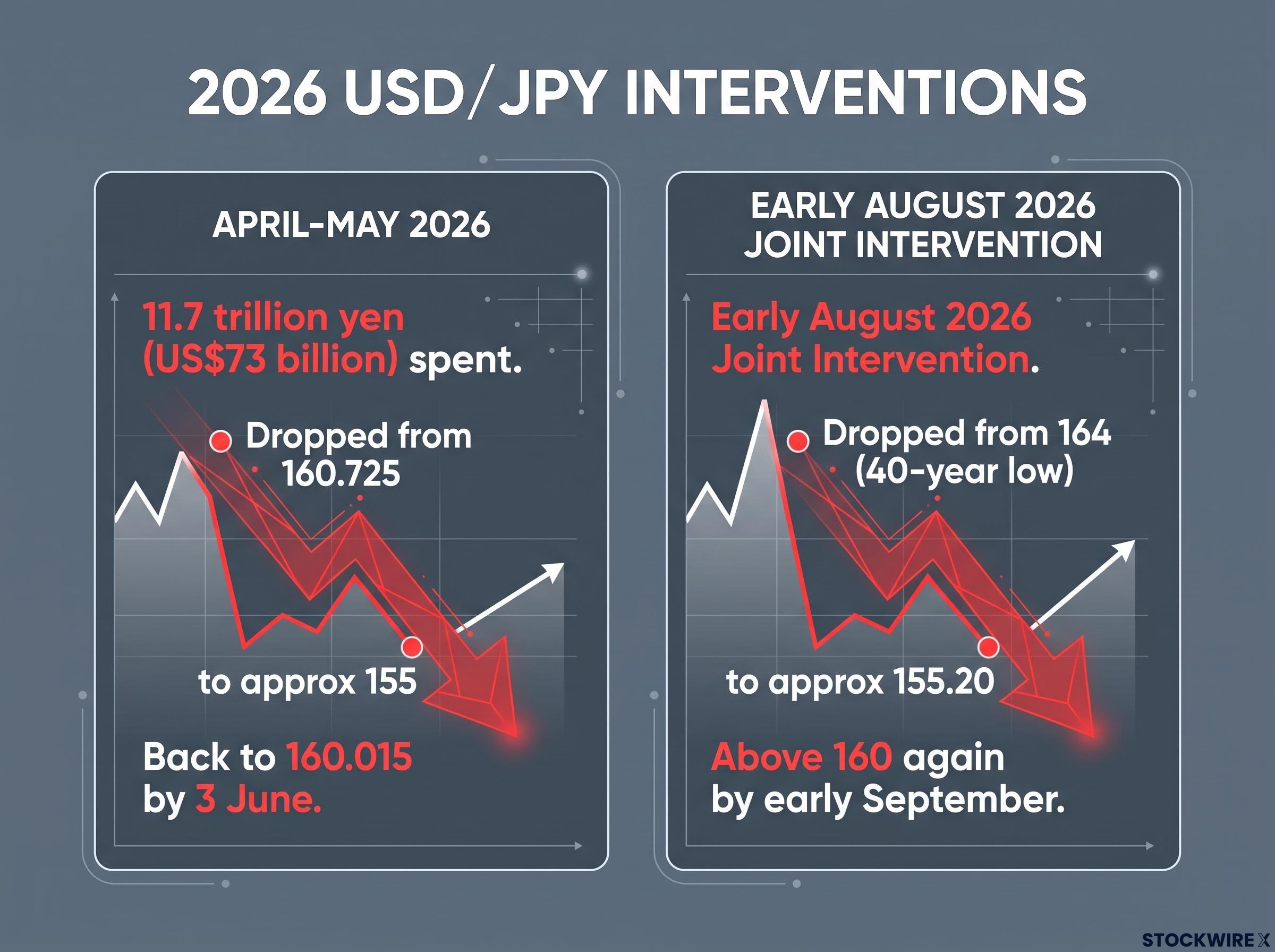
| Period | Action | USD/JPY before | USD/JPY after | Durability |
|---|---|---|---|---|
| January 2026 | Verbal warning (Katayama) | 159.45 | Not reported | Not reported |
| April-May 2026 | 11.7 trillion yen intervention | 160.725 | Approx. 155 | Erased by early June |
| Early August 2026 | Joint Japan-US intervention | Approx. 164 | Approx. 155.20 | Above 160 again by early September |
Japan’s previous intervention, in July 2024, also took place near 160. Each round since then has followed the same course: a sharp drop, then a gradual return. The reversals have lasted only when interest rate differentials did not support a rebound.
Intervention near 160 limits how far the dollar can rise, but it works more like a speed bump than a floor. Without policy support, each round has faded.
Intervention timing appears to depend on velocity, not price level, so a rapid sprint toward 160 carries far higher reversal risk than a slow drift to the same figure.
What could make a 155 USD/JPY target right or wrong?
Taken together, the three forces make Foley’s target a conditional scenario. Moving from about 158 to 155 needs several things to happen at once.
The case for the target is straightforward. The BoJ hikes in December, Fed pricing softens and intervention continues to cap the pair near 160. With all three in place, the yield gap narrows from both sides while officials limit how far the dollar can rise.
The risks are also clear:
- Cautious BoJ: weak growth could delay the next hike beyond December, keeping the gap wide.
- Inflation and wages: this risk cuts both ways. Sticky inflation or stronger wage growth could speed up BoJ hikes and push the pair below 155. Softer inflation could extend the pause and weaken the yen.
- Fed and US data: strong US data into 2027 would undermine the over-pricing argument and could send the pair back above 160.
- Intervention effectiveness: both 2026 rounds faded, so the 160 cap does not keep the pair anchored at 155.
- Politics and communication: markets may test Japan’s willingness to keep intervening after spending 11.7 trillion yen, causing overshoots.
The red-line zone Authorities treat the high-150s to 160 as a red line. Intervention can push USD/JPY 5-10 yen lower quickly, but those gains have lasted only when BoJ hikes and Fed repricing narrowed the yield gap.
Treat 155 as a scenario that requires both a BoJ hike and a Fed repricing. It is not a base case that intervention alone can deliver.
Past performance does not guarantee future results. These projections are speculative and subject to change based on market and policy developments.
Reading the yen between now and December
BoJ timing shapes sentiment, Fed repricing sets the pace and intervention caps the dollar near 160. None of the three can move the yen sustainably on its own. Foley’s view also reaches readers through secondary coverage, since the original Rabobank note is not publicly available.
The signals to watch:
- 30 October BoJ tone: whether Ueda supports a December hike
- US data and Fed pricing: whether expectations for next year start to soften
- Approaches to 160: how quickly officials respond
- The December meeting: the decision the 155 scenario depends on
If December brings a hike and US data cools, the target becomes plausible. If either fails, the high 150s look more likely to persist.
Investors weighing the December hike call can use our deep-dive into the BoJ path to 1.75%, which sets out how economists see the rate cadence through March 2027.
This article is for informational purposes only and should not be considered financial advice. Investors should conduct their own research and consult with financial professionals before making investment decisions.