Nu Holdings jumped roughly 14% and MercadoLibre about 8% in U.S. trading on Monday, 5 October 2026, after Brazil’s first-round vote went against the polls. The surge in Brazil election Nu Holdings MercadoLibre trading came on a result that decided nothing outright.
Flávio Bolsonaro edged President Luiz Inácio Lula da Silva by roughly 47% to 45%, according to Brazil’s Superior Electoral Court (TSE). Neither cleared 50%, so a runoff is set for 25 October.
For U.S. holders of Brazil-linked stocks, the next three weeks carry both the gain already banked and the risk of giving it back.
Here is what drove the move, how political risk reaches these two companies, and what is and is not priced in before the runoff.
Why did Brazilian stocks surge on a result that settled nothing?
A vote that decided nothing produced a very decisive rally. The market was not reacting to an outcome; it was reacting to a surprise.
With more than 99% of ballots counted, Bolsonaro held about 47.0-47.2% (roughly 56.1 million votes) and Lula about 45.1% (roughly 53.8 million). Reuters attributed the rally to Bolsonaro beating opinion polls, which raised the odds of a more market-friendly, right-of-centre government. Yahoo Finance said the result showed stronger-than-expected support for him.
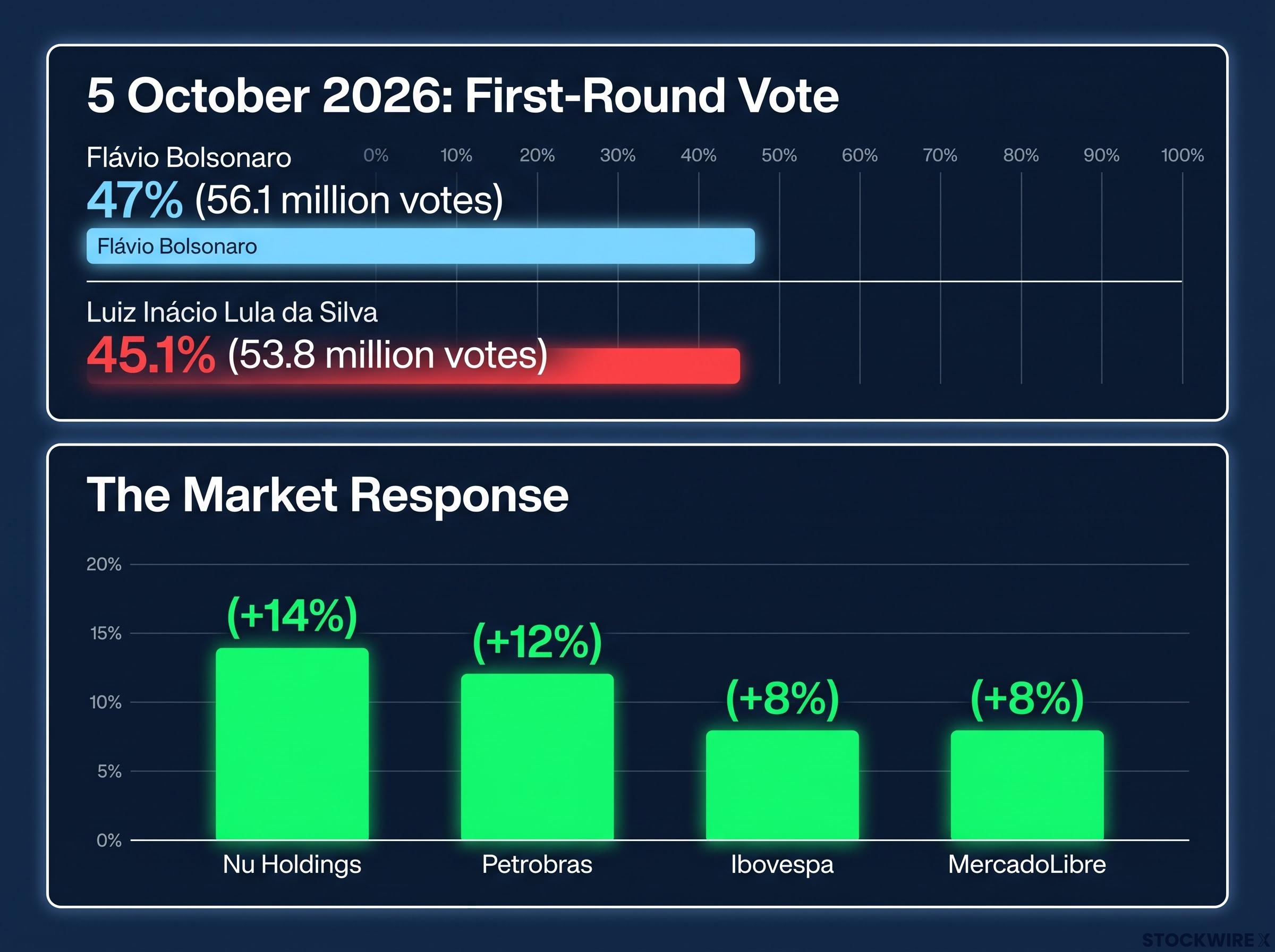
The breadth is the telling detail. Equities, the currency and state-controlled oil company Petrobras all moved together, the pattern you would expect when investors cut the political risk premium (the extra return demanded for holding assets in an uncertain political setting).
| Asset | Move on 5 October | Source note |
|---|---|---|
| Ibovespa (Brazil’s benchmark index) | Up more than 8% | Reuters; other outlets cite 7-8% |
| Nu Holdings (NU) | Up about 14% | Some intraday reports up to 15.1% |
| MercadoLibre (MELI) | Up about 8% | U.S. trading |
| Petrobras | Up about 12% | Same session |
| Brazilian real | Stronger | No precise percentage available |
Index figures vary by source and measurement window; Euronews implies roughly 10-11% across two sessions, including Friday’s 2.46% gain.
The breadth of the move also reflects Brazil’s oil-exporter status and record foreign inflows earlier in 2026, structural supports that help explain why Petrobras and the index rose alongside the consumer-facing names.
One analyst view BTG Pactual analysts, cited by Euronews, estimate a Bolsonaro victory could lift shares on Brazil’s B3 exchange by as much as 45%.
A move this size tells you the market had priced a meaningful chance of a Lula win. The rally is a repricing of that probability, not proof that reform is on its way.
When big ASX news breaks, our subscribers know first
How political risk reaches Nu and MercadoLibre
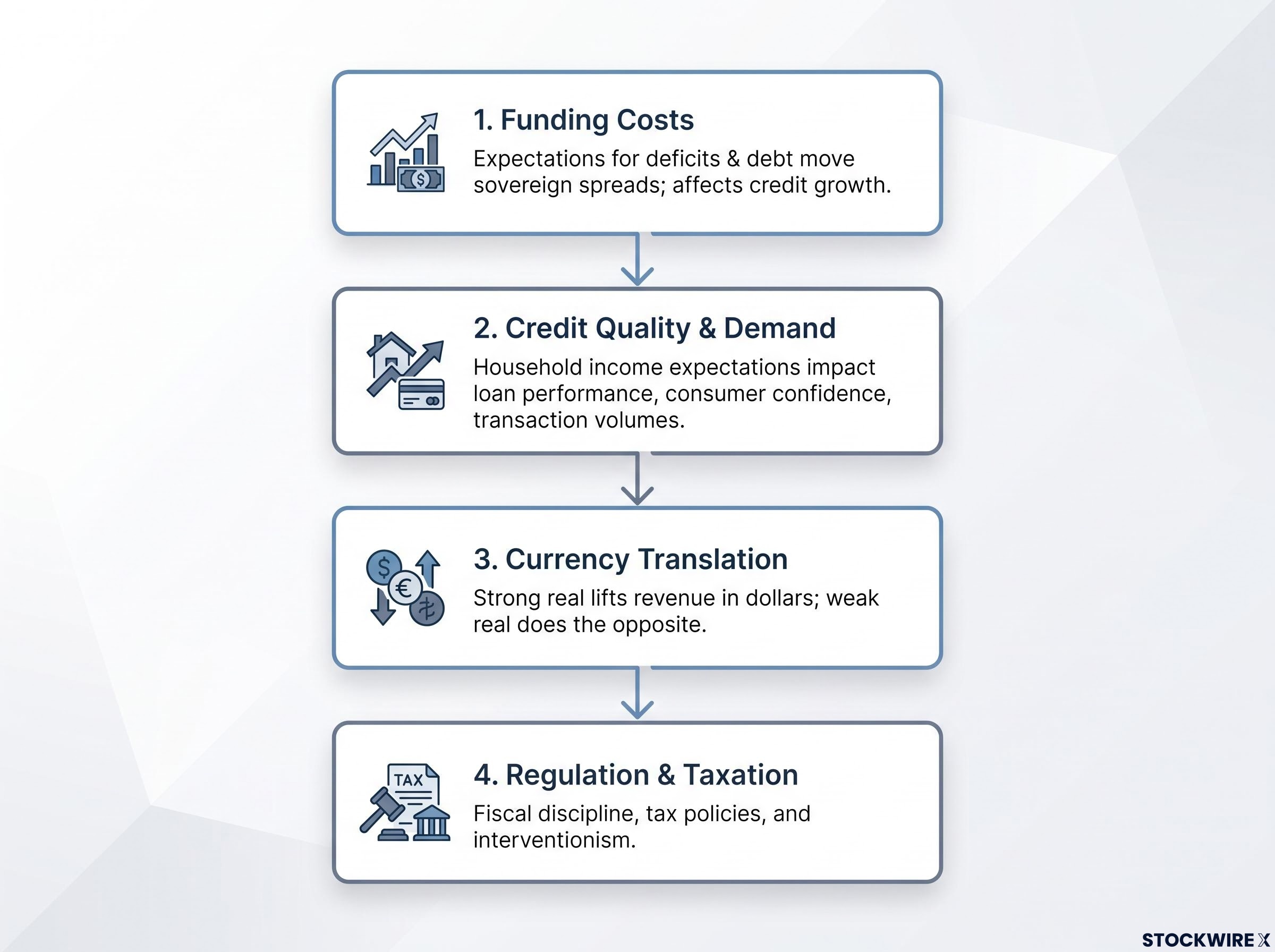
Follow the chain from ballot box to income statement and the logic builds in four steps. These are expected channels; the research provides no company-specific earnings figures to quantify them.
- Funding costs: Election results shape expectations for deficits and debt, which move sovereign spreads. Lower risk premia compress wholesale funding costs, supporting credit growth.
- Credit quality and demand: Better household income expectations support loan performance, consumer confidence and transaction volumes.
- Currency translation: A stronger real lifts revenue translated into dollars; a weaker one does the opposite.
- Regulation and taxation: Investing.com reports markets read the result as a signal of tighter fiscal discipline and lower taxes, with a Bolsonaro-led government seen as less interventionist.
Nu Holdings: credit and currency
Nu Holdings reports in dollars but earns largely in reais, so it sits closest to every link in that chain. Cheaper funding helps its lending, loan performance depends on Brazilian households, and a firmer real lifts what those earnings are worth in dollars.
Berkshire Hathaway is a known institutional backer of Nu. Its current stake size and latest Form 13F details were not confirmed, so no figures are asserted here.
MercadoLibre: commerce across currencies
MercadoLibre pairs e-commerce with a fintech arm and earns in several Latin American currencies. Consumer confidence and transaction volumes matter, and so does currency translation.
Brazil is one market among several, so its exposure is more diluted than Nu’s. That is consistent with the smaller move, 8% against 14%.
For a U.S. investor holding either stock in dollars, the currency channel means you carry a Brazil political bet and a real-dollar bet at the same time, whatever the business fundamentals.
The currency channel is shaped heavily by positioning in the BRL carry trade, where a wide forward-implied yield has historically cushioned the real against domestic political noise and left the Fed and global risk appetite as the larger threats.
What could unwind the rally before October 25?
Start with the runoff. Lula still holds about 45%, and DW, NBC News and Al Jazeera all describe a polarised, tight contest.
A Bolsonaro lead also does not guarantee reform. Brazil’s Congress is fragmented and its budget rules are complex, so a win at the ballot box may not translate into policy.
Valuation compounds the problem. Double-digit gains leave less margin of safety, the cushion between a price and what a company is worth, and room for sharp reversals if policy or data disappoint.
Three scenarios would re-widen spreads and weaken the real:
- A Lula comeback in the runoff
- Reform gridlock in Congress
- Fiscal slippage that revives concern over debt
Two readings of the same rally BTG Pactual sees up to 45% upside on a Bolsonaro win. Others argue high debt, complex taxation and political fragmentation make this a tactical move, not a structural one.
Precedent urges caution. Argentina’s 2023 election of Javier Milei brought an initial pro-market jump followed by volatility as feasibility was reassessed, and Brazilian relief rallies in 2018 and 2022 were followed by more mixed performance. No percentage data was available for these cases.
If you bought after the jump, you are paying for a Bolsonaro win and for reforms Congress may not deliver. Your downside is two-layered.
How should U.S. investors weigh the runoff?
Treat the runoff as a binary event and today’s prices as contingent, not a new baseline. These are considerations, not advice.
- Size for a two-way outcome. A three-week event can move prices sharply in either direction.
- Know your currency exposure. Your return depends on the real as well as the business.
- Separate the trade from the thesis. A short-term election trade differs from a long-term re-rating case.
- Verify the gaps. The exact real-dollar move, latest NU and MELI earnings and customer metrics remain unconfirmed, and researchers found no Selic (Brazil’s benchmark interest rate) forecasts tied to the runoff.
NU’s 14% gain against MELI’s 8% is a rough gauge of relative Brazil sensitivity.
What Berkshire’s stake does and does not signal
Berkshire’s presence is a credibility marker for Nu, not a trade signal. The position details need checking in the latest Form 13F.
A well-known holder tells you a long-term case exists. It does not tell you what to do about a three-week binary event.
Pricing the runoff: what the first-round jump does and does not settle
The first round cut near-term political risk but left the binary outcome open. The rally already embeds optimism, and fiscal follow-through will matter more than the vote count.
Three variables deserve watching through 25 October: runoff polling, the real-dollar level, and any signals on fiscal policy from the candidates.
For readers tracking the real-dollar level through the runoff, our detailed coverage of the USD/BRL forecast gap compares Rabobank and J.P. Morgan targets.
This article is for informational purposes only and should not be considered financial advice. Investors should conduct their own research and consult with financial professionals before making investment decisions. These statements are speculative and subject to change based on market developments.