Symbotic sits on a backlog worth $22.5 billion. It also draws 90.5% of its revenue from a single customer.
Those two numbers are the entire story, and they point in opposite directions. One says durable, multi-year demand. The other says everything rests on one relationship.
The tension matters right now because Symbotic is clearly trying to change what it is. The July 2026 acquisition of ARMS Innovations and 57% year-over-year software revenue growth both point to a deliberate pivot from hardware integrator toward software platform, yet the stock has fallen roughly 18% over the past year. The market is pricing something it has not fully resolved, and that gap is why this company is worth examining closely rather than at headline level.
Here is what the financials, the technology architecture, and the Walmart relationship actually tell you about whether that backlog is worth what the bulls claim, and which type of investor this thesis is built for.
What $22.5 billion in backlog actually means for Symbotic’s revenue visibility
A backlog larger than annual revenue sounds like a reason to buy. The more useful question is what has to go right for that number to become earnings.
Symbotic’s $22.5 billion backlog, drawn from its primary SEC filings, comfortably exceeds the company’s annual revenue run rate. A SimplyWall.st note dated 22 June 2026 references a slightly different $22.3 billion figure from company disclosures, but both are broadly consistent and likely reflect different reporting dates. Either way, this is not a short-term order book. It is a multi-year pipeline.
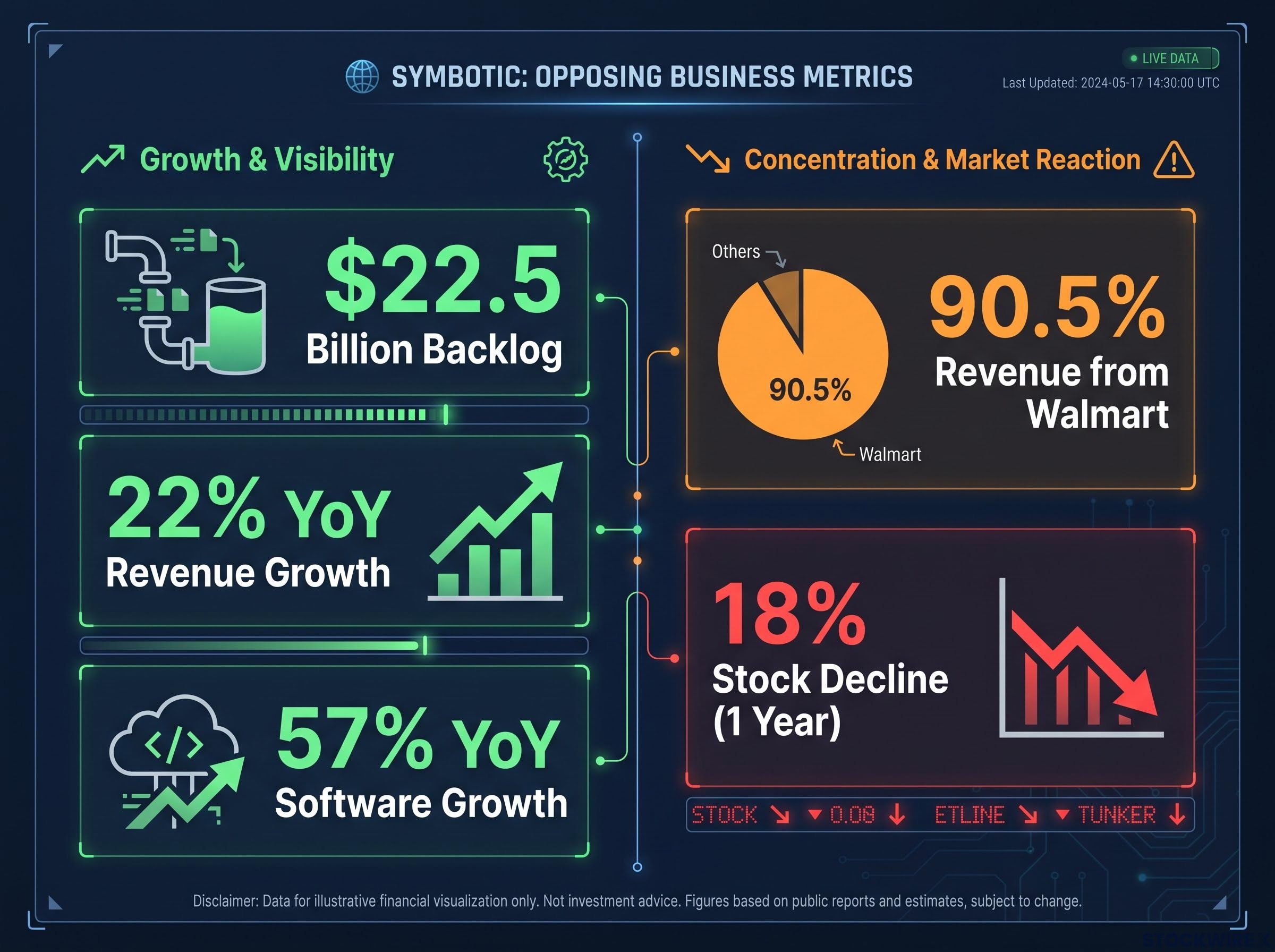
That distinction changes how you should read it. Most recent quarterly revenue exceeded $700 million, up 22% year-over-year, which means the backlog represents many years of deployment work rather than something that converts cleanly over the next few quarters.
The headline metrics driving analyst optimism Revenue up 22% year-over-year. Software revenue up 57% year-over-year, excluding the ARMS contribution. These are the figures the bull case leans on.
The catch is how that backlog turns into reported revenue.
Why project-based recognition creates earnings volatility risk
Symbotic recognises revenue on a project basis, tied to deployment milestones, rather than ratably the way a software subscription business does. A SaaS company bills a predictable slice each month. Symbotic books revenue in lumps when specific installation and commissioning stages are reached.
Picture a single large deployment slipping a quarter. In a diversified business, other customers smooth the gap. For Symbotic, with one customer supplying almost all revenue, a delay or scope change lands directly on the reported result with no cushion.
This recognition structure is normal for capital-equipment automation. It is less comfortable for a company increasingly valued on a software-growth story, where investors expect smoother, recurring revenue. For the backlog to convert as modelled, three conditions must hold:
- Walmart maintains the pace of its automation programme
- No commercial renegotiation reduces revenue or margin per site
- Symbotic executes deployments at scale without persistent delays
The backlog is real. Its investment value, though, depends entirely on execution and on Walmart staying the course, which means you should treat it as a conditional asset rather than a guaranteed revenue stream.
When big ASX news breaks, our subscribers know first
The technology moat that makes Symbotic hard to displace
The strongest part of the investment case is also the part you can physically point to. Symbotic’s advantage starts in the concrete and builds upward.
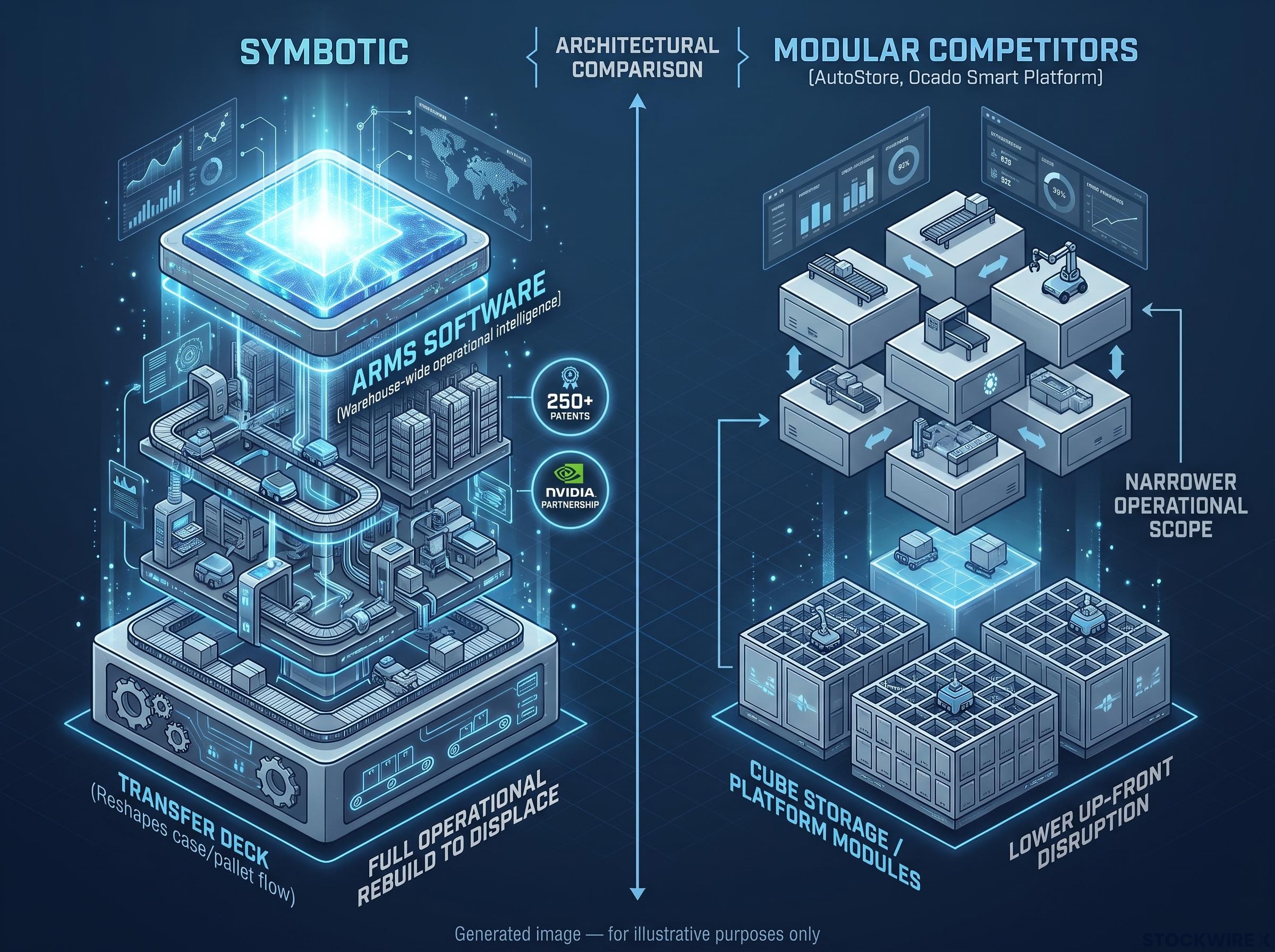
At the centre of each deployment is the transfer deck, a machine-only floor installed inside the customer’s warehouse. It sits between inbound docks, storage, and outbound order assembly, and it is tightly coupled to Symbotic’s robots, conveyors, software, and inventory logic. This is not equipment bolted into a corner. It reshapes how cases and pallets move through the entire building.
That depth is what makes it sticky. According to the company’s technology disclosures, ripping the system out would require redesigning the warehouse layout, re-engineering the inventory and order-flow algorithms, and retraining operations staff on a new stack entirely. The switching cost is structural, not a line in a contract.
On top of that sit 250-plus patents and a partnership with Nvidia covering computer vision and route optimisation. These reinforce the moat independently of any single customer relationship.
The competitive moat Symbotic is building with ARMS sits inside a broader structural debate about US robotics stocks, where China’s compounding installation advantage and rare-earth supply-chain concentration create sector-wide risk factors that apply regardless of any individual company’s software pivot.
How ARMS Innovations changes the revenue model, not just the product
The July 2026 ARMS acquisition is where the hardware moat starts to grow a software layer. On the Q3 FY2026 earnings call, management said ARMS lets Symbotic “expand the reach of our software beyond our automation system to the entire warehouse operation, optimizing the movement of both equipment and people.”
Logistics Viewpoints framed the deal as pushing automation “up the stack” toward operational intelligence. StreetInsider described Symbotic defining a new category, Warehouse Operations Optimization, sitting above traditional warehouse management and execution systems.
The revenue implication is the interesting part. ARMS brings capabilities, continuous optimisation, predictive maintenance, and disruption diagnosis, that are naturally priced as a subscription rather than a one-time fee. Each installed fleet of robots becomes a long-lived anchor for selling ongoing orchestration software, including into non-Symbotic automation footprints.
When that orchestration layer fuses with the transfer deck’s physical integration, the customer’s whole operations model becomes co-designed with Symbotic’s stack. For you as an investor, that is the key durability insight: the advantage is becoming architectural rather than contractual, and the more ARMS intelligence runs daily operations, the harder displacement becomes regardless of a rival’s price or feature list.
| Dimension | Symbotic | Modular competitors (AutoStore, Ocado Smart Platform) |
|---|---|---|
| Physical integration depth | Transfer deck reshapes core case and pallet flow through the building | Cube storage or platform modules integrate into existing facilities |
| Software orchestration layer | ARMS adds warehouse-wide operational intelligence above automation | More modular or platform-based, often narrower in operational scope |
| Switching cost structure | Full operational rebuild required to displace | Lower up-front disruption, generally easier to swap or layer |
Direct comparative data between these systems is limited, so the comparison reflects documented architectural differences rather than attributed performance claims.
The Walmart problem: when your biggest strength is also your biggest risk
Everything positive about Symbotic has to pass through one number first. Per its most recent 10-Q, Customer A, identified as Walmart, accounted for 90.5% of revenue.
That is not a large customer. In revenue terms, it is effectively the only customer.
90.5% Share of Symbotic’s revenue from a single customer, Walmart, according to the company’s most recent 10-Q filing.
The relationship runs deeper than a standard vendor contract. Walmart merged its own advanced systems and robotics division into Symbotic, which is the same structural depth that creates the moat described above. That is the uncomfortable symmetry here: the integration that makes Symbotic hard to displace is the same integration that makes it dangerously dependent. The strength and the risk are one fact seen from two angles.
SimplyWall.st’s 22 June 2026 analysis called the concentration “currently manageable,” pointing to the backlog’s multi-quarter visibility and ongoing rollouts as offsets. It still flagged it as the central risk. A 90.5% concentration is not a footnote to be netted off against a big backlog. It is the single variable that, if it turns, overrides every other positive in the case at once.
The concentration becomes thesis-threatening under three specific conditions:
- If Walmart slows or curtails its automation programme, then deployment revenue, the engine behind that 22% growth, decelerates with almost nothing to replace it.
- If Walmart renegotiates commercial terms, then revenue or margin per site falls directly through to reported results.
- If Symbotic fails to add new large anchor customers before the Walmart rollout plateaus, then the concentration stays unresolved and the backlog argument loses its forward power.
This is also why the analyst targets sit so far apart. Barclays raised its target to $44 (from $40), KeyBanc sits at $70, and the average fair-value estimate is around $64.87. That spread is not mainly a disagreement about technology or backlog quality. It is a disagreement about how to price the Walmart dependency, and whether new customers arrive fast enough to shrink it.
What Symbotic needs to prove over the next 12-18 months
The useful output here is not a price prediction. It is a short list of signals that will tell you whether the thesis is actually tracking.
Three variables will decide whether the bull or bear case wins. First, ARMS software adoption at paying-customer scale. Second, new anchor customer additions outside Walmart. Third, the margin trajectory as the revenue mix shifts from deployment hardware toward software.
The 18% share price decline over the past year, set against 22% revenue growth, tells you the market has already priced in a good deal of execution skepticism. That cuts both ways for you. The upside is real if the company delivers, but further disappointment has limited room to punish a stock already marked down, with the Walmart relationship acting as a rough floor.
Integration risk is the near-term wildcard. On the Q3 FY2026 call, management disclosed two tuck-in acquisitions now being absorbed: Fox Robotics for dock automation, and ARMS Innovations for warehouse operations optimisation. Integrating two platforms at once, while continuing to spend over $100 million on R&D this fiscal year, is exactly the kind of execution stretch that can slow the roadmap if it goes wrong.
Here are the four observable milestones worth tracking across the next four to six quarters:
- ARMS customer adoption disclosures, specifically paying customers rather than pilots
- New anchor customer announcements outside Walmart
- Gross margin trajectory as software revenue grows relative to deployment revenue
- Integration update language on earnings calls regarding ARMS and Fox Robotics
The concentration resolution question no analyst can answer yet
There is no published timeline for when Walmart concentration falls below a material threshold. That absence is the honest reason the case is speculative at current targets: no one, including the analysts setting the $44 to $70 range, can tell you when the dependency ends.
The most plausible path to new customers faster is ARMS’s ability to work across non-Symbotic automation footprints, which widens the addressable market beyond full transfer-deck installations. That potential is genuine. Adoption at scale, though, has not yet been demonstrated, so it remains a thesis to test rather than a result to bank.
Weighing the backlog against the dependency before making a call
Pull the three layers together and the shape of the decision becomes clear. The technology moat is real and deepening as ARMS adds a software layer on top of the physical integration. The $22.5 billion backlog is substantial but conditionally valuable, since it only converts if Walmart keeps spending and deployments stay on track. And the 90.5% concentration is the lens every other positive has to be viewed through.
That makes Symbotic a high-conviction, high-concentration bet rather than a diversified growth holding. The 57% software revenue growth, excluding ARMS, is the strongest early evidence that the model pivot is beginning to work, and ARMS is the single variable most likely to change the customer diversification story if it succeeds.
The valuation disagreement across warehouse automation stocks is not unique to Symbotic; Kion Group’s Dematic subsidiary trades at a similar discount to its long-run software and services potential, suggesting the market is broadly skeptical of the hardware-to-software pivot story across the sector rather than singling out any one company.
| Bull case holds if | Bear case holds if |
|---|---|
| Walmart completes its automation rollout at pace | Walmart slows, defers, or renegotiates terms |
| ARMS converts to paying customers at scale | Software monetisation stalls or underdelivers |
| New anchor customers arrive, reducing concentration | Concentration stays near 90% with no timeline to fall |
The practical test is simple. If you can articulate exactly what you believe about Walmart’s long-term automation commitment and ARMS’s software adoption trajectory, you are in a position to form a view. If you cannot, the current information set is not enough for a high-conviction entry, and waiting for the next few earnings releases costs you little.
This article is for informational purposes only and should not be considered financial advice. Investors should conduct their own research and consult with financial professionals before making investment decisions. Past performance does not guarantee future results, and financial projections are subject to market conditions and various risk factors.