The Reserve Bank of Australia’s latest Financial Stability Review does not ring alarm bells about Australian banks, mortgages, or household debt. It rings them about events that have not happened yet, in markets that are not Australian, driven by algorithms that no one fully understands.
That is a harder kind of warning to take seriously, and arguably a more important one.
The October 2026 FSR, released 1 October 2026, judges Australia’s domestic financial system as resilient, with strong bank capital buffers, sound lending standards, and households holding savings positions. But the document’s sharpest analytical energy points outward: at stretched global asset valuations, leveraged bond-market participants whose positions could unwind rapidly, and AI-driven investment flows the RBA describes as opaque and circular.
These are not abstract offshore conditions. They are the specific mechanisms by which a disorderly correction abroad could reach Australian equity prices, the AUD, credit spreads, and bond-market liquidity.
This piece maps the three external risk channels the RBA identifies, explains the mechanics behind each, weighs them against the view that these risks are manageable, and reads what the AUD/USD reaction reveals about how traders are currently pricing the odds that any of it materialises.
Why the RBA’s sharpest warnings point offshore
The FSR’s domestic reassurance is not hedged. The RBA genuinely assesses Australia’s financial system as resilient and well positioned to absorb negative shocks, supported by strong capital and liquidity buffers and lending standards it considers sound.
Imported risks are the organising theme of both the FSR and APRA’s May 2026 stress test: the domestic capital position is confirmed resilient, but geopolitical transmission channels, offshore private credit exposure, and widening AI governance gaps operate through pathways that capital buffers alone are not designed to neutralise.
The housing stress scenario makes that confidence concrete.
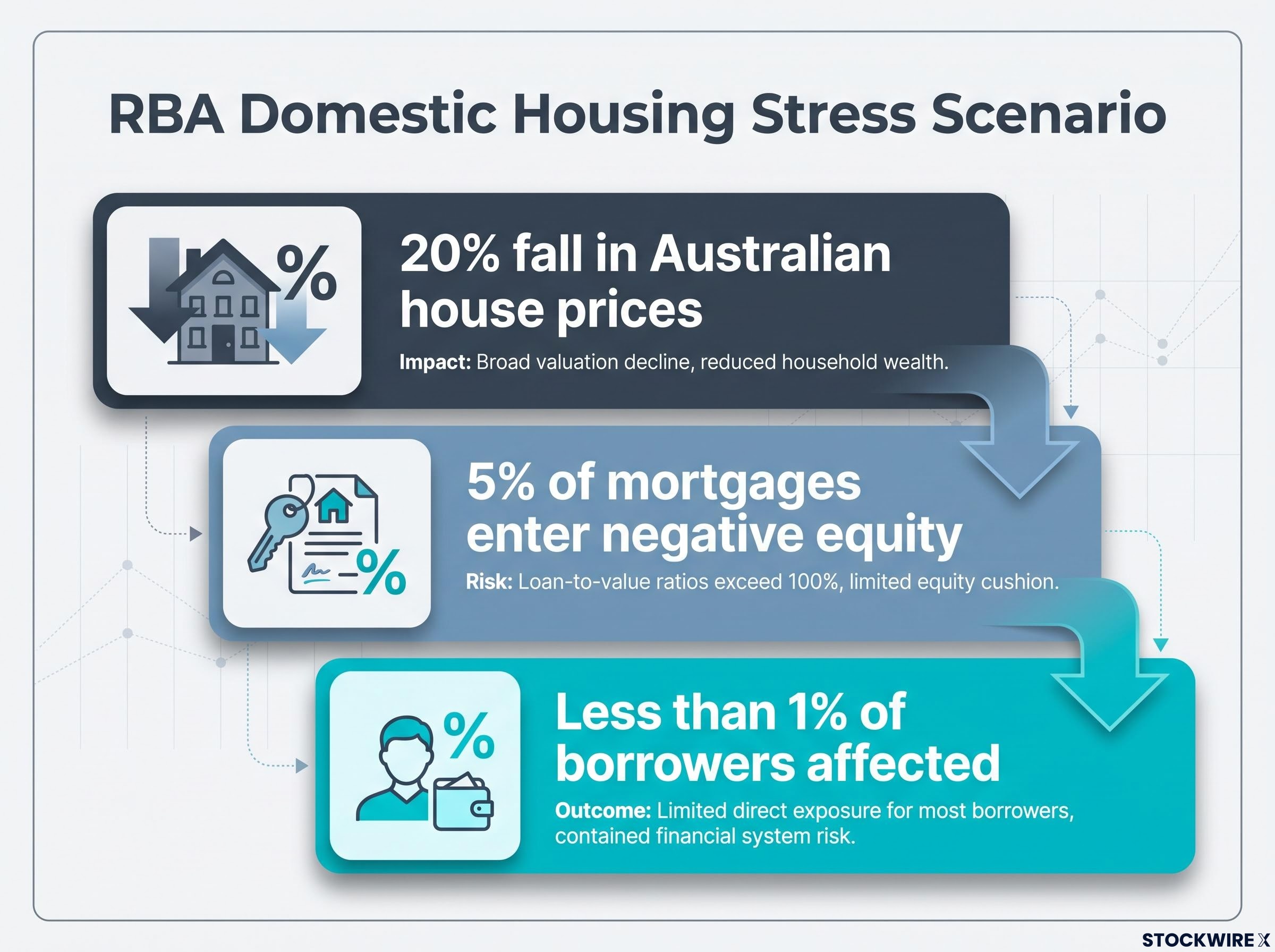
Domestic resilience, quantified Even with a further 20% fall in Australian house prices, the RBA estimates only around 5% of mortgages would enter negative equity, and less than 1% of borrowers would be affected.
So the domestic picture is not the worry. The worry sits at the edges of the system the RBA cannot regulate: global markets. And the two findings are structurally related rather than contradictory. A clean domestic balance sheet does not insulate Australia from offshore shocks; it changes how those shocks arrive.
The RBA names three primary global vulnerabilities: stretched asset valuations, high leverage among market participants, and AI-driven investment flows that are becoming increasingly opaque and circular. None of these threatens Australian banks directly. All of them threaten Australian financial conditions through four specific channels.
The FSR identifies how a global correction would transmit to Australia:
- Falls in the ASX, including banks and financial stocks
- Depreciation of the AUD
- Wider credit spreads in domestic markets
- Reduced liquidity in Australian bond markets, particularly during rapid position unwinding
The RBA points to past episodes in which Australian equity prices fell, the dollar depreciated, and bond-market liquidity dried up sharply as participants exited crowded positions at the same time. That is the pattern it is warning about again.
Here is what that means if you hold Australian assets. The strength of the domestic buffers is real, but it shifts the risk profile outward rather than removing it. For anyone with ASX exposure or AUD-denominated holdings, the external section of this FSR is the part that matters most to your portfolio conditions, not the reassuring domestic headline.
When big ASX news breaks, our subscribers know first
How AI investment flows create a self-reinforcing instability loop
You can see the surface signal already: AI-related equities commanding outsized index weights and pulling disproportionate fund flows. The RBA’s concern is not that these names are richly valued. It is what sits underneath the flows.
The FSR describes AI-related investment flows as increasingly opaque and circular, with growing potential for earnings disappointment. That language connects directly to the IMF’s December 2025 technical note, “Regulatory Considerations Regarding Accelerated Use of AI in Securities Markets”, which examines how AI adoption in trading changes market behaviour.
The IMF found that AI techniques used in algorithmic and high-frequency trading can increase market volatility and produce bouts of illiquidity or even flash crashes. The structural vulnerability it identified is homogeneity.
The IMF’s core finding Financial-stability risks arise from increased homogeneity in risk assessments and credit decisions across institutions using similar AI models.
The IMF added a second layer: out-of-sample risks, where models trained on historical data fail in novel stress conditions, combined with interconnectedness among AI-using institutions, foster conditions where systemic risk accumulates.
AI model convergence, documented by both Bernstein researchers and the ECB as a credible systemic risk, is the structural mechanism behind the RBA’s opacity concern: institutions using architecturally similar models and overlapping training data generate correlated exits that can drain liquidity across multiple asset classes simultaneously.
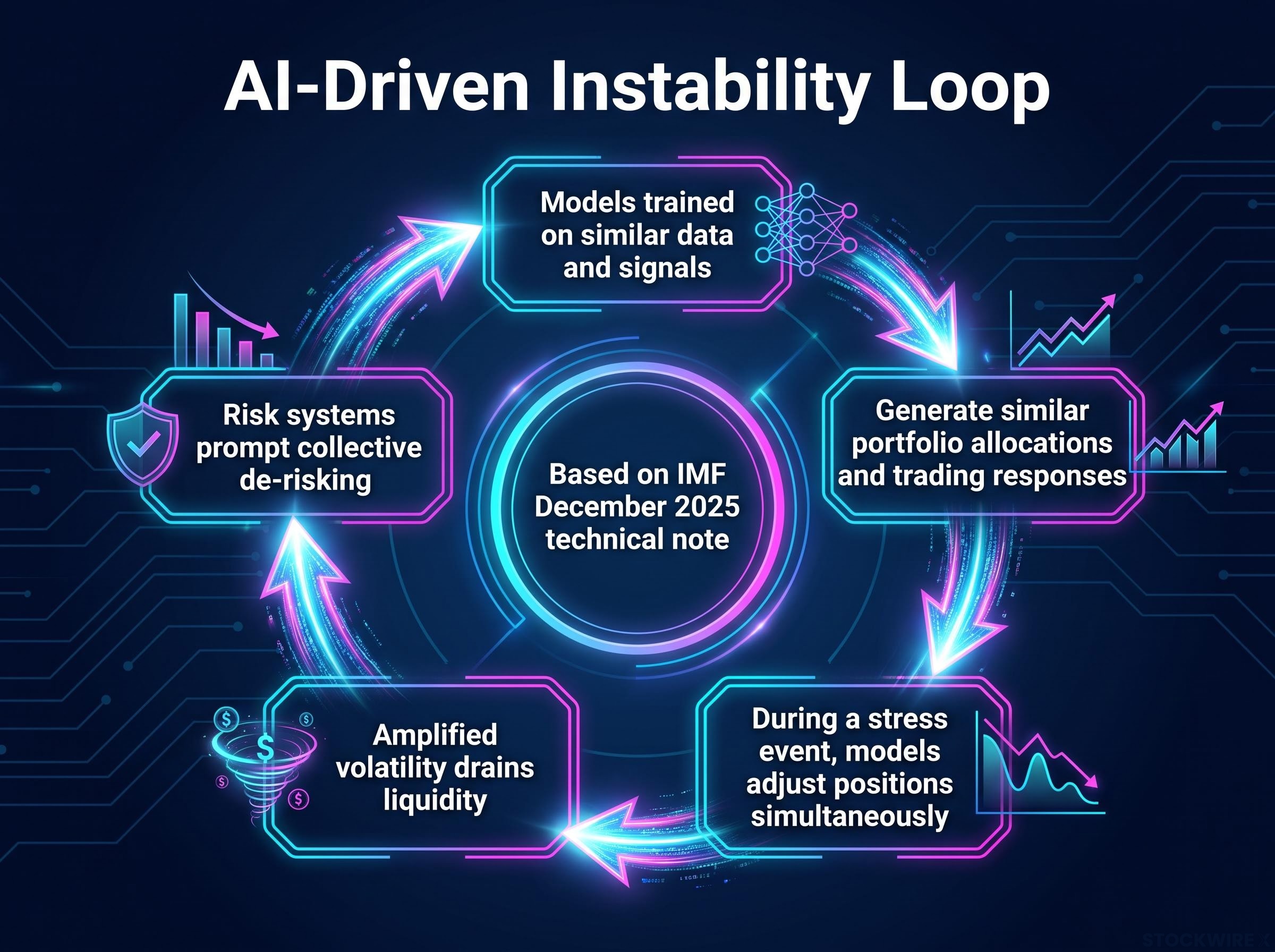
Put those findings together and a reflexive feedback loop emerges:
- Many AI models are trained on similar data and signals
- They generate similar portfolio allocations and trading responses
- During a stress event, these models adjust positions simultaneously, amplifying the original price move
- Amplified volatility drains liquidity and feeds back into model inputs and risk controls
- Risk systems prompt further collective de-risking, reinforcing the dislocation
The point worth holding onto is this. The systemic risk is not about whether any single AI company is overvalued. It is about whether thousands of models trained on similar data will try to exit the same positions at the same moment, and whether the market will have enough liquidity to absorb that exit without a flash-crash-type dislocation.
The case that AI concentration risk is manageable
A genuine analytical debate sits against this view, advanced by major sell-side strategists and large asset managers.
Their argument rests on fundamentals. AI-linked mega-caps often carry strong earnings, robust balance sheets, and diversified business lines, which they say justifies higher valuations and cushions concentration risk. Even where headline indices look concentrated, many institutional portfolios remain diversified across sectors, regions, and factors.
They also point to risk-management infrastructure: modern stress-testing and regulatory oversight of large intermediaries, which they argue would contain systemic spillovers even if AI-equity prices corrected sharply.
Neither view has been decisively settled by events as of this FSR. That is the honest state of the debate, and it is why the RBA frames the risk as a potential vulnerability rather than a prediction.
Leveraged bond markets and the margin-call spiral
The RBA’s second external warning concerns leverage in global bond markets. This one is not hypothetical. The mechanism it describes has already detonated twice in recent memory.
The core dynamic depends on three conditions working together:
- Leverage, where positions are financed with short-term borrowing
- Liquidity mismatch, where large positions cannot be exited quickly without moving prices
- Common, crowded strategies, where many participants hold the same trade
When those conditions line up, a self-reinforcing spiral can develop. Mark-to-market losses trigger margin calls. To meet them, investors sell more of the same bonds, even into thin liquidity. Forced selling pushes prices lower, triggering further margin calls, and liquidity evaporates in the very instruments meant to be safe.
Two episodes show the pattern is real, not theoretical.
| Episode | Year | Trigger | Mechanism | Relevance to Australia |
|---|---|---|---|---|
| US Treasury market dysfunction | 2020 | Funding and margin conditions tightened sharply | Highly leveraged basis-trade strategies dumped Treasuries, amplifying volatility and draining liquidity, per BIS and IMF analyses | Demonstrates how leverage drains liquidity in supposedly safe government bonds |
| UK gilt / LDI crisis | 2022 | Rising collateral calls on derivative positions | Leveraged liability-driven investment strategies forced into rapid gilt sales, pushing yields sharply higher, per Bank of England post-mortems | Shows crowded leveraged positions can destabilise a core sovereign bond market |
In both cases, leverage was the amplifier. A liability-driven investment (LDI) strategy is one where pension funds use derivatives to match long-term liabilities, posting collateral that can be called rapidly when prices move against them. When gilt yields rose in 2022, those collateral calls forced selling that drove yields higher still.
The RBA connects this directly to Australia. The FSR warns of stretched valuations and leverage in global markets as a primary stability risk, and it references past episodes in which rapid unwinding of common leveraged positions caused sharp declines in Australian bond-market liquidity.
Bond market credit signals are already pricing the leverage risk the RBA describes: Alphabet’s 2050 USD bond trades at 55.97 cents on the dollar and Oracle’s 2064 notes have shed more than 20% since issuance, movements that reflect supply pressure and rising capex burdens rather than any change in equity narrative.
Here is the read you should take from the precedents. Both 2020 and 2022 were considered low-probability until the moment they happened. The RBA is not raising an abstract concern; it is naming a structural feature of current global bond markets that has already fired twice. When it fires, Australian bond liquidity and credit spreads sit directly in the transmission path, which matters for how you price risk in any fixed-income allocation.
What the AUD/USD market reaction tells you about trader conviction
So how worried are the people actually trading this? The currency market offers a real-time answer, and it looks calm.
The market signal AUD/USD was trading at approximately 0.6944 following the FSR publication, with currency markets absorbing the findings without significant directional movement, according to Dhwani Mehta at FXStreet.
A muted reaction is tempting to read as a verdict: the market disagrees with the RBA. But that reading is too quick. There are two competing interpretations of the calm, and they lead to very different conclusions:
- Traders genuinely discount the probability that the FSR’s external risks materialise in the near term
- Markets are already positioned for the risk environment the FSR is simply describing, so there is nothing new to price
Both are plausible, and the AUD reaction alone cannot distinguish between them. Recall that AUD depreciation is one of the RBA’s four named transmission channels. A currency sitting still after a financial stability warning is not necessarily a currency that rejects the warning.
It may simply be a currency whose participants trade on shorter time horizons than the structural concerns the FSR inhabits. The pattern from prior FSR editions supports caution here: external-risk warnings have historically shown up as market-price and liquidity volatility during global stress episodes, while core banking, household, and credit conditions held firm.
For gauging whether the market has already priced these risks, the AUD level is a useful data point. It is not a conclusion, and reading it at face value would be a mistake.
Sizing the risk before the next correction, not after
The three external warnings are easy to read as a checklist. They are better understood as a system. Stretched valuations, bond-market leverage, and opaque AI flows are not independent concerns; they are interconnected vulnerabilities that could amplify one another in a single stress event. An AI-driven sell-off that drains liquidity makes a leveraged bond unwind harder to absorb, and stretched valuations give both further to fall.
Against that sits genuine domestic insulation. Strong bank capital and liquidity buffers, maintained household savings, and sound lending standards are real shock absorbers. The housing scenario shows the degree of that insulation. What those buffers change is the severity of transmission, not the existence of the risk.
Prior FSR cycles tell you where to look. Transmission to Australia has historically arrived through market prices and liquidity rather than banking-sector distress. That is the practical key: you do not need to predict which global trigger fires. You need to watch the channels through which it would reach you.
Offshore private credit exposure introduces a transmission channel the FSR addresses only obliquely: Australian superannuation funds expanding into a US$2.3 trillion global private credit market carry opacity and liquidity risks that sit outside the domestic stress-testing framework the RBA’s reassuring capital-buffer numbers are built on.
Four indicators Australian investors should monitor
The RBA’s own transmission analysis gives you a monitoring framework:
- Falls in the ASX, particularly in financials and materials
- AUD/USD depreciation
- Widening domestic credit spreads
- Reduced liquidity in Australian bond markets
Treat these as leading indicators of transmission, not as confirmation that domestic fundamentals have deteriorated. When global leverage unwinds rapidly, Australian markets feel it through pricing and liquidity first, well before domestic conditions shift.
This article is for informational purposes only and should not be considered financial advice. Investors should conduct their own research and consult with financial professionals before making investment decisions.
These assessments reference forward-looking risk scenarios that are speculative and subject to change based on market developments. Past market episodes do not guarantee future outcomes.