Japan just raised interest rates to their highest level in 31 years, and its central bank has spent record sums buying its own currency this year. Yet the yen sits stubbornly near 157.5 to the dollar, and the trade that keeps it weak is still very much alive.
That trade is the yen carry trade, and it is one of the most important pieces of global market plumbing you have probably never examined closely.
Here is the late-September 2026 reality. The Bank of Japan (BoJ) lifted its policy rate to 1.25% on 18 September 2026, while the Federal Reserve holds its target range at 3.75-4.00%. The gap between the two is the entire story.
This explainer gives you a clear framework for understanding what it would actually take to break this dynamic, why government intervention keeps failing to fix it, and how the unwinding process threatens the very assets sitting in your portfolio.
The anatomy of a global funding currency
On a trading screen, the mechanics look almost too simple. An investor borrows money in yen, where interest costs are low, and uses that money to buy assets denominated in a higher-yielding currency, such as US Treasuries or American equities.
The difference between the cheap cost of borrowing and the higher return on the investment is called the positive carry. As long as that gap holds and the yen does not suddenly strengthen, the investor pockets the spread.
Japan earned its status as the world’s primary funding currency the hard way. Its enormous domestic savings pool provides a deep well of cheap capital, and its legacy of ultra-easy monetary policy from 2013 through 2024 kept borrowing costs near zero for more than a decade.
The Japanese yen drivers operating across different time horizons, BoJ monetary policy in the short term, yield differentials in the medium term, safe-haven flows during stress episodes, and Japan’s record net creditor position over the long run, each push the exchange rate in directions that do not always reinforce one another.
That legacy runs deep. As recently as early 2024, the BoJ policy rate sat at minus 0.1%, meaning banks were effectively charged to park cash. Six hikes later, the rate has climbed to 1.25%, its highest since the mid-1990s.
Even after that normalisation journey, the yield gap remains substantial at both the short and long ends of the curve. The table below shows how wide the divide still is.
| Metric | Japan | United States | Approximate spread |
|---|---|---|---|
| Short-term policy rate | 1.25% | 3.75-4.00% | 2.5-2.75 pp |
| 10-year government bond yield | 2.89-3.09% | 5.24-5.26% | ~2.2 pp |
This is not a niche institutional strategy tucked away in a hedge fund somewhere. It is a vast global system that channels cheap Japanese money into higher-yielding assets around the world, and it likely subsidises the very US equities and bonds you may already own. That is why the strategy remains overwhelmingly popular despite Japan’s rate hikes: the maths still works.
When big ASX news breaks, our subscribers know first
The structural rate gap trapping the yen
The reason the yen stays weak comes down to arithmetic, and the arithmetic is unforgiving.
With the BoJ at 1.25% and the Fed holding at 3.75-4.00%, the short-term gap sits at roughly 2.5 to 2.75 percentage points. For the carry trade to lose its appeal, that gap has to close meaningfully. For it to disappear entirely, Japan would have to hike a great deal more.
According to the source analysis, closing the differential entirely would require Japan to raise rates all the way up to the bottom of the Fed’s range.
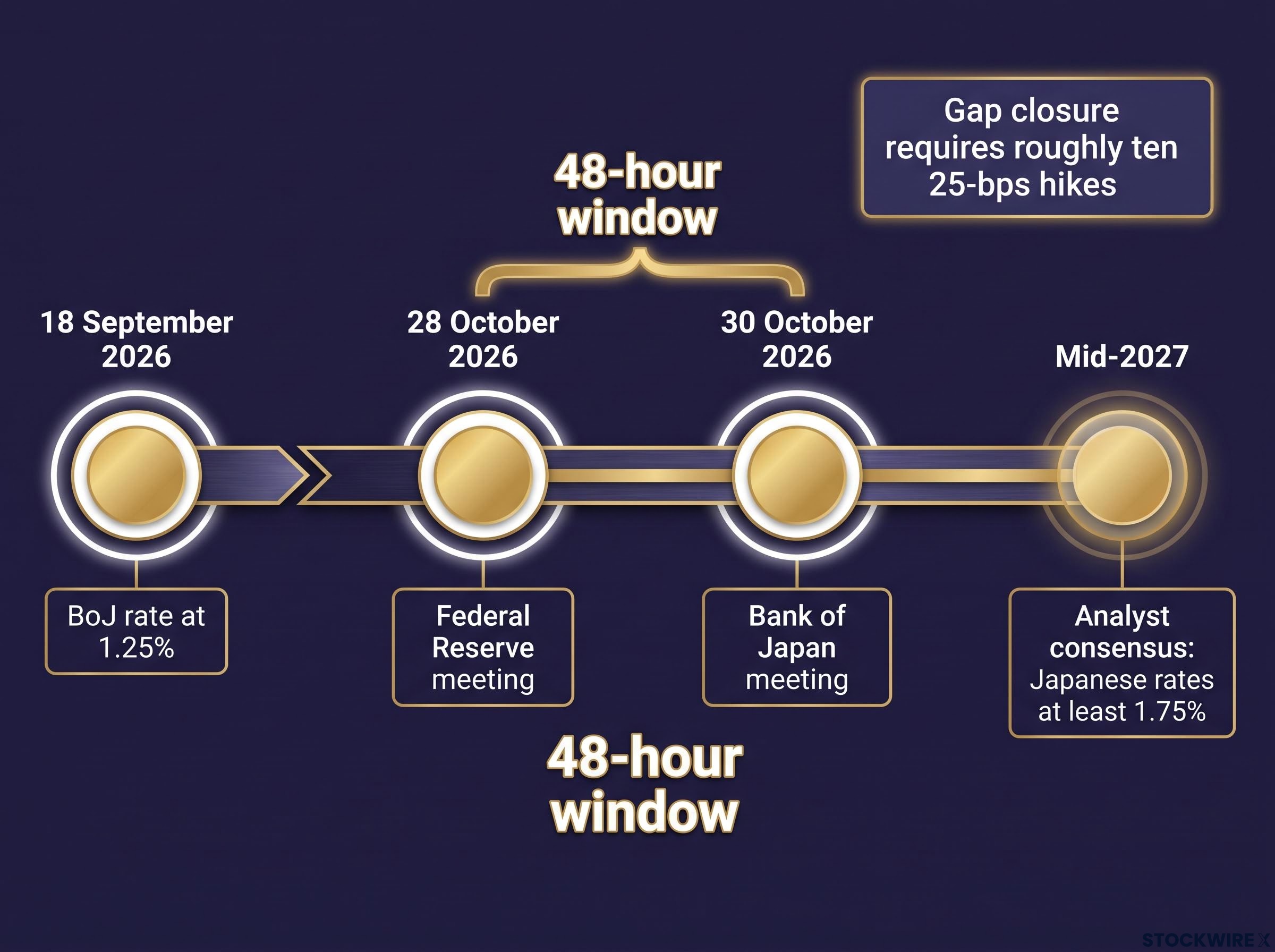
Closing the differential entirely would require roughly ten additional 25-basis-point hikes from Tokyo just to reach the lower boundary of the Federal Reserve’s current target range.
Ten more hikes is not a realistic near-term scenario, and here is why. The BoJ itself estimates Japan’s neutral rate, the level at which policy neither stimulates nor restrains the economy, at somewhere between 1.1% and 2.5%.
At 1.25%, the BoJ has already stepped into the lower part of that band. This raises a genuine market question: how much higher can it go before it starts to damage a domestic economy that spent decades fighting deflation?
That ceiling matters enormously for you. It tells you that hoping for a natural currency recovery driven by Japanese tightening alone is likely futile. The BoJ simply may not have the room.
The realistic path to convergence, then, runs the other way. Either US rates fall significantly as the Fed eases, or Japanese rates break through their historical ceiling, or some combination of both. Until one of those things happens, the structural pull keeping the yen weak stays firmly in place, and the carry trade keeps paying.
Why record interventions cannot fix a mathematical problem
When a currency slides, governments often step in to buy it, and Japan has done so on a historic scale. Through the spring and summer of 2026, Tokyo conducted large-scale yen-buying operations, including what has been described as a record episode across April and May, with further action referenced in July.
And yet, by late September, the yen still trades near 157.5. That gap between the spending and the result tells you almost everything you need to know about the limits of intervention.
The reason is that intervention treats the symptom, not the cause. International institutions including the International Monetary Fund (IMF) and the Bank for International Settlements (BIS) stress that fundamentals win out over time. A currency’s value is ultimately driven by rate and inflation differentials, and no amount of official buying can override that indefinitely.
Three constraints explain why the government cannot simply buy its way to a stronger yen:
- Fundamentals dominate. Sterilised intervention can move the exchange rate briefly, but once markets reassert the carry trade, the effect fades and positions rebuild.
- Political limits. Japan operates within G7 and G20 commitments against persistent competitive devaluations, which constrain how aggressively and how often it can intervene without drawing international objection.
- Balance-sheet risks. Every intervention draws down foreign reserves and exposes the government to valuation losses and political criticism, especially when the currency drifts back to where it started.
Japan’s ability to repeat these operations is also constrained by IMF episode limits on free-floating currency classification, with the Golden Week 2026 operations potentially consuming one or two of the three intervention episodes the fund permits per six-month window before scrutiny intensifies.
So when you next see a headline announcing another massive Japanese currency intervention, treat it as a temporary floor rather than a structural turning point for your international exposure. The source analysis is explicit on this: only a meaningfully narrower rate gap between Japan and the US would durably reduce the appeal of borrowing cheaply in yen. Intervention buys time. It does not buy a solution.
Contagion risks and the catalysts for a rapid unwind
A carry trade this large does not simply fade away when it ends. It snaps, and when it snaps, the effects ripple far beyond the currency market.
Three catalysts could break it. The first is the BoJ hiking faster than markets expect, particularly if Japanese inflation firms and the central bank moves to avoid falling behind. The second is the Fed cutting more aggressively than priced, narrowing the gap from the other side. The third is a global risk-off shock, the kind of panic that sends investors fleeing to the yen as a safe haven precisely because it is a recognised store of value in a crisis.
The danger lies in the mechanics of a disorderly exit. When the yen appreciates suddenly, everyone who borrowed in yen to buy foreign assets faces a double hit: their funding currency is now more expensive to repay, and volatility spikes. That forces leveraged investors to sell, and the selling feeds on itself.
Here is how that contagion travels through your holdings:
- Sharp yen appreciation. A sudden spike in the funding currency makes carry positions unprofitable overnight, triggering a rush to unwind short-yen bets.
- Margin calls and liquidity squeezes. As volatility jumps, margin requirements rise and prime brokers tighten financing, forcing investors to liquidate positions to raise cash.
- US fixed income and equity pressure. Because carry flows help fund positions in US Treasuries, credit, and shares, a rush to close those positions means foreign selling of American assets, pushing yields up and equity valuations down.
Prior episodes, including the carry unwinds of the late 1990s and 2007-2008, are cited by the BIS and sell-side research as precedents for exactly this kind of cross-asset deleveraging.
For investors wanting a structured framework before acting on unwind headlines, our dedicated guide to separating carry trade panic from systemic risk walks through the three diagnostic questions, covering position size, intervention coordination, and genuine fundamental shift, that distinguish episodic stress from structural breakdown.
The October policy sequence
The next major test arrives at the end of October, and the timing is what makes it dangerous.
The Federal Reserve meets on 28 October 2026, and the Bank of Japan follows roughly 48 hours later on 30 October. That narrow window means the Fed’s decision, along with the US inflation and payrolls data that precede it, will directly frame the environment the BoJ walks into.
If the Fed signals a hold or a hike while the BoJ signals further normalisation, the differential dynamics could shift sharply in either direction depending on the relative surprises. MUFG analysts have flagged this combined window as a potentially significant moment for the yen.
You should not view these as two isolated domestic meetings. They are tightly linked catalysts, and analyst consensus already expects Japanese rates to reach at least 1.75% by mid-2027. A surprise in that direction could violently reprice the equity and bond holdings in your own portfolio.
The BoJ rate hike path toward a projected 1.75% by April 2027 is complicated by Japan’s planned food consumption tax cut, which could mechanically suppress headline CPI by up to 1.5 percentage points and create a window in which the BoJ must establish credibility before the distortion arrives.
Preparing your portfolio for the convergence timeline
The competing views among analysts converge on one uncomfortable truth: this is not a static phenomenon. Some see a gradual unwind already underway as BoJ hikes slowly raise funding costs. Others warn the BoJ could accelerate now that its rate sits within the neutral band, while dovish voices argue faster Fed cuts could close the gap first.
What they agree on is that the trade is highly sensitive to the October policy window and the months that follow.
For now, the structural rate gap remains lucrative, and that is precisely where the risk sits. Complacency is elevated. Markets are heavily positioned for continued yen weakness, which is exactly the setup that turns an orderly rebalancing into a disorderly rush.
The practical takeaway is this. Recognise that some portion of the support under US assets may rest on cheap foreign funding that will not last forever. Watch the rate differential, not the intervention headlines, and treat the October meetings as the signals that matter most.
This article is for informational purposes only and should not be considered financial advice. Investors should conduct their own research and consult with financial professionals before making investment decisions. Past performance does not guarantee future results, and forward-looking statements are speculative and subject to change based on market developments.