

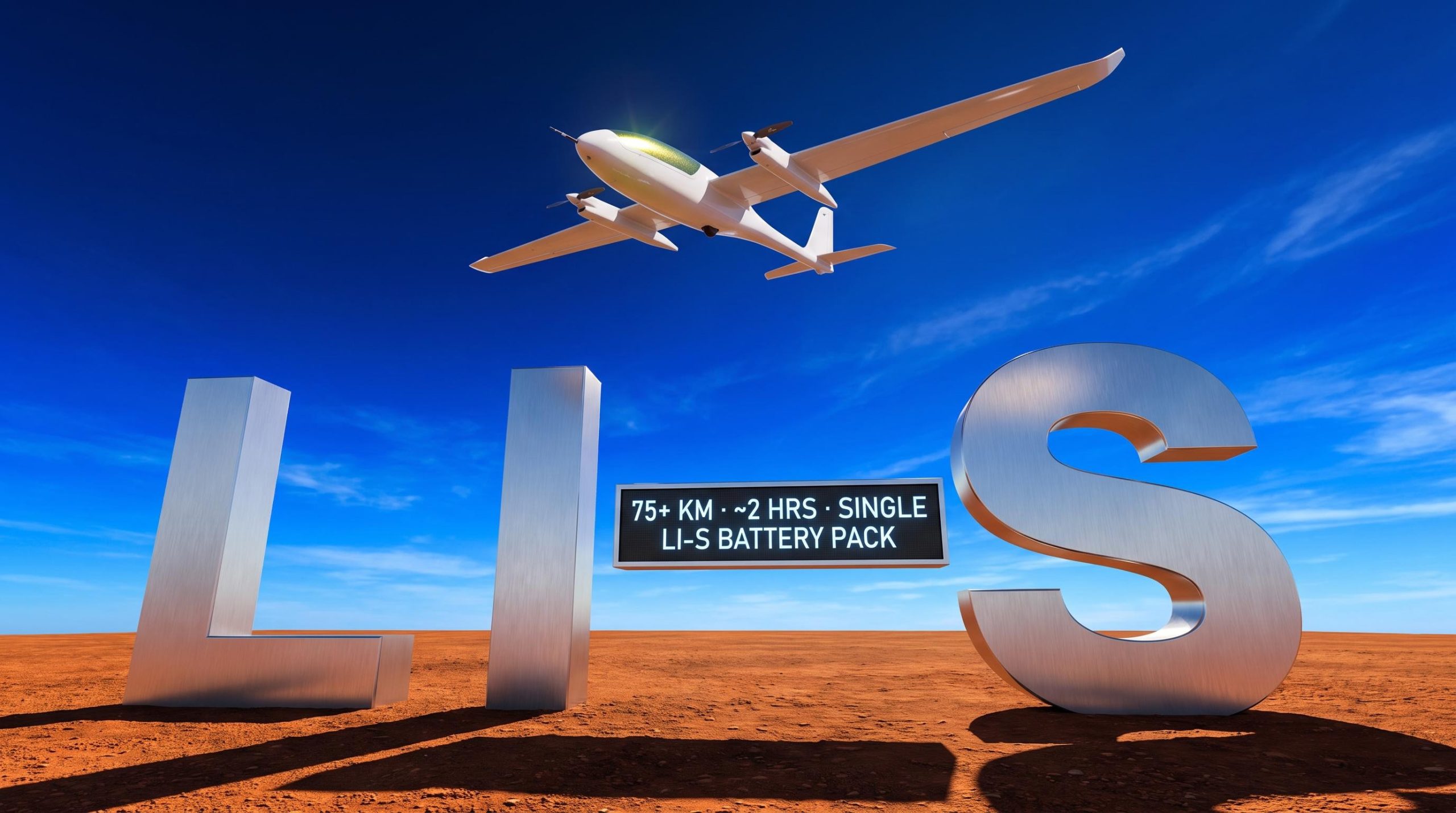
Australian-made drone flies nearly two hours on a single Li-S Energy battery
Li-S Energy (ASX: LIS) has announced a significant endurance milestone for the EATP Pegasus long endurance drone, which completed a flight of almost 2 hours covering more than 75 kilometres on a single 382 Wh Li-S Energy lithium sulfur battery pack. The flight landed safely with battery capacity to spare, confirming the system met its expected performance targets throughout.
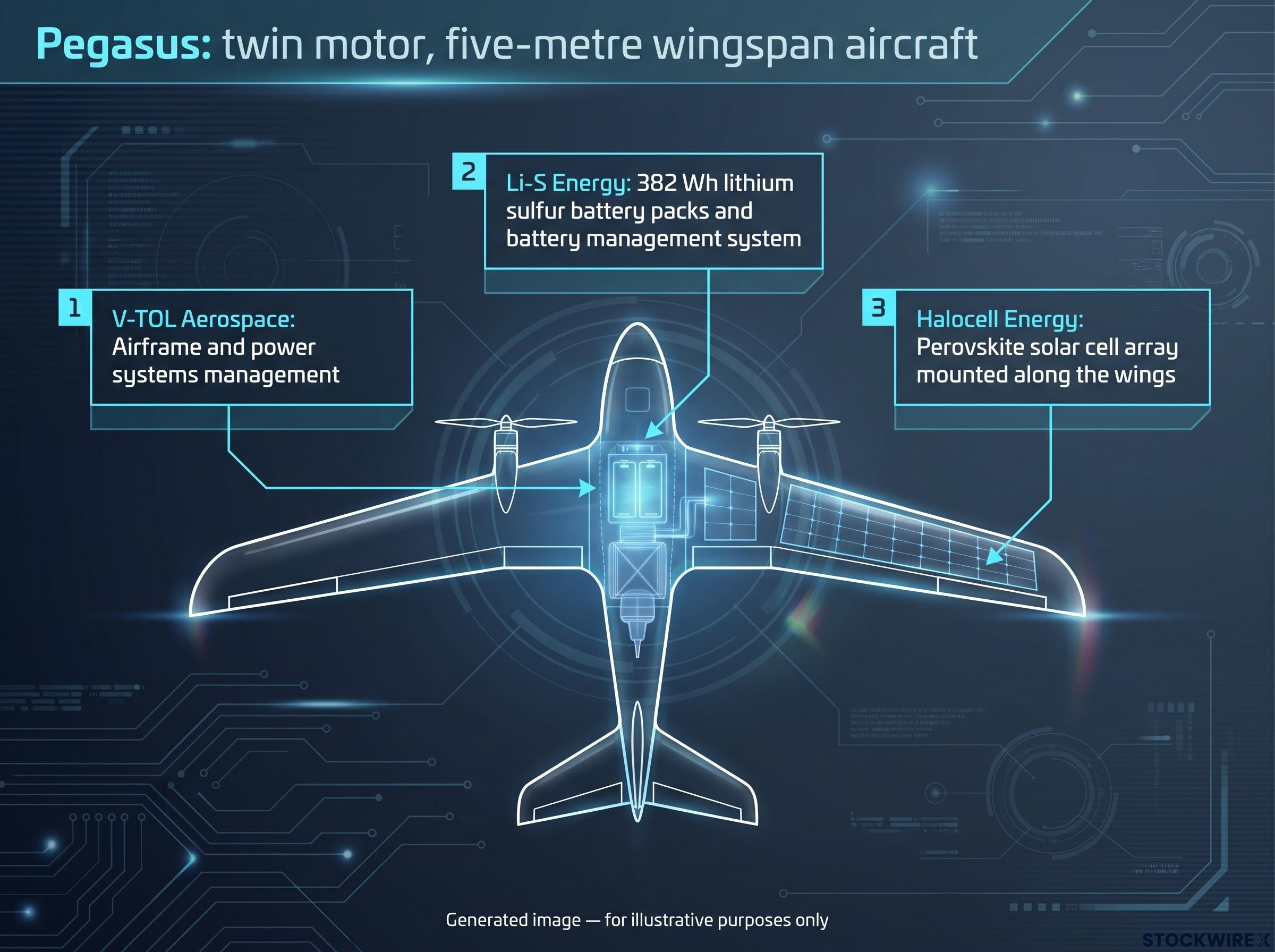
The Pegasus was developed through a collaboration of three Australian companies: Li-S Energy (lithium sulfur battery system and battery management system), V-TOL Aerospace (airframe and power systems), and Halocell Energy (perovskite solar cell array). On a same cell weight basis, the Li-S Energy cells delivered 80% more range and flight time than would have been achieved by an equivalent high-performance professional lithium polymer UAV battery pack, based on a cell-level comparison that excludes pack housing and battery management system weight and assumes flight time scales linearly with cell energy.
Key flight metrics from the milestone endurance test:
- Endurance flight duration: almost 2 hours
- Distance covered: more than 75 kilometres
- Power source: single Li-S Energy 382 Wh lithium sulfur battery pack
- Cell-level performance advantage: 80% more range and flight time vs equivalent lithium polymer UAV battery (same cell weight basis)
- Outcome: landed safely with battery capacity remaining
A one-minute video of the flight is available at https://lis.plus/EATP.
When big ASX news breaks, our subscribers know first
Inside the Pegasus — what makes this platform different
Three technologies, one all-Australian aircraft
The Pegasus is a twin motor, five-metre wingspan aircraft designed and built from the ground up by three Australian companies. V-TOL Aerospace, a Brisbane-based aerospace firm, contributed the airframe and power systems management. Li-S Energy supplied the 382 Wh lithium sulfur battery packs and the battery management system, which was integrated with V-TOL’s power management system to control battery power for the twin motors and control systems while simultaneously managing the feed-in from the solar array. Halocell Energy fabricated the perovskite solar cell array mounted along the wings.
The project is supported by a grant of just over $1.35 million from the Commonwealth Government under the EATP programme, matched by the collaboration partners, as announced in June 2024. This flight marks the culmination of the EATP project and the successful completion of its practical development and flight test work.
Why lithium sulfur matters for drones
In drone applications, weight is the critical constraint. Every gram saved on the battery system translates directly into more flight time, greater range, or additional payload capacity. Li-S Energy’s lithium sulfur cells offer around twice the energy density of conventional lithium-ion batteries, using proprietary nanomaterials including boron nitride nanotubes (BNNTs) and Li-Nanomesh™ to achieve this advantage.
Beyond raw performance, sovereign supply is increasingly a competitive differentiator in both defence and commercial drone markets. An all-Australian platform with domestically produced battery technology, airframe, and solar array addresses a capability gap that imported systems cannot readily fill.
From test flight to commercial opportunity
What the numbers point to next
The Pegasus was designed to accommodate two Li-S Energy battery packs. With the latest improvements to Halocell’s solar array performance beyond those fitted to the current airframe, the platform is expected to be capable of flight missions of 5–8 hours and approximately 250 kilometres. Target mission types include long endurance mapping, surveillance, agricultural, utilities, and environmental monitoring.
Li-S Energy filed two patent applications during the project to protect innovative developments relating to the battery management system and battery pack design. Flight data is now being analysed by the partners to characterise platform performance and inform the assessment of its commercial potential.
Li-S Energy has been advancing the manufacturing readiness of its lithium sulfur cells in parallel, with a gigawatt-scale manufacturing study underway following a $1.9 million ARENA grant and the appointment of engineering firm Hatch to lead feasibility work targeting 1 GWh annual production capacity.
| Configuration | Battery Packs | Expected Endurance | Expected Range | Target Applications |
|---|---|---|---|---|
| Current (flown) | 1 x Li-S pack | ~2 hours | 75+ km | Proof of concept |
| Future (planned) | 2 x Li-S packs | 5–8 hours (expected) | ~250 km (expected) | Mapping, surveillance, agricultural, utilities, environmental monitoring |
Future configuration figures represent anticipated performance projections from the announcement and are not confirmed results.
A market with serious momentum
The commercial and defence demand backdrop for long endurance uncrewed aircraft continues to strengthen. According to the Li-S Energy 2026 Annual Report, proposed US and Australian government investment in drone and counter-drone technologies now exceeds A$100 billion. With integrated technologies now proven in flight, the collaboration partners intend to capitalise on this market potential by assessing further commercial development and targeting future platform sales.
The US Army cell evaluation at Aberdeen Proving Ground, completed in August 2026, represented Li-S Energy’s first direct engagement with a US Government agency and required securing three separate international air transport approvals from CASA, PHMSA, and the FAA before the shipment could proceed.
What management said
Dr Lee Finniear, Chief Executive Officer and Managing Director, Li-S Energy
“With the exponential growth of drones and uncrewed systems in both commercial and military applications, flight endurance and sovereign capability are critical to Australia’s future in this sector. Today, with our partners, we have shown what Australian innovation and collaboration is capable of. The EATP Pegasus drone is the result of two years of work by the teams from V-TOL Aerospace, Halocell and Li-S Energy, proving that Australia has the sovereign capability and the unique technology to be leaders in this field.”
Mark Xavier, Managing Director and Chief Executive Officer, V-TOL Aerospace
“The Pegasus flew exactly as our team designed it to. Our airframe and power systems performed faultlessly throughout the flight, and pairing them with Li-S Energy’s new lightweight pouch cell battery system gives the platform an endurance advantage operators will immediately recognise. I am proud of what our engineers have delivered, and our focus now turns to the pathway from successful trials to commercial platform sales.”
Paul Moonie, Founder and Chief Executive Officer, Halocell Energy
“Seeing our ultra-lightweight perovskite cells take to the air on the Pegasus is a proud moment for the Halocell Energy team, whose skill in fabricating flexible solar modules for such a demanding application has been outstanding. Each flight builds the data and experience we need as we continue to develop higher output modules for aerospace applications, and we are delighted to stand alongside Li-S Energy and V-TOL Aerospace in an all-Australian collaboration delivering this platform.”
Following the successful milestone, the collaboration partners intend to assess further commercial development, targeting future platform sales. Li-S Energy will keep the market informed of material developments in accordance with its continuous disclosure obligations.
Don’t Miss the Next ASX Tech and Manufacturing Breakthrough
Get FREE breaking ASX news delivered to your inbox within minutes of release, complete with in-depth analysis already done for you. Join 20,000+ subscribers who stay ahead of the market the moment announcements drop. Click the “Free Alerts” button at Big News Blast to start receiving alerts across ASX tech, manufacturing, and beyond.