
Japan’s Prime Minister Takaichi Sanae confirmed last week that US President Trump raised the issue of yen weakness directly during their recent bilateral summit. Days later, Finance Minister Katayama Satsuki reaffirmed Tokyo’s view that the yen’s low valuation is a problem, following a phone call with US Treasury Secretary Scott Bessent.
That alignment matters now because the yen remains stubbornly weak, trading in the 156-160 band against the dollar even after the Bank of Japan (BOJ) raised its policy rate to a 31-year high of 1.25% in September 2026. The yen is not weak because Japan is ignoring the problem. It is weak because the structural forces pinning it down are larger than modest rate hikes alone can reverse.
That tension is exactly what makes this diplomatic moment worth reading closely. After this, you will know what coordinated intervention actually involves, why the yen stays weak even as the BOJ tightens, and what a possible policy move means for how you position across Japanese and Asian exposure.
The diplomatic signal: what US and Japanese officials are actually saying
The signal is unusually direct for two of the world’s largest economies. Both sides have now put the yen’s level on the record, and the language has moved beyond routine central-bank commentary into bilateral diplomacy.
Here are the three statements that establish the baseline:
- Prime Minister Takaichi Sanae stated that US President Trump raised yen weakness during a recent bilateral summit.
- Finance Minister Katayama Satsuki reaffirmed that the yen’s low valuation is problematic, following a phone call with US Treasury Secretary Scott Bessent.
- Al Jazeera, reporting on 18 September 2026, described the BOJ’s rate hike as occurring “amid rising inflation and wages, and pressure from Washington.”
Business Times reporting on Bessent-Katayama coordination details how the bilateral channel between Washington and Tokyo formed around yen weakness, providing the clearest public account of how the current diplomatic posture came together ahead of the September rate decision.
That last point matters most. It reframes the diplomatic pressure not as a single episode but as a sustained posture from Washington, one that has plausibly been shaping BOJ decisions rather than merely commenting on them.
Yet the gap between this language and formal action is wide. As of now, no joint communique, no explicit bilateral currency target, and no G7 or G20 statement addressing yen valuation has been publicly identified.
What this tells you is that visible diplomatic pressure around a currency level has historically preceded formal action, even without a signed accord. The signal is real and worth taking seriously. It is not yet a mechanism.
What formal intervention actually requires
There are two distinct paths, and conflating them is the most common analytical error here.
Unilateral action means Japan’s Ministry of Finance intervening alone in the currency market, as it did during 2022. It requires no foreign sign-off, but it also carries no foreign support to sustain it.
Coordinated action is a different order of commitment. It requires the US Treasury to align with Japan around a shared policy rationale, and that is diplomatically sensitive because Washington publicly supports market-determined exchange rates. An explicit accord to weaken the dollar sits uncomfortably against that stated position, which is precisely why the current signalling stops short of it.
When big ASX news breaks, our subscribers know first
Why the Japanese yen intervention debate persists at a 1.25% policy rate
To understand why the yen stays weak, watch the mechanism rather than the headline. The BOJ’s tightening has been genuine and sustained, not cosmetic, and that makes the currency’s stubbornness feel less puzzling once the moving parts are visible.
The yen’s stubbornness at 156-160 despite a 1.25% policy rate reflects how a yen driver framework that spans BOJ policy, yield differentials, safe-haven flows, and Japan’s net creditor position can produce outcomes that no single variable predicts on its own.
The normalisation path is real. The Bank exited near-zero rates in March 2024, raised to 1.0% in June 2026 on a 7-1 vote, and lifted again to 1.25% in September 2026 on a 7-2 vote, effective 24 September 2026. That is the highest policy rate since the mid-1990s.
| Date | Policy rate | USD/JPY at the time | Vote margin |
|---|---|---|---|
| March 2024 | 0-0.1% | Exit from near-zero rates | Not applicable |
| January 2026 (proposal) | Proposed 1.0% | Not applicable | Proposal stage |
| June 2026 | 1.0% | Approx. 160 | 7-1 |
| September 2026 | 1.25% | Approx. 156.64-157.72 | 7-2 |
Look at the currency column. At the June hike to 1.0%, the yen sat near 160, a level Reuters described as a “line in the sand” for possible intervention. After the September hike to 1.25%, it barely moved, holding around 156.64-157.72.
The reason is the rate differential. Even at 1.25%, Japanese short-term rates remain well below those in the US and other major economies, which keeps the yield gap wide.
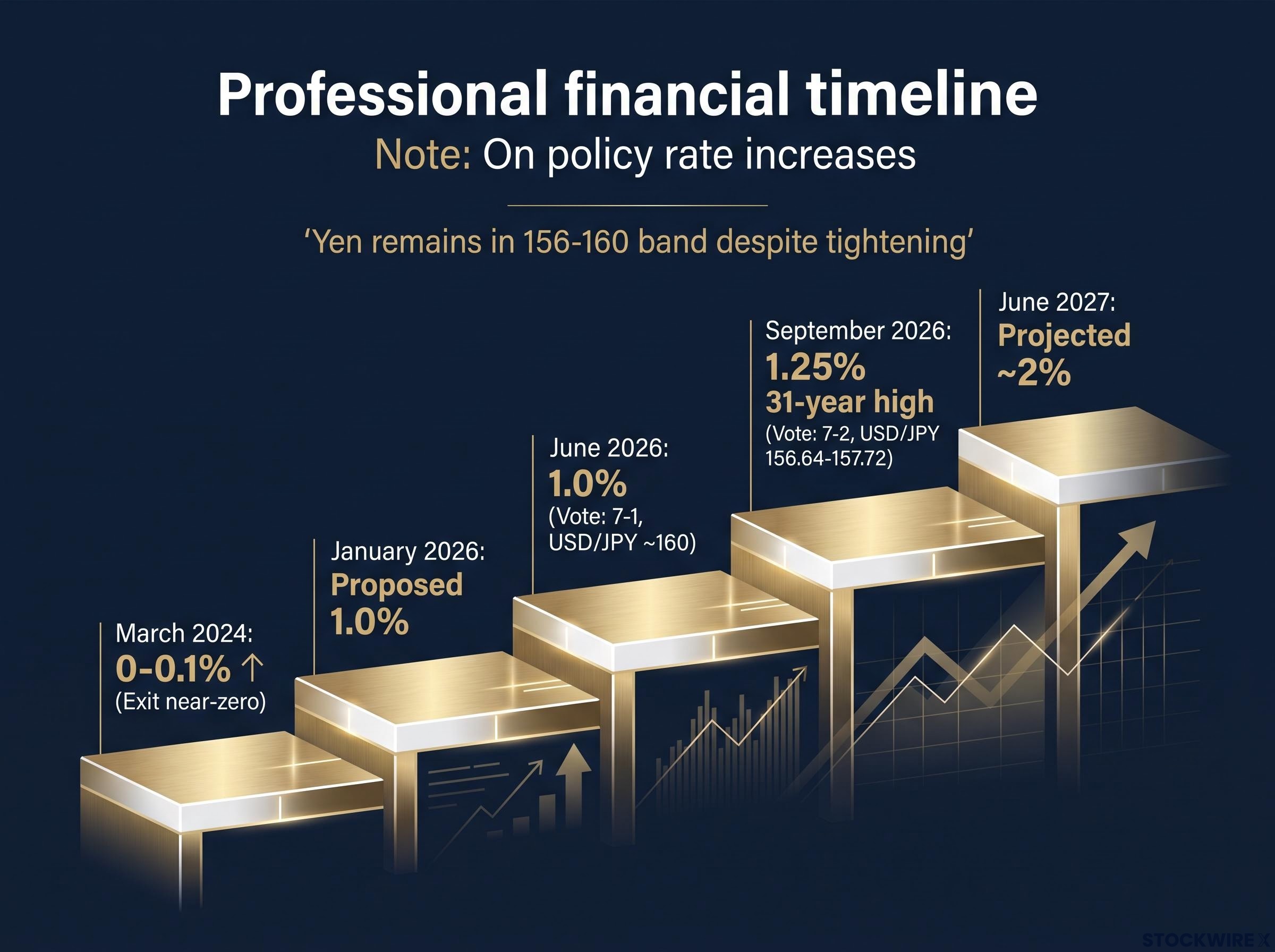
The difficult normalisation BNP Paribas, in a September 2026 research note titled “Bank of Japan: The Difficult Normalization,” characterised the current cycle as a constrained path away from long-standing unconventional policy. Former BOJ board member Makoto Sakurai told Reuters on 24 September 2026 he expects hikes roughly every three months, pushing rates toward around 2% by June 2027.
The read for you is direct: a 31-year-high policy rate has not been enough to turn the currency, so the question is not whether the BOJ is trying, but whether rate hikes or intervention can actually overpower the structural flows underneath.
The carry trade: why cheap yen borrowing persists
The carry trade is the clearest expression of that yield gap. Investors borrow in yen at low rates, then invest the proceeds in higher-yielding currencies or assets elsewhere, pocketing the difference.
At 1.25%, the yen remains cheap enough to keep working as a funding currency for these leveraged positions. That is the engine of persistent selling pressure.
The yen carry trade persists because the roughly 2.5 percentage point spread between Japanese and US short-term rates still makes borrowing in yen and investing in dollars one of the most structurally embedded trades in global capital markets, and a single 25-basis-point hike does little to change that arithmetic.
It matters for a second reason. Unwinding that trade at scale is exactly what large-scale intervention would trigger, and the ripple effects would not stay contained to Japan.
What coordinated intervention could actually do, and what history says about its limits
Place two episodes side by side and the pattern becomes clear. The variable that decides whether intervention lasts is not the size of the operation. It is whether underlying policy changes follow.
The Plaza Accord of 1985 is the benchmark for durable coordinated action. Joint G5 intervention produced sharp, lasting dollar depreciation, and it repriced global equities, bonds, and trade balances for years. It worked because it was accompanied by genuine structural policy shifts across the participating economies.
Japan’s 2022 unilateral interventions are the counter-example. They produced only temporary yen strength before the currency resumed weakening, because BOJ policy stayed ultra-accommodative while the Federal Reserve was tightening aggressively. The rate differential reasserted itself the moment official buying stopped.
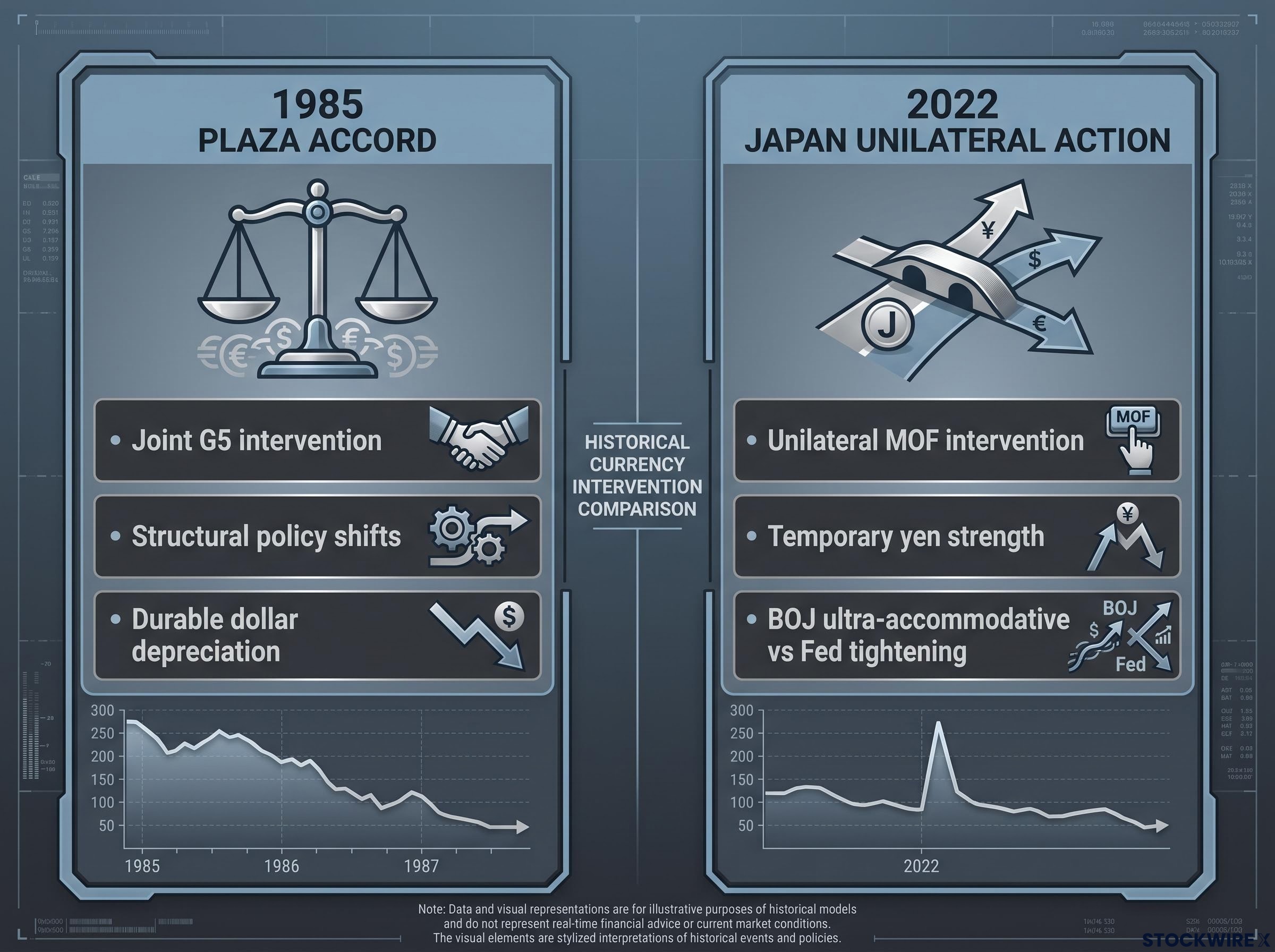
The 2022 lesson Intervention without a credible change in the underlying policy stance behaves like a speed bump, not a turning point. Once the official buying subsides, fundamentals that were never addressed pull the currency back toward its prior trajectory.
Three conditions determine whether intervention delivers durable yen strength rather than a temporary spike:
- The rate differential between Japan and other major economies narrows meaningfully.
- Structural capital flows out of Japan reverse rather than merely pause.
- Sustained multilateral political commitment backs the action over time.
Even beyond durability, large-scale coordinated action carries second-order risks. Forcing a rapid unwind of yen-funded carry trades could trigger risk-off moves across emerging-market currencies, high-yield credit, and leveraged equity positions worldwide.
Carry trade unwind risk carries a well-documented pattern of headline severity outrunning actual systemic damage: the 2024 episode cleared 40-60% of speculative positioning within weeks without a cascading structural breakdown, which sets a useful base rate for calibrating the second-order risks identified here.
There are also political constraints on both sides. The US publicly favours market-determined exchange rates, and Japanese exporters benefit from a weak yen, which makes sustained intervention contentious in Tokyo as much as in Washington.
The takeaway for you is a positioning discipline: intervention without a credible policy shift is more likely to be a tactical volatility event than a regime change. Treat any intervention signal as a spike to navigate, not a trend to chase.
How carry-trade unwinding and a stronger yen ripple through global portfolios
Move from policy to portfolio, and the transmission chain becomes concrete. A stronger yen does not act on one asset in isolation. It moves through Japanese exporters, Asian benchmarks, and carry-funded risk assets in sequence.
Start with Japanese export-sector equities: autos, electronics, and technology names. A weak yen inflates the value of overseas earnings once translated back into yen, flattering margins. Yen appreciation, whether from intervention or faster BOJ tightening, would compress that translation benefit and could re-rate export-heavy stocks downward.
The reach extends across the region. Asia is estimated to contribute roughly 70% of total global economic growth, and the yen functions as a barometer for global risk appetite and funding conditions. Sudden yen strength can signal tightening global liquidity, prompting rotation out of riskier Asian assets held in benchmarks like the Nikkei 225, KOSPI, Hang Seng, Shanghai Composite, Shenzhen Composite, Sensex, and Nifty.
For investors exploring the tail scenario in which BOJ tightening triggers a disorderly carry unwind across US megacap tech, emerging markets, and commodities simultaneously, our dedicated guide to the global margin call risk examines the JPMorgan positioning estimates and the specific asset classes most exposed to a faster-than-expected hike path.
| Asset class | Yen weakens further | Yen strengthens via intervention |
|---|---|---|
| Japanese exporters | Earnings translation boosted, margins supported | Translation benefit compressed, downward re-rating risk |
| JGBs and cash | Nominal yield of 1.25%, but FX-adjusted returns eroded for foreign holders | Short-term FX gains, though sustainability uncertain |
| Asian equities | Supports carry and risk-on positioning | Rotation risk as liquidity tightens across the region |
| Carry-funded positions | Remain profitable while the yield gap holds | Forced unwinding, cross-asset volatility |
The interpretive point is one many miss. A yen that strengthens on intervention is not straightforwardly good news for Asian exposure, because it can squeeze Japanese exporter earnings and flag tighter global liquidity that hits regional risk assets at the same time.
That is why the tactical and strategic layers need separating. Consider these tactical responses to a possible intervention signal:
- Hedging FX exposure on Japanese and Asian equity holdings.
- Using options to define downside around the 160 threshold.
- Shortening carry exposure ahead of potential volatility events.
Strategic allocations are a different matter. Those should anchor to the BOJ’s normalisation trajectory, currently at 1.25% and projected toward around 2% by June 2027 on Sakurai’s view, rather than to any single FX operation.
What the yen tells you about where this cycle is heading
The yen’s weakness is not a mystery or a policy failure in isolation. It is the predictable output of rate differentials and structural capital flows that are only slowly being addressed, and seeing it that way removes the surprise element from the next policy event.
Three variables will decide the next move:
- The pace of BOJ normalisation relative to Sakurai’s roughly 2% projection for June 2027.
- The USD/JPY level relative to the 160 intervention threshold identified by Reuters in June 2026.
- The durability of US diplomatic pressure as a multiplier on Japan’s own policy will.
The medium-term outlook leans gradually more constructive for the yen as normalisation proceeds. The short-term picture is tactical: intervention risk concentrated near 160, without guaranteed durability. BOJ vote margins of 7-1 in June and 7-2 in September suggest the tightening path is broadly supported but not unanimous.
Watch USD/JPY approaching 160 as the trigger, the next BOJ meeting for the pace signal, and treat medium-term yen strength as a structural probability rather than a near-term certainty.
This article is for informational purposes only and should not be considered financial advice. Investors should conduct their own research and consult with financial professionals before making investment decisions. Past performance does not guarantee future results, and financial projections are subject to market conditions and various risk factors.