#
Two numbers are about to tell contradictory stories in the same inflation report, and only one of them matters. TD Securities expects September consumer prices to accelerate sharply at the headline level while cooling underneath, a split that is not a rounding quirk but a structural read on what is actually pushing prices right now.
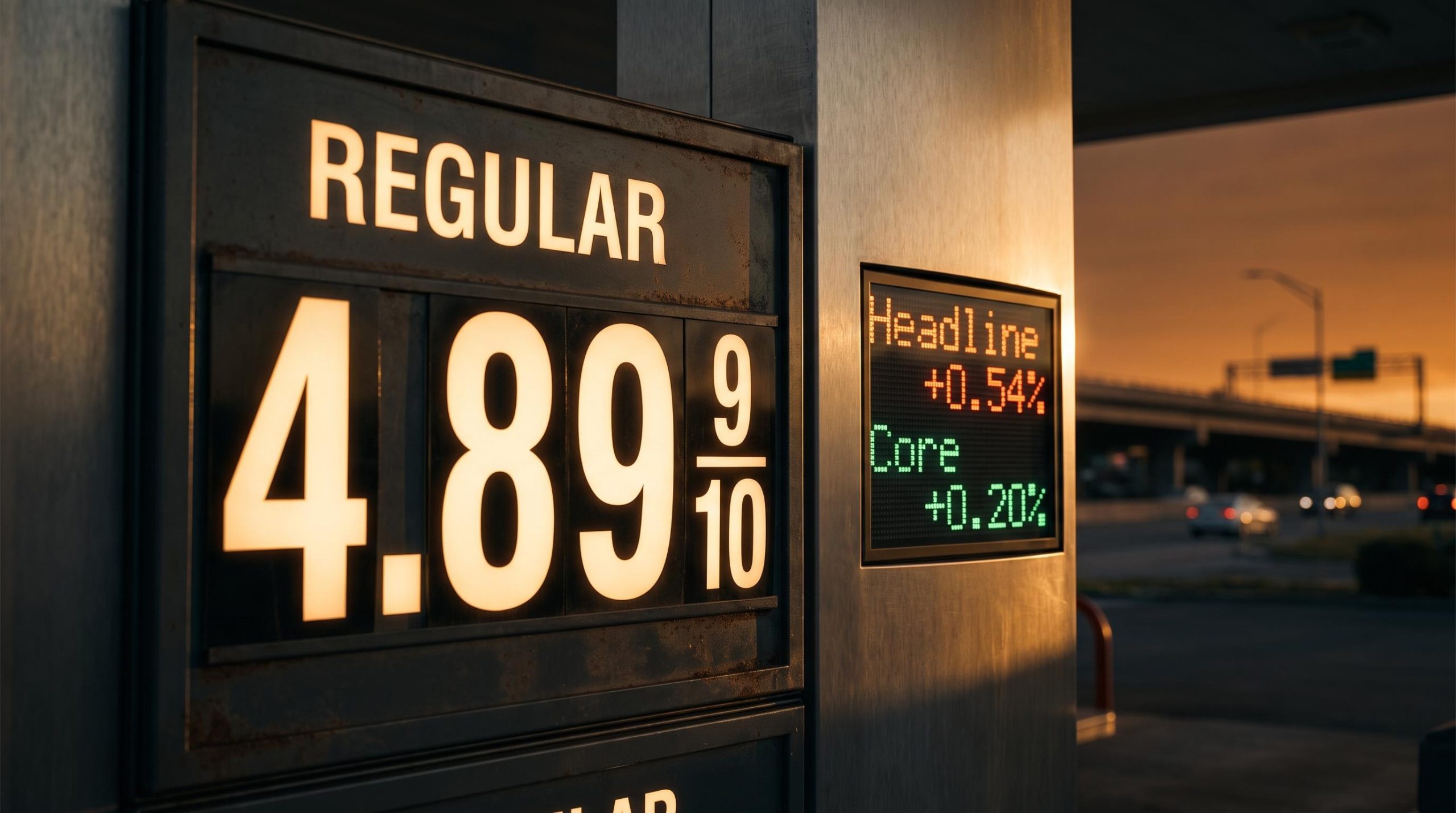
The culprit up top is gasoline. TD Securities economists Oscar Munoz and Eli Nir, as reported by FXStreet, have put a preliminary figure on the September Consumer Price Index (CPI) before the Bureau of Labor Statistics (BLS) release: +0.54% month-over-month at the headline and just +0.20% m/m at the core. Those projections are anchored to the distortion-heavy August 2026 print, which surprised to the upside on core and rattled rate expectations. The September data has not yet landed, which makes this a forward-looking call with direct stakes for how the Federal Reserve positions into the final months of the year.
After reading this, you will know which number to watch when the report drops, why the headline figure is set to mislead, and what a softer core reading would actually mean for rate expectations heading into the last Federal Open Market Committee (FOMC) meetings of 2026.
Why gasoline is doing the heavy lifting on headline inflation
The headline number is going to look loud, and the reason is almost entirely one commodity. TD Securities estimates gasoline prices climbed nearly 8% month-over-month in September, the single mechanical driver behind its +0.54% m/m headline forecast.
TD Securities September headline CPI forecast: +0.54% m/m Economists Oscar Munoz and Eli Nir, via FXStreet, attribute the acceleration primarily to a near-8% monthly surge in gasoline prices, with firmer food costs adding secondary pressure.
Put that gasoline move in context and the step-up is real. In August, gasoline rose +3.9% m/m and still counted as a major headline mover, with energy overall up +2.1% m/m. A near-doubling of that monthly gasoline contribution is what pulls the September headline forecast well above August’s +0.40% m/m actual.
Food prices are expected to firm too, adding a second layer of upward pressure on the headline beyond energy alone.
| Metric (m/m) | August 2026 Actual | September 2026 TD Forecast |
|---|---|---|
| Headline CPI | +0.40% | +0.54% |
| Gasoline | +3.9% | ~+8% (estimated) |
| Energy overall | +2.1% | Not specified |
TD Securities projects a CPI NSA index level of roughly 336.510 for September, just below the market’s prevailing fixing of 336.600, and flags the estimate as preliminary while volatile components such as hotel rates and airfares finalise.
Here is the read you should take from all of it. A near-8% gasoline spike will dominate the print and generate alarming-looking numbers for casual observers, but if you are tracking Fed policy, treat it as noise. The Fed does not set interest rates in response to gasoline swings, and neither should your positioning.
The mechanism by which CPI data drives Fed rate decisions is more direct than many investors assume: a single tenth of a percentage point on monthly core is enough to reprice the implied probability of a hike by double digits in a single session, which is precisely why the core reading carries more weight than the headline.
When big ASX news breaks, our subscribers know first
The August distortion that explains September’s core-cooling call
Strip out gasoline and the story flips from acceleration to expected relief, but that relief is really a bet that one strange August category behaves itself. To understand the September core forecast, you have to solve the August puzzle first.
August core CPI came in at +0.29% m/m and +2.4% y/y, the largest monthly core gain since April and above consensus for a second straight month, when economists had penned in +0.2%. The upside was concentrated in one place: wireless telephone services.
What supercore tells you that core CPI does not
Supercore CPI strips shelter out of core services, isolating the part of inflation the Fed worries about most: services pricing that is sticky and wage-driven rather than pushed around by rent or energy. It is where policymakers see their most stubborn challenge.
In August, supercore jumped to +0.51% m/m, a sharp acceleration from +0.20% m/m in July. That reading alarmed analysts precisely because it landed in the category the Fed cannot easily dismiss.
The supercore acceleration in August moved CME FedWatch odds of a September hike from 69% to approximately 87% in a single session, a repricing that illustrates why the September report carries similarly outsized stakes: a second consecutive core beat at that magnitude would shift the conversation from distortion to persistence.
The engine behind that jump was telephone services. Estimates of the monthly move range from +5.37% m/m (The Inflation Guy) to +5.9% m/m (CryptoBriefing), the latter characterising it as the largest single-month increase ever recorded for the category.
A category worth roughly 1.3%-1.47% of CPI moved the whole core reading. CryptoBriefing describes the August wireless telephone services spike as the largest monthly increase ever logged for the line item.
That is the detective’s key clue: a tiny category threw a punch far above its weight. The other August supercore contributors were far more ordinary:
- Wireless telephone services: the dominant driver
- Airline fares: positive contributor
- Education: positive contributor
- Medical care services: partial offset
- Motor vehicle insurance: partial offset
TD Securities forecasts supercore slowing to +0.23% m/m in September, down sharply from August’s +0.51%, with core easing to +0.20% m/m. That is a normalisation call in plain terms: if telephone services partially reverses or simply stabilises, the mechanical tailwind that inflated August disappears.
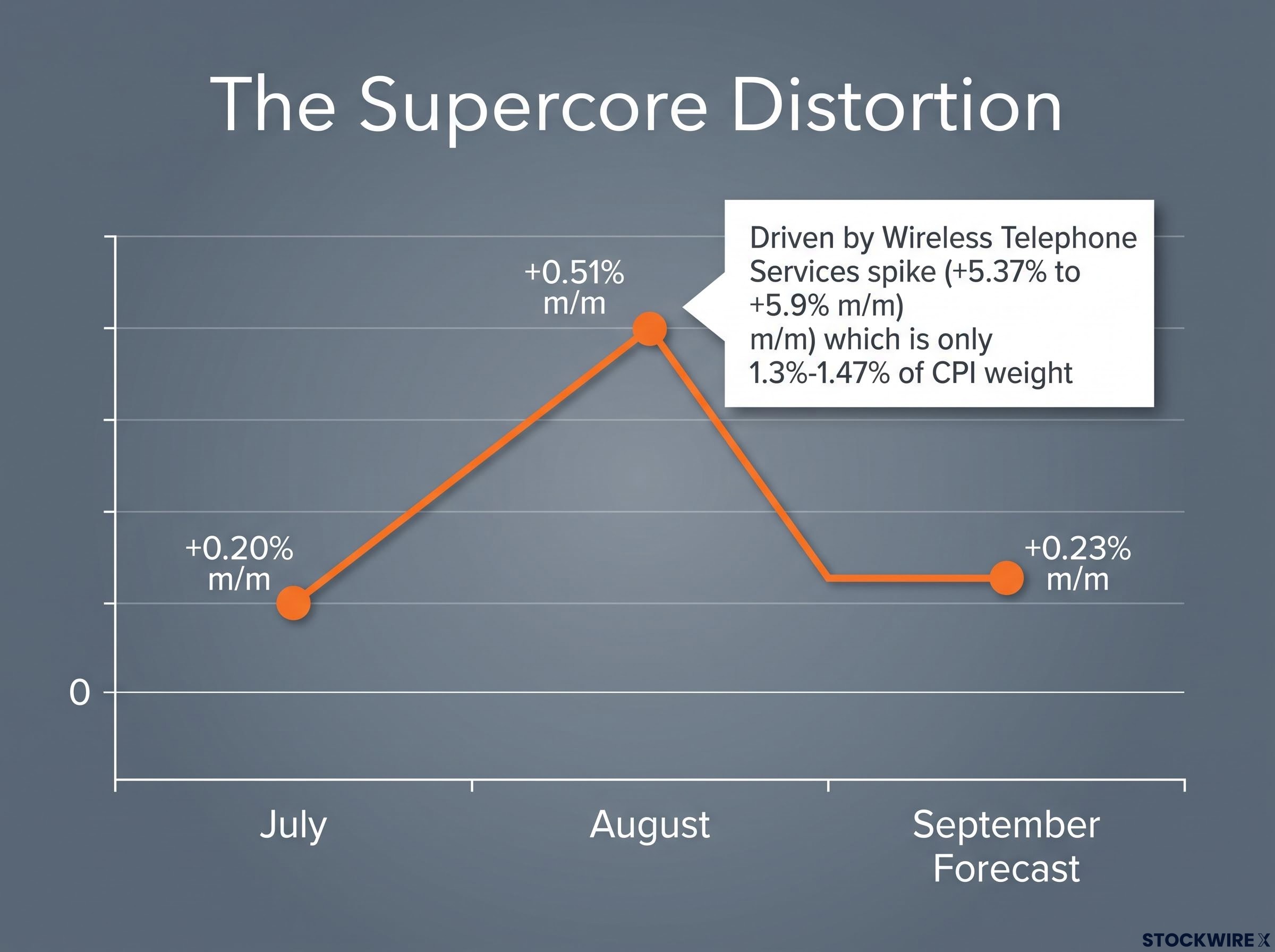
August’s core surprise was substantially a telephone services story, not a broad reacceleration. The September forecast is essentially a wager that the distortion fades, and whether that wager pays off is the single most important variable to watch when the BLS publishes.
What the TD Securities forecast is not saying
The cooling call may well be right. It may also be wrong for reasons serious enough that you should hold both outcomes in mind before the data prints.
Start with the pattern. August’s +0.29% m/m core was the largest since April and beat consensus for a second consecutive month. When surprises keep breaking the same direction, that direction deserves respect, not dismissal.
Even granting the telephone services reversal, core and supercore still lean heavily on continued shelter disinflation. A single category cooling is not the same as broad-based cooling. Gianluca Benigno frames the pressure as “inflationary pressures primarily concentrated in the core services sector,” noting the longer-term easing in core services “paused” in August with supercore running near 3.1% y/y (The Inflation Guy reads the same data closer to 2.99% y/y, a definitional or rounding gap).
The counterweight to the cooling story. Gianluca Benigno argues core services stickiness resurfaced in August, with non-housing services firm and supercore holding around 3.0%-3.1% y/y, meaning the Fed cannot relax even if one category normalises.
Several volatile service lines could offset any telephone services relief and keep core elevated:
- Wireless telephone services (reversal not guaranteed)
- Airline fares
- Education-related services
- Motor vehicle insurance
- Medical care services
The stakes of getting this wrong are concrete. The August core upside pushed the implied Fed hike probability to roughly 70% in futures markets, per Reuters. If September core lands at +0.29% or higher again, the one-off narrative collapses into a persistence narrative, and the odds of further tightening in late 2026 rise meaningfully. That scenario belongs in your contingency plan before the release, not after it.
The policy mistake risk framing sits on the other side of the persistence argument: Bloomberg Economics analyst Anna Wong argues the economy is in an early-to-mid cycle recovery where tightening is a late-cycle tool, and that anomaly-driven data like August’s wireless spike is being misread as entrenched demand pressure rather than category noise.
How September CPI will shape Fed positioning for the rest of 2026
The Fed reads inflation through a specific filter: energy-driven headline strength gets looked through, while the core and supercore trajectory is where credibility decisions get made. That filter is what turns this report into a policy signal rather than a data point.
Two scenarios frame the coming release:
- Core cools to +0.20% m/m as TD Securities forecasts. That reinforces the pause narrative, treats August as a distortion, and supports a wait-and-see stance rather than a decisive pivot in either direction.
- Core holds at or above +0.29% m/m. The sticky-services story reasserts itself, and the probability of an additional hike into late-2026 FOMC meetings climbs.
August offers a concrete template for the reaction. Reuters characterised that print as pushing the Fed “closer” to a hike while keeping a “wait-and-see” posture alive, with the implied move probability lifting to around 70%.
From CPI to the Fed’s own gauge. A +0.20% m/m core, per TD Securities, implies core Personal Consumption Expenditures (PCE) of roughly +0.25% m/m. Core PCE is the Fed’s preferred inflation measure, which is why the CPI core reading matters beyond the headline.
| Metric (m/m) | August 2026 Actual | September 2026 TD Forecast |
|---|---|---|
| Headline CPI | +0.40% | +0.54% |
| Core CPI | +0.29% | +0.20% |
| Supercore CPI | +0.51% | +0.23% |
| Gasoline | +3.9% | ~+8% |
| Core PCE (implied) | Not specified | ~+0.25% |
For you, the report is less about where inflation sits today and more about which narrative controls the Fed’s next move: the distortion-driven pause or the services-inflation-reasserting story. Rate-sensitive portfolios, fixed income, and equity sector exposures all move on Fed expectations, and knowing which scenario you are watching in real time means tracking core and supercore, not the headline.
What to watch for when the September CPI report drops
Enter the release with a signal hierarchy, because the number that flashes first is the one that matters least for policy.
- Core CPI m/m against the +0.20% TD Securities forecast. This is the number that drives Fed thinking.
- Supercore m/m against the +0.23% forecast. The most sensitive services read.
- Telephone services m/m as the category-level tell for whether August normalised.
- Headline CPI m/m as context only, distorted by the gasoline surge.
Thresholds that would shift the market read
Below +0.20% core confirms the cooling story and validates the August-as-distortion thesis. Landing in the +0.20%-0.25% band is broadly in line with the TD Securities call. Above +0.25% m/m core starts to reinforce the persistence narrative and would likely read as hawkish. A repeat of August at +0.29% m/m or higher would mark a second consecutive miss and materially strengthen the case for further Fed tightening.
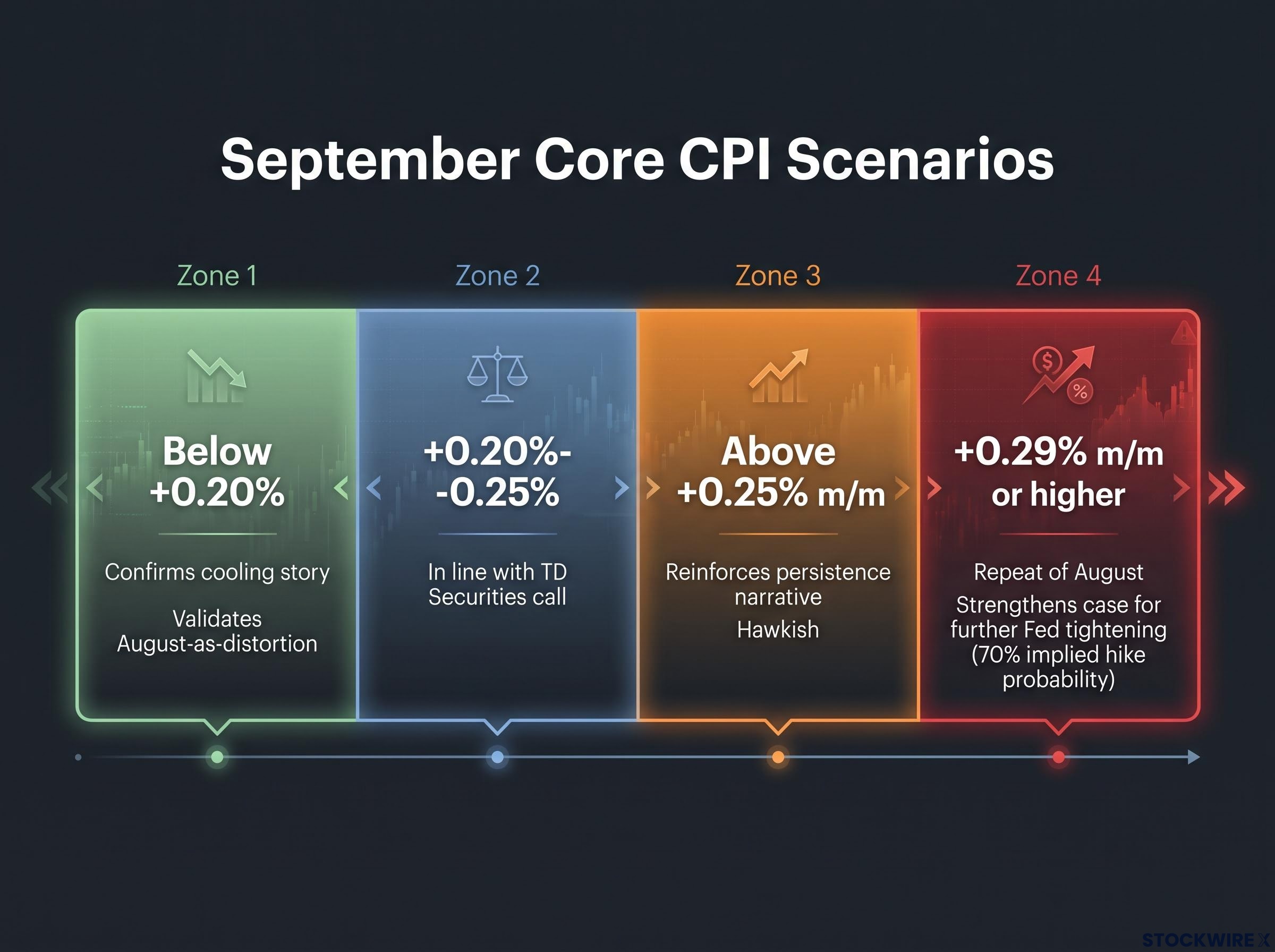
Keep the caveats in view. The forecast is preliminary, and TD Securities flagged hotel rates and airfares as categories where late data could still move the projection before release.
September is one data point in a cumulative Fed narrative, not a decisive pivot on its own. Enter the release knowing the thresholds and you can act on the data rather than react to a headline that will almost certainly mislead in a gasoline-surge month.
The Fed’s sensitivity to incoming data has been amplified by Chair Kevin Warsh’s limited forward guidance, meaning each CPI print now carries sharper immediate market impact than under previous communication regimes, a dynamic that raises the stakes of the September release beyond what the historical average reaction would suggest.
This article is for informational purposes only and should not be considered financial advice. Investors should conduct their own research and consult with financial professionals before making investment decisions.
Past performance does not guarantee future results. Financial projections are subject to market conditions and various risk factors, and these forward-looking statements are speculative and subject to change based on market developments.