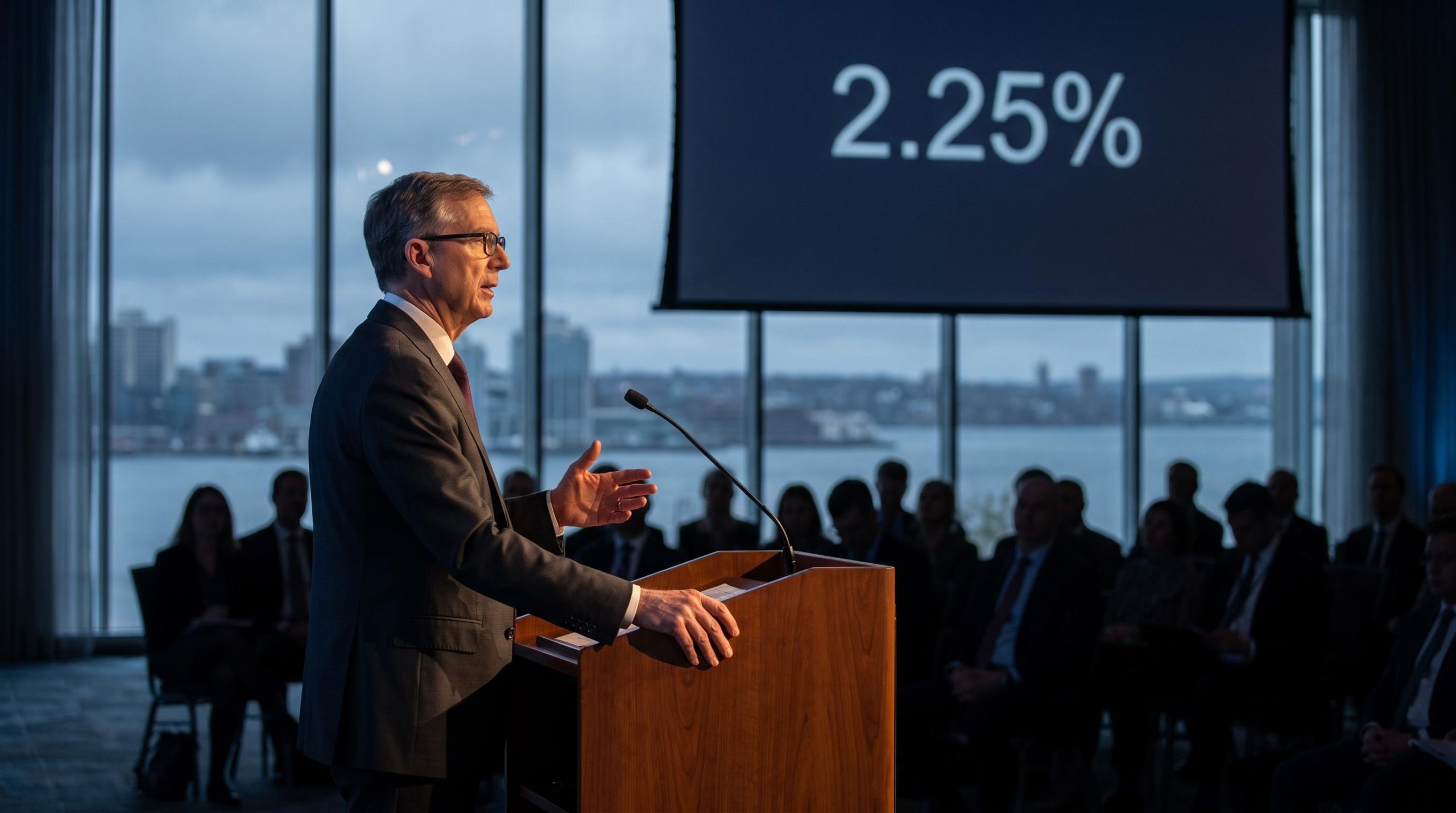
Governor Tiff Macklem walked into a Halifax business audience today and delivered a warning the Bank of Canada has not put on the record all year: wait too long to raise interest rates, and the Bank will be forced to raise them harder and higher than it otherwise would. That single sentence changes how every Canadian should read the next rate decision.
The context makes the warning land harder. The Bank has held its overnight rate at 2.25% through four consecutive decisions in 2026, headline inflation is stuck at 3.0% as of August, oil is trading near US$100 per barrel after Middle East disruptions, and Macklem today named energy costs as an explicit upside risk to inflation in the months ahead.
Here is what that warning actually means for anyone holding a variable-rate mortgage, sitting on a fixed-income position, or owning an investment sensitive to Canadian borrowing costs. The signal beneath the headline is that the Governor’s patience now has a documented limit.
What Macklem said in Halifax, and why the warning matters
Governor Tiff Macklem addressed the Halifax Partnership on 21 September 2026 in a speech titled “Navigating uncertainty and adapting to change.” The framing was not a routine hold-and-monitor update. It was a central bank governor putting the cost of delayed action into a formal speech.
His central tension was direct.
“We don’t want to raise our policy rate and restrain growth if inflationary pressures are contained. But nor do we want to be too slow to respond if inflationary pressures are becoming more persistent.”
The harder edge came in what followed. Macklem warned that if the Bank moved too gradually in starting rate increases, it would then need to raise rates more aggressively, and to a greater degree, than if it had acted sooner. Bloomberg summarised the message plainly: policymakers “don’t want to be late to hike interest rates.”
That word, “late,” is the signal to register. This is a governor who steered the Bank through the 2022 tightening cycle, and he is on record warning against repeating the pattern of insufficient early action.
The hold pattern that gives the warning its weight is worth seeing in full. Every 2026 decision to date has kept the rate at 2.25%:
- 28 January 2026: held at 2.25%
- 29 April 2026: held at 2.25%
- 15 July 2026: held at 2.25%
- 2 September 2026: held at 2.25%
Macklem also framed elevated uncertainty as a durable condition rather than a passing phase, and singled out oil near US$100 per barrel as the primary near-term upside risk to inflation. For anyone tracking Canadian rate policy, this speech should be treated as a forward-guidance event, not boilerplate. A governor who names the price of waiting is telling the market the next decision carries more weight than another quiet hold.
The bond market’s reaction reflects a broader repricing already underway before Halifax: BoC hike odds surged from below 10% to roughly 60% in the two weeks following the Fed’s September rate increase, the fastest shift in market pricing since the 2022 tightening cycle.
When big ASX news breaks, our subscribers know first
Why inflation is not cooperating: energy, trade, and what comes next
The reason Macklem cannot simply act on inflation is that two forces are pulling in opposite directions on policy, and he named both.
The inflation picture itself is uneven. Statistics Canada reported on 14 September 2026 that headline CPI held at 3.0% year-over-year in August, matching July. Strip out gasoline, and the figure drops to 2.4%. That gap tells you energy is carrying most of the distance between current inflation and the Bank’s 2% target.
Canada core inflation measures CPI-trim and CPI-median were both tracking below the Bank’s own MPR projections as of August, which is precisely why the gap between headline CPI at 3.0% and the underlying trend has made the Bank’s position so difficult to communicate.
Here is where the readings sit against the anchor:
| Indicator | August 2026 reading | BoC target |
|---|---|---|
| Headline CPI | 3.0% | 2.0% |
| CPI excluding gasoline | 2.4% | 2.0% |
| Policy rate | 2.25% | Neutral range |
Macklem’s concern is that the gap could widen. With oil near US$100 per barrel on the back of Middle East conflict disrupting fuel production, he said, “We would expect inflation to edge up in the coming months.” He also flagged that policy needs to look beyond the initial shock of higher oil prices, a signal he is watching for second-round effects that spread beyond the fuel component itself.
The IEA has characterised Middle East geopolitical tension as a structural inflation risk rather than a transient spike, meaning the risk premium embedded in oil near US$100 per barrel is likely to decompress slowly over months, not unwind quickly after any single ceasefire announcement.
Pulling the other way is trade. Macklem cautioned that unpredictable U.S. trade policy and new tariffs risk causing businesses to delay investment and hiring, a drag that could weigh on fourth-quarter growth. That is the countervailing force: raise rates to counter energy-driven inflation, and you risk deepening a slowdown that tariffs may already be creating.
For Canadian investors and mortgage holders, that tension is the whole story. It determines whether the Bank is dealing with a transitory energy spike or a more embedded price problem. Macklem’s Halifax answer leaned toward embedded risk if action is delayed, which is why he reaffirmed the 2% target as the fixed point guiding every call.
The 2022 precedent: what being “late” actually looks like
Macklem’s warning is not abstract theory. It is grounded in a tightening cycle the Bank lived through less than four years ago.
In a speech to the Halifax Chamber of Commerce on 6 October 2022, Macklem described how the Bank had raised its policy rate that year.
The Bank raised its policy interest rate by three percentage points in five steps during 2022, reinforced by quantitative tightening.
That pace was a direct consequence of inflation running well above target before the tightening began. The lesson embedded in it is the same one Macklem invoked in Halifax today: move late, and you move fast and far to catch up.
The mechanism is what makes early action preferable. Rate changes work through interest-sensitive demand and through inflation expectations, and both channels operate with long lags. Once expectations become entrenched, moderate hikes may no longer be enough to re-anchor them. Delayed tightening forces larger eventual moves through three channels:
- Inflation expectations that become firmly embedded in wage negotiations and price-setting
- Wage growth that builds in the anticipation of higher future costs
- Demand that has already outrun the economy’s supply capacity
The bond market is already pricing this in. According to MarketWatch, two-year Government of Canada bond yields are trading more than one percentage point above the current policy rate, meaning fixed-income investors are placing bets on rate increases even as the Bank signals caution. That gap between market pricing and Bank messaging is itself a measure of policy uncertainty.
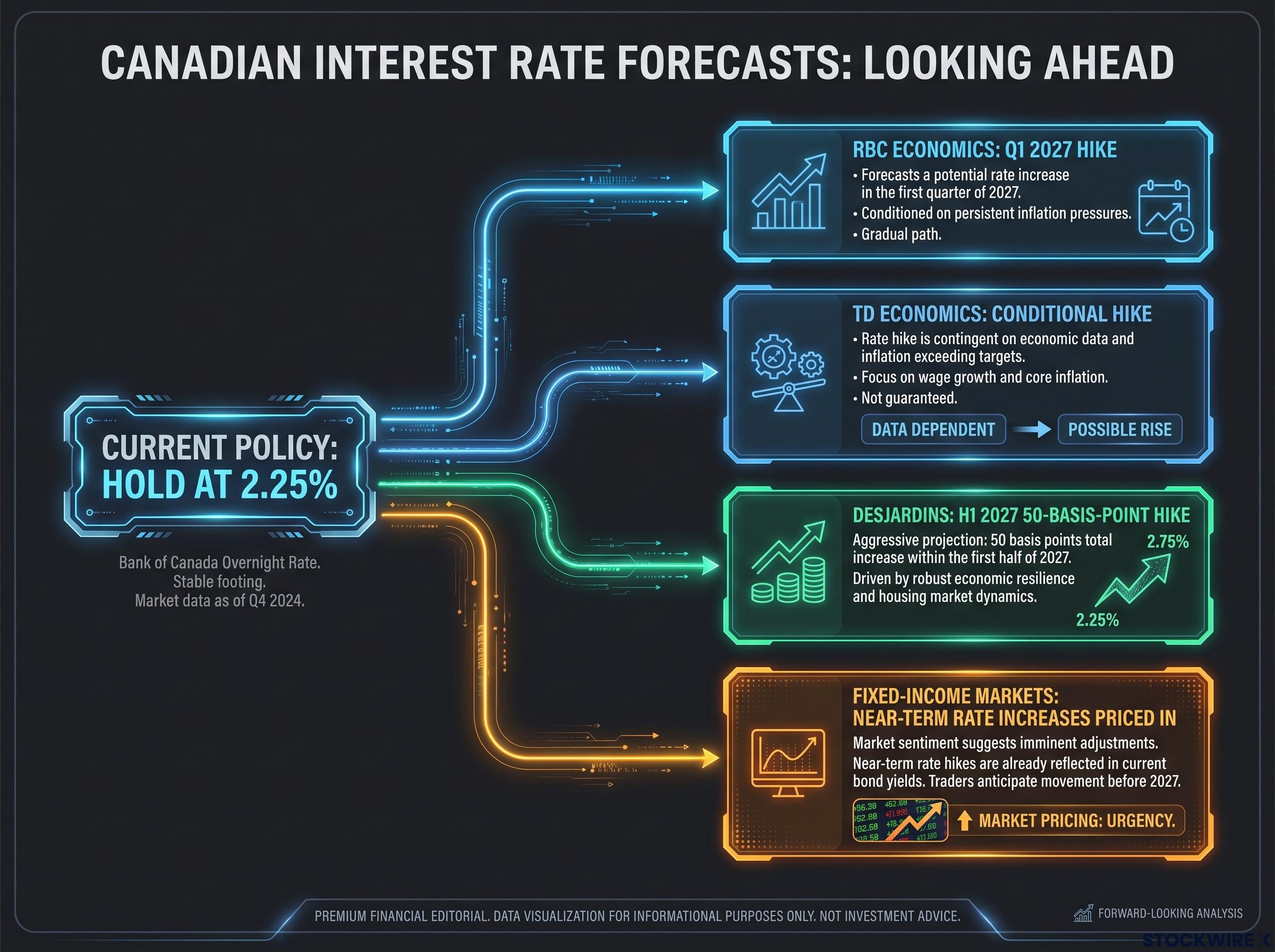
The institutional read is more patient. RBC, TD, and Desjardins all project a hold through 2026, with Desjardins forecasting a 50-basis-point increase in the first half of 2027. But the 2022 cycle is the benchmark that gives Macklem’s warning its force: the Bank moved fast because it moved late, and both the pace and the scale landed on borrowers.
What a rate hike means for Canadian mortgage holders right now
For more than a million Canadians, the Governor’s policy framing is not a macroeconomic abstraction. It is a direct statement about the size of a payment shock they may be facing within months.
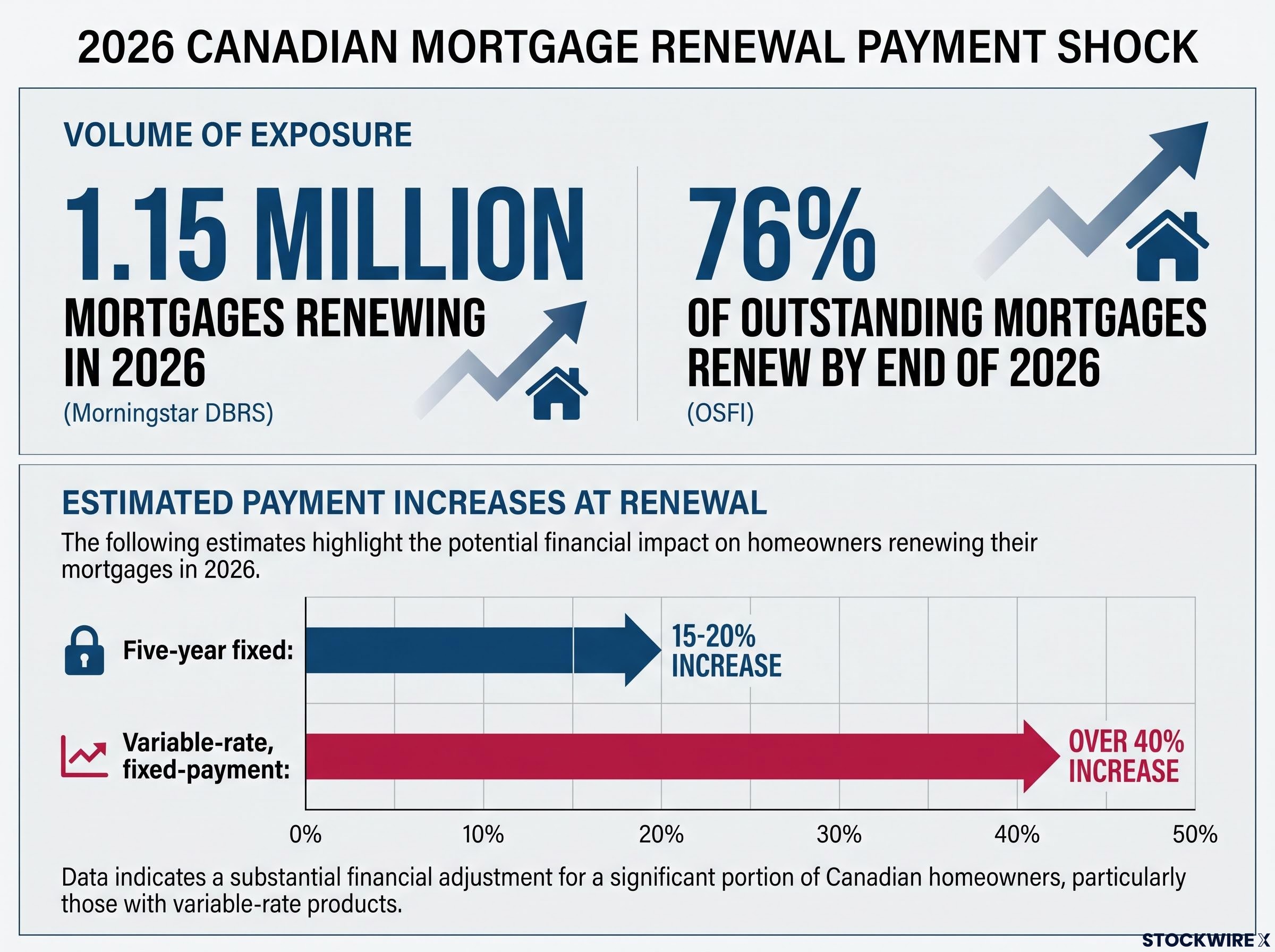
The scale of exposure is the starting point. OSFI’s Annual Risk Outlook 2024-25 found that 76% of outstanding Canadian mortgages are expected to come up for renewal by the end of 2026. Morningstar DBRS, via Canadian Mortgage Trends, estimates approximately 1.15 million mortgages will renew in 2026 alone.
That renewal wave is already forcing payments higher before any additional tightening. The Bank of Canada’s 2026 Financial Stability Report confirms that borrowers who locked in low pandemic-era rates are now renewing at significantly higher market rates, pushing up debt-service ratios. Morningstar DBRS quantifies the shock:
| Borrower type | Estimated payment change at renewal |
|---|---|
| Five-year fixed | 15-20% increase (Morningstar DBRS) |
| Variable-rate, fixed-payment high-exposure cohort | Over 40% increase (Morningstar DBRS) |
Those figures reflect current conditions. Any further BoC tightening would push them higher still. When Macklem warns that delayed action forces steeper hikes, he is describing, in practical terms, a larger number on the renewal notices arriving in Canadian mailboxes.
OSFI has flagged the borrowers most exposed:
- More heavily leveraged households carrying larger debt balances
- Variable-rate, fixed-payment borrowers whose amortisations were extended during the last tightening cycle
- Borrowers renewing into higher-rate fixed terms after pandemic-era lows
The regulator has warned that further rate increases could lead to a higher incidence of arrears or defaults among these groups. That is what makes this cycle structurally different from past tightening episodes. The Bank cannot raise rates without a near-immediate hit to household cash flow for well over a million borrowers, which is exactly why the hold-versus-hike tension Macklem described today has stakes that reach far beyond financial markets.
Timing is everything: what comes next for BoC policy
The base case among Canada’s major forecasters is stability. What Macklem did today was narrow the conditions under which that base case survives.
The institutional consensus points to a hold, with the earliest move well into next year:
| Institution | 2026 rate forecast | First hike projected |
|---|---|---|
| RBC Economics | Hold at 2.25% | Q1 2027 |
| TD Economics | Hold at 2.25% | Conditional |
| Desjardins | Hold at 2.25% | H1 2027 |
| Fixed-income markets | Rate increases priced in | Near-term |
RBC expects hikes to begin in Q1 2027, with earlier action possible if oil persists and the labour market keeps recovering. TD holds its baseline at 2.25% through both 2026 and 2027, conditional on no significant shift in inflation or growth. Desjardins projects a 50-basis-point rise in the first half of 2027. All three flag oil and trade as the variables that could pull the timeline forward.
For readers wanting to understand why the major banks reached their hold consensus in the first place, our full explainer on the BoC rate outlook through 2026 examines the GDP growth trajectory, inflation path, and output gap that placed the Bank in neutral territory before Macklem’s Halifax speech changed the tone.
Macklem named the specific indicators the Bank will watch:
- Whether oil prices stay near US$100 per barrel
- Whether trade uncertainty materially weighs on Q4 growth, already revised downward
- Whether inflation expectations show signs of becoming more firmly embedded in October and November
Reuters reported after the September decision that Macklem said policymakers were prepared to raise borrowing costs multiple times if inflation stayed too high. Read alongside today’s speech, the message is consistent: the pause is not a promise. If oil holds near US$100 and inflation edges up as he predicted, the Q1 2027 timeline moves from a forecast to a live risk.
For investors, mortgage holders, and businesses with Canadian borrowing exposure, the next two months of inflation data are now the decisive variable. Macklem has signalled the Bank’s patience has limits, and today in Halifax, he put those limits in writing.
This article is for informational purposes only and should not be considered financial advice. Investors should conduct their own research and consult with financial professionals before making investment decisions.
Past performance does not guarantee future results. Financial projections and forecasts referenced here are subject to market conditions and various risk factors, and these forward-looking statements are speculative and subject to change based on economic developments.