A platform that recorded just 30 transactions in its first month is now worth more than Wendy’s, Under Armour, Hertz, Harley-Davidson, and American Airlines combined. That is not a typo. That is the trajectory of Whatnot, a live commerce marketplace founded in late 2019 and valued at roughly $20 billion by August 2026.
The reason most marketplace businesses never come close to that number is the cold start problem: without buyers, sellers will not join, and without sellers, buyers have nothing to buy. Most platforms die inside that trap. Whatnot’s escape from it has become a case study in marketplace theory, and its August 2026 Series G round at $20 billion, led by ICONIQ, Lightspeed, and Avra, with Kleiner Perkins and Wellington Management joining, has made the question of what actually drove that growth newly urgent for anyone weighing live commerce as an investable category.
What follows here is a working framework for evaluating durable marketplace scale, with Whatnot as the live specimen. This breaks down the mechanics that made the growth real, and the structural questions that determine whether $20 billion holds.
How Whatnot escaped the chicken-and-egg trap that kills most marketplaces
The founders did not try to attract sellers and buyers at the same time. They removed one side of the equation entirely.
For the first stretch of the platform’s life, the founding team was the only seller. They sourced and authenticated inventory themselves, and critically, they only bought the item from an online retailer after a customer had already committed to the purchase. A remote team in Brazil helped hunt down specific Funko Pop stock across the internet. That single decision, absorbing the sourcing and fulfilment risk that would normally sit with a merchant, is what got the platform moving at all.
Then came the pricing problem. To set credible resale prices, the team built an algorithm that scraped multiple platforms for Funko Pop listings and factored in real sales liquidity, requiring a minimum threshold of roughly 10 units per 30-day period before it would trust a price. That threshold mattered: it meant prices reflected genuine demand rather than the wishful figures sellers tend to attach to their listings.
The four moves, in order, looked like this:
- Act as the sole seller and authenticate every item in-house
- Build algorithmic pricing anchored to real sales liquidity
- Seed demand through Funko Pop content creators from December 2019
- Trigger a viral giveaway loop to compound early awareness

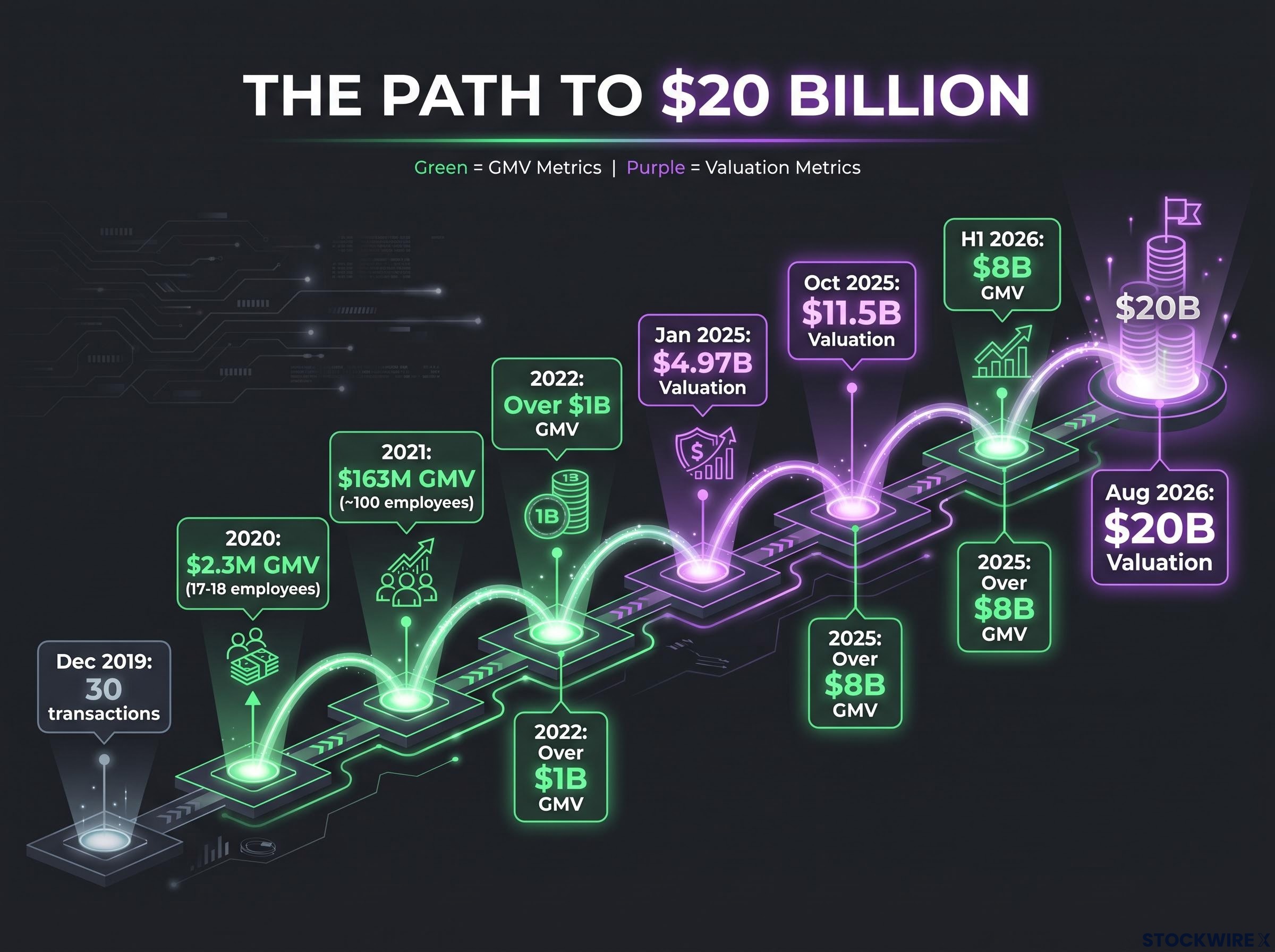
Launch month, December 2019: 30 total transactions. The first two weeks produced exactly one sale each.
By the third week, following the first influencer collaboration, sales jumped to around 30. When Whatnot exited Y Combinator in approximately March 2020, monthly GMV sat at an estimated $20,000 to $25,000. Third-party sellers were held back deliberately until buyer demand was proven, with the platform opening to outside sellers toward the end of February 2020.
The lesson for anyone assessing an early-stage marketplace is uncomfortable but useful: Whatnot did not solve the cold start with clever advertising. It solved it by having a founding team willing to shoulder operational risk that most founders push onto their users. When you evaluate a seed-stage marketplace, that willingness is the variable to interrogate first.
The giveaway loop as a demand-creation engine
The giveaway mechanic is where demand actually caught fire. Weekly prizes worth $500 to $1,000 were offered, and users could earn unlimited additional entries by sharing the promotion through referral links.
That turned every entrant into a distributor. Users pushed the giveaways across subreddits and Facebook groups, and the first raffle’s 104 entries grew roughly two-and-a-half times in the rounds that followed.
It worked because of where it was aimed. Collectibles communities already had dense digital gathering places and a high tolerance for community-driven promotions, so the loop landed in an audience primed to spread it rather than one that had to be built from scratch.
When big ASX news breaks, our subscribers know first
Why atomic networks explain the GMV explosion from $2.3 million to $8 billion
The numbers below look like a highlight reel until you understand the structural choice underneath them. Whatnot did not chase broad, horizontal user growth. It built atomic networks.
An atomic network is a small, self-sustaining, high-density community organised around a shared passion and, usually, a shared frustration with an incumbent. Whatnot targeted collectible niches, sports cards, sneakers, trading cards, that already had established Discord servers and Facebook groups, high existing spend, and visible friction with existing platforms over fees and counterfeit goods. Rather than manufacturing a transaction stream, the platform redirected one that already existed.
The broader e-commerce landscape is being reshaped by marketplace consolidation dynamics that mirror the same niche-community logic Whatnot exploited: eBay’s $1.2 billion acquisition of Depop reflects a direct bid for Gen Z resale communities that already had dense digital gathering places and established transaction habits.
The inflection came in July 2020, when Whatnot launched its live auction feature and month-over-month growth pushed past 100%. This was not video bolted onto a product catalogue. Whatnot rebuilt its entire navigation around live formats, drops, and auctions, an entertainment-first design that fed directly into the density of those atomic communities.
| Year | GMV | Context |
|---|---|---|
| 2020 | $2.3M | First full year; live auctions launched July |
| 2021 | $163M | Headcount grew to roughly 100 |
| 2022 | Over $1B | Pandemic accelerated online niche commerce |
| 2025 | Over $8B | More than double 2024 live volume |
| H1 2026 | $8B | Six months matched all of 2025 |
At the post-seed stage in September 2020, monthly GMV had reached $250,000 to $300,000 at a take rate of roughly 10%, and the company hit a $1 billion valuation within about 20 months of founding. Headcount ran from 17-18 employees at the end of 2020 to roughly 100 by the close of 2021.
In the first six months of 2026 alone, Whatnot crossed $8 billion in GMV, matching its entire 2025 volume.
That single fact is the one investors should sit with. When a marketplace matches a full year’s transaction volume in six months, it has moved out of linear growth and into a compounding network phase. For anyone pricing a comparable business, that distinction is not a footnote; it is the difference between adding users and deepening density, and it shows up in engagement ratios long before it shows up in revenue.
What makes a live commerce moat, and where Whatnot’s is genuinely fragile
Here is where the analysis has to hold two arguments at once, because the moat question does not resolve cleanly.
The defensible case is real. Whatnot’s advantage sits in community density, liquid enthusiast subcultures, and a creator flywheel that compounds: hosts bring their audiences, engaged audiences pull in more sellers, and a high density of shows attracts more hosts. Replicating tuned live mechanics at scale, across thousands of niche communities, carries an operational cost that a new entrant cannot simply code around.
Set that against the skeptical case, which is equally credible.
- Defensible: deep community density, liquid subcultures, a self-reinforcing creator flywheel, and the operational difficulty of tuning live mechanics at scale
- Skeptical: software features are copyable, hosts can multi-home across platforms, and a well-resourced competitor with a distribution advantage can move fast
TikTok Shop makes the second point concrete. Its GMV in Southeast Asia alone jumped from $4.4 billion in 2022 to $16.3 billion in 2023, and broader global estimates place it at $33.2 billion in 2024 and $64.3 billion in 2025. That is what a platform with built-in distribution can do to a category, and it raises the genuine risk that live commerce becomes an absorbed feature rather than a standalone business.
The seller economics add another pressure point. Whatnot charges an 8% seller commission plus a 2.9% and $0.30 payment processing fee per transaction. The Whatnot Seller Alliance has raised concerns about arbitrary suspensions, withheld bonuses, and money transmitter law compliance, and if hosts feel squeezed, multi-homing to a platform with better economics becomes a live threat rather than a theoretical one.
The regulatory and legal vectors investors should track
The legal exposure is a separate category of fragility, and it targets the mechanics that make Whatnot work.
Regulatory exposure in e-commerce platforms is not unique to live commerce formats; Coupang’s experience in South Korea, where the founder faced personal liability under antitrust frameworks targeting undisclosed operational influence, illustrates how governance and compliance risks can escalate independently of a platform’s commercial trajectory.
A December 2025 investigation by The Guardian highlighted the app’s gambling-style features, reporting that users felt hooked on impulsive buying.
Attorney Paul Lesko has filed arbitration claims alleging that Whatnot’s randomised box breaks and repack products violate the RICO Act and function as an unlicensed lottery. If those claims gain traction, they strike at the randomised formats the platform relies on for engagement.
The company’s 2025 Digital Services Act transparency report documented high volumes of proactive account bans and content reports, an operational signal worth watching. And as Whatnot pushes into luxury goods and electronics, the burden of verifying authenticity and controlling return fraud grows, with direct margin implications for a $20 billion valuation.
The valuation itself tripled from $4.97 billion in January 2025 to $11.5 billion in October 2025 to $20 billion in August 2026, even as these risks grew rather than shrank. That tells you the discount rate applied to Whatnot’s growth has to price in a genuine probability of disruption, both regulatory and competitive. Treating the moat as simply defensible or not defensible will mislead you. The sharper question is whether it survives the specific vectors most likely to materialise in the next 24 months.
These statements are speculative and subject to change based on market developments and company performance.
The investor’s framework for evaluating early-stage marketplace businesses
Strip away the Whatnot specifics and you are left with a portable set of diagnostics you can point at any marketplace pitch.
Liquidity is the foundation. The liquidity ratio, transactions divided by active listings, tells you whether the market actually clears, and in a healthy focused early market you want to see 50% or more of listings transacting. Alongside it, Time to First Transaction under 14 days is the signal that sellers will stick around rather than churn out after a dead week.
Engagement density is the second layer. The DAU/MAU ratio, daily active users divided by monthly active users, measures how habitual usage is, with 30% a healthy baseline and 50% or above excellent. The zero metric, the share of user actions that produce no result, should fall steadily as a network gets denser.
| Metric | What to measure | Benchmark |
|---|---|---|
| Liquidity ratio | Transactions divided by active listings | 50%+ in focused early markets |
| Time to First Transaction | Days from seller signup to first sale | Under 14 days |
| DAU/MAU | Daily actives over monthly actives | 30% healthy, 50%+ excellent |
| Take rate | Platform revenue as share of GMV | ~10% at Whatnot’s post-seed stage |
| Zero metric | Share of actions yielding no result | Should decline over time |
The four questions that framework generates:
- Did the founding team bootstrap liquidity by absorbing operational risk, or manufacture it through paid acquisition? The answer shapes unit economics at scale.
- Is the liquidity ratio improving over the first 12-18 months, or stuck?
- Is the zero metric falling as the network grows?
- How concentrated is GMV across a few niches or top hosts, a risk that GMV and take rate figures alone will hide?
Whatnot raised roughly $1.5 billion across its history, with the Series G alone at $545 million, so it has never wanted for capital. But the diagnostic that matters is not the raise. If a platform cannot show improving liquidity ratios and a declining zero metric inside its first 12-18 months, the GMV figure in the pitch deck almost certainly overstates durable demand, and no amount of funding fixes that.
For investors wanting to apply the liquidity and engagement diagnostics described here to other marketplace businesses, our dedicated guide to fundamental analysis metrics covers the five core ratios, including how to read revenue growth and return on equity alongside sector peers, providing a starting framework for any comparable analysis.
What the $20 billion number actually tells you about live commerce’s direction
The arc from 30 transactions to $20 billion proves one thing cleanly: the cold start problem is solvable. It takes a founding team with the right combination of operational willingness, category specificity, and community insight, all of which Whatnot had, starting from an estimated $100,000 to $200,000 in personal savings.
What it does not prove is that solving the cold start guarantees a durable moat. Those are two separate problems, and Whatnot has demonstrably cracked the first while the second remains genuinely open.
The $20 billion valuation is best read as a signal about conviction in live commerce as a structurally distinct channel, not as a settled verdict on Whatnot itself. Whether that number ultimately holds depends on three forward variables: how regulators treat gambling-style mechanics, whether TikTok Shop pushes hard into Western collectibles markets, and whether the creator flywheel survives hosts multi-homing at scale.
Regulatory fragmentation across jurisdictions is creating a structurally similar risk profile for live commerce to the one already repricing semiconductor equities: enforcement timing is uncertain, national frameworks diverge sharply, and a single regulatory signal can compress multiples well before any earnings deterioration appears in results.
Kleiner Perkins and Wellington Management joined the $545 million Series G at a $20 billion valuation, alongside lead investors ICONIQ, Lightspeed, and Avra.
That participation is itself information. It signals that institutional capital has shifted from observing live commerce to pricing it as a structural outcome, with the first half of 2026 already running at $8 billion in GMV. Factor that conviction into your own view, but hold it against the risks that remain unresolved, and let the liquidity and engagement diagnostics, not the headline valuation, tell you when the story is genuinely working.
This article is for informational purposes only and should not be considered financial advice. Investors should conduct their own research and consult with financial professionals before making investment decisions. Past performance does not guarantee future results, and financial projections are subject to market conditions and various risk factors.