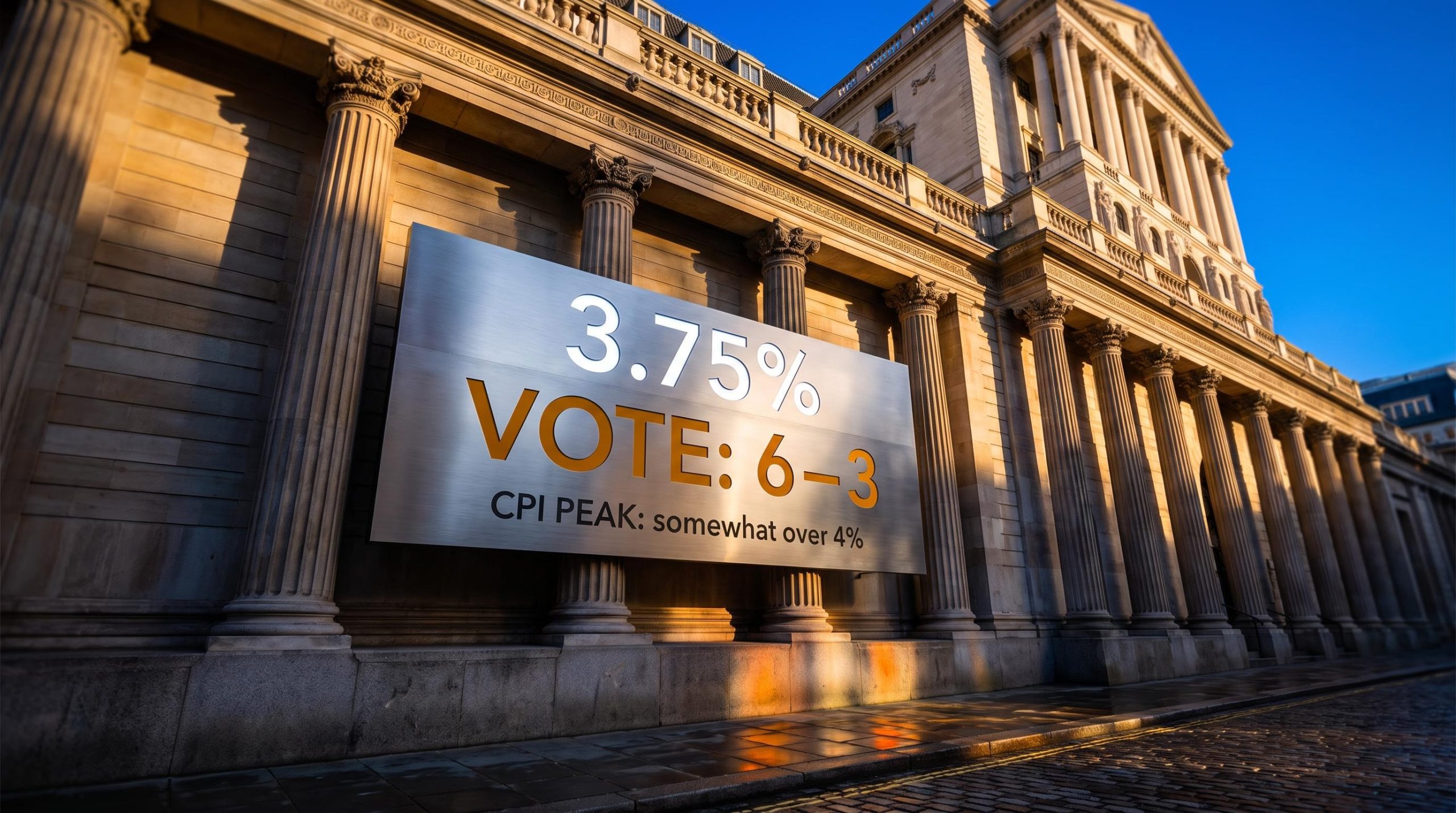
The Bank of England held interest rates steady at 3.75% yesterday, and in the same set of minutes it revised its own inflation forecast to a peak of “somewhat over 4%.” Those two facts do not obviously belong together, which is exactly why this decision demands a closer read.
A rate hold while your own models point to inflation climbing further above target is not a comfortable equilibrium. It is a judgement call, and the 6-3 vote makes clear that not everyone on the Monetary Policy Committee (MPC) agreed with it. Three members wanted to raise rates immediately, and they named the specific conditions that would justify action, conditions that are now drifting in the direction they warned about.
This piece separates what the Bank actually signalled from what it formally decided, tracing the consequences across gilt markets, sterling, and the forward rate path, so you can form a clear view of where UK monetary conditions are heading and what would change that view.
A committee divided, and what the dissenting three are really telling you
The headline is straightforward: six members of the MPC voted to hold the Bank Rate at 3.75%, and three voted to raise it by 25 basis points to 4.0% at the meeting ending 16 September 2026.
The three dissenters were Megan Greene, Catherine L. Mann, and Huw Pill. What makes their vote worth more than a footnote is that this is the same hawkish bloc that pushed for a hike at the July 2026 meeting. That consistency turns a single dissent into a sustained analytical position rather than a one-off protest.
The hawkish dissent at this meeting did not emerge from nowhere: the bloc of Pill, Greene, and Mann has been consolidating since April 2026, growing from a single outlier vote to a sustained three-member position that now sits just one defection from a majority.
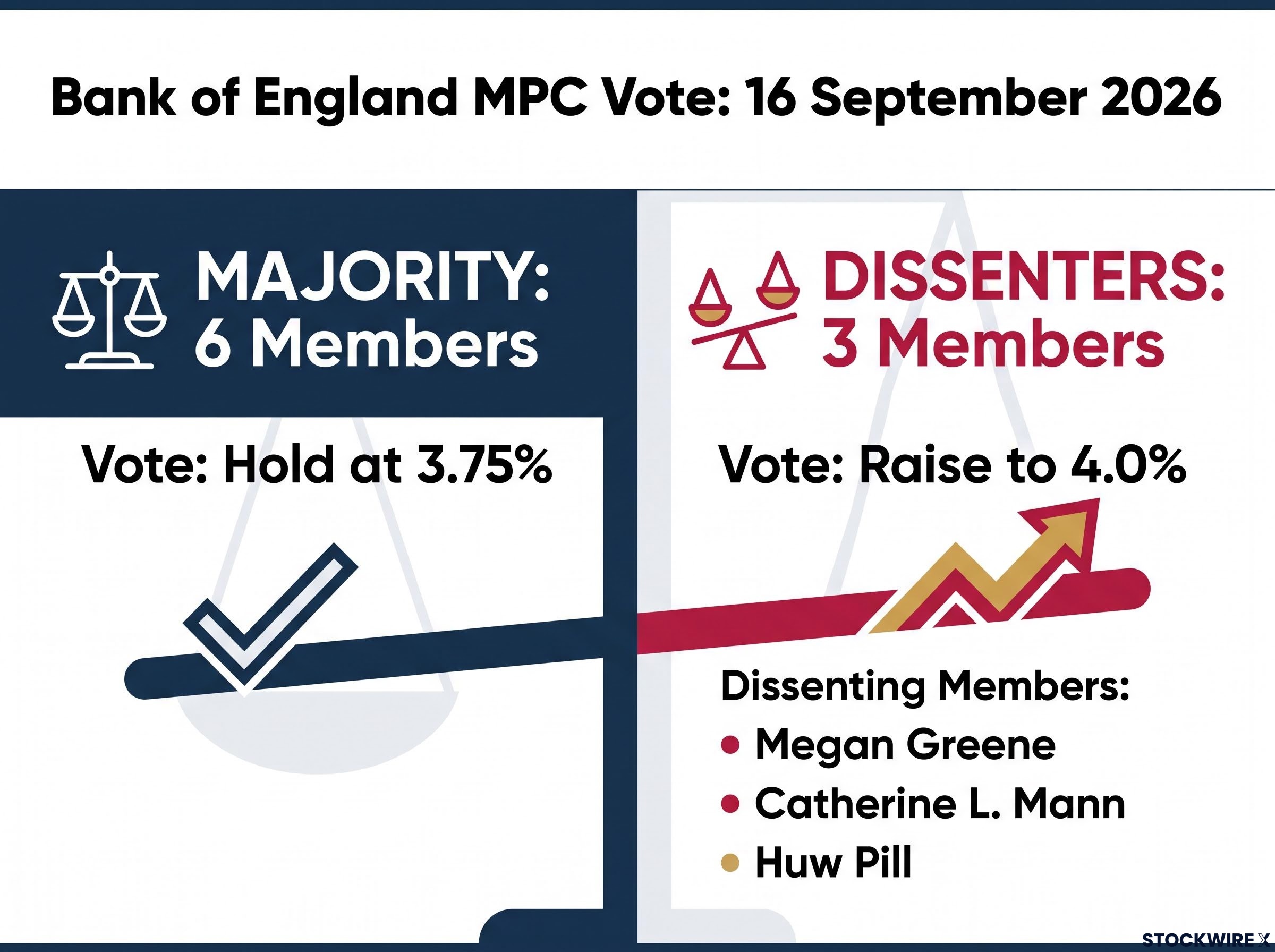
Their case for moving to 4.0% rested on a specific concern:
- Rising CPI projections that the committee itself has been forced to revise upward
- The growing risk of second-round effects, where higher energy and input costs feed into wages and broader prices rather than fading out
The majority saw it differently. Their argument was that the existing rate, working alongside tighter financial conditions and softening domestic demand, is already doing the job of pulling inflation back toward target without the need for another hike.
The MPC majority judged that the current 3.75% Bank Rate, combined with tighter financial conditions and weakening domestic demand, is already restraining inflation, with minimal evidence of second-round effects flowing through to wages and prices.
Here is why the structure of the vote matters more than its result. A persistent three-member dissent is not background noise. It tells you the majority’s consensus is arithmetically thin.
If any single variable moves materially, whether that is wage growth, energy pass-through, or public inflation expectations, the majority only needs to lose a couple of votes for the balance to tip. For anyone with UK rate exposure, this is where the tripwires sit. The next move becomes a hike, not a hold, faster than the headline decision suggests.
When big ASX news breaks, our subscribers know first
What the inflation numbers actually show, and why the BoE’s own forecast is the bigger story
The hold decision has to be weighed against a set of numbers that are still climbing. To understand the pressure the committee is under, start with what is already confirmed, then look at where the Bank now expects things to go.
The August data: what has already happened
According to the Office for National Statistics, UK CPI rose to 3.1% year-on-year in August 2026, up from 2.9% in July, with a monthly increase of 0.5%.
The underlying picture was steadier. Core CPI, which strips out food and energy, held at 2.6%, and services inflation sat at 3.4%. But the pipeline is where the pressure is building: producer input prices rose 6.1% year-on-year, and factory-gate output prices climbed 3.7%.
Energy is the main culprit. The Bank attributes roughly 0.7 percentage points of the current 1.1 percentage point overshoot above its 2% target to direct energy effects, motor fuels in particular. Its own scenario work has energy adding around 0.4 percentage points to CPI in the second half of 2026 and over 1 percentage point in the fourth quarter, measured against a counterfactual without the Middle East conflict.
These pipeline pressures are live, not fading. That distinction matters because it shapes how quickly the current overshoot could deepen.
The projection revision: what is coming and how fast the BoE’s view has shifted
The more revealing part of this meeting is not the August print. It is how much the Bank’s own forecast has moved.
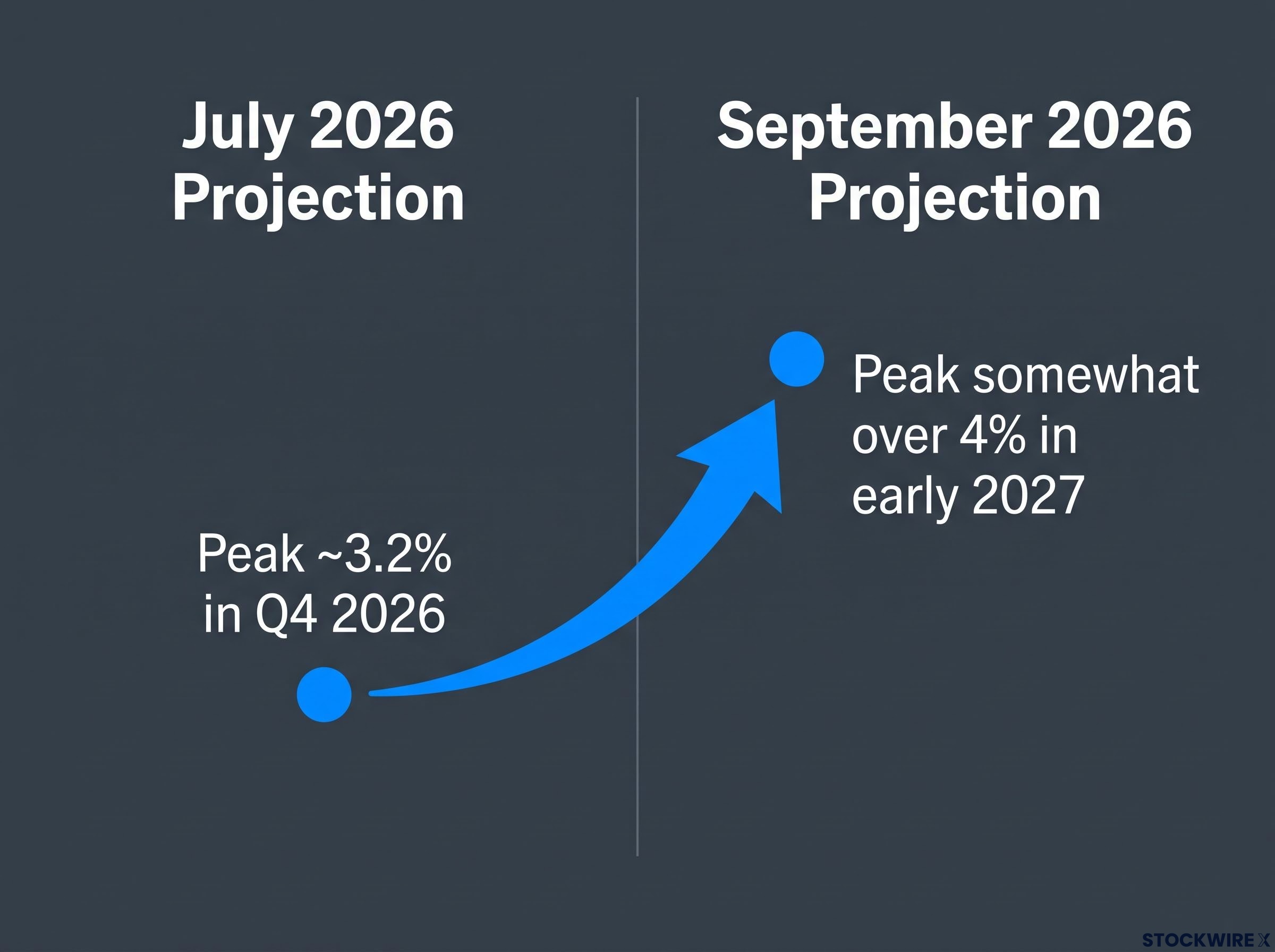
The BoE’s September 2026 minutes project CPI reaching “somewhat over 4%” early next year, a marked step up from the peak of around 3.2% it projected for Q4 2026 in its July report.
That is roughly a full percentage point of upward revision in two months. When a central bank revises its own near-term peak that sharply and that fast, it is telling you its models are being overtaken by events. The practical read for you is to treat further upside surprises as the base case, not the tail risk.
External forecasters land in similar territory. The National Institute of Economic and Social Research (NIESR) projects inflation peaking between 3.8% and 4.1% in early 2027 before returning to target in 2028, while Goldman Sachs sees a peak near 3.9% in Q1 2027.
| Metric | August 2026 actual | BoE July 2026 projection | BoE September 2026 projection | External forecast |
|---|---|---|---|---|
| Headline CPI | 3.1% y/y | Rising toward peak | Rising toward peak | NIESR: ~3.1% avg 2026 |
| CPI peak | Not yet reached | ~3.2% in Q4 2026 | Somewhat over 4% early 2027 | NIESR: 3.8-4.1%; Goldman: ~3.9% Q1 2027 |
| Return to 2% target | Not applicable | Not specified | Not specified | NIESR: 2028 |
For anyone calibrating UK inflation exposure or real return expectations, that July-to-September gap is the clearest quantitative signal on offer. The Bank’s forward guidance window is compressing, and that revision tells you more than the hold decision ever could.
Gilts told a different story from sterling, and the QT suspension explains why
If you looked only at the rate decision, the gilt market’s reaction would make no sense. The MPC held, and yet long-dated yields moved sharply. The resolution lies in the fact that the Bank pulled two levers at this meeting, not one.
UK 30-year gilt yields fell roughly 12 basis points immediately after the announcement. The driver was not the rate call. It was the Bank’s decision to restructure its quantitative tightening (QT) programme, which is the process of unwinding the bond holdings it built up during earlier stimulus rounds.
Specifically, the Bank announced a six-month suspension of active gilt sales. Removing a large, forced seller from the market eases supply pressure, and that is what the yield move priced in.
The relief was real but partial. Here are the numbers that frame it:
Long-dated gilt yields were already under structural pressure before this meeting: the 30-year yield had touched 5.948% on 10 September 2026, its highest since 1998, as thin pension fund demand and the Bank’s own active selling combined to stress the long end of the curve.
- A decline of roughly 12 basis points in the 30-year yield after the announcement
- A 30-year yield range of 5.763% to 5.924% around the decision
- A 2056 gilt syndication in early September that cleared at 5.8168%
Even after the intraday move, long-dated UK gilt yields remain elevated near multi-decade highs not seen since 1998.
That context is the whole point. A 12bp fall does not undo yields sitting at their highest in more than two decades, and the syndication level confirms that underlying demand for long UK debt is still stressed.
For you, the lesson is one of mechanics. The gilt move was not a verdict on rate policy. It was the market pricing relief from the removal of a forced seller. If QT resumes after the six months, or if the supply picture worsens, that relief reverses independently of anything the MPC does with the Bank Rate. Reading the yield drop as a dovish policy signal would be a mistake, and for anyone tracking gilt exposure or UK fiscal risk, the QT suspension is arguably the more consequential action from this meeting.
Sterling’s dilemma: already-priced tightening and a Fed that just reclaimed the yield edge
Sterling’s reaction was more predictable once you follow the rate differential logic. GBP/USD softened into the 1.3355-1.3390 range after the decision, and the reason was not just the BoE.
The US Federal Reserve raised its target range to 3.75-4.0% at the same time. That put the dollar back in front on yield at the precise moment the Bank chose to stand still, and capital tends to follow the higher return.
The bigger constraint on sterling is what markets have already built into the price. Investors are pricing roughly 40-50 basis points of further BoE tightening, with rates peaking near 4.2% in early 2027 before easing back toward 4.0% by early 2028. When that much hawkishness is already embedded, additional hike expectations offer limited fresh support for the pound.
Already-priced tightening is the central constraint on sterling’s upside: with the swaps curve embedding 50-75 basis points of further hikes, the pound requires the Bank to deliver every increment currently priced to hold its current level, leaving the asymmetry firmly on the downside if the majority’s hold stance persists.
Analysts are split on whether that pricing is even justified:
- ING and Oxford Economics view current market pricing as overdone, pointing to sluggish growth and the absence of a wage-price spiral
- Goldman Sachs sees a hike to 4.0% in November 2026 as justified, based on its raised inflation forecasts
A Reuters poll of economists sits closer to the cautious camp, expecting the Bank to hold at 3.75% through at least mid-2027, with a 25bp cut pencilled in for Q3 2027.
The technical picture does not predict a price so much as map where the next decisions get made.
| Level | Price | Significance |
|---|---|---|
| Resistance 1 | 1.3420 | 38.2% Fibonacci retracement of 2026 high-to-low |
| Resistance 2 | 1.3480 | 50-day moving average |
| Current range | 1.3355-1.3390 | Post-decision trading band |
| Support 1 | 1.3310 | 23.6% Fibonacci level |
| Support 2 | 1.3270 | Key floor |
Daily momentum reads as bearish, but the Relative Strength Index (RSI), a gauge of whether an asset has moved too far too fast, has slipped into oversold territory. That leaves room for a short-term bounce, though analysts expect any such move to be faded rather than sustained.
What that tells you is where the real drivers sit. Sterling’s near-term path is defined less by anything the Bank said yesterday and more by what the Fed does next and whether UK wage data surprises. The pound is caught between two limits: already-priced rate support capping the upside, and a dollar that just reclaimed its yield edge pressing on the downside.
What would actually change this picture, and when to watch for it
Enough about what happened. The more useful question is what would move the balance, and when to look for it. The good news is that the list is short and specific.
The variables that matter most before November
Three data streams sit at the centre of the majority-versus-dissenters debate:
- Wage growth. Private-sector wage growth is currently described as broadly consistent with the 2% target, and it is the single biggest reason the majority felt able to hold. Any clear deterioration here shifts the arithmetic toward the three dissenters.
- Energy price persistence. The Bank’s own scenario work already has the Middle East conflict adding over 1 percentage point to Q4 2026 CPI. A further leg up in energy benchmarks is the external factor most likely to force the majority’s hand.
- Producer price pass-through. Producer input prices ran at 6.1% year-on-year in August. That is a leading indicator: if those costs feed through to consumer prices faster than expected, the second-round risk the dissenters flagged becomes real.
What November looks like under each scenario
The November 2026 meeting is the next genuine decision point. Goldman Sachs has explicitly called a hike to 4.0% there, tied to its higher inflation forecasts.
For that call to land, the data between now and then would need to show wage growth firming, energy costs staying elevated, and pipeline pressures pushing through to consumers. For the hold to continue, wage growth would need to stay anchored near target and energy pressures would need to stabilise, validating the ING and Oxford Economics view that current pricing is overdone.
The practical takeaway is that the October UK wage data and any material move in energy benchmarks are the two releases that will decide whether Goldman or ING is right. Watching those numbers is more useful than parsing MPC rhetoric.
Rate holds do not always mean policy is on pause
The Bank formally held rates, but almost nothing else about this meeting looks settled. It revised its inflation peak sharply higher, suspended QT gilt sales, and watched a consistent three-member bloc keep pressing for a hike.
Read together, this is better understood as a conditional pause than a stable resting point. The majority’s position holds only as long as wages stay anchored and energy pressure does not intensify, and its own forecast revision suggests it is less confident on that front than it was two months ago.
That leaves you with a manageable framework rather than open-ended uncertainty. Watch the October wage data, watch energy benchmarks, and hold the November meeting as the moment those signals get tested. The competing camps, Goldman on one side and ING and Oxford Economics on the other, give you a clear scorecard for judging which way UK rate exposure is likely to move next.
For readers wanting to build a repeatable framework for the November meeting and beyond, our full explainer on reading MPC decisions walks through how to interpret vote splits, forward guidance language, and conditioning variables before markets price them in.
This article is for informational purposes only and should not be considered financial advice. Investors should conduct their own research and consult with financial professionals before making investment decisions. Past performance does not guarantee future results. Financial projections are subject to market conditions and various risk factors, and forward-looking statements are speculative and subject to change based on economic developments.