The Bank of Japan just raised its policy rate to 1.25% on a 7-2 vote, the highest borrowing cost Japan has seen since 1995. The hiking cycle looks intact, and Governor Kazuo Ueda has reframed the mission from supporting inflation to guarding against an overshoot.
But the vote itself carries a warning. Two of the Board’s most hawkish voices are scheduled to leave by mid-2027, and who replaces them may matter as much to the rate path as any inflation print between now and then.
Institutional forecasters have pushed their terminal-rate assumptions higher, with Goldman Sachs now at 1.75% by July 2027 and TD Securities holding a 2.25% baseline. Yet those forecasts assume the Board executing the hikes will resemble the one that started them. That assumption deserves scrutiny. What follows below maps a specific structural risk building inside the BoJ: who is leaving, who controls the replacement process, and what a more dovish Board would mean for the rate forecasts global investors are currently pricing.
What a 7-2 vote at 1.25% actually tells us about where the hiking cycle stands
Start with the arithmetic. On 18 September 2026, the BoJ lifted its policy rate from 1.0% to 1.25% by a 7-2 margin, with Ueda noting that underlying inflation now sits close to the 2% target and that the Board’s focus has moved toward preventing an overshoot rather than nurturing price growth.
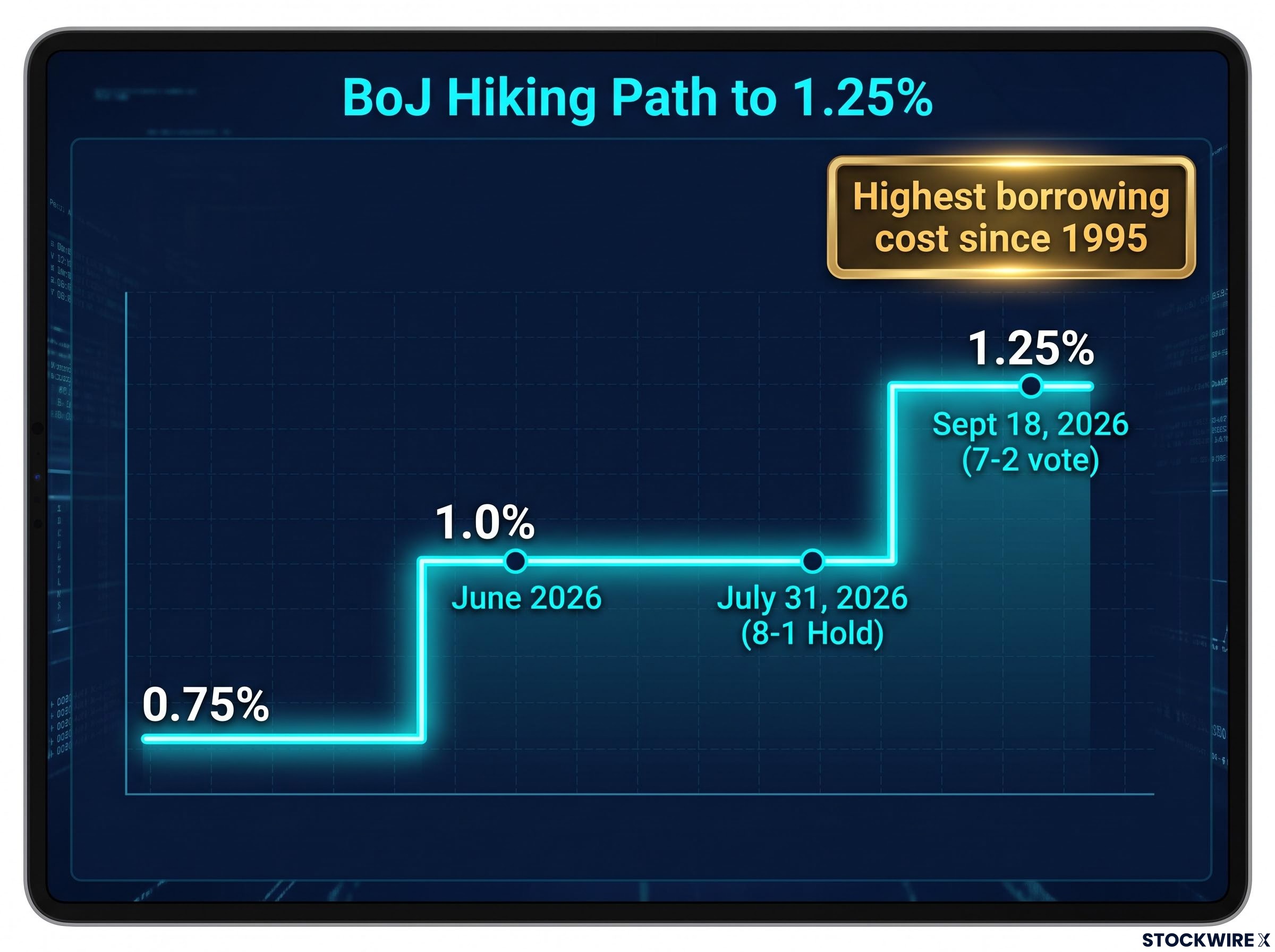
The current rate is the endpoint of a steady climb. The Board set 1.0% in June 2026, up from 0.75% before that, taking borrowing costs to their highest since 1995.
The June 2026 hike to 1.0% was itself delivered on a 7-1 vote, with Board Member Toichiro Asada the sole dissenter, establishing a pattern of near-but-not-unanimous decisions that has continued through each subsequent move.
Look one meeting back and the picture sharpens. At the 31 July 2026 meeting, the Board voted 8-1 to hold, with Hajime Takata dissenting in favour of an immediate hike to 1.25%. The direction has been consistently hawkish-leaning, but never unanimous.
That non-unanimity is the point. A hawkish tilt carried by a working majority is not the same as a hawkish consensus that survives a change in personnel.
The institutional forecasters read the destination differently, and the spread is wide.
| Forecast house | Terminal rate | Timeline | Key assumption |
|---|---|---|---|
| Goldman Sachs | 1.75% | By July 2027 | Inflation expectations converging toward 2% |
| Nomura (base) | 1.5% | Mid-2027 | Wage growth and output gap primary drivers |
| Nomura (risk) | 1.75% | End-2027 | Firmer inflation path |
| TD Securities | 2.25% | Late 2027 to early 2028 | Sustained hawkish path, downside risks flagged |
| Market-implied | ~2.25% | Late 2027 to early 2028 | Hawkish-continuation scenario |
The nominal neutral-rate range cited across these houses runs from 1.1% to 2.5%, which tells you how much room there is for genuine disagreement about where normalisation ends.
TD Securities’ read Prashant Newnaha describes Japan as firmly on a “hawkish path” with further hikes expected, while explicitly flagging downside risks to the firm’s 2.25% baseline.
The gap between Goldman’s 1.75% and TD’s 2.25% is not merely a forecasting quarrel. It reflects genuine uncertainty about whether the Board that executes the final hikes will be the same Board that initiated them. If you are pricing Japanese rates off any single terminal-rate number, you are ignoring the governance variable buried inside that divergence.
When big ASX news breaks, our subscribers know first
How Japan’s Cabinet controls who sits on the BoJ’s most powerful committee
The forecasters disagree about the destination. To understand why, you have to look at who gets to vote, and how they get there.
Under the Bank of Japan Act, the Cabinet nominates the Governor, two Deputy Governors, and six Board members, all requiring the consent of both the House of Representatives and the House of Councillors. Each of the nine members serves a five-year term, with reappointment possible.
The Bank of Japan Act establishes the legal architecture governing nominations, term lengths, and voting rights on the Policy Board, making the Cabinet’s appointment power a constitutionally embedded mechanism rather than an informal influence channel.
Articles 15 and 16 of the Act hand the Board explicit authority over discount rates, lending rates, and money-market control guidelines, decided by majority vote. Every member holds one vote. Members cannot be dismissed against their will during their term except under narrow legal conditions.
The Diet’s consent power gives the legislature an explicit veto over nominees. In practice, though, the Cabinet drives the ideological selection. Academic analyses stress that appointment and reappointment is the only routine channel through which electoral politics reaches monetary policy in Japan.
Here is why that matters more at the BoJ than at larger central banks. On a nine-member Board, five votes carry any decision, and there is no regional or non-political representation to dilute government-nominated members.
A two-seat swing on a nine-member Board is not marginal. It is the difference between a majority that can carry a hike and one that cannot. Global investors often file central bank policy under “macro variable” and appointment dynamics under “political noise.” At the BoJ, the legal architecture collapses that distinction: the appointment mechanism is the policy mechanism.
Who currently holds the hawkish majority, and when their terms expire
The current Board splits along a recognisable hawk-dove line, drawing on Reuters profiling from March 2024 and subsequent voting behaviour.
- Hawkish: Hajime Takata, whose 31 July dissent in favour of an earlier hike is the clearest recent signal of his position, and Naoki Tamura, identified among the most hawkish members.
- Dovish: Toyoaki Nakamura, Asahi Noguchi, and Seiji Adachi, all identified as proponents of caution about tightening.
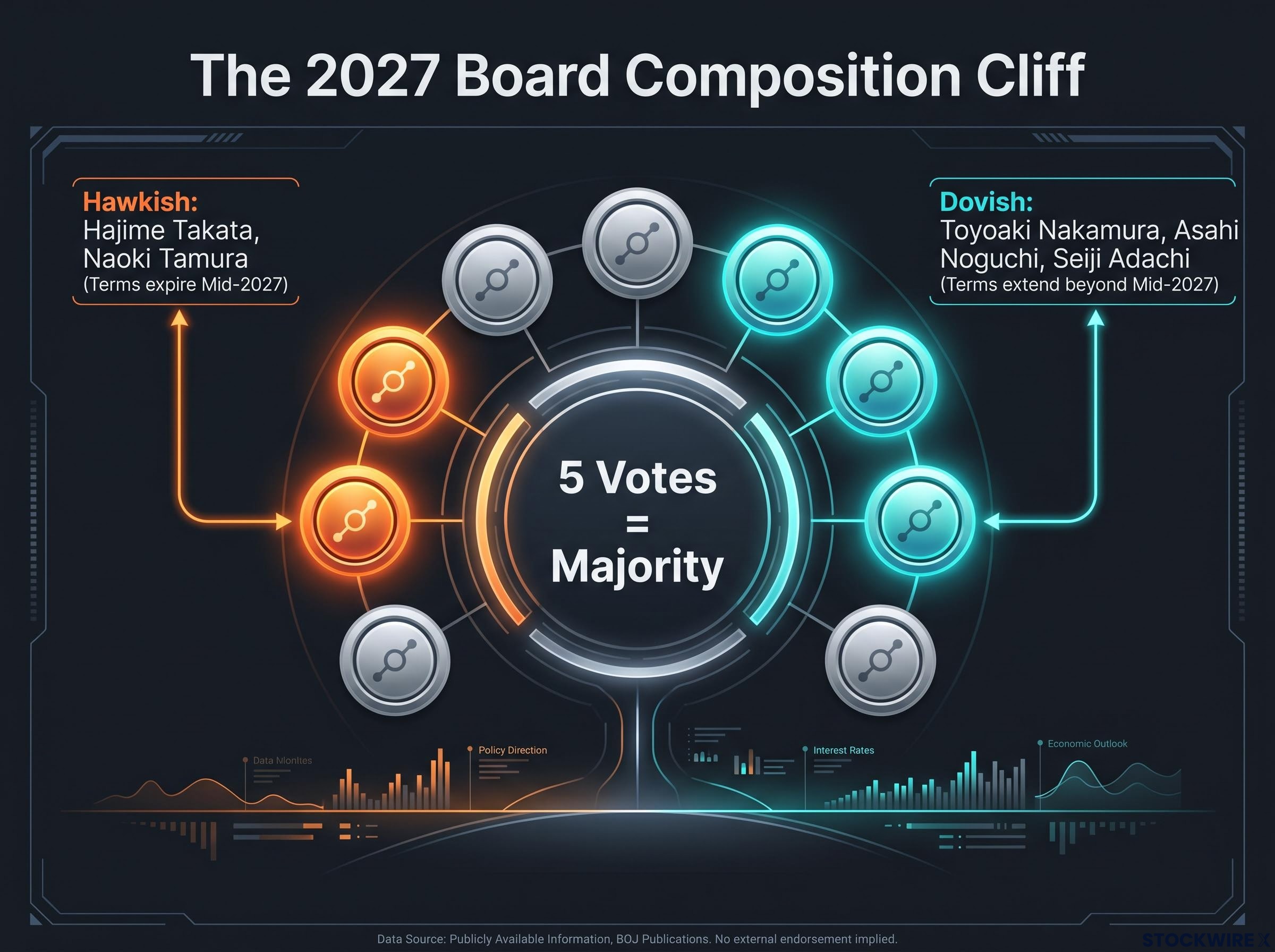
The critical detail is timing. Both Takata and Tamura are scheduled to conclude their terms in mid-2027. The dovish cohort’s terms extend beyond that window. That asymmetry is what turns 2027 into a discrete policy inflection point rather than background noise.
Why Takaichi’s appointment preferences are the variable TD Securities is actually pricing
If the Cabinet controls the nominations, the Cabinet’s preferences become the story. And Japan’s Prime Minister, Sanae Takaichi, has left a clear record.
Reuters reported on 24 September 2025 that Takaichi, then a leadership contender, stated the government sets the direction of monetary policy while the BoJ chooses the specific means. That framing was itself a moderation of her earlier stance.
Takaichi on the government-BoJ boundary The government is responsible for the direction of fiscal and monetary policy; the Bank of Japan is responsible for the specific means of achieving it.
The moderation is real, but so is the history behind it. An October 2025 policy commentary noted she had previously called raising rates at the time “stupid” and anticipated her administration would press for an accommodative environment while formally acknowledging the BoJ’s control over instrument choice.
Domestic research fills in when that pressure is expected to intensify. DLRI analysis from July 2025 describes Takaichi as viewing underlying inflation as still below target and likely to become especially cautious once the rate enters neutral territory around 1.0%. Rates have now moved above that threshold, which heightens the relevance rather than diminishing it.
Japan’s neutral rate range, which the BoJ’s own research places between 1.1% and 2.5%, is the conceptual battleground where Board composition matters most: a dovish majority can declare the lower bound sufficient while a hawkish one pushes through the upper range, and the legal and institutional framework gives either majority broad discretion to frame the same data as a justification for their preferred destination.
Aberdeen’s global-macro research connects her caution to Japan’s high public-debt ratio and the fiscal cost of aggressive tightening. The conditions under which her pushback is expected to sharpen are specific:
- Once the policy rate crosses into neutral or restrictive territory above 1.0%.
- When rate increases are judged to strain fiscal sustainability given Japan’s debt load.
- Where tightening runs ahead of what the government regards as consistent with its economic policy.
Domestic analysts have gone further, raising the possibility of policy paralysis heading into 2027 under a more dovish Board.
The mechanism here is quiet, and that is what makes it easy to underprice. Takaichi does not need to call the BoJ and ask for a pause. She needs only to nominate two members in mid-2027 whose priors about neutral and restrictive rates sit closer to 1.25% than to 1.75%, and the majority arithmetic does the rest. This is not a tail risk requiring a specific political trigger. It is a scheduled, constitutionally embedded reset, and the government’s preferences are already on record.
Three channels through which a more dovish Board would reach global markets
The governance argument only matters if it shows up on a trading screen. It does, through three concrete channels.
- Rate-path signalling and extended pauses. Goldman and Nomura both structure their forecasts around discrete hikes with pauses built in. A dovish Board could lengthen those pauses, delay hikes, or communicate a lower terminal range, immediately reducing expected future short rates and compressing the yield curve. All of it travels through Monetary Policy Meeting statements and minutes, which the Board controls.
- Redefining where neutral ends and restrictive begins. DLRI and Nomura draw a sharp line between moving to neutral (around 1.0%) and crossing into restrictive territory above it. A dovish Board influenced by Takaichi’s instincts might declare neutral to be lower or stress the dangers of going restrictive, anchoring market expectations at 1.25% to 1.5% rather than 1.75% or above.
- Dissenting votes as market signals. Even when dovish proposals fail to carry a majority, repeated minority dissent tells markets a meaningful faction remains reluctant to tighten. Noguchi and Adachi historically moved expectations at the margin this way, pulling yields and the yen lower than they would otherwise sit, without ever needing a majority.
A fourth channel, long-term yields and bond purchases, is historically present but currently secondary. The focus remains on short-rate normalisation rather than a formal revival of yield-curve control.
If you are positioned for a 1.75% to 2.25% terminal rate, you are, in effect, pricing a Board that votes the way the current one votes. Shift the median member one step toward dovish in mid-2027, and the JGB curve and the yen would reprice before any formal guidance change is announced.
Yen carry trade dynamics compound the Board composition risk: a dovish tilt that anchors the terminal rate at 1.25% to 1.5% would delay the narrowing of the US-Japan yield differential, extending the window in which carry positions remain viable and reducing the self-reinforcing unwind pressure that a higher terminal rate would create.
Where Goldman and Nomura disagree with TD Securities on how much board composition matters
The houses are not just producing different numbers. They are running different models of what drives Japanese rates.
Goldman and Nomura treat macro fundamentals as primary. Wages, inflation, and the output gap set the path; appointments shift timing at the margin. An ING note from February 2026 makes the same case, arguing the BoJ is unlikely to alter its normalisation path in response to day-to-day politics.
TD Securities treats Board composition as a co-equal downside risk to its 2.25% projection, sitting alongside FX and macro variables rather than beneath them.
The split is genuine and analytical. Is Japan’s rate path driven by data alone, or does the institutional question of who votes on that data matter independently? Your answer determines which forecast you should weight.
What the 2027 window changes, and what it does not
The appointment risk is real, but it is bounded, and the boundary is where the actionable read lives.
Several structural constraints limit how far dovish appointments can pull the Board off a data-driven path. Members serve fixed five-year terms and cannot be reversed once seated, which cuts both ways. Legal independence, embedded market expectations, sustained wage-led inflation, and external scrutiny all narrow the deviation.
Here is the clean split between what the 2027 window can and cannot move:
- Can plausibly change: the pace of hikes, the terminal-rate ceiling, and the rhetoric distinguishing neutral from restrictive rates.
- Cannot change: the legal independence framework, the underlying wage and inflation data, and the expectations already priced into JGBs.
The macro caveats remain co-equal throughout. Wage-growth durability, global recession risk, fiscal-dominance concerns flagged by Aberdeen, and the FX sensitivity TD Securities highlights all sit alongside Board composition as risks to any forecast.
For investors wanting to model how the g-versus-r equation constrains the tightening window, our full explainer on Japan’s sovereign debt arithmetic examines how each 25 basis point hike affects megabank earnings, JGB yields, and the fiscal sustainability conditions that Aberdeen’s research flags as a ceiling on aggressive normalisation.
The synthesis TD Securities’ 2.25% projection is the figure most exposed to Board composition risk. The Goldman and Nomura 1.5% to 1.75% range is the more resilient baseline, precisely because it depends less on hikes above that level.
So the appointment risk does not threaten the consensus terminal rate in most scenarios. It is the primary structural variable separating that consensus from TD’s more aggressive number. The single most decision-relevant signal is visible in advance: who Takaichi nominates in mid-2027 will preview the Board’s next-term posture before a single vote is cast. If your positioning is premised on the higher terminal rate, treat those nominations as an event, not noise.
This article is for informational purposes only and should not be considered financial advice. Investors should conduct their own research and consult with financial professionals before making investment decisions. Past performance does not guarantee future results. Financial projections are subject to market conditions and various risk factors, and forward-looking statements are speculative and subject to change based on market developments.