

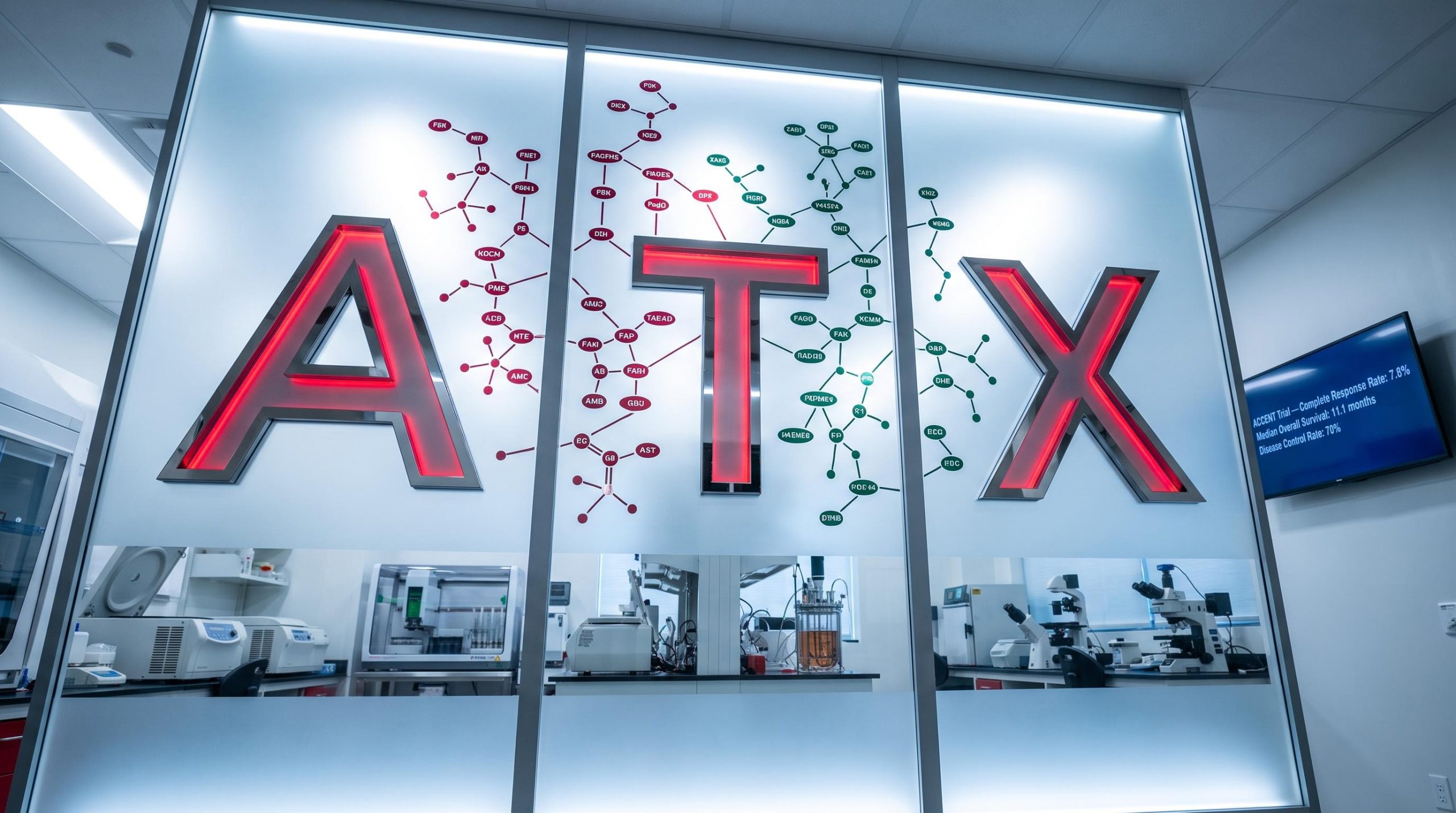
Amplia takes the stage at E&P Healthcare 2026
At the E&P Healthcare Conference in Sydney on 16 September 2026, Amplia Therapeutics Limited (ASX: ATX | OTCQB: INNMF) CEO and Managing Director Dr Chris Burns presented the company’s clinical progress across its pipeline of Focal Adhesion Kinase (FAK) inhibitors in cancer. At the time of the presentation, Amplia held a share price of A$0.12, a market capitalisation of A$61.60M, and cash of A$24.0M as at 30 June 2026.
When big ASX news breaks, our subscribers know first
ACCENT trial results — the headline case for narmafotinib
The centrepiece of Dr Burns’ presentation was data from the ACCENT Phase 1b/2a trial, evaluating narmafotinib combined with standard-of-care chemotherapy in first-line advanced pancreatic cancer. The trial enrolled 64 patients at the top dose of narmafotinib, combining it with gemcitabine and nab-paclitaxel (Abraxane).
What the data shows
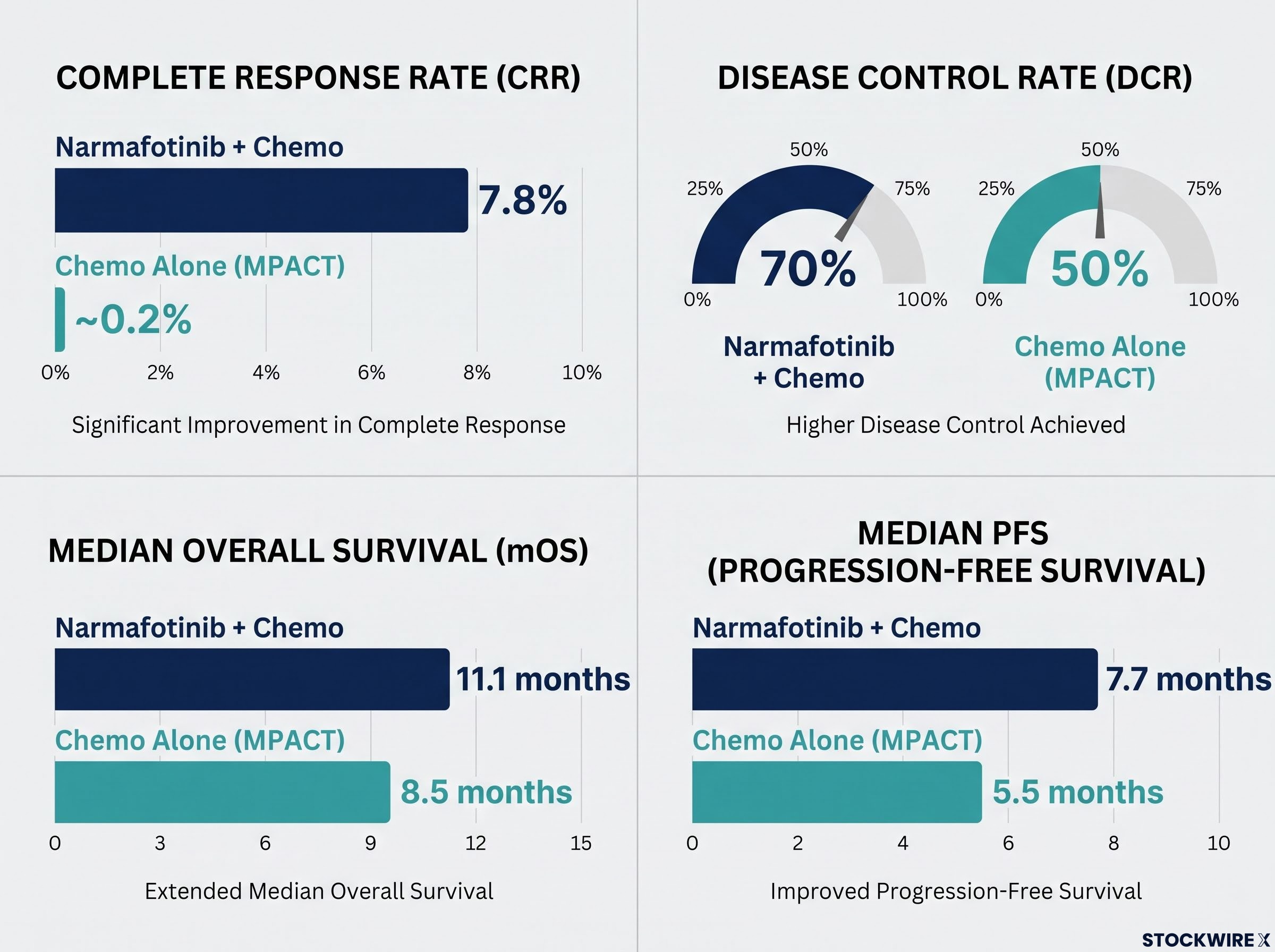
The results presented showed improvements across all key efficacy measures compared to chemotherapy alone, as benchmarked against the MPACT study.
| Metric | Narmafotinib + Chemo | Chemo Alone (MPACT) | Notes |
|---|---|---|---|
| Complete response rate | 7.8% | ~0.2% | 5 CRs and 1 pCR from 64 pts |
| Disease control rate | 70% | 50% | 8% CR, 28% PR, 34% SD |
| Median overall survival | 11.1 months | 8.5 months | mPFS 7.7 mos vs 5.5 mos (MPACT) |
| Median PFS | 7.7 months | 5.5 months | Median progression-free survival |
The presentation also included visual evidence of deep and sustained tumour shrinkage, presented via a target lesion chart and an overall survival swarm plot stratified by response category, though specific data labels were not readable from those charts. The company characterised the 7.8% complete response rate as “unprecedented” relative to the historical benchmark of approximately 0.2% for chemotherapy alone.
The FAK mechanism — why it matters in fibrotic cancers
Focal Adhesion Kinase (FAK) is a protein that is over-expressed in multiple cancer types. In fibrotic cancers such as pancreatic and ovarian cancer, FAK contributes to a dense fibrous barrier surrounding the tumour that physically prevents chemotherapy from reaching cancer cells. This structural problem is a central reason why chemotherapy response rates in these cancers remain poor.
Narmafotinib addresses this barrier directly. As presented, the mechanism operates in three connected steps:
- FAK drives a dense fibrous matrix that surrounds the tumour and creates a barrier for chemotherapy
- Narmafotinib acts to reduce the fibrous tissue, allowing chemotherapy and other treatments to penetrate
- Chemotherapy can then kill cancer cells, while narmafotinib simultaneously blocks resistance processes
This positions narmafotinib as more than a chemotherapy adjuvant. By targeting the fibrotic tumour microenvironment, it addresses a structural barrier to treatment efficacy that standard chemotherapy cannot overcome on its own. Pancreatic and ovarian cancers, both characterised by high fibrotic content, are Amplia’s priority indications for this reason.
Garvan Institute preclinical findings published in July 2026 identified four distinct biological mechanisms behind narmafotinib’s activity, including fibrosis reduction, enhanced chemotherapy penetration, reduced metastatic spread, and downregulation of chemo-resistance genes, providing independent laboratory support for the combination-therapy rationale.
Three programs, three market opportunities
The presentation outlined Amplia’s three lead clinical programs and the market context supporting each.
Pancreatic cancer — the lead program
The ACCENT registration pathway is structured in three parts, designed around FDA feedback:
- ACCENT Mini — daily dosing across two dose levels in 12 patients at three to four Australian sites, assessing safety, tolerability, pharmacokinetics, and biomarker endpoints
- ACCENT Reg Phase 2b — builds on ACCENT Mini data to compare the two daily dosing levels head-to-head to identify the optimal dose ahead of Phase 3, following Project Optimus principles
- ACCENT Reg Phase 3 — a pivotal registrational study designed to support FDA submission for narmafotinib approval in pancreatic cancer
Key milestones from the presentation:
- First patient dosing, ACCENT Mini: September 2026
- Safety and PK review complete: Q1 2027
- FDA meeting planned: Q2 2027
- Phase 2b start: 2H 2027
The pancreatic cancer market was cited at US$2.5B in 2025, forecast to grow to US$8.8B by 2034 (Source: Clarivate / Nature Reviews Drug Discovery 2026). Narmafotinib holds both FDA Orphan Drug and Fast Track designations in this indication.
Lilly collaboration — kRAS combinations in NSCLC
Amplia outlined a Phase 1b/2b trial combining narmafotinib with Eli Lilly’s next-generation kRAS G12C inhibitor olomorasib in previously treated, second-line KRAS G12C-mutant advanced or metastatic non-small cell lung cancer (NSCLC). The study includes a dose escalation phase (approximately 20 patients) followed by a randomised two-dose comparison (approximately 40 patients) at Australian and US sites.
The contractual terms of the collaboration, as presented, are:
The Eli Lilly collaboration agreement, signed in August 2026, formalised the in-kind supply arrangement for olomorasib and confirmed both parties would share resulting data, with Lilly simultaneously running two separate Phase 3 registrational NSCLC trials behind the same asset.
- Amplia to sponsor and fund study out of existing funds
- Lilly to supply olomorasib in-kind for use in the study
- Resulting data to be shared between both parties
- Non-exclusive
Olomorasib’s Phase 1/2 data in second-line NSCLC showed a median PFS of 8.1 months, an overall response rate of 41%, and median OS not yet reached, comparing favourably to approved first-generation kRAS G12C inhibitors adagrasib (mPFS 5.5 months, ORR 31.9%) and sotorasib (mPFS 5.6 months, mOS 10.6 months). Eli Lilly carries a market capitalisation of approximately US$1.1 trillion, providing context for the strategic weight of the collaboration.
The rationale for combination approaches in kRAS-driven cancers was underscored by the following published view:
Trends in Cancer, February 2025
“It is now generally accepted that the long-term effectiveness of KRAS inhibitors will not be achieved through mono-therapy, but rather through combination therapy.”
PRROSE trial — ovarian cancer
The PRROSE trial is an investigator-initiated study led by Dr Gwo Yaw Ho of Monash Health and Monash University, sponsored and coordinated through ANZGOG (Australia New Zealand Gynaecological Oncology Group). The trial targets approximately 20 patients with high-grade serous ovarian cancer (HGSOC) with poor chemotherapy response, treating with narmafotinib combined with carboplatin and paclitaxel, with endpoints covering safety, surgical eligibility, and tissue and biomarker analysis. The ovarian cancer market was cited at US$3.9B, with approximately 50% of an ovarian tumour being fibrotic, a key driver of drug resistance.
Investment snapshot
Amplia entered the second half of 2026 with A$24.0M in cash, which management presented as the funding base for near-term catalysts across all three programs. Upcoming milestones as outlined in the presentation:
- ACCENT Mini first patient dosing: September 2026
- Safety and PK review: Q1 2027
- FDA meeting: Q2 2027
- PRROSE recruiting: later 2026
- Lilly/narmafotinib NSCLC trial: late 2026 start planned
Substantial shareholders as disclosed:
- Platinum Investment Management Ltd
- Acorn Capital Ltd
- Blueflag Holdings Pty Ltd
- Pengana Capital Group
Ready to Explore Narmafotinib’s Clinical Pipeline and Investment Case?
Amplia Therapeutics is advancing a compelling suite of FAK inhibitor programmes across pancreatic cancer, ovarian cancer, and NSCLC, with the ACCENT trial delivering a complete response rate of 7.8% against a historical benchmark of just 0.2% for chemotherapy alone. Backed by A$24.0M in cash and a freshly signed collaboration with Eli Lilly, the company has multiple near-term catalysts on the horizon.
Investors seeking a deeper understanding of Amplia’s registration pathway, trial timelines, and pipeline rationale can explore the full investment case at the Amplia Therapeutics website.