

Emyria earns a seat at the FDA table on psychedelic medicine
On 14 September 2026, Emyria Limited (ASX: EMD) presented in person to the U.S. Food and Drug Administration (FDA) at its public hearing examining considerations for the potential future therapeutic use of psychedelic drugs, held at the FDA’s White Oak Campus in Silver Spring, Maryland. Executive Chairman Greg Hutchinson delivered the remarks directly to U.S. regulators, representing a company whose Australian clinical experience gave it a standing that remains uncommon on the global stage.
Emyria was selected for one of a limited number of in-person speaking positions at the hearing. That selection itself carries weight: this was not an open floor, and inclusion signals that regulators saw the company’s real-world operational track record as relevant to the policy questions being examined. The U.S. is the world’s largest healthcare market, with approximately US$5.3 trillion in annual healthcare spending in 2024, making regulatory visibility in that jurisdiction a material development for any specialist clinical operator.
When big ASX news breaks, our subscribers know first
What Emyria brought to the FDA hearing
The FDA hearing examined four specific implementation areas related to the potential future deployment of psychedelic-assisted therapies:
- Provider training and credentialing
- Patient safety
- Access
- Clinical data collection and standardisation
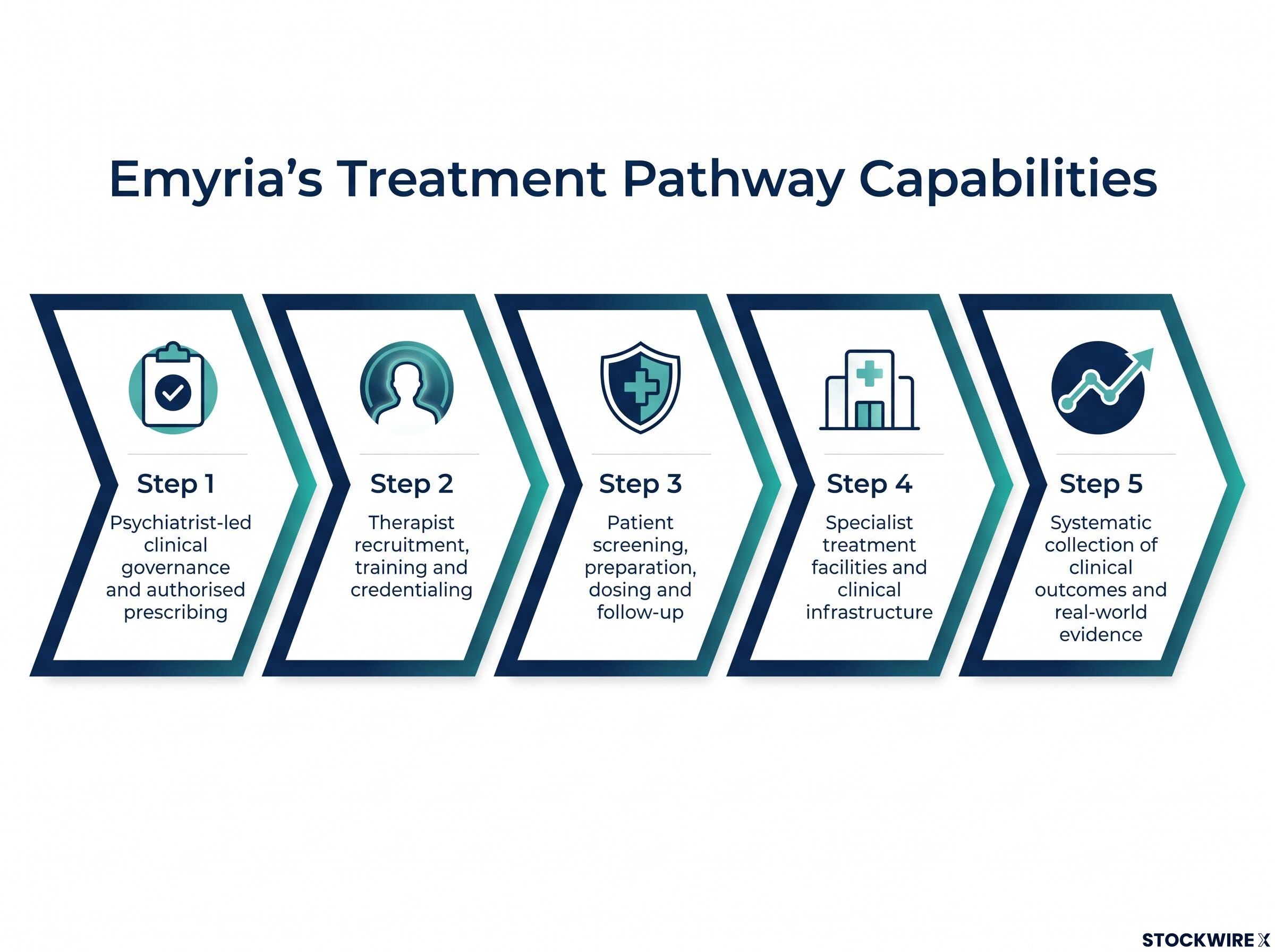
Emyria’s existing Australian clinical operations already span each of these areas. The company has developed capabilities across the full treatment pathway, including:
- Psychiatrist-led clinical governance and authorised prescribing
- Therapist recruitment, training and credentialing
- Patient screening, preparation, dosing and follow-up
- Specialist treatment facilities and clinical infrastructure
- Systematic collection of clinical outcomes and real-world evidence
The differentiation point is significant. While much of the global psychedelic medicines sector remains focused on drug development, Emyria has built practical capability around the clinical infrastructure and treatment-delivery systems that may ultimately be required to translate psychedelic medicines into broader regulated healthcare use. Mr Hutchinson presented that operational perspective directly to U.S. regulators and other stakeholders gathered at the hearing.
That reimbursed treatment-delivery model now spans three active funding pathways, including Medibank private health insurance, DVA coverage for veterans, and Workers Compensation, providing the financial infrastructure that underpins the clinical evidence base Emyria brought to the FDA.
Greg Hutchinson, Executive Chairman
Greg Hutchinson, Executive Chairman
“Presenting directly to the FDA was important validation that what Emyria and Australia has, remains uncommon globally. Real-world experience treating real-world patients within a regulated healthcare system. As psychedelic medicines move toward broader adoption, the challenge is no longer just about drug development, it is about building the systems to deliver treatment safely, consistently and at scale. We believe Emyria’s expertise can create significant opportunities as we consider how we can support the United States.”
Why psychedelic-assisted therapy is attracting regulatory attention
Psychedelic-assisted therapy refers to a treatment model in which controlled substances such as psilocybin or MDMA are administered to patients in a supervised clinical setting, typically alongside structured psychological support. The therapeutic process is distinct from recreational drug use: it occurs within a regulated healthcare environment, under direct medical supervision, and as part of a structured treatment protocol.
Regulators and researchers have been paying increasing attention to this area because early clinical data has suggested potential benefits for conditions such as treatment-resistant depression and post-traumatic stress disorder, where conventional therapies often fall short. The challenge, however, is not only about developing the drug compound itself. Bringing these medicines into mainstream healthcare requires an entirely separate layer of infrastructure: trained providers, credentialling systems, specialist facilities, patient safety protocols, and standardised data collection. That is the treatment-delivery side of the equation, and it is where significant complexity resides.
Australia’s regulatory framework has made it one of the first jurisdictions globally to permit regulated clinical use of certain psychedelic medicines, giving Australian operators hands-on experience that remains rare internationally. That practical operating history is precisely what positioned Emyria for a speaking role at an FDA hearing focused on how these therapies might eventually be implemented, not merely whether the underlying compounds show promise.
For readers interested in how Emyria has built and activated each node of this clinical network in practice, our detailed coverage of Emyria’s Victorian clinic launch walks through the operational setup, therapist credentialling process, and reimbursement activation that the company replicates across each new site.
What the FDA appearance means for Emyria’s U.S. strategy
The FDA presentation is a visibility and credibility milestone rather than a commercial agreement. Its tangible value lies in the profile it builds with U.S. regulators, drug developers, healthcare providers, and other stakeholders who are actively evaluating how psychedelic medicine frameworks might be structured in the world’s largest healthcare market.
Emyria is assessing opportunities to apply its Australian clinical capabilities, reimbursed treatment-delivery experience, and evidence-generation platform in the United States through clinical partnerships, treatment-delivery collaborations, research programs, and real-world evidence initiatives. No specific partnership names, revenue figures, or timelines have been disclosed.
The investment case rests on Emyria being well-positioned if and when the U.S. moves toward regulated psychedelic-assisted therapy frameworks. The FDA hearing provided a direct line of communication with the regulator that would ultimately shape those frameworks, and Emyria’s inclusion among the limited in-person speakers reflects the credibility its Australian clinical operations have established. Whether that visibility converts into commercial activity in the U.S. will depend on the pace and direction of regulatory development, which remains subject to the FDA’s own deliberative process.
Don’t Miss the Next Healthcare Breakthrough in Your Inbox
Big News Blast delivers FREE breaking ASX healthcare news directly to your inbox within minutes of release, complete with in-depth analysis already done for you. Join 20,000+ subscribers staying ahead of the market the moment announcements drop. Click the “Free Alerts” button to start receiving real-time coverage today.