

Li-S Energy outlines defence-focused battery strategy in September 2026 investor presentation
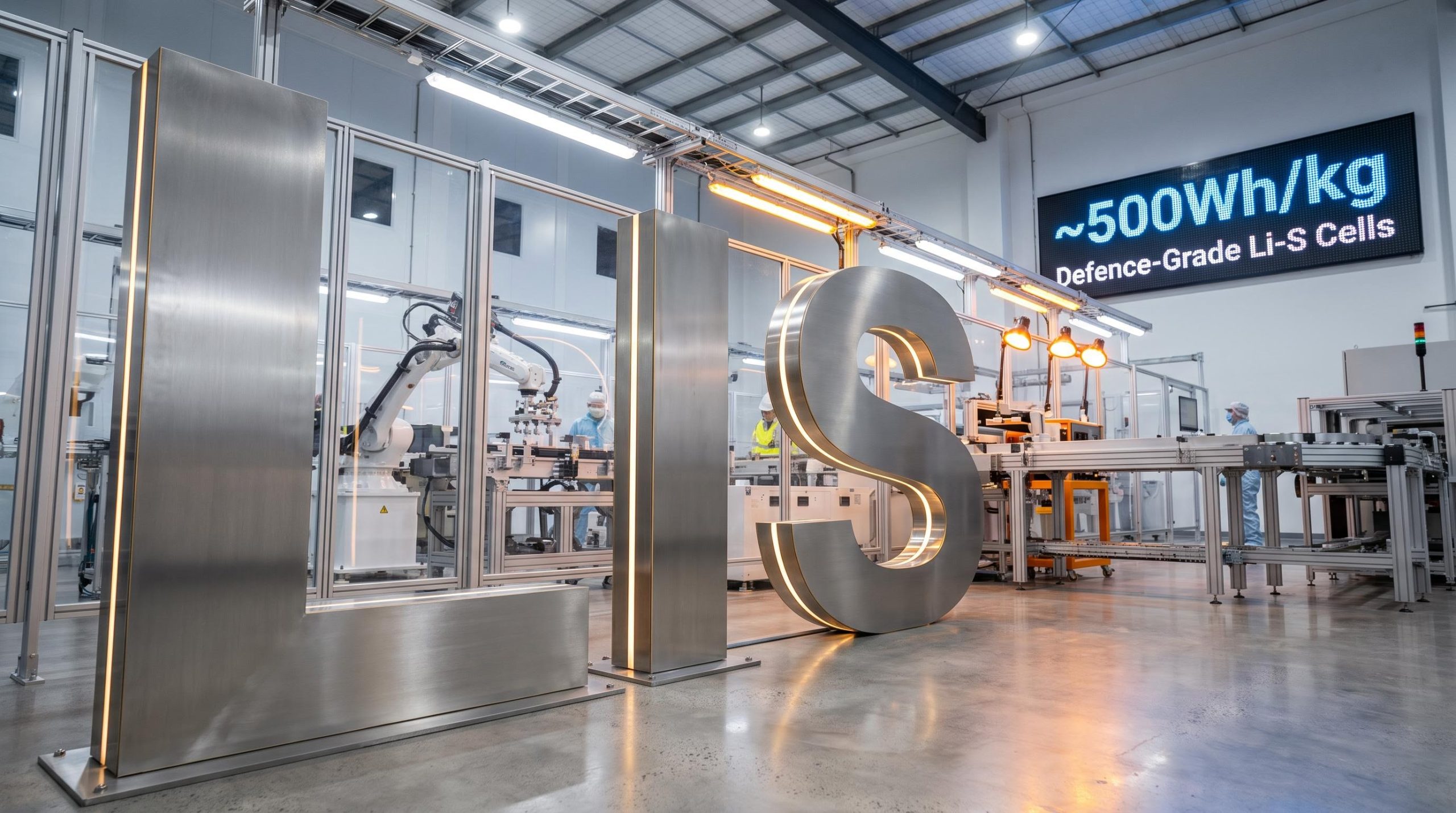
In its September 2026 investor presentation, Li-S Energy (ASX: LIS) outlined its position as Australia’s sovereign manufacturer of lithium-sulfur battery cells, with energy density approaching ~500Wh/kg, roughly twice that of conventional lithium-ion. The presentation framed the company’s strategic focus around the defence drone market, referencing US$100B+ in allied government commitments to unmanned systems as the broader demand backdrop.
When big ASX news breaks, our subscribers know first
Why lithium-sulfur batteries matter for defence drones
Energy density refers to how much energy a battery stores relative to its weight. For drones, a higher energy density battery means longer flight times, greater range, or heavier payloads for the same battery weight — a material operational advantage in defence applications.
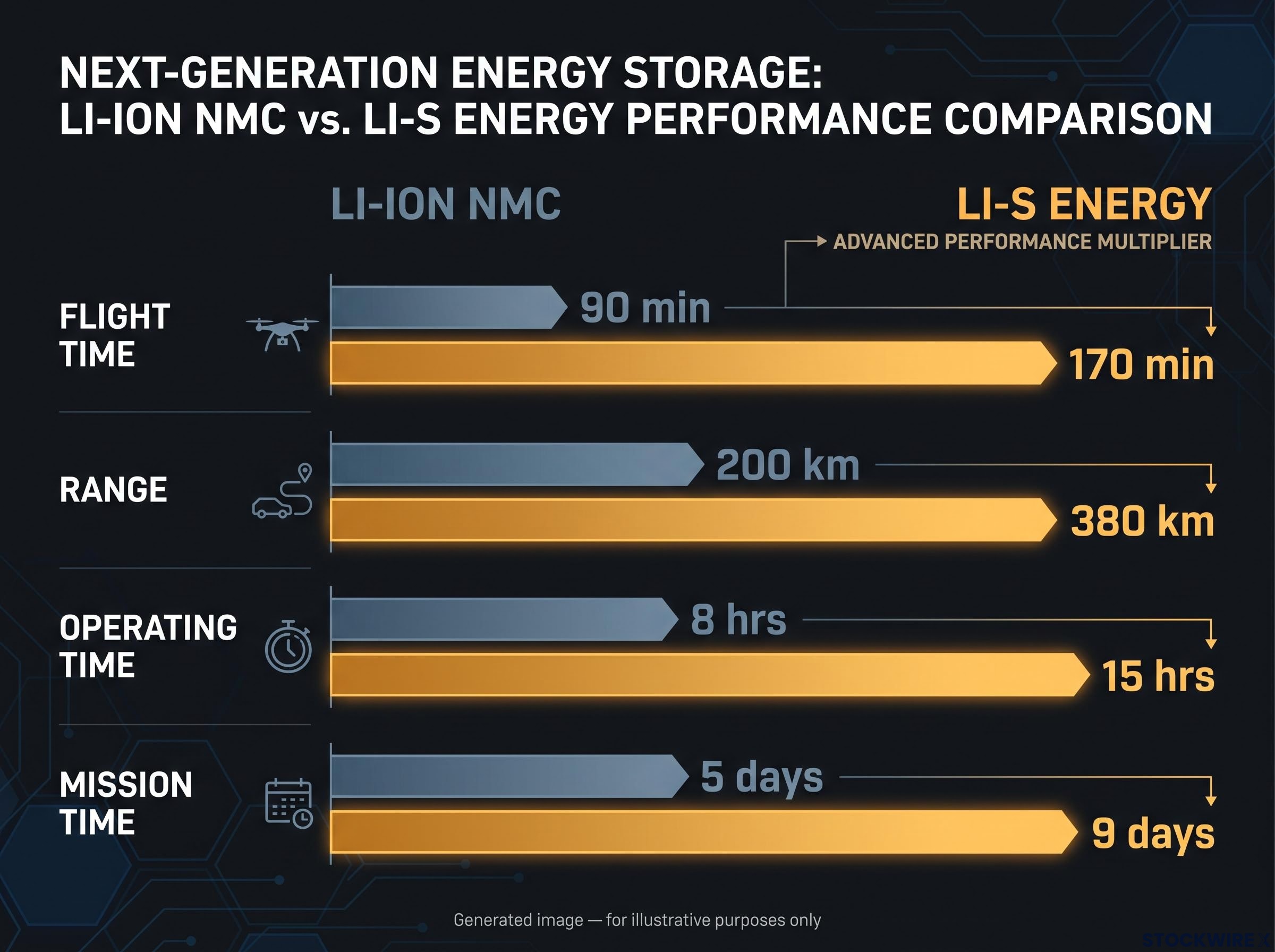
The presentation included a performance comparison table illustrating the typical expected advantages of LIS cells over a standard lithium-ion NMC battery of the same weight:
| Performance Metric | Li-ion NMC | Li-S Energy |
|---|---|---|
| Flight Time | 90 min | 170 min |
| Range | 200 km | 380 km |
| Operating Time | 8 hrs | 15 hrs |
| Mission Time | 5 days | 9 days |
Beyond performance, the presentation highlighted a sovereign supply chain advantage that is particularly relevant for defence procurement. Conventional lithium-ion batteries depend on materials processed by non-aligned countries — graphite, cobalt, and nickel — allied nations control less than 5% of battery-grade graphite processing, less than 20% of refined cobalt, and less than 25% of refined nickel. LIS cells use none of these materials, drawing instead on a sulfur cathode and a lithium-metal anode. For allied defence customers, the presentation noted, supply chain assurance is a procurement requirement, not a preference.
2026 milestones and the defence partner network
The presentation detailed progress across several operational fronts, with the headline milestone being the delivery of LIS Power Cells to the US Army’s C5ISR centre at Aberdeen Proving Ground in Maryland in August 2026. The presentation described this as the first LIS cells delivered to a US Government agency, with applications considered for testing including UAV, land systems, and soldier wearable systems. Results are expected to inform US Army program selection for Li-S Energy battery cells.
The US Army cells delivery required three separate international air transport approvals from CASA, PHMSA, and the FAA, and was enabled by LIS’s AUKUS membership, which allows cell export to the US and UK without individual export permits.
The company’s defence partner network, as outlined in the presentation, includes four named collaborators:
- Praetorian Aeronautics — developing a counter-UAV interceptor drone system, with LIS batteries expected to extend range, flight time, and payload. Praetorian is targeting 10,000 units per year production.
- Multi-national Defence Prime — unnamed, with LIS cells to be provided for tests and trials across multiple products currently supplied to governments worldwide, spanning unmanned air, land, and soldier wearable systems.
- MSubs (UK) — collaborating with LIS on the Project CETUS Extra Large Unmanned Underwater Vehicle (XLUUV) for the UK Ministry of Defence. Cells are currently being tested to almost 1,000 metres of depth.
- EPE — providing a structured route into a partner network of 60+ allied defence and security OEMs, with EPE holding prime contractor status with the Australian Department of Defence and the New Zealand Defence Force.
On the commercial drone side, the presentation noted two partnerships: the Pegasus long-endurance drone developed with V-TOL Aerospace and Halocell, co-funded by a $1.3M Emerging Aviation Technology Partnership (EATP) federal grant; and the Kea Aerospace High Altitude Platform Station (HAPS) programme, targeting multi-month flight times for persistent surveillance and communications.
Financial position and the road to commercial scale
As at 30 June 2026, the presentation reported the following financial position:
- Cash: $15.0M
- Interest-bearing investments: $0.6M
- Total financial assets: $15.6M
- Secured grant funding not yet received: $9.3M
- Debt: nil
The company has secured a total of $22.4M in federal grants and R&D tax credits across the following programmes:
- Deakin Trailblazer: $5.8M
- ARENA ARP: $7.9M
- R&D Tax Credit: $5.7M
- IGP: $1.7M
- EATP: $1.3M
On the scale-up pathway, the presentation outlined a Phase 4 process beginning with a FEL-1 feasibility study underway in FY27, co-funded by ARENA. The study is targeting investment-ready concept designs and costings as the precursor to a detailed project financing business case.
The presentation identified the following near-term value drivers:
- DEVCOM testing progression and results
- EATP drone flight testing
- MSubs deep-water testing
- Power Cell demonstration and qualification
- UN38.3 approval to ship worldwide
- Phase 4 FEL-1 study completion
With its 2MWh production line operational, defence customer testing underway across multiple platforms, and $15.6M in liquidity plus $9.3M in secured grants yet to be received, the company’s September 2026 presentation positioned it as progressing through the qualification phase ahead of targeting its first commercial battery sales.
Sovereign lithium foil production at the Geelong facility, certified to ISO 9001:2015 in May 2026, supports vertical integration of the LIS cell manufacturing process and opens a parallel external revenue channel through commercial foil sales.
Don’t Miss the Next Defence Tech Breakthrough on the ASX
Big News Blast delivers FREE breaking ASX news straight to your inbox within minutes of release, complete with in-depth analysis already done for you. Join 20,000+ subscribers staying ahead of market-moving announcements across tech, defence, and beyond. Click the “Free Alerts” button at Big News Blast to make sure you never miss the next big move.