CapitaLand Investment reported a 14% rise in after-tax profit for the first half of 2026, and it did so without owning more real estate. The gain came from earning more fees for managing property on behalf of others.
That distinction matters. The result was powered by a near-17x surge in transaction-driven fees from its Listed Funds business, and a 59% jump in Private Funds fee revenue following the acquisition of the Wingate Group. Revenue actually slipped 2%, which makes the profit improvement more striking rather than less.
The numbers tell you something about what kind of company CapitaLand Investment (CLI) now is, and what anyone tracking the stock should be watching from here. Here is how the fee income engine turned a softer top line into a stronger bottom line, and where the risks in that model sit.
How fee income turned a revenue dip into a profit jump
Revenue and profit moved in opposite directions in the first half, and that gap is the whole story.
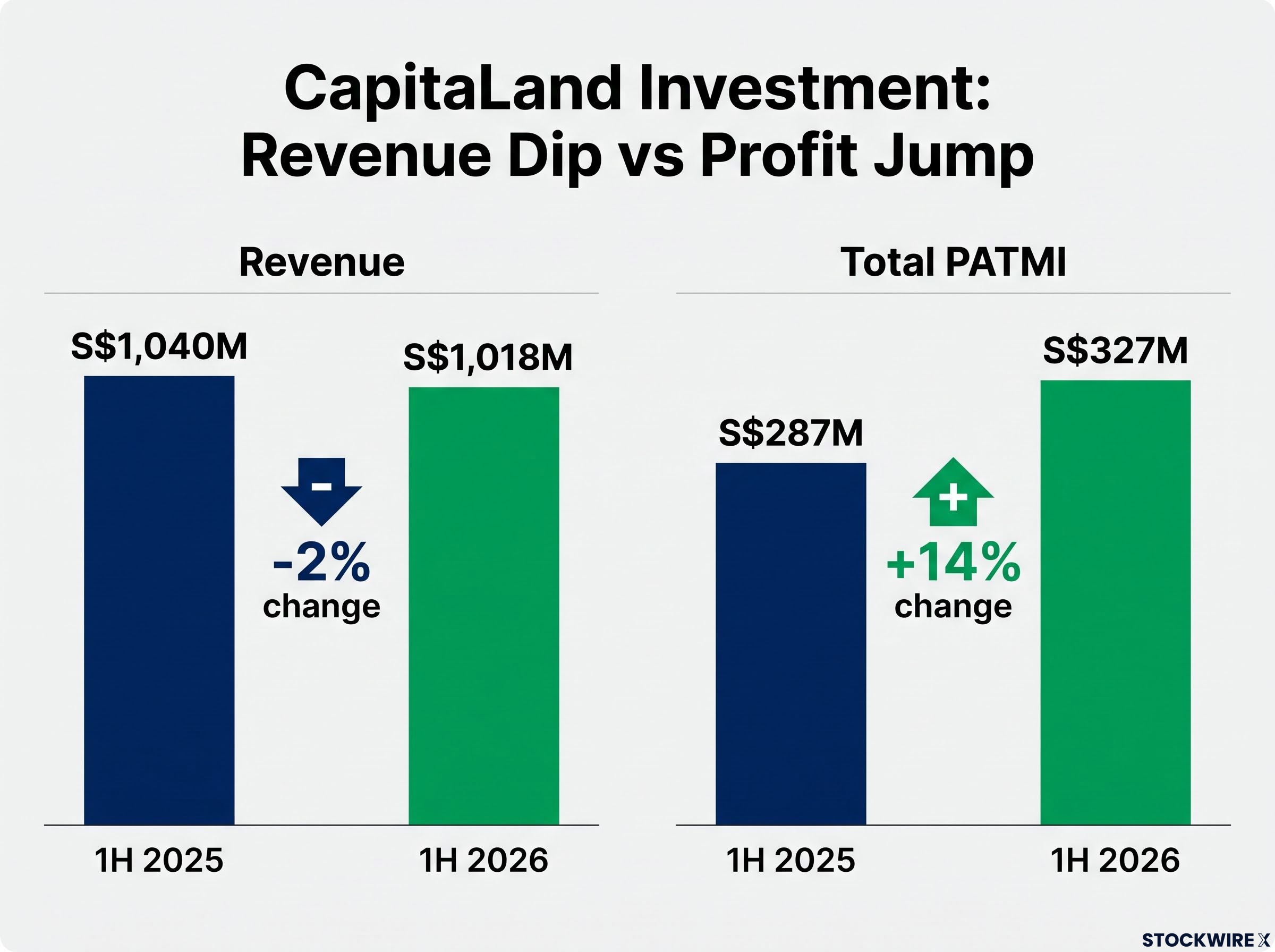
Revenue came in at S$1,018 million for the six months ended 30 June 2026, down 2% from S$1,040 million a year earlier. Yet total profit after tax and minority interests (PATMI), the profit attributable to the company’s owners, rose 14% to S$327 million from S$287 million. According to CLI’s results release dated 13 August 2026, that divergence came down to where the money was earned.
The answer sits in the Fund and REIT Management business. Fee-related revenue from that segment reached approximately S$687 million, up 20% year-on-year, per Maybank Research’s 17 August 2026 report. That expansion more than offset softness elsewhere on the top line.
A second tailwind compounded the effect. Interest expenses fell 7% year-on-year, trimming the cost of servicing debt and letting more of the fee income flow through to profit.
Operating PATMI: S$293 million, up 13% Operating PATMI strips out portfolio gains, unrealised revaluation changes, and impairments, so it reflects recurring profit rather than one-off items. At S$293 million versus S$260 million a year earlier, it confirms the improvement was driven by the underlying business, not accounting gains.
| Metric | 1H 2025 | 1H 2026 |
|---|---|---|
| Revenue | S$1,040M | S$1,018M |
| Total PATMI | S$287M | S$327M |
| Operating PATMI | S$260M | S$293M |
| Fund & REIT Management revenue | ~S$573M | ~S$687M |
For investors, the read here is that CLI’s profit quality has shifted. It is now more sensitive to fee dynamics than to gross revenue, which means anyone tracking only the top line will repeatedly misjudge how this company is actually performing.
When big ASX news breaks, our subscribers know first
The event-driven fee surge and what Wingate added to the picture
The single most dramatic number in the result is the event-driven fee line. Fees tied to specific transactions within Listed Funds jumped from S$4 million in 1H 2025 to S$66 million in 1H 2026, a near-17x increase supported by more than S$10 billion in transactions across CLI-sponsored REITs and business trusts.
Event-driven fees: S$4 million to S$66 million A single half-year, driven by acquisitions and portfolio restructuring undertaken by the listed funds CLI manages.
That is not the whole story, though. Growth came from two distinct engines, and separating them is essential to reading the result correctly.
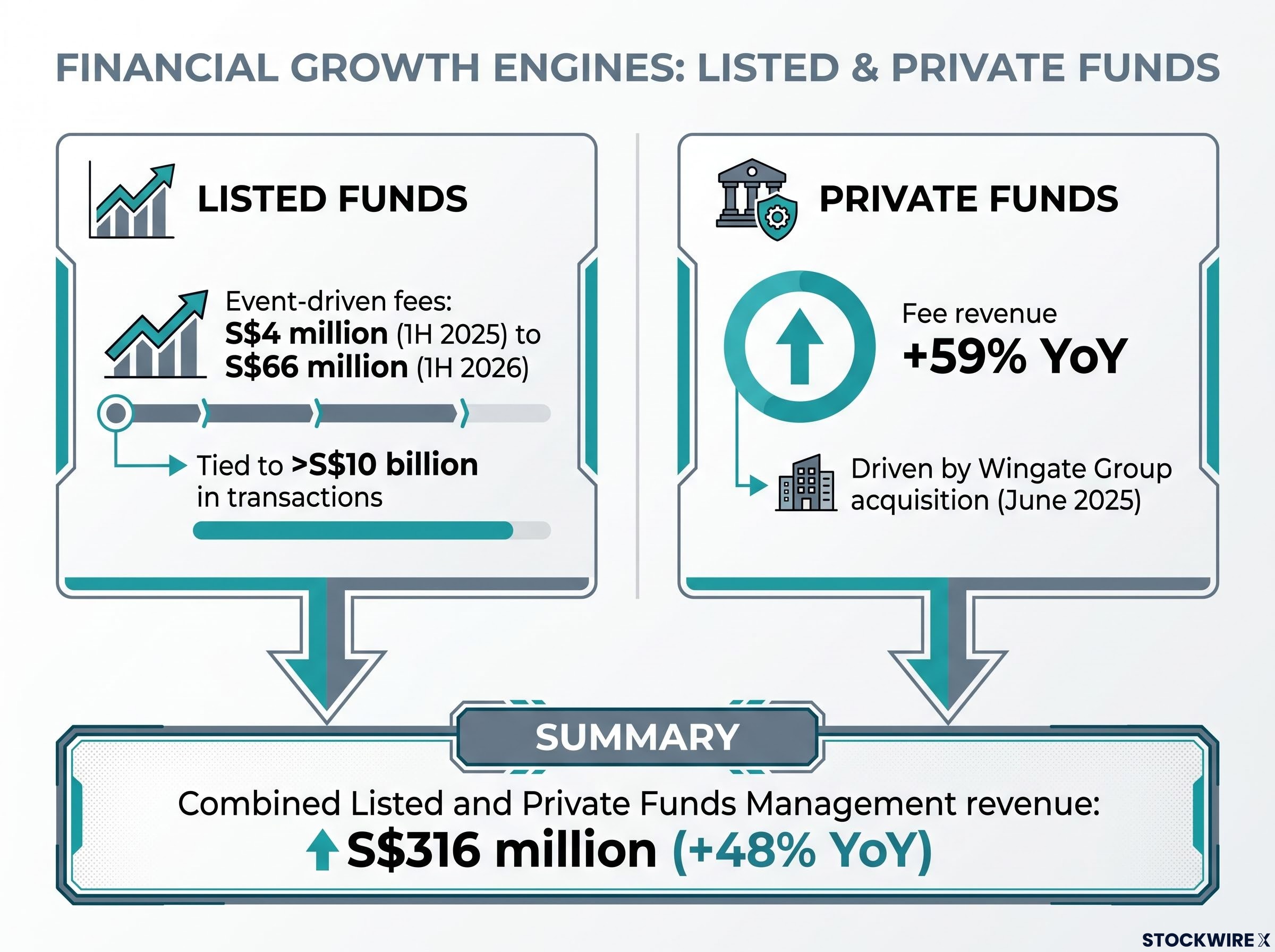
- Listed Funds event-driven fees: the S$66 million spike, tied to more than S$10 billion in deal activity, lifting Listed Funds Management revenue 45% year-on-year.
- Wingate-driven Private Funds growth: Private Funds Management fee revenue rose 59% year-on-year, driven by the Wingate Group acquisition completed in June 2025 and higher operational activity across the private credit platform.
Together, combined Listed and Private Funds Management revenue reached S$316 million, up 48% year-on-year.
The question that matters for forward earnings is whether this fee surge is structural or opportunistic. Management framed the expanded platform, broadened by Wingate, as something that makes event-driven fees more frequent over time. Analysts read it differently.
Stocksbnb (16 August 2026) and Maybank Research characterised the 1H 2026 spike as opportunistic within a supportive environment for capital recycling and dealmaking, not a permanent reset of the baseline. Both stressed that recurring management fees remain the backbone of fee income, while transaction fees rise and fall with market conditions.
For investors, the near-17x jump is real, but treating it as a baseline rather than a spike would misprice the earnings risk. The signal to track is which part of the fee line is recurring and which part depends on deal flow continuing at a similar pace.
Why REIB revenue fell 24% and whether it matters
The Real Estate Investment Business (REIB) posted S$392 million in revenue for the half, down 24% from S$519 million a year earlier. On its own, that figure could read as weakness. The detail says otherwise.
Two named causes account for almost the entire decline.
- Synergy deconsolidation: Synergy, a US corporate housing platform, was deconsolidated following the SilverDoor-Synergy merger. It had contributed S$134 million of revenue in 1H 2025, so its removal alone explains the bulk of the drop.
- China business park divestment: the sale of a business park property in China further reduced the segment’s top line.
In other words, revenue fell because CLI sold and deconsolidated assets on purpose, not because the underlying business deteriorated.
What analysts make of the contraction
The majority reading treats the REIB drop as strategy in action. DBS Group Research (14 August 2026), Maybank Research, and Business Times all interpreted the contraction as consistent with a deliberate plan to recycle capital out of lower-yielding assets, pointing to approximately S$3.4 billion of divestments completed as part of the process. DBS went further, framing the pivot as a potential S$7-9 billion value unlock through divestments and redeployment into fee platforms.
There is a dissenting note, and it deserves equal weight. SG Property Atlas (21 August 2026) and aggregated Morningstar commentary warned that accelerating asset recycling increases CLI’s dependence on capital markets and transaction volumes. The more the company leans on fee income, the more its earnings become sensitive to deal cycles and interest rate conditions.
For investors, the REIB drop is less a warning than a structural consequence of a strategic choice. The real question is not whether the decline is concerning, but whether the fee income engine can sustain the growth that justifies trading away that revenue.
FUM growth, capital raising, and analyst views on what comes next
Funds under management (FUM), the total value of assets CLI manages on behalf of investors, stood at S$128 billion at 30 June 2026, up from S$125 billion at the end of FY25. Alongside that, CLI raised approximately S$3.7 billion of new capital in the first half, a solid outcome given how selective Asia-Pacific fundraising for private real estate and credit strategies has become.
The broker view is uniformly positive. Phillip Securities, DBS, and Maybank all carry BUY calls, with SGinvestors aggregating a target price range of S$3.35 to S$3.69 and a median of S$3.49 as of 21 August 2026.
| Broker | Recommendation | Target Price (S$) |
|---|---|---|
| Phillip Securities | BUY | S$3.69 |
| DBS Group Research | BUY | S$3.40 |
| Maybank Research | BUY | Not disclosed |
There is one figure that frames the second half sharply. The 1H 2026 result accounted for 52% of Phillip Securities’ full-year 2026 PATMI estimate, per analyst Darren Chan. That puts the first half slightly ahead of the typical 50% mid-year run-rate.
Three variables will determine where the stock goes from here.
- FUM trajectory: whether CLI keeps growing managed assets and raising capital at a similar clip.
- Sustainability of event-driven fees: whether the S$66 million transaction-fee spike repeats in the second half or normalises toward baseline.
- Interest rate conditions: whether rates stay supportive enough to keep transaction volumes flowing.
For investors, the consensus around S$3.49 suggests the market has broadly absorbed the positive surprise. Whether the price re-rates further depends on the second half delivering a comparable level of transaction-driven revenue, rather than the current fee story simply holding.
Past performance does not guarantee future results. Financial projections are subject to market conditions and various risk factors. These statements are speculative and subject to change based on market developments and company performance.
What CLI’s 1H 2026 result tells you about the company it is becoming
Pull the threads together and one picture emerges: CLI is behaving increasingly like a capital-light asset manager rather than a property owner. Profit rose while owned-asset revenue fell. FUM grew while the balance sheet was deliberately lightened, with interest expenses down 7% as a marker of that reduction.
The direction is clear. Fee-related revenue grew 20% year-on-year, which Maybank Research places at the upper end of the regional peer group, and DBS frames the asset-light pivot as a potential S$7-9 billion value unlock.
DBS: S$7-9 billion potential value unlock Through continued divestments and redeployment of capital into higher-margin fund platforms, per DBS Group Research (14 August 2026).
What remains uncertain is the pace. The structural shift depends on Asia-Pacific deal volumes staying high enough to sustain event-driven fees beyond a single strong half.
For investors, this result marks a transition point. Tracking CLI’s recurring management fee growth now matters more than tracking its top-line revenue, because the top line is designed to shrink as the fee engine grows. Reframe your monitoring accordingly, and future results will read as strategy rather than surprise.
This article is for informational purposes only and should not be considered financial advice. Investors should conduct their own research and consult with financial professionals before making investment decisions.