


Immutep charts a new path for efti
Immutep Limited has been conducting a root cause analysis following the early discontinuation of its TACTI-004 trial and is now outlining a focused, FDA-aligned clinical development strategy for eftilagimod alfa (efti). The company intends to concentrate registration-directed development on two indications: head and neck squamous cell carcinoma (HNSCC) in patients with negative PD-L1 expression (Combined Positive Score (CPS) < 1), and the neoadjuvant setting of soft tissue sarcoma (STS).
Preparations for the next clinical trials have commenced, with study start targeted for 2H CY2027, subject to final decisions on trial design, regulatory interactions, manufacturing timelines, partnering and resources. The announcement reflects a company applying scientific rigour to redirect its development programme toward the indications where clinical evidence, unmet need, and regulatory support are most compelling.
When big ASX news breaks, our subscribers know first
Root cause analysis uncovers manufacturing differences, not clinical failure
Based on the currently available data from the root cause analysis to date, Immutep believes that the unexpected outcome of TACTI-004 cannot be explained by clinical and trial execution factors. The analysis found no evidence of a suboptimal protocol, substantial imbalance between treatment arms, safety findings, an invalid randomisation pattern, or general issues with clinical trial conduct.
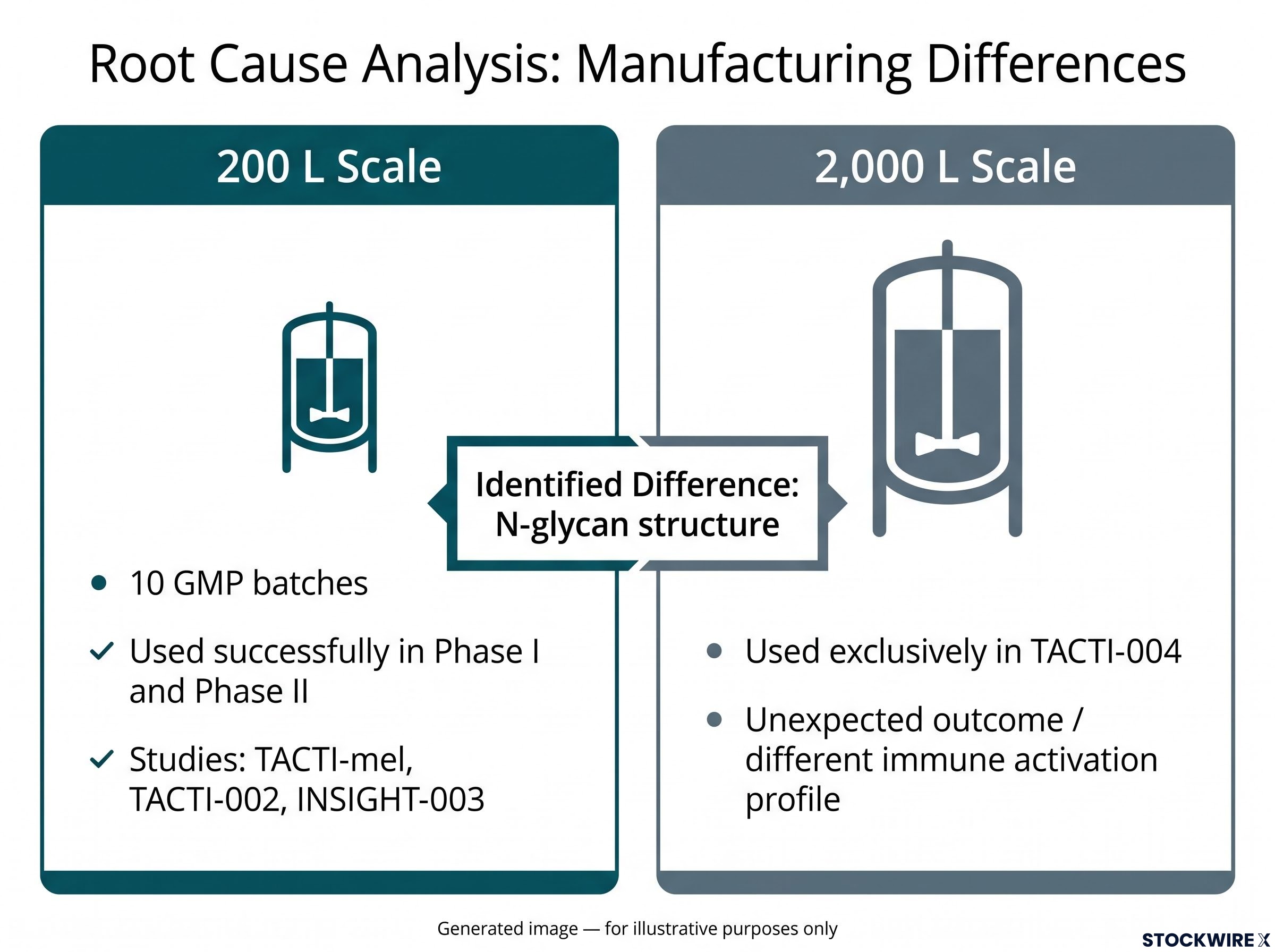
Instead, the analysis identified structural differences between the efti used in TACTI-004 and the efti used in earlier successful studies. Specifically, a subtle difference in N-glycan structure was identified between efti manufactured at 200 L scale and efti manufactured at 2,000 L scale. TACTI-004 was conducted exclusively with 2,000 L scale material.
These differences are considered potentially relevant given the markedly different immune activation profile observed in TACTI-004 compared to previous trials. Prior to TACTI-004, ten GMP batches of efti had been manufactured at 200 L scale and used successfully across Phase I and Phase II studies, including TACTI-mel, TACTI-002, and INSIGHT-003.
Based on these findings, Immutep has contracted a new manufacturing run of efti at 200 L scale. The root cause analysis remains ongoing, and the company has stated it will provide a further update upon completion. This is a consequential distinction for investors: the working hypothesis points to manufacturing variability rather than flawed science, preserving the underlying clinical thesis for efti.
INSIGHT-003 survival data, which recorded a mature median overall survival of 30.9 months in first-line non-squamous NSCLC against a 22.0-month historical benchmark, further reinforces the view that the TACTI-004 outcome reflects a trial-specific manufacturing variable rather than a fundamental flaw in efti’s mechanism.
Two high-potential indications anchor the new development focus
HNSCC — Fast Track designation and compelling CPS < 1 data
Immutep’s HNSCC focus centres on patients with negative PD-L1 expression (CPS < 1), a population with high unmet need and limited approved treatment options. Clinical efficacy data, including mature overall survival data, supports this focus.
Efti has received Fast Track designation from the FDA for first-line HNSCC, and Immutep has described its interactions with the FDA on this indication as constructive. These regulatory signals provide meaningful validation for pursuing a registration-directed path in this patient population.
Soft tissue sarcoma — Orphan Drug Designation and Phase II endpoint achievement
In STS, the development focus is on the neoadjuvant setting, supported by positive Phase II data including achievement of the primary endpoint. The FDA granted Orphan Drug Designation for efti in STS in April 2026.
Immutep’s licensing partner, Dr. Reddy’s Laboratories (DRL), has been consulted on and is supportive of this approach. The company is also in preliminary discussions with other parties regarding the proposed development pathway.
| Indication | Patient Population | Regulatory Designation | Key Data | Development Phase |
|---|---|---|---|---|
| HNSCC | CPS < 1 | Fast Track (FDA) | Mature overall survival data | Registration-directed |
| STS | Neoadjuvant setting | Orphan Drug (FDA, April 2026) | Phase II primary endpoint met | Registration-directed |
Understanding efti — how it activates the immune system
Eftilagimod alfa is a novel immunotherapy that works by directly activating antigen-presenting cells (APCs), such as dendritic cells and monocytes, via the MHC Class II pathway. As an MHC Class II agonist, efti triggers a broad anti-cancer immune response by engaging both the adaptive and innate immune systems.
This activation includes priming and activating cytotoxic T cells (the immune cells that directly attack cancer) and generating co-stimulatory signals and cytokines that further boost the immune system’s capacity to combat tumours. Efti’s favourable safety profile has enabled various combinations in clinical studies, including with anti-PD-[L]1 immunotherapy, radiotherapy, and/or chemotherapy. This combination flexibility is a practical asset for the trial designs being considered in HNSCC and STS.
What comes next — timelines and strategic milestones
Immutep has outlined the following next steps for efti’s development:
- Completion of the root cause analysis (ongoing; a further update will be provided on completion)
- Manufacturing run of efti at 200 L scale (contracted)
- Final decisions on trial design and regulatory interactions
- Partnering and resource decisions
- Study start targeted for 2H CY2027, subject to the above conditions
Marc Voigt, CEO, Immutep
“Based on the totality of evidence generated with efti, we believe there is a scientifically and clinically justified path to continue its development. This includes clinical and translational data across multiple tumour types, consistent evidence of immune activation, encouraging results in soft tissue sarcoma and head and neck cancer with CPS < 1, and constructive regulatory interactions. At the same time, we fully recognise the significance of the TACTI-004 outcome. Our root cause analysis remains ongoing, including further investigation of smaller differences identified between product batches. We intend to apply these learnings rigorously and focus future potential development on settings where the clinical evidence, biological rationale, time-to-market and unmet medical need are most compelling."
Separately, development of IMP761, Immutep’s agonist anti-LAG-3 antibody being investigated for autoimmune disease, continues in line with previously disclosed plans, keeping the company’s broader LAG-3 portfolio on track alongside the refocused efti programme.
IMP761 Phase I results at EULAR 2026 confirmed statistically significant immunosuppressive activity at the 7 mg/kg dose and pharmacokinetic data supporting a once-every-4-week dosing schedule, reinforcing the commercial and clinical potential of Immutep’s LAG-3 portfolio beyond the refocused efti programme.
Don’t Miss the Next Healthcare Breakthrough
Big News Blast delivers FREE breaking ASX healthcare news directly to your inbox within minutes of release, complete with in-depth analysis already done for you. Join 20,000+ investors who stay ahead of the market the moment announcements hit. Click the “Free Alerts” button at StockWire X to start receiving alerts today.