The Central Bank of the Republic of Turkey (CBRT) cut its policy rate once in January 2026, then held at 37% through five successive meetings while quietly dismantling the liquidity premium that had kept the effective funding rate 300 basis points above its own policy rate. That technical adjustment, not any change to the headline number, is what actually moved Turkey’s monetary conditions this year.
Heading into Q4 2026, the picture is unusually crowded with conflicting signals. Inflation has fallen for a third consecutive month, second-quarter GDP came in softer than expected, yet analyst year-end rate projections span 34.5% to 36%, and the lira sits on a managed depreciation path that turns any carry position into a function of timing as much as yield.
This maps the CBRT’s current stance against the conditions it has signalled must materialise before cuts resume, layers in the divergent market and analyst projections, and turns to what a 52 USD/TRY year-end forecast implies for carry trade positioning. The goal here is a decision-ready read, not a recap of events.
Why the CBRT held at 37% even after conditions softened
On the surface, the hold looks like a contradiction. Inflation is falling, growth is cooling, and the CBRT still refused to cut across five straight meetings. Resolve that puzzle and the whole stance makes sense.
The January 2026 move was never a single action. When the Monetary Policy Committee reduced the one-week repo rate from 38% to 37% on 22 January 2026, it simultaneously restarted weekly repo auctions as part of a broader liquidity normalisation. That second step pulled the effective funding rate down from 40% to sit exactly on the 37% policy rate.
Policy corridor: 35.5% (floor) to 40% (ceiling), with the 37% repo rate now the effective anchor following January liquidity normalisation.
What liquidity normalisation actually changed
The distinction matters more than the headline. Restarting weekly repo auctions is an operational lever, not a rate decision, but it transmits to money markets in much the same way a cut does.
Before the restart, the CBRT was funding the system closer to the 40% ceiling of its corridor, defined by an overnight lending rate of 40% and an overnight borrowing rate of 35.5%. Bringing the effective rate down to 37% delivered roughly 300 basis points of easing without the political optics of touching the benchmark.
Read that way, the five consecutive holds on 12 March, 22 April, 11 June, 23 July and 30 July 2026 are not inaction. They are credibility management by a central bank that already loosened conditions meaningfully in January and knows its reserve position leaves little room to defend the lira through intervention if it eases too fast.
Monitoring funding channel mechanics rather than the headline policy rate is what separates the January normalisation’s true signal from its surface appearance: the effective rate moved 300 basis points without the MPC touching the benchmark figure once.
The CBRT has signalled three conditions that need to hold before formal cuts resume:
- Continued month-on-month disinflation momentum, not just a single soft print
- No external shock to imported energy prices
- No premature deterioration in the output gap that would reverse demand-side disinflation
For anyone modelling the next cut, the takeaway is that the headline rate overstates how restrictive policy actually is. Effective conditions already loosened in January. What you are waiting for now is a technical resumption after that relief was transmitted, not a first move from a standing start.
When big ASX news breaks, our subscribers know first
What the inflation data is actually telling the market
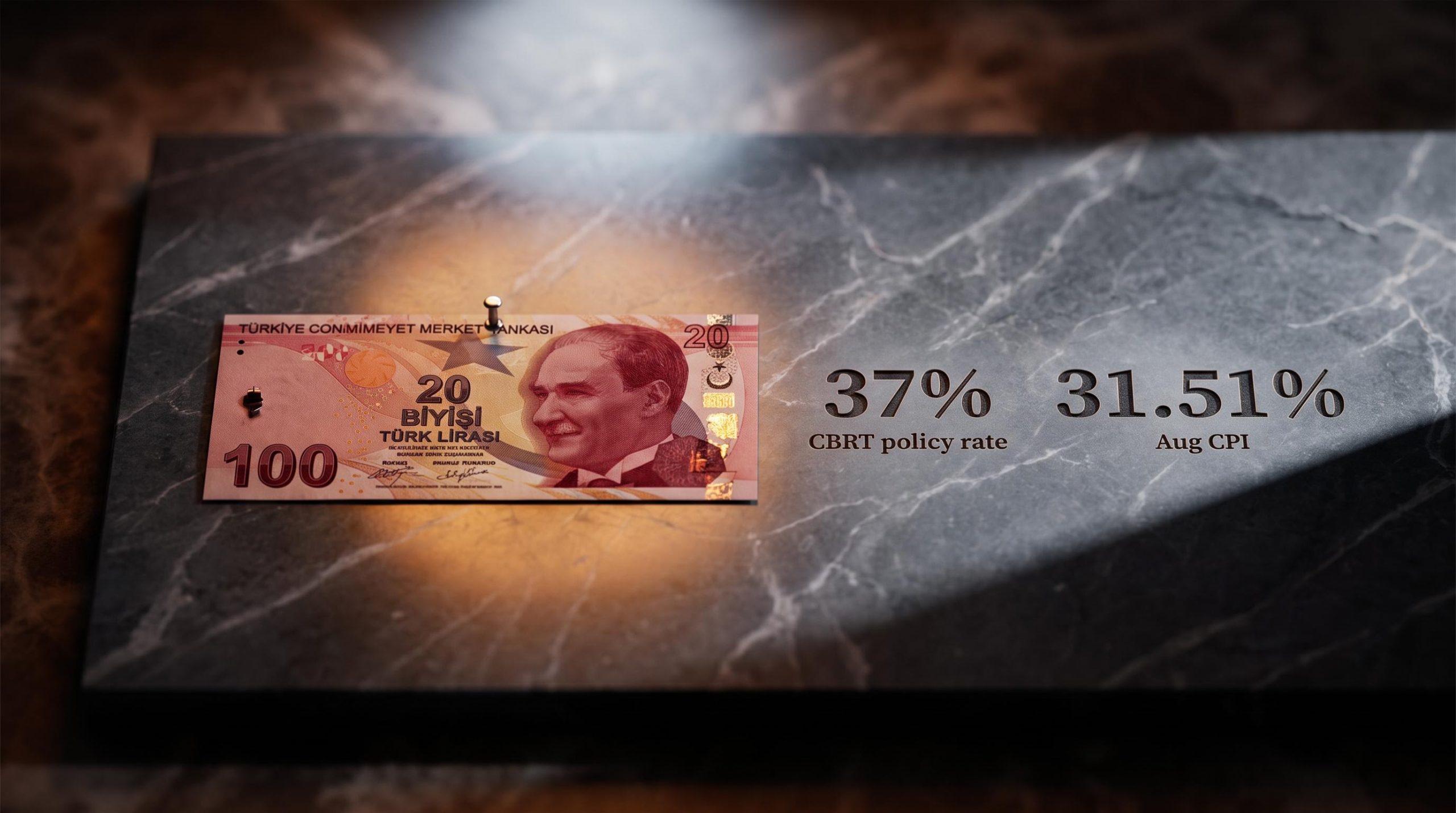
The August 2026 CPI print was a genuine positive. Headline inflation came in at 31.51% year-on-year, below consensus, and 1.84% month-on-month, marking the third consecutive monthly slowdown. With the policy rate at 37%, that puts the real policy rate at roughly 5.5 percentage points positive.
With nominal rates at 37% and August CPI at 31.51%, Turkey’s real policy rate sits at approximately 5.5 percentage points positive, one of the highest in the emerging market universe.
So why has falling inflation not translated into market confidence? Because there is a wide gap between what the CBRT projects and what the market actually believes.
The CBRT’s official forecast puts end-2026 inflation between 15% and 21%. A recent Reuters poll placed the consensus at 27.53%, up from a prior reading. That is not a rounding difference. It reflects a structural credibility deficit.
| Forecast source | End-2026 CPI projection | End-2027 CPI projection |
|---|---|---|
| CBRT official | 15% to 21% | 6% to 12% |
| Reuters poll consensus | 27.53% | Not specified |
The CBRT argues that demand conditions have reached disinflationary levels, supported by a widening output gap, which is the difference between what the economy is producing and what it could produce at full capacity. Slack demand cools pricing pressure.
What this tells you is practical. Markets will not price in the full cut cycle until realised monthly prints consistently undershoot the CBRT’s own projections, not just beat Street estimates. A soft print that still sits above the official trajectory does not close the credibility gap.
Three shock vectors could reverse the disinflation path entirely: geopolitical escalation in the Middle East, a spike in imported energy prices, and premature easing feeding back into pricing expectations. Any one of these would push the CBRT’s target further out of reach.
Energy price transmission into core CPI typically follows a 3-6 month lag, meaning the geopolitical shock vectors the CBRT has flagged, particularly a Middle East escalation that spikes imported energy costs, would not fully appear in Turkish monthly prints until well after the trigger event, compressing the window for a policy response.
For positioning around cut timing, the gap between official and market inflation forecasts is the single most consequential input. It determines whether Q4 cuts arrive on schedule or slip into 2027. Tracking each monthly CPI print against the Reuters poll trend is the practical way to monitor whether that gap is closing.
How divergent rate cut projections translate into lira forecasts
There is no single consensus on where the policy rate ends the year. Instead there is a spectrum, and the width of that spectrum is itself the signal.
Forward markets imply a year-end rate of 34.50%. ING’s Frantisek Taborsky projects 35%, arriving via two 100-basis-point cuts in Q4. BBVA Research sits at roughly 36%. That 150 basis point spread between the most dovish and most hawkish view is wide enough to produce materially different carry-adjusted returns.
Each projection anchors a different lira outcome, because the CBRT appears to be accommodating gradual, managed depreciation as a deliberate tool. A weaker lira supports exporters and discourages the kind of speculative hot-money inflows that can reverse violently.
ING forecasts USD/TRY at 52 by the end of 2026 and 63 by the end of 2027. Against a spot rate near 48.47 to 48.48 in early September 2026, that implies further depreciation you have to build into any return calculation.
| Source | Year-end 2026 rate | Implied cuts from 37% | USD/TRY year-end forecast |
|---|---|---|---|
| Forward markets | 34.50% | 250 bp | Not specified |
| ING | 35% | 200 bp | 52 |
| BBVA Research | ~36% | 100 bp | Not specified |
The divergence is not noise. It reflects a real disagreement about whether the CBRT prioritises disinflation credibility or responds to a softening growth picture.
Deeper cuts beyond the base case would require a specific sequence to unlock:
- Monthly CPI printing consistently below roughly 2%, confirming durable disinflation
- The output gap widening further, easing demand-side price pressure
- Continued reserve accumulation, giving the CBRT more room to ease without exposing the lira
The read you should take is that your own view on CBRT credibility and inflation persistence is the key input. Hold a view on that trade-off, because it, not the direction of rates alone, determines how you would size a TRY position.
The TRY carry trade: yield arithmetic versus structural risk
On paper, the carry trade looks compelling. The nominal yield differential remains among the highest in emerging markets, and long TRY positioning has recovered to levels seen before the recent US-Iran conflict. The surface appeal is real.
EM local-currency debt returned roughly 19% in 2025, attracting $11.4 billion in Q1 2026 flows, and Turkey’s high real policy rate positions TRY-denominated instruments as one of the higher-carry expressions within that asset class, even as the depreciation path requires building FX loss assumptions into total return calculations.
Then the structural risks stack up. The clearest illustration came in March 2026, when the exit narrowed fast.
In March 2026, approximately $15 billion in carry positions unwound in a compressed window, alongside $7.3 billion in bond and equity outflows, illustrating the asymmetric exit risk when TRY positioning becomes crowded.
Carry-related positions have historically peaked near $40 billion. When positioning is that crowded, a shift in sentiment forces a rush for the door, and the March episode showed how quickly it can happen.
What Simsek’s macroprudential measures change (and what they do not)
To reduce that hot-money risk, Finance Minister Mehmet Simsek has overseen elevated reserve requirements on banks’ external liabilities and external repos. Macroprudential tools are rules that constrain how much short-term foreign borrowing the banking system can rely on.
The intent is to curb dependence on speculative short-term capital and build a more sustainable financing base. These measures aim to reshape the composition of inflows rather than shut carry activity down.
What they cannot do is fix the reserve position. Turkey’s net effective reserves sit at approximately negative $45 billion on the World Bank metric, even though total CBRT reserves including gold stood at $152 billion as of 12 June 2026, with foreign-exchange assets alone at $53.1 billion.
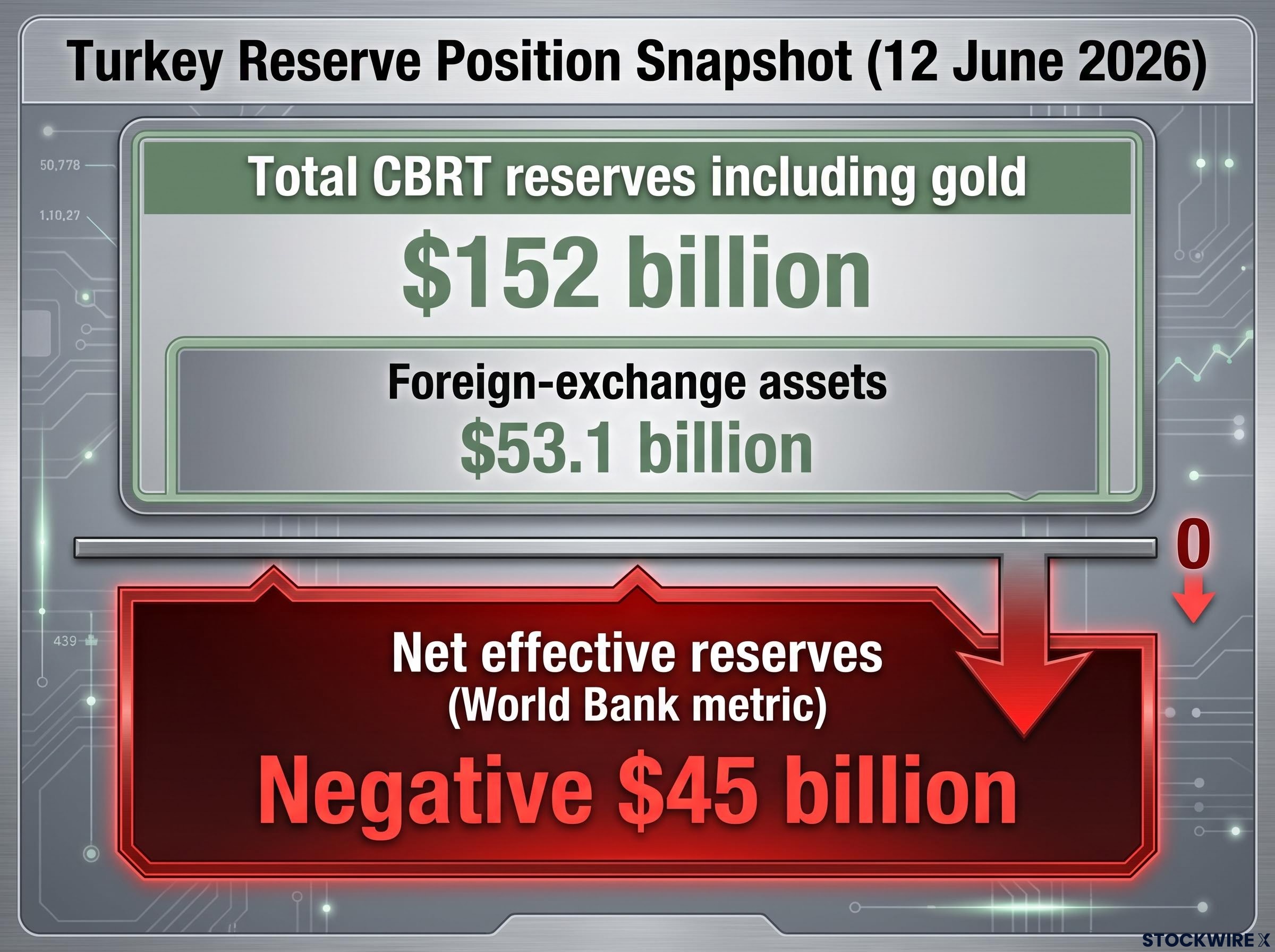
That negative net figure means the CBRT cannot defend the lira through intervention if a second major carry unwind hits during an easing cycle. This transforms the rate cut timeline from a pure monetary policy question into a reserve adequacy question you have to track in parallel.
Four structural risks warrant continuous monitoring for anyone running or considering TRY carry exposure:
- The net reserve position and its trajectory
- The monthly CPI path relative to CBRT projections
- Geopolitical shock vectors, particularly Middle East escalation
- The degree of crowding in long TRY positioning
The arithmetic works until the exit narrows. March 2026 was the reminder. Entry timing, exit discipline and the reserve trajectory matter as much as the spread itself.
What a rate cut cycle in Q4 actually requires from here
Pull the four threads together and a monitoring framework emerges. Q4 cuts materialising depends on a specific combination: sustained monthly CPI deceleration below the Reuters poll trajectory of 27.53%, no external shock to energy or geopolitical stability, continued reserve accumulation, and no premature carry unwind forcing the CBRT to tighten liquidity again.
GDP is the wild card. Softer-than-expected second-quarter growth creates political pressure to ease, which the CBRT must weigh against its inflation credibility. If Q3 GDP also disappoints, that balance tips toward earlier or deeper cuts than the base case of two 100-basis-point reductions to a 35% year-end rate.
Four checkpoints will resolve the question in sequence between now and the anticipated Q4 meetings:
- The September CPI print, measured against the Reuters poll trend
- The October CPI print, confirming or breaking the disinflation momentum
- The Q3 GDP release, testing whether growth pressure intensifies
- The reserve trajectory through November, signalling how much room the CBRT has
The path splits cleanly. A faster cut pace becomes likely if prints undershoot official projections and reserves keep building; easing slips toward 2027 if inflation proves sticky, an external shock lands, or positioning unwinds again.
For investors wanting to track how emerging market central banks signal reserve stress before it appears in spot FX moves, our dedicated guide to EM reserve composition signals examines how sovereign gold accumulation patterns map onto the jurisdictional and sanctions-proofing motivations that shape reserve adequacy decisions across EM institutions.
The 2027 forward curve, pricing only around 100 basis points of total cuts, is the market saying the easing cycle will be shallow and slow. That is precisely what would reprice dovishly if the CBRT’s 15% to 21% end-2026 target starts to look achievable, rewarding anyone who built TRY duration before the consensus shifted.
This article is for informational purposes only and should not be considered financial advice. Investors should conduct their own research and consult with financial professionals before making investment decisions. Past performance does not guarantee future results. Financial projections are subject to market conditions and various risk factors, and forward-looking statements are speculative and subject to change based on market developments.