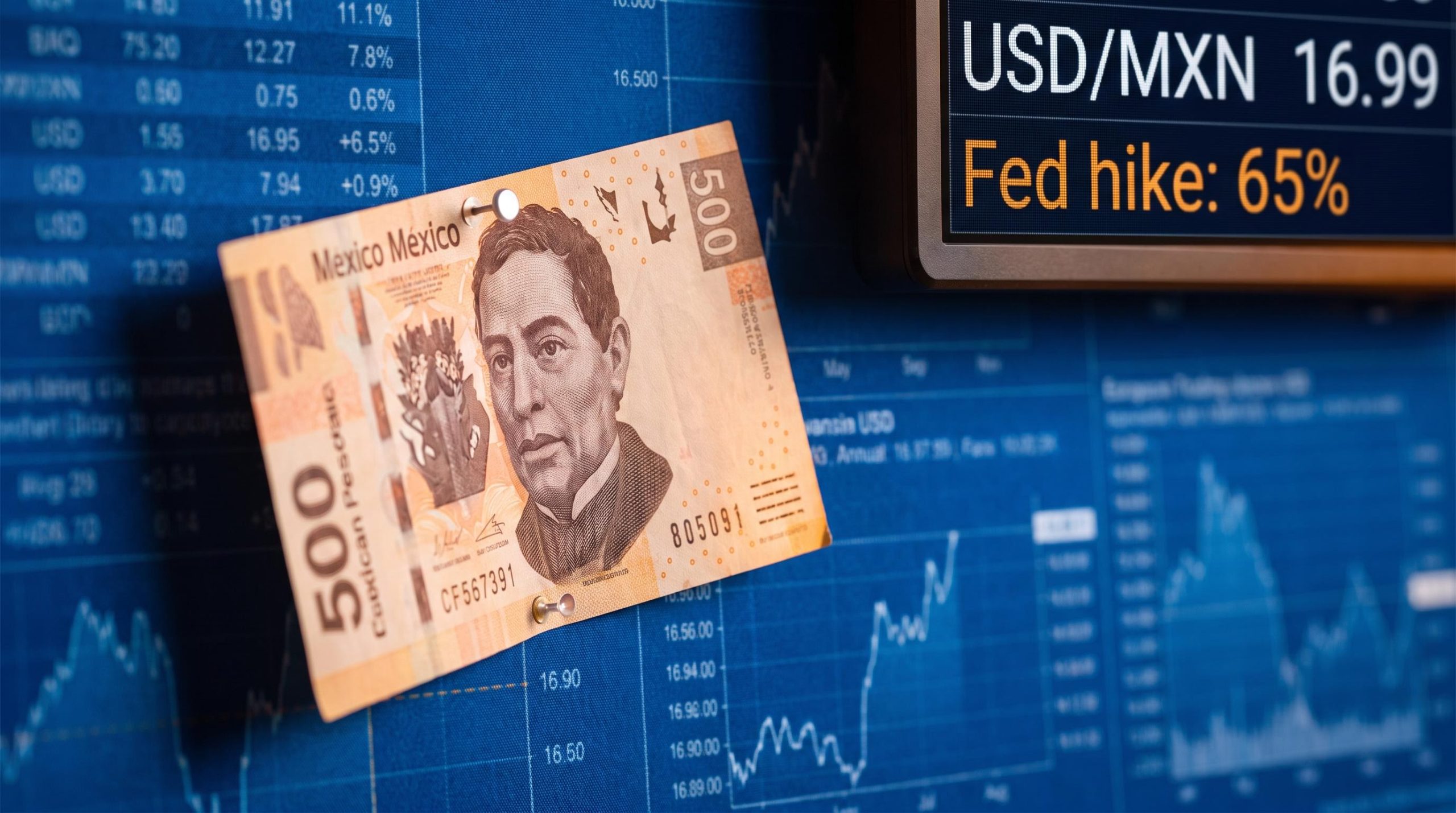
The Mexican Peso is holding near 17.0 against the Dollar today even as geopolitical risk has ratcheted higher overnight. That divergence, Peso strength against a worsening backdrop, tells you something important about what is actually driving this currency pair right now. It is not Mexico. It is the Dollar.
Three distinct forces are bearing down on USD/MXN simultaneously: a Federal Reserve under Chair Kevin Warsh that has repriced rate expectations sharply higher, US-Iran military exchanges that have pushed WTI above $85.00 per barrel, and a USMCA renewal process that stalled at its first joint review on 1 July 2026 without an automatic extension. Each operates on a different time horizon and through a different transmission channel.
Here is how those three drivers map to their respective time horizons, which one is dominant right now, and under what conditions the Peso’s current resilience could quickly unravel.
What today’s price action is actually telling you
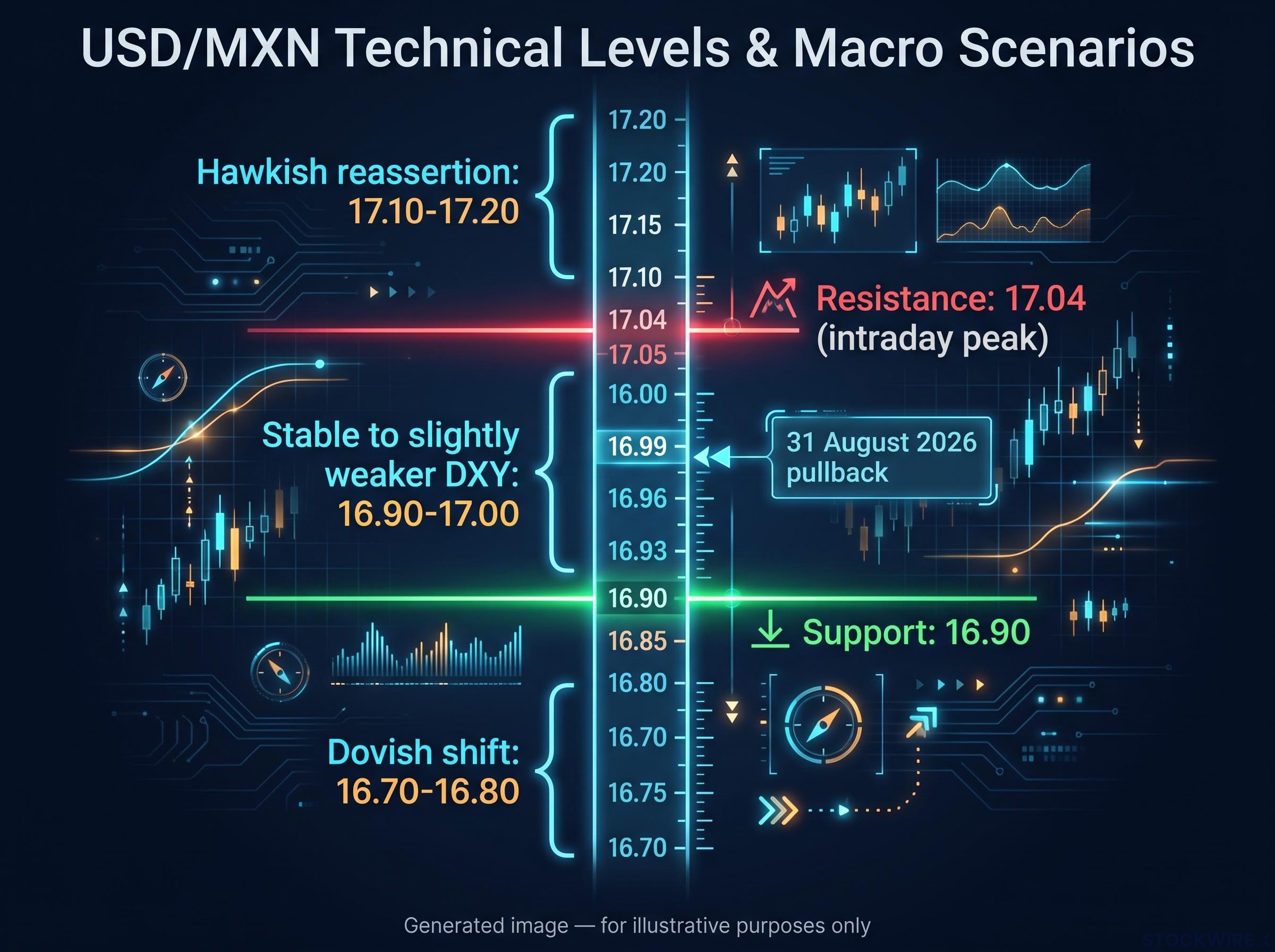
On 31 August 2026, the Peso advanced roughly 0.20% against the Dollar, with USD/MXN touching a session high of 17.04 before pulling back to trade near 16.99. The gain materialised even as overnight US-Iran escalation rattled global risk sentiment and drove an oil price spike higher.
The US Dollar Index (DXY), which gauges the Dollar’s performance against a basket of six major currencies, lost 0.25% on the session. That broad Dollar softness is doing most of the work holding USD/MXN down. This is a Dollar weakness story, not a Peso strength story.
That distinction matters for positioning. The prior week tells you what happens when the Dollar narrative flips. Hawkish commentary from Chair Warsh sent USD/MXN up 0.38% over the course of Friday’s session, with the pair settling at 17.03. The Peso’s current session gain has only partially reversed that move. Read today’s price action as Peso resilience and you draw the wrong conclusion. Read it as conditional relief driven by a softer Dollar, and you have a more accurate framework for what comes next.
The US Dollar Index softness doing the work today is itself a product of intersecting forces, and the Mexican peso drivers that operate beneath the DXY layer, the Banxico rate differential, remittance flows, and nearshoring FDI, each run on separate clocks that today’s session price action alone cannot reveal.
Two technical levels define the boundaries. Support sits near 16.90; resistance is confirmed at the 17.04 intraday peak. A sustained break of either level signals which macro narrative has taken control.
| Scenario | Trigger | USD/MXN Range |
|---|---|---|
| Stable to slightly weaker DXY | Dollar stays soft, no new hawkish catalyst | 16.90-17.00 |
| Hawkish reassertion | Strong US data or renewed Fed rhetoric | 17.10-17.20 |
| Dovish shift | Weak US data or softened Fed language | 16.70-16.80 |
Positioning around MXN right now requires tracking DXY and US rate expectations, not Mexico-specific data releases. The Dollar is the variable that moves first.
When big ASX news breaks, our subscribers know first
The Fed’s hawkish pivot and its direct line to MXN
The sequence that brought USD/MXN to 17.03 last Friday is worth tracing step by step, because it reveals the transmission chain that will dominate this pair over the next two weeks.
- Chair Kevin Warsh delivered hawkish remarks the prior week, signalling the Fed’s willingness to raise rates further if inflation data warrants it.
- Treasury yields repriced higher as markets absorbed the signal, widening the rate differential between US and Mexican assets.
- That wider differential made Dollar-denominated assets relatively more attractive, pulling capital toward US fixed income and away from emerging-market currencies including MXN.
- Rising US yields simultaneously tightened global financial conditions, applying indirect pressure on economies and corporates carrying significant USD-denominated debt.
The output of that chain is now visible in the numbers.
The Federal Reserve’s July FOMC statement, which recorded dissenting votes indicating internal pressure for an earlier hike, established the baseline from which Warsh’s subsequent hawkish commentary was read as a decisive shift in the Committee’s direction.
Prime Terminal data puts the market-implied probability of a 25 basis point rate hike at the 16 September Fed meeting at roughly 65%, representing a full swing in trader positioning relative to where markets stood before Warsh’s remarks.
That 65% figure is where the asymmetry sits, and it is the most important number in the near-term USD/MXN forecast. A hike confirmation at 65% implied probability produces a modest further move higher in USD/MXN because much of the move is already priced. But any dovish surprise, whether from weak US employment data, a softer inflation print, or an unexpected shift in Fed language, could trigger a sharper MXN rally than current positioning suggests, because markets would need to rapidly unwind a crowded hawkish bet.
What the September 16 meeting changes
The Fed meeting is the primary event risk on the tactical horizon. With hike probability at 65%, dips in USD/MXN are more likely to be bought than aggressively extended. That skew persists until either the probability shifts meaningfully or the meeting itself delivers a verdict.
The dot plot repricing from the June 2026 FOMC meeting, which shifted the year-end rate median from 3.4% to 3.8%, was the foundational event that set current market positioning; the 65% September hike probability visible today is a direct descendant of that June signal, not an independent development.
Mexico’s August Consumer Confidence reading, due 3 September, is the first domestic data point before the Fed decision, but its capacity to move the pair is limited compared to incoming US data. The next two weeks of American economic releases will either validate or puncture the 65% hike probability, and that is what anyone with near-term MXN exposure should be watching most closely.
Why the oil price surge is not straightforwardly bad for the Peso
Overnight military exchanges between the US and Iran sent WTI crude surging past $85.00 per barrel, weighing on broader risk appetite and lifting US yields through higher inflation expectations. A reflexive read would classify this as straightforwardly negative for MXN: oil up, risk off, sell emerging markets.
Oil supply shock dynamics from the earlier phase of the US-Iran conflict, when Saudi output collapsed to a 36-year low and global inventories were drawing at 8.5 million barrels per day, established the baseline from which today’s $85 WTI move is being assessed; markets are calibrating the current spike against that prior shock history when deciding how much safe-haven Dollar demand to price in.
That read is incomplete. The oil-MXN channel runs in two opposing directions, and which one dominates depends on conditions that are genuinely uncertain.
Crude oil crossed above $85.00 per barrel on the back of US-Iran military activity, pushing risk sentiment lower across global markets. USD/MXN nonetheless settled near 16.99 on the session.
| Channel Direction | Mechanism | Time Horizon | Dominant When |
|---|---|---|---|
| Positive for MXN | Mexico’s oil production revenue and terms of trade improve with higher crude prices | Medium term (weeks to months) | Oil price rise is gradual, supply-driven, and not accompanied by severe risk-off |
| Negative for MXN | Higher oil raises US inflation expectations, pushes yields up, and drives safe-haven Dollar demand | Short run (days to weeks) | Oil spike is sudden, conflict-driven, and triggers broad risk-off |
Today’s session is a live example of this tension. The Peso held near 16.99 despite an oil-driven deterioration in risk sentiment because Dollar weakness was the bigger force. That does not mean oil escalation is neutral for MXN. It means the Dollar weakness channel was temporarily stronger.
The scenario that collapses this ambiguity is a severe escalation threatening supply routes, particularly the Strait of Hormuz. In that environment, safe-haven Dollar demand would almost certainly overwhelm any benefit Mexico receives from higher nominal oil revenues, implying sharp upside for USD/MXN regardless of Mexico’s producer status.
The analytical work, then, is not in deciding whether oil is “good” or “bad” for MXN. It is in correctly sequencing which channel is active and how durable the Dollar weakness offsetting the risk-off channel really is. Today, the offset held. Tomorrow’s conditions may not permit it.
USMCA uncertainty as the slow-burning structural risk to the Peso
The drivers discussed so far operate on horizons of days and weeks. The United States-Mexico-Canada Agreement (USMCA), the free trade pact governing North American commerce, operates on a horizon of months to years, and it may ultimately matter more than any single Fed decision.
On 1 July 2026, the US, Mexico, and Canada held the first joint review of the USMCA, required six years after the agreement’s entry into force. The parties did not agree to automatically extend the agreement for an additional 16 years. The treaty remains in force, but the absence of renewal triggers a new phase of annual reviews over the next decade. US officials have signalled an aim to reach provisional arrangements before the end of 2026, while more complex issues could remain under negotiation into 2027.
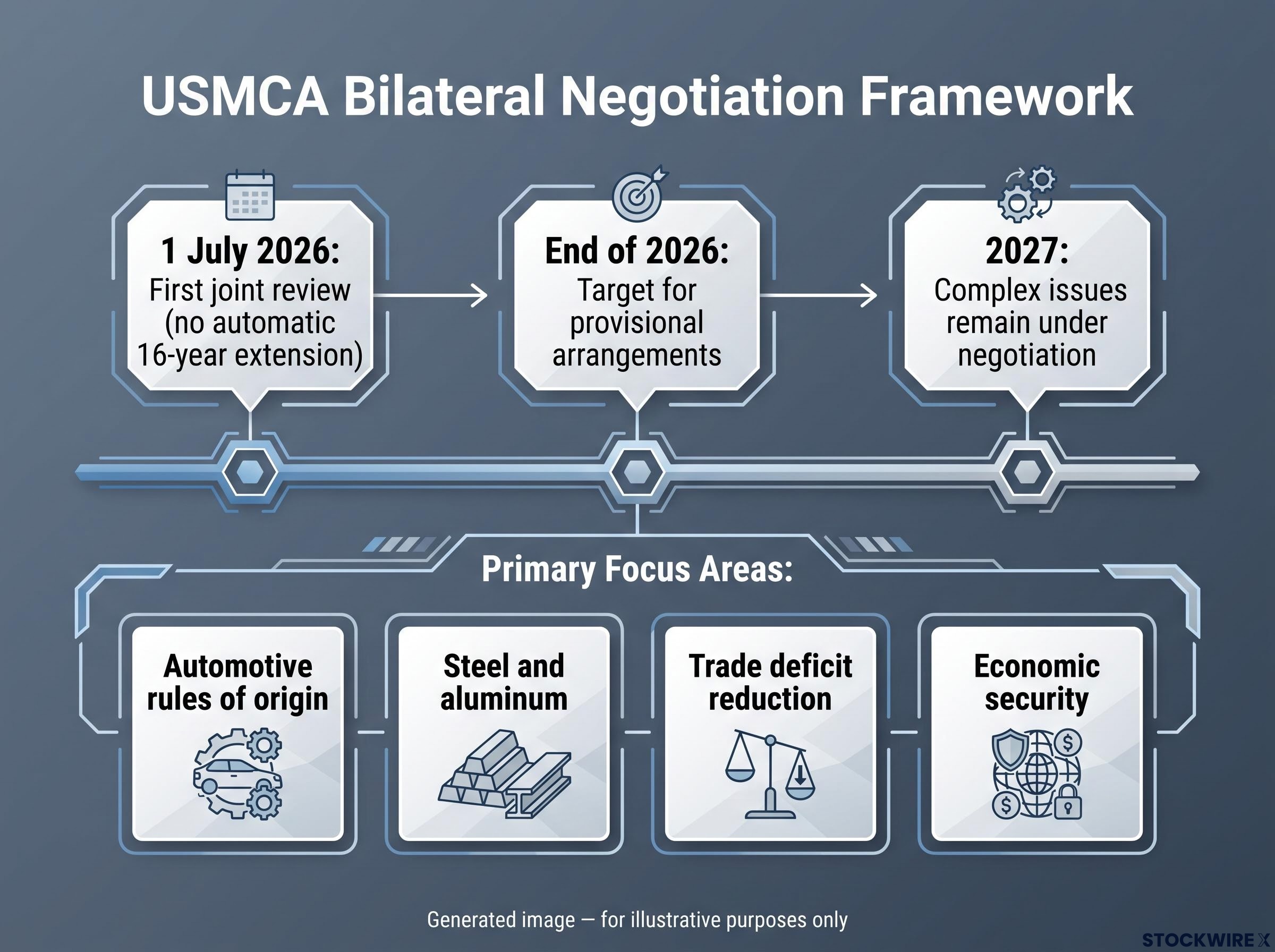
The bilateral rounds between the US and Mexico are focused on four primary areas:
- Automotive rules of origin
- Steel and aluminum
- Trade deficit reduction
- Economic security
Why the nearshoring channel amplifies USMCA risk
Manufacturing foreign direct investment (FDI) into Mexico, the flow of capital from foreign companies building factories and supply chains on Mexican soil, has been anchored on predictable USMCA rules. Prolonged uncertainty over those rules raises the risk that investment decisions are delayed or redirected to other markets entirely. That weakens Mexico’s growth outlook, its current account position, and the structural case for holding MXN.
| Outcome Scenario | Description | USD/MXN Implication |
|---|---|---|
| Constructive extension | Parties reach a provisional arrangement preserving core market access | Anchors USD/MXN near or below current levels |
| Partial friction outcome | Tightened rules of origin or new automotive content requirements imposed | Imposes a lasting risk premium on MXN; limits rally potential |
| Structural breakdown | Meaningful restrictions on Mexican market access or tariff escalation | USD/MXN potentially well beyond 17.50 over time |
Even a middle-ground outcome, one that falls short of outright breakdown but tightens rules of origin or introduces new automotive content requirements, would impose a risk premium on MXN that no Fed pivot can fully offset. That is because it attacks the structural investment story, the nearshoring thesis, that underpins Mexico’s current account. Readers with medium-to-long-term MXN exposure need to track the bilateral negotiation calendar as closely as the Fed meeting schedule.
For readers wanting to stress-test the structural breakdown scenario against a sceptical reading of North American trade politics, our deep-dive into USMCA trade risk frameworks examines how much of apparent tariff escalation reflects electoral positioning versus durable structural rupture, a distinction that changes the probability weight assigned to the severe MXN depreciation scenario.
Reading the risk hierarchy before the next major catalyst
The three drivers organise into a coherent time-horizon map, and knowing which one to watch first depends on your exposure horizon.
| Time Horizon | Primary Driver | Current Signal | USD/MXN Bias |
|---|---|---|---|
| Near term (days) | DXY swings and global risk sentiment | Dollar soft, masking underlying risk | Mildly lower while DXY weakness persists |
| Tactical (weeks) | September 16 Fed meeting; 65% hike probability | Hawkish positioning dominant | Skewed higher; dips likely bought |
| Structural (months to years) | USMCA outcome and nearshoring durability | No extension agreed; annual reviews ahead | Higher if friction materialises |
The overall risk skew is readable from this map. Near-term Dollar weakness is providing temporary relief, but both the tactical and structural horizons lean toward a higher USD/MXN.
The balance of risks tilts mildly toward a higher USD/MXN over the coming months. Peso resilience at 17.0 is real but conditional, and MXN strength remains vulnerable to reversal until both the Fed and USMCA fronts look decisively more benign.
The asymmetric scenario worth tracking is a dovish Fed surprise combined with a constructive USMCA provisional arrangement before the end of 2026. That combination would be the most likely catalyst for a genuine, sustained Peso rally. Both occurring simultaneously, given current negotiating dynamics and a 65% rate hike probability, is a relatively low-probability outcome.
What changes the call, and what the data calendar tells you to watch
Three conditions would materially shift the USD/MXN outlook:
A dovish Fed signal or weak US employment and inflation data before 16 September would puncture the 65% hike probability and relieve the most immediate source of upward pressure on the pair. A constructive USMCA provisional arrangement announced before the end of 2026 would address the structural overhang and allow nearshoring capital flows to resume with greater confidence. A severe Middle East escalation threatening Strait of Hormuz supply routes would override both, driving sharp safe-haven Dollar demand regardless of what happens on the other two fronts.
The monitoring sequence, in chronological order:
- Mexico August Consumer Confidence release on 3 September, the first domestic data point
- US economic data in the two weeks leading into the 16 September Fed meeting, particularly employment and inflation prints
- Federal Reserve meeting outcome on 16 September, confirming or denying the 65% hike probability
- USMCA bilateral communiques from the US-Mexico track, with a provisional arrangement targeted before the end of 2026
Peso resilience at 17.0 is a real but fragile holding pattern. The current level reflects Dollar weakness temporarily masking a risk skew that still leans bearish for MXN. The conditions required to extend that resilience meaningfully, a dovish Fed and a constructive trade outcome, are more demanding than today’s price action implies.
This article is for informational purposes only and should not be considered financial advice. Investors should conduct their own research and consult with financial professionals before making investment decisions. Forward-looking statements regarding Fed policy, USMCA outcomes, and oil price scenarios are speculative and subject to change based on market developments.