The next great health crisis will not announce itself with a televised press conference or a global lockdown. It is already here, spreading through everyday infections that the antibiotics your doctor prescribes can no longer reliably cure.
When a landmark study appeared in The Lancet in September 2024, the numbers were difficult to dismiss: the GRAM Project’s modelling placed cumulative deaths directly attributable to antimicrobial resistance (AMR) at roughly 39.1 million across the period from 2025 to 2050, a toll that resolves to something close to three lives lost every single minute. In July 2026, the US government responded by placing broad-spectrum antimicrobials as its second-highest biodefence funding priority, behind only pandemic influenza.
This is no longer a background medical concern. It is becoming a foreground economic priority that is reshaping how governments spend and how the biotechnology sector develops new treatments. Here is a clear framework for understanding the mechanics of the AMR crisis, why the traditional antibiotic pipeline is failing, and how ASX biotech stocks and their global counterparts are being forced to engineer entirely new solutions.
The numbers behind a slow-motion global crisis
The mortality data is difficult to process, and that is partly the point. AMR does not produce a single catastrophic event. It kills incrementally, across thousands of hospitals and clinics, in infections that used to be routine.
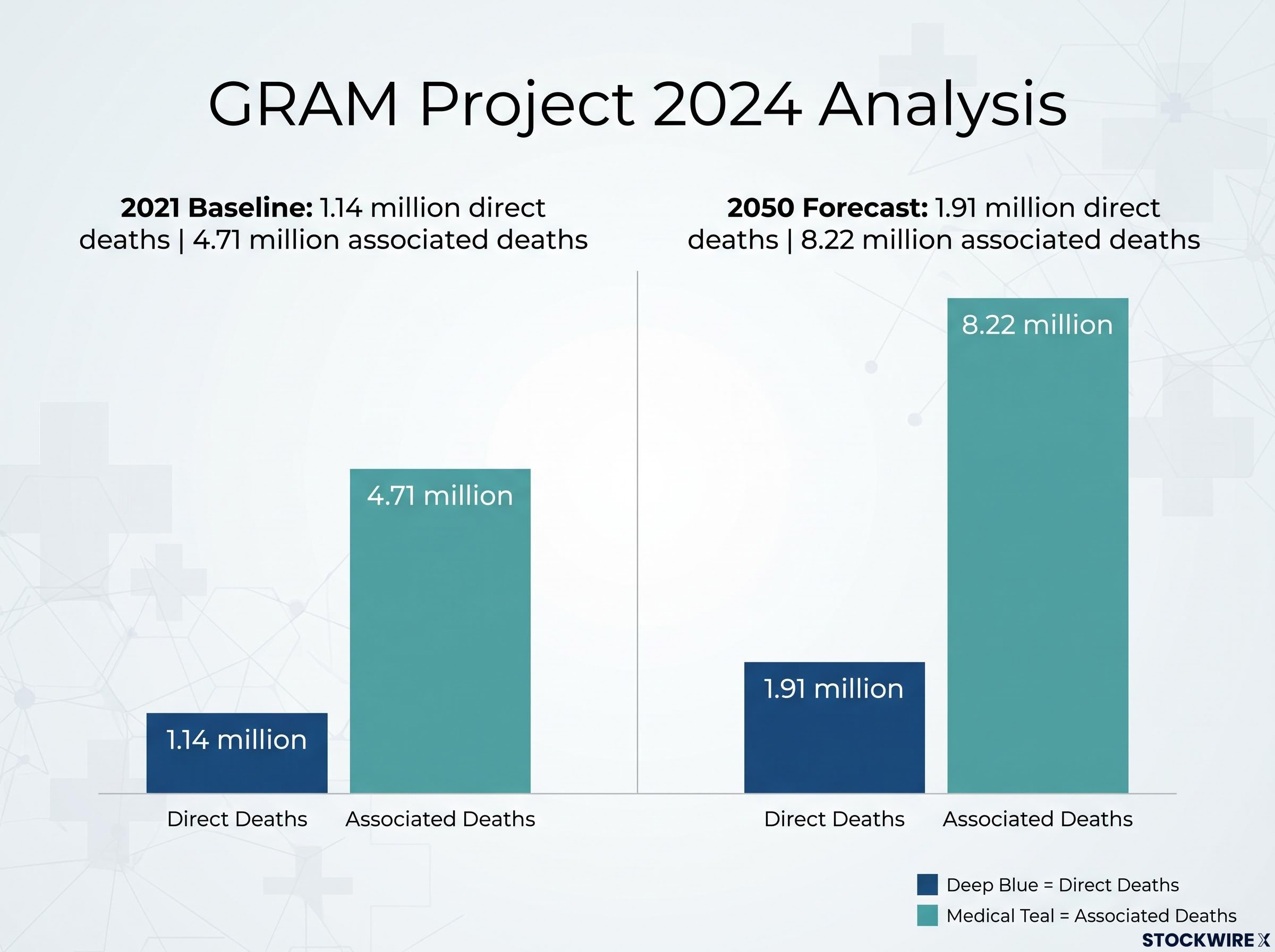
The 2024 Lancet analysis was the work of the Global Research on Antimicrobial Resistance (GRAM) Project, a collaboration between Oxford University and the Institute for Health Metrics and Evaluation (IHME). Its findings for 2021 alone were stark: bacterial AMR was the direct cause of death for 1.14 million people across the globe, while resistant infections contributed to a further 4.71 million deaths, cases where resistance was a factor alongside other causes rather than the singular driver.
Those are not projections. Those are modelled estimates of what already happened.
The forward view is worse. Under the GRAM Project’s reference scenario, annual deaths directly caused by AMR are forecast to reach 1.91 million by 2050, with 8.22 million associated deaths per year. The study’s cumulative toll across 2025 to 2050 sits at roughly 39.1 million deaths attributable to AMR under that scenario.
A separate, earlier modelling exercise adds further weight. The O’Neill Review, commissioned by the UK government and published in its final form in 2016, projected 10 million annual AMR-related deaths by 2050 under its own scenario assumptions, a figure that would surpass current global cancer mortality. The O’Neill Review and the GRAM Project used different methodologies, different scopes, and different base assumptions; readers should treat them as independent estimates rather than complementary data points from a single body of evidence.
| Model | Methodology Focus | 2050 Key Projections |
|---|---|---|
| Lancet/GRAM Project (2024) | Systematic global analysis of 1990-2021 data with scenario-based forecasting to 2050 | 1.91 million attributable deaths per year; 8.22 million associated deaths per year |
| O’Neill Review (2016) | Scenario-based modelling commissioned by the UK government, focused on total AMR-related mortality | 10 million AMR-related deaths per year (under specific scenario assumptions) |
Both are projections, not confirmed outcomes. But the sheer volume of these mortality models tells you something important: this is not a niche medical issue. It is a systemic risk that will eventually touch every healthcare system your family relies upon.
When big ASX news breaks, our subscribers know first
How the standard antibiotic pipeline effectively broke itself
To understand why new treatments are so scarce, you first need to understand how bacteria win.
Every time an antibiotic is used, whether appropriately or not, it creates what scientists call evolutionary pressure. The drug kills most of the bacteria it targets, but any bacterial cells that happen to carry a genetic mutation allowing them to survive gain an enormous advantage. They reproduce. They spread. Over time, entire populations of bacteria become resistant to the drug that once eliminated them.
This is not a rare occurrence. It is a fundamental feature of biology. Bacteria reproduce rapidly, sometimes dividing every 20-30 minutes, and each division is an opportunity for a resistance-conferring mutation to appear or be shared between organisms.
The problem is compounded by what is coming through the development pipeline. Clinical-stage antibiotic candidates are overwhelmingly derivatives of familiar drug families, built by adjusting the molecular structure of established compounds rather than introducing mechanisms that bacteria have never encountered. Because resistance to a parent drug class can confer at least partial protection against chemically similar successors, patients may face a new treatment that bacteria can already partially neutralise on its first day in the clinic.
The structural limitations of the current global antimicrobial development pipeline include:
- Most candidates are chemical derivatives of established antibiotic classes, not mechanistically novel
- Genuinely new antimicrobial mechanisms remain scarce in clinical-stage development
- Decades of underinvestment have thinned the pipeline of early-stage novel candidates
- Resistance spreads faster than replacement therapies are introduced
Simply funding more of the same traditional drug development will not solve this for you, because bacteria have already learned how to defeat the underlying chemistry the pipeline is relying on.
The commercial roadblock for new therapies
Even when a genuinely promising antibiotic does emerge, the economics work against it. New broad-spectrum antibiotics face a pricing and reimbursement paradox that is unique in medicine.
If a new drug works well against resistant infections, public health guidelines typically recommend holding it in reserve, using it only when existing options fail. That is good medicine. It preserves the drug’s effectiveness by limiting the evolutionary pressure that drives resistance.
But it is terrible business. A drug held in reserve generates minimal revenue, regardless of how effective it is. The result is a market where the most successful clinical outcome, a powerful last-resort antibiotic, produces the weakest commercial return. That dynamic has driven major pharmaceutical companies away from antibiotic development for decades, leaving the field to smaller biotechs with thinner balance sheets and higher risk profiles.
The US government’s multi-billion dollar strategic pivot
The biological problem alone was not enough to move government budgets. What shifted the calculus was the growing recognition that antimicrobial resistance poses a direct threat to national security, military readiness, and pandemic preparedness.
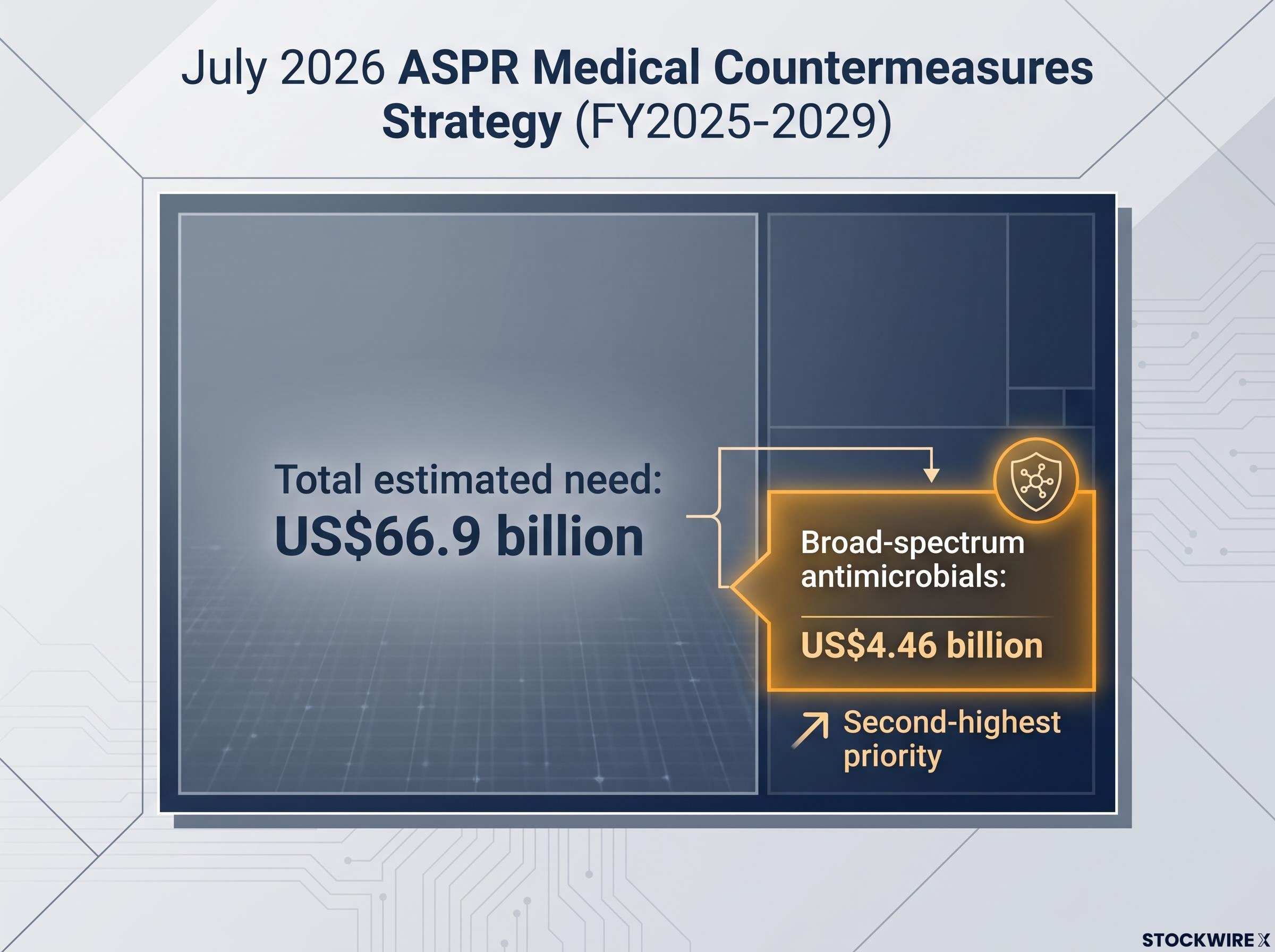
In July 2026, the US Administration for Strategic Preparedness and Response (ASPR) released its five-year medical countermeasures strategy, covering FY2025-2029, through the Public Health Emergency Medical Countermeasures Enterprise framework. The numbers were striking.
The total estimated medical countermeasures funding need across the strategy: US$66.9 billion.
Within that framework, broad-spectrum antimicrobials were allocated approximately US$4.46 billion, ranking as the second-highest funding priority after pandemic influenza.
That capital allocation signals something you should pay close attention to: the world’s largest defence apparatus now treats bacterial resistance with the same financial urgency as a viral pandemic. For clinical developers working on novel antimicrobial mechanisms, this represents a significant policy tailwind.
The biodefence funding pipeline extends beyond bacterial resistance to include antiviral countermeasures, with ASX-listed Island Pharmaceuticals building its Galidesivir programme around the same US government procurement frameworks described here, targeting Strategic National Stockpile contracts through the FDA Animal Rule pathway for Marburg and Ebola.
It is worth being clear about what these figures do and do not represent: they reflect the strategy’s stated funding needs and priorities, not appropriated budgets or commitments directed at any specific company. Access to this capital for any given developer would require a separate, competitive application process. But the direction of travel is unmistakable, and it fundamentally alters the funding environment for early-stage antimicrobial research.
The full breakdown of the ASPR biodefence strategy, including which pathogen categories secured priority allocations and how existing CRADA holders are positioned relative to the funding framework, is covered in dedicated news coverage of the July 2026 announcement.
Tackling the crisis from multiple fronts with synthetic technology
Policy frameworks and mortality projections tell one part of the story. The other part lives in the laboratory, where a small number of biotechnology companies are engineering approaches that attack the resistance problem from a fundamentally different angle.
Australian biotechnology company Recce Pharmaceuticals (ASX: RCE) provides a useful worked example of how the sector is responding. The company’s pipeline centres on a range of synthetic, broad-spectrum anti-infective candidates built around polymer technology rather than conventional antibiotic chemistry. This architectural difference is material: because Recce’s platform does not belong to the drug families that resistant bacteria have spent decades learning to neutralise, it operates outside the chemical territory where existing resistance mechanisms tend to function.
The company’s lead candidate, RECCE 327 (R327), is being tested across multiple clinical settings simultaneously, which shows you exactly why broad-spectrum assets are becoming so valued in the global AMR response:
- Civilian chronic wounds: The topical gel formulation (R327G) is running Phase 3 registrational trials across sites in Australia and Indonesia, with diabetic foot infections as the primary indication, a complication that is both clinically serious and frequently resistant to standard treatment. An interim data readout from the Indonesian trial is anticipated, with commercial launch in Indonesia targeted around end-2026, subject to positive data and regulatory completion.
- Military trauma medicine: Recce has established two Cooperative Research and Development Agreements (CRADAs) with US Army medical research bodies, specifically the US Army Medical Research Institute of Infectious Diseases (USAMRIID) and the US Army Institute of Surgical Research (USAISR). The research programmes under these agreements evaluate R327G against MRSA (methicillin-resistant Staphylococcus aureus) and multi-drug-resistant Pseudomonas aeruginosa in burn wound contexts, supported by US$2 million in funding from the Congressionally Directed Medical Research Programs (CDMRP).
- Systemic indications: R327’s intravenous formulation targets serious systemic infections including sepsis, the broadest and most lethal application of the technology.
USAMRIID research partnerships have become a recurring structural element in how ASX biotech companies validate their antimicrobial and antiviral programmes, with the institute’s BSL-4 laboratory access and regulatory expertise providing external credibility that is difficult to replicate through commercial arrangements alone.
Watching how a single synthetic technology is being tested in both civilian diabetic clinics and military trauma centres shows you why broad-spectrum assets are attracting attention across completely different medical settings, and why governments are willing to fund them.
Institutional validation and regulatory pathways
Several independent designations provide external validation of R327’s positioning within the global pipeline.
The US Food and Drug Administration (FDA) awarded R327 Qualified Infectious Disease Product (QIDP) designation under the GAIN Act. The practical consequences of that designation include Fast Track status, which can shorten the regulatory review timeline, together with a 10-year period of market exclusivity that would begin on potential approval. For a small-cap biotech, that exclusivity period is a meaningful commercial runway.
According to the Pew Charitable Trusts’ Global New Antibiotics in Development Pipeline review, R327 holds a singular position in the global dataset: it is the only synthetic polymer candidate in the pipeline that is also targeting sepsis. Beyond R327, all three of Recce’s core compounds, including R435 (the oral formulation) and R529 (the antiviral candidate), appear on the World Health Organization’s list of antibacterial products in clinical development targeting priority pathogens, an independent signal that the global health community considers the pipeline relevant to the documented burden of resistance.
These are not guarantees of success. They are markers that independent international bodies have assessed the pipeline’s relevance to the AMR crisis and found it worth tracking.
Pricing in the reality of a post-antibiotic era
The threads of this story converge on a single uncomfortable conclusion. Bacterial resistance is accelerating. The traditional antibiotic pipeline is structurally unable to keep pace. And governments are only now beginning to allocate capital at a scale that matches the documented mortality burden.
For the biotechnology sector, and for ASX biotech stocks specifically, the macroeconomic tailwinds are strengthening. Federal biodefence strategies are creating funding pathways that did not exist five years ago. Regulatory mechanisms like QIDP designation are designed to de-risk the commercial model that has historically driven developers away from antibiotic research.
For ASX biotech stocks at the clinical stage, milestone-based analysis replaces the earnings and valuation metrics that apply to profitable companies; regulatory designations, trial progression, and conference outcomes are the signal set that actually reflects probability-weighted value for pre-revenue developers.
But tailwinds are not certainties. Biotechnology development carries inherent pre-approval risks: clinical trials can fail, regulatory pathways for novel mechanisms can encounter unexpected hurdles, and the pricing and reimbursement challenges that plague new antibiotics will not disappear overnight. Competitive risk also exists, as other development-stage companies and academic programmes are pursuing alternative approaches.
The question is whether the world can close the gap between the treatments it needs and the treatments it has before the 2050 projections edge closer to reality. The scale of the crisis suggests the answer depends on whether genuinely novel approaches can survive the long path from laboratory to clinic.
This article is for informational purposes only and should not be considered financial advice. Investors should conduct their own research and consult with financial professionals before making investment decisions. All forward-looking statements regarding clinical trials, regulatory approvals, and commercialisation timelines remain subject to successful outcomes, regulatory approval, and market access. Past performance does not guarantee future results.
—