

Shine Justice delivers stronger FY26 result with adjusted NPAT up 62.9%
In its FY26 full year results presentation released on 28 August 2026, Shine Justice Ltd (ASX: SHJ) reported a materially improved earnings profile for the financial year ended 30 June 2026, headlined by adjusted net profit after tax (NPAT) of $15.8m, up 62.9% on FY25’s $9.7m.
Adjusted revenue reached $220.4m, up 7.8%, while adjusted earnings before interest, tax, depreciation and amortisation (EBITDA) rose 13.7% to $44.7m. The year also marked the group’s 50-year milestone, presented as “SHINE 50 — 50 years serving the community.”
Shine Lawyers operates as one of the nation’s largest plaintiff law firms across two segments, Personal Injury and Class Actions, under a predominantly no-win-no-fee model, complemented by an evolving international mass torts capability. Management framed the FY26 result as a stronger earnings profile alongside a well-funded balance sheet.
When big ASX news breaks, our subscribers know first
FY26 financial snapshot at a glance
The headline figures below reflect adjusted (non-IFRS) measures used by management to assess underlying performance. These differ from the statutory result, which absorbed $13.0m in write-downs of revenue and disbursements on a legacy class action.
| Metric | FY26 Adjusted | FY25 Adjusted | Change | Note |
|---|---|---|---|---|
| Adjusted revenue | $220.4m | $204.4m | +7.8% | Led by Personal Injury |
| Adjusted EBITDA | $44.7m | $39.3m | +13.7% | Margin expansion |
| Adjusted NPAT | $15.8m | $9.7m | +62.9% | Earnings recovery |
| Adjusted basic EPS | 11.19c | 5.96c | +87.8% | Per share uplift |
| Operating cash flow | $19.0m | $19.5m | Broadly flat | Stable generation |
| Net work in progress | $366.6m | $363.5m | +0.9% | Future revenue pipeline |
Statutory NPAT was $6.7m. The reconciliation between statutory and adjusted results reflects the following items:
The H1 FY26 profit turnaround, which saw Shine swing from a $1.7 million loss to a $6.7 million profit on 8% revenue growth, established the trajectory that the full-year result has now confirmed.
-
An $11.2m increase in the constraint carried against revenue on a legacy class action.
-
A $1.8m write-down on the recoverability of disbursements on the same legacy matter.
-
No fair-value loss on deferred consideration this year, compared with a $9.6m non-cash loss in FY25.
Personal Injury growth offsets legacy Class Action drag
Management presented FY26 as a two-segment story, with Personal Injury growth offsetting the impact of write-downs on a legacy Class Action matter.
The legacy class action writedown, which Shine flagged ahead of results and which carried no cash flow impact in the year, was the subject of an appeal consideration by management at the time of announcement.
Personal Injury — the foundation
Personal Injury remains the core damages-based plaintiff practice, spanning motor accidents, workers’ compensation, public liability, medical law, abuse law and dust diseases. The segment reported revenue of $180.9m (FY25: $166.3m), an increase of 8.8%, with EBITDA up 18.4% to $36.6m from $30.9m.
Operational highlights included more than 4,000 clients compensated, over $800m in damages secured, and 5,900+ new files opened, with a further 180 files acquired during the year.
The presentation noted an 8.5% market share across a fragmented market, supported by 47 PI offices and 540+ PI staff. Management attributed the result to the highest fees billed on record and improved legal work per fee earner, underpinned by lower staff turnover.
Class Actions — addressing legacy matters, building for growth
Positioned as one of Australia’s largest practices, the Class Actions segment focused on structure and strategy during the year. Adjusted revenue rose to $39.4m (FY25: $38.1m), with adjusted EBITDA up 6.5% to $8.2m from $7.7m. The presentation noted this adjusted EBITDA figure “Excludes $11.2m constraint increase and a $1.8m fair value loss on disbursements on legacy matter.”
The segment held 26 active matters and 22 investigation matters. Management highlighted six in-principle settlement agreements totalling over $290 million, alongside the group’s first class action win in New Zealand.
A deep Class Action pipeline underpins future upside
The Class Actions growth story centres on approximately 48 open matters diversified across seven sectors, including financial services, First Nations/social justice, shareholder, consumer, employment, medical and environmental. Management noted that concentration risk is actively managed through sector breadth.
The core mechanic is straightforward: matters under investigation convert to revenue upon filing. Strong referrals from the group’s US hub are driving new pipeline momentum, while portfolio funding discussions were described as well progressed.
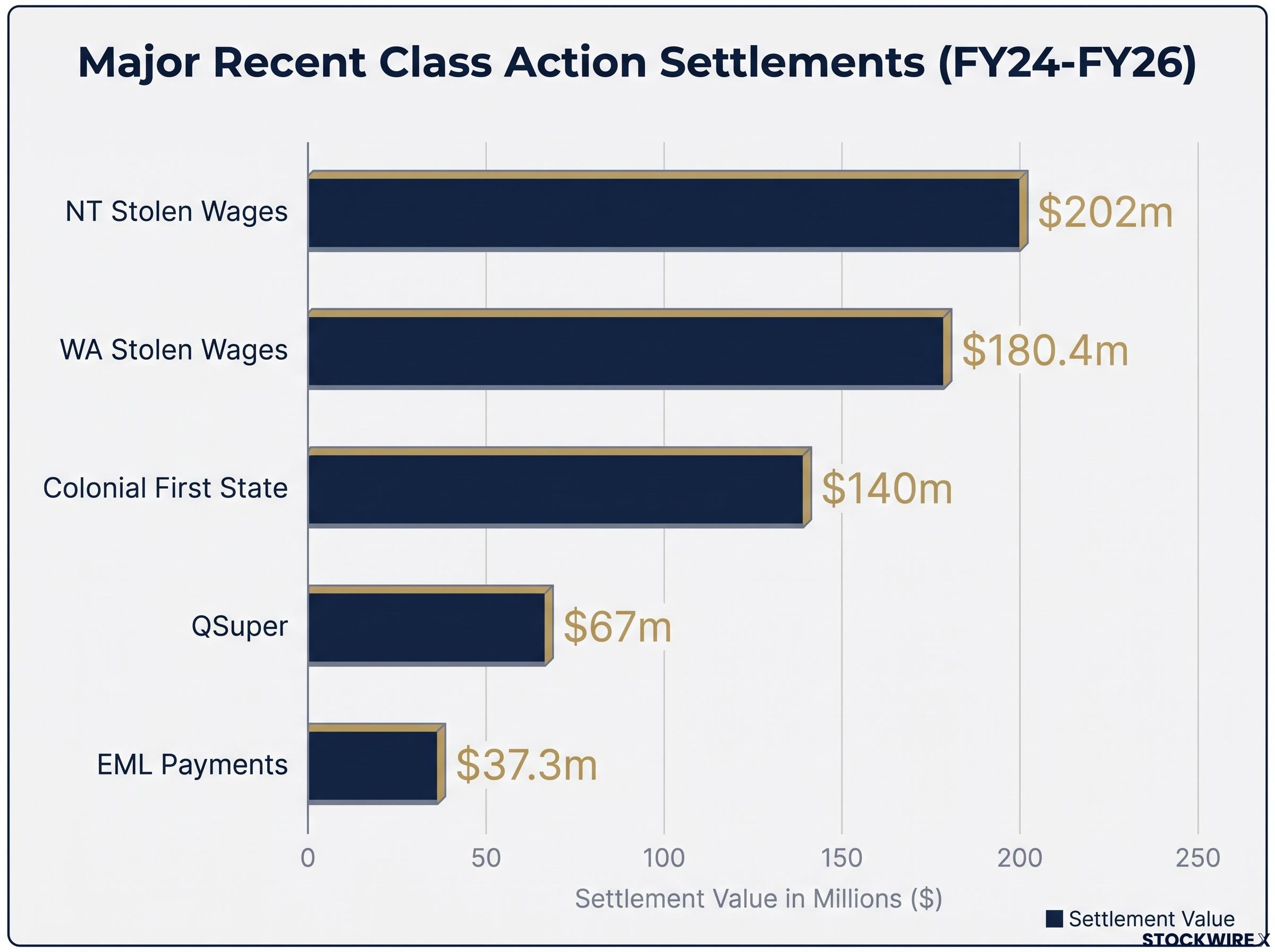
FY24–FY26 Landmark Outcome
Over $380m in combined Stolen Wages compensation secured across the Northern Territory ($202m) and Western Australia ($180.4m) matters, described as the defining landmark First Nations outcome of the period.
Major recent wins across FY24 to FY26 included:
-
NT Stolen Wages — up to $202m settlement on behalf of Aboriginal and Torres Strait Islander peoples.
-
WA Stolen Wages — up to $180.4m, Federal Court approved.
-
Colonial First State — in-principle $140m settlement (November 2025).
-
QSuper — $67m settlement.
-
EML Payments — $37.3m shareholder class action settlement.
By sector, Financial Services leads filed actions with 7, while Consumer and Medical hold the largest under-investigation cohort at 6 each, signalling near-term conversion opportunity.
Understanding net work in progress — why the $366.6m matters
For a plaintiff law firm operating on a no-win-no-fee basis, net work in progress (WIP) represents the value of case investment on matters that have not yet been billed. In plain terms, it reflects the accumulated effort and cost invested in cases that are expected to generate revenue once they resolve.
A large WIP balance, in this case $366.6m (up 0.9%), matters to investors for two reasons. It underpins a pipeline of future revenue and supports cash conversion as cases settle, but it also ties up capital until those matters are resolved.
This connects directly to management’s forward focus. Converting WIP into billed fees and cash sits at the centre of the FY27 cash-conversion story the company outlined.
Balance sheet, capital returns and technology strategy
A funded and compliant balance sheet
Net assets stood at $259.7m, broadly stable and down 0.6% on FY25. Cash and equivalents were $12.5m (FY25: $18.1m), while net debt including lease liabilities rose 6.5% to $86.3m.
The group held $119.7m in financing facilities with $41.4m of headroom, running to March 2028, and complied with all banking covenants. Franking credits available at 30 June 2026 were $6.1m (FY25: $4.4m).
Disciplined capital returns
The company declared a fully franked final dividend of 2.5c per share for FY26, payable in October 2026, taking the total FY26 fully franked dividend to 4c per share. Across the total life of the on-market buy-back scheme, 3.87m shares were cancelled.
Management noted its commitment to fully franked dividends is being maintained, balanced against continued investment in growth.
Technology roadmap — from proof of concept to maturity
Management outlined a FY25–FY28 technology roadmap, with FY26 representing the “Proof of Concept” phase. During the year, the group implemented an enterprise AI governance framework, deployed AI capabilities across legal and business operations, and established a data platform.
The Emerging Technology Centre, established in FY25, continues to identify and deploy AI capabilities, while Salesforce CRM remains the core client intake platform, now enhanced with AI. Management positioned these initiatives as supporting operating leverage and scalability into FY27 and FY28.
Strategy and FY27 outlook
Management outlined a forward agenda built around three strategic pillars:
-
Scale Personal Injury: maintain productivity and recoverability momentum, grow suitable file volumes, and pursue disciplined acquisition opportunities.
-
Build the Class Action engine: increase investigation-to-filing velocity, advance external funding arrangements, and progress Australian, New Zealand, Thailand and other international opportunities.
-
Improve cash and efficiency: convert WIP into billed fees and cash, scale technology-supported workflows, and preserve facility and covenant headroom.
For FY27, the group indicated it expects growth in both Personal Injury and Class Action segment profitability, alongside an increase in Group cashflow. Personal Injury momentum from FY26, reflecting improvements in legal work per fee earner, fewer write-offs and higher resolution quantum, is expected to carry into FY27. Litigation and portfolio funding arrangements are to be progressed and finalised.
Management framed the outlook clearly: Shine enters FY27 focused on sustaining Personal Injury momentum, strengthening Class Actions earnings quality and increasing Group cash conversion.
Don’t Miss the Next Consumer Sector Winner on ASX
Big News Blast delivers FREE breaking ASX news directly to your inbox within minutes of release, complete with in-depth analysis already done for you. Join 20,000+ investors who stay ahead of the market the moment announcements drop. Click the “Free Alerts” button at Big News Blast to start receiving real-time coverage across ASX Consumer and beyond.