On Wednesday, the USD/CHF pair gained approximately 0.47%, pushing the exchange rate to around 0.8052, as stronger-than-expected US inflation figures drove dollar demand. On the same day, Switzerland’s ZEW Survey Expectations Index (a forward-looking measure of economic sentiment) posted a reading of 12.1 for August, climbing from 10.0 the month before. Better Swiss data, weaker franc. That is the paradox.
The contradiction is not a one-off. It is symptomatic of a structural imbalance that has been building since June 2025, when the Swiss National Bank (SNB) locked its policy rate at 0% and left it there. Understanding why the Swiss franc weakens on days when Switzerland’s economy looks fine requires understanding what actually moves currencies in a rate-differential world, and rate differentials are doing the heavy lifting in USD/CHF right now.
Here is the framework that makes the Wednesday move, and every move like it, legible. After this, you will have a clear mental model for connecting central bank rate decisions to currency pair direction, using USD/CHF as the working example, so the next time the pair ticks higher on a US data print, you will know exactly why.
The number that explains the move: a 350-basis-point yield gap
The two numbers that matter most for USD/CHF right now are these:
The SNB’s policy rate sits at 0%, held since June 2025 and reaffirmed at the June 2026 quarterly assessment. The Federal Reserve’s target range is approximately 3.50%-3.75% (mid-2026 estimate). That is a policy rate gap of roughly 350 basis points in the dollar’s favour.
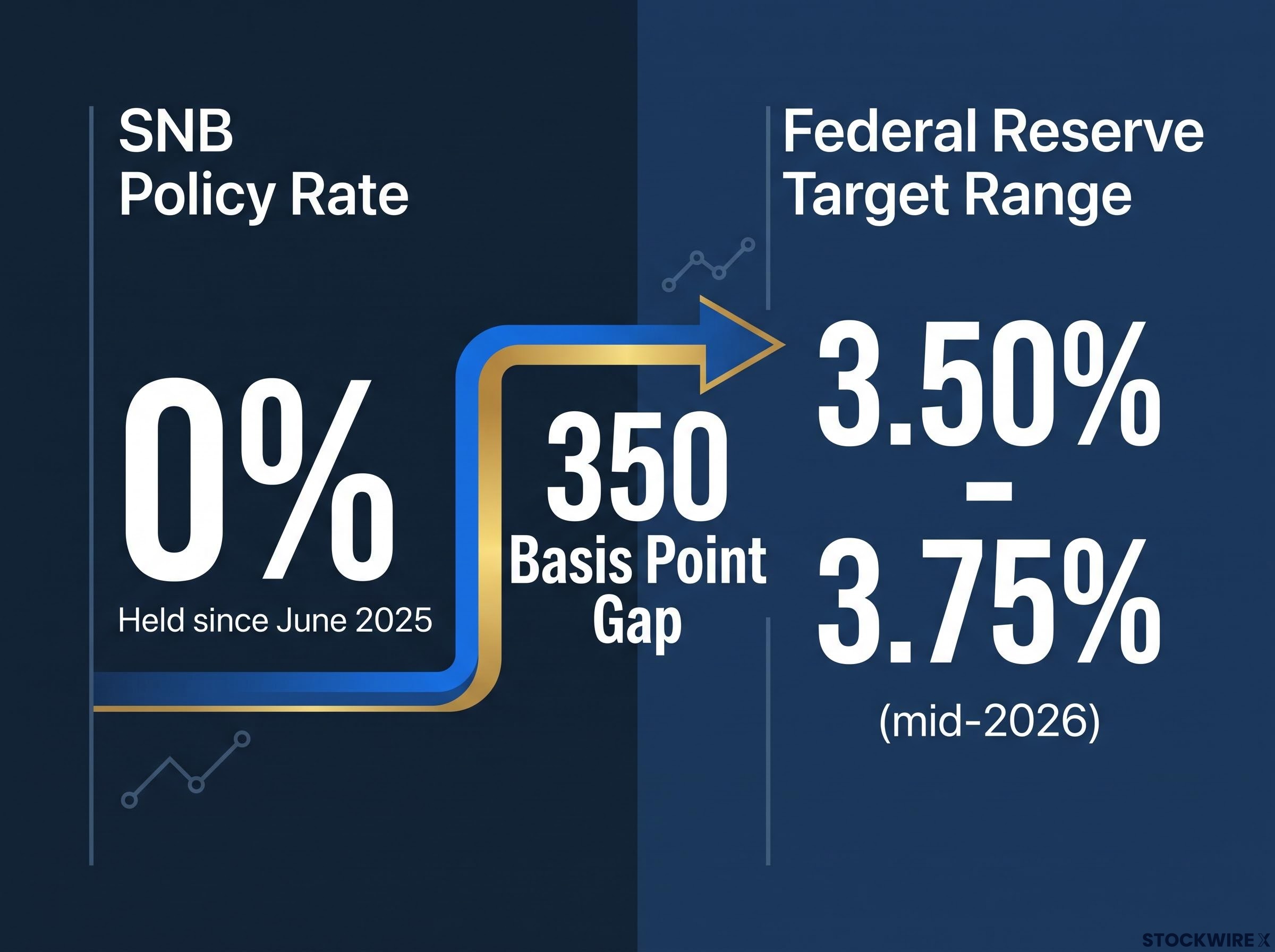
Three hundred and fifty basis points is not a rounding error. It is the single most important quantitative fact shaping this currency pair, and the carry logic that flows from it is straightforward.
Carry is the return you earn simply by holding a currency. When you hold US dollar-denominated short-term paper, you earn a positive real return at current rates. When you hold Swiss franc cash, you earn effectively nothing in nominal terms. Capital has a structural incentive to prefer dollars, and the mechanics are simple:
The mechanics of policy rate transmission operate through a floor-ceiling corridor: the rate paid on reserves sets the floor, a standing lending facility sets the ceiling, and open market operations fine-tune overnight liquidity supply to hold the overnight rate within that band.
- The SNB holds its policy rate at 0%, removing any yield incentive to hold francs
- The Fed holds at approximately 3.50%-3.75%, offering a meaningful return on dollar-denominated assets
- Capital flows toward the higher-yielding currency, lifting USD/CHF
That three-step logic is what played out on Wednesday. Stronger US inflation data reduced the probability of near-term Fed rate cuts. A delay in cuts means the rate gap persists for longer. A longer-lasting gap means the carry advantage stays in place, which is why USD/CHF moved higher. The US Dollar Index (DXY) rose approximately 0.25% to around 99.16 on the same session, confirming broad dollar demand.
The 350-basis-point gap means that, in the absence of any other factor, rational capital has a strong structural reason to favour USD over CHF. Any US data print that delays Fed cuts makes that advantage persist longer, which is exactly what the Wednesday move reflected. This is not a one-day story. Rate differentials are the single most important driver of currency pair direction in normal market conditions, and understanding this gap gives you an interpretive framework that extends well beyond a single session.
When big ASX news breaks, our subscribers know first
Why Switzerland’s ultra-low inflation keeps the SNB on the sidelines
The rate gap only matters because it is locked in place. To understand why it stays locked, you need to understand the rule the SNB operates under.
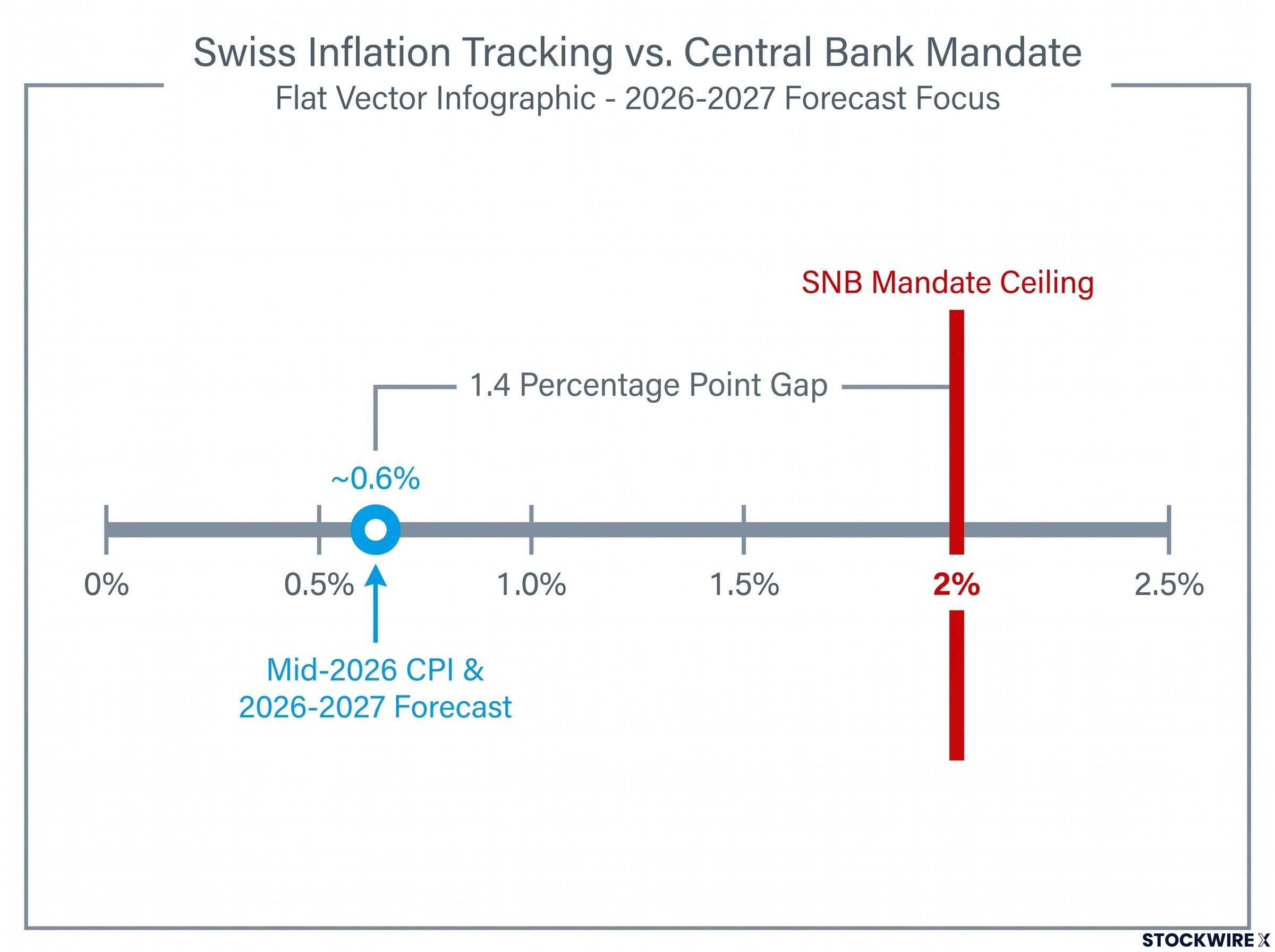
The SNB’s formal definition of price stability is annual Swiss CPI growth of below 2%. That is the threshold that determines whether the SNB has any mandate-driven reason to move rates.
SNB price stability definition: Annual CPI inflation below 2%. This is the formal threshold that governs whether the central bank faces pressure to tighten monetary policy.
Swiss inflation is currently nowhere near that ceiling. CPI hovered around 0.0%-0.1% in late 2025 and early 2026, rising to approximately 0.6% by mid-2026, driven primarily by higher energy prices. The SNB’s own conditional forecast puts average inflation at roughly 0.6% for 2026-2027, assuming the policy rate remains at 0% throughout the forecast horizon. That is 1.4 percentage points below the mandate ceiling.
| Category | Switzerland | United States | Implication for USD/CHF |
|---|---|---|---|
| Current policy rate | 0% | ~3.50%-3.75% | 350 bp gap favours USD |
| Recent CPI reading | ~0.6% | Above target | US inflation delays cuts, widening gap |
| Central bank mandate threshold | Below 2% | 2% target | SNB has no pressure to tighten |
| Market expectation for rates in 2026 | Held at 0% | Cuts delayed by sticky inflation | Gap expected to persist through 2026 |
This is where the asymmetry between Swiss and US macro surprises becomes visible. On the US side, stronger inflation data translate directly into dollar strength because they push back Fed-cut expectations and keep the yield advantage alive. On the Swiss side, positive economic surprises (like the ZEW sentiment improvement to 12.1) do not translate into franc strength because markets see no credible path to SNB rate hikes when inflation is running 1.4 percentage points below the ceiling.
Swiss inflation near zero means the SNB has no mandate-driven reason to raise rates, so any improvement in Swiss economic data is essentially inert from a currency-yield perspective, and CHF traders know it. The analytical habit this teaches you is worth carrying to any currency pair: do not just ask “is the economy improving?” Ask “does this improvement create a plausible central bank rate response?” If the answer is no, the macro surprise is unlikely to move the exchange rate.
The franc weakness cycle playing out against the dollar has a structural counterpart in EUR/CHF, where institutional consensus from Commerzbank to UBS maps a tight 0.91-0.95 corridor over the next 12-18 months, with near-term weakness treated as a finite repricing event rather than a permanent downtrend.
The SNB’s intervention architecture and the asymmetric ceiling on franc strength
The rate differential tells you why capital prefers dollars. The SNB’s intervention history tells you why the franc faces an additional headwind that makes sustained strength against the dollar even harder to achieve.
The SNB has built up a well-documented history of stepping into currency markets to push back against franc appreciation it considers excessive. That record is best understood as a sequence of escalating commitments:
- In September 2011, the SNB imposed a floor of 1.20 on EUR/CHF, committing to buy unlimited quantities of foreign currency to prevent the franc from strengthening beyond that level
- Defending the floor required the SNB to accumulate enormous foreign exchange reserves as it sold francs and bought euros to hold the line
- In January 2015, the SNB abruptly abandoned the floor, producing one of the largest single-day moves in modern FX history and demonstrating both the scale of the commitment and the volatility that follows when such commitments end
That episode established something important: the SNB is willing to act decisively, even dramatically, in the currency market when franc strength threatens its objectives. The question for USD/CHF today is not whether the SNB will intervene, but in which direction.
Coordinated FX intervention, as demonstrated by the August 2026 US-Japan operation that deployed an estimated $59 billion in a single session, illustrates the scale and structural design that distinguishes genuine crisis-level central bank action from the SNB’s more routine reserve accumulation: the former targets systemic risk, the latter targets gradual appreciation pressure.
What the asymmetry means for USD/CHF today
The current posture is asymmetric. The SNB is openly more willing to intervene against rapid franc appreciation than against franc depreciation, and the logic is straightforward: a softer franc supports Swiss exporters and nudges inflation toward target, both of which align with SNB objectives. A stronger franc does the opposite.
FX reserve data suggests this intervention is already underway. Reserves increased from approximately CHF 711 billion in May 2026 to approximately CHF 759 billion in June and CHF 768 billion by July (monthly figures flagged as unverified but consistent with renewed CHF-selling intervention to curb appreciation).
This asymmetry functions as an invisible ceiling on franc gains. If you hold a long-CHF position and the franc strengthens too quickly, the SNB may step in to sell francs and push the currency back down. If the franc weakens, no equivalent institutional resistance exists. The central bank is broadly comfortable with, or even welcomes, a softer currency.
For you, this means that even if you believe the franc is fundamentally cheap at current levels, sustained CHF appreciation against the dollar faces an institutional headwind that makes the position difficult to hold. Long-USD positions in this pair, by contrast, face no equivalent central bank pushback in the current environment. That structural skew reinforces the direction already set by the rate differential.
It is worth noting one important caveat: during periods of elevated energy-driven inflation, the SNB has generally allowed franc strength to reduce the cost of energy imports. The intervention posture is conditional, not mechanical, and it adapts to the inflation environment.
Institutional constraints on intervention, including the IMF’s free-floating classification framework and its episode-count benchmarks, set limits on how aggressively any central bank can sell its own currency before attracting formal scrutiny, a structural ceiling that shapes how far reserve accumulation campaigns like the SNB’s can run before drawing multilateral pushback.
When the franc reclaims its safe-haven role: the variables to watch
The rate differential and intervention asymmetry both point in the same direction right now: dollar strength, franc weakness. But treating that as the permanent state of affairs would be a mistake.
The franc’s safe-haven status is intact. In periods of intense risk aversion or equity drawdowns, CHF can still outperform and USD/CHF can fall decisively, even without any change in the rate differential. Geopolitical developments, such as Middle East tensions, remain a live secondary factor in trader positioning. Even on Wednesday, when yield dynamics dominated, geopolitical news was present in the background, a reminder that safe-haven flows can reassert themselves quickly.
The complication is that the dollar now competes directly with the franc as a defensive currency. In previous cycles, the franc was a safe haven that offered no yield, competing against a dollar that also offered no yield. Today, the dollar offers both defensive properties and a meaningful yield. That means the outcome of risk-off episodes is no longer automatic for CHF. It depends on the nature and severity of the shock.
The key tension to carry forward: The franc’s safe-haven properties have not disappeared, but they now operate within a rate-differential framework. A risk-off episode needs to be severe, or the US narrative needs to shift materially, before CHF reclaims leadership over the dollar as a defensive currency.
That tension brings you to the practical question: what data should you track to anticipate the next directional shift in USD/CHF, rather than reacting after the move has already happened?
| Signpost | What a shift would signal for USD/CHF |
|---|---|
| SNB meeting guidance (next: September and December 2026) | Any hint the SNB is reconsidering the 0% path would be a major catalyst for CHF strength and lower USD/CHF |
| Swiss CPI trajectory | A print pushing inflation convincingly toward or above 2% would be the first credible catalyst for SNB tightening speculation |
| Fed communication and US data | Softer US inflation or growth that accelerates Fed-cut expectations would narrow the rate gap and pressure USD/CHF lower |
| SNB FX reserve movements | Sustained reserve increases signal active CHF-selling; a plateau or decline suggests the SNB is more comfortable with prevailing franc levels |
These four variables give you a monitoring framework that moves you from reactive to anticipatory. When one of them shifts, you will know whether the current USD/CHF regime is being reinforced or challenged.
What the current regime tells you about reading any currency pair
The Wednesday move in USD/CHF was a single intraday tick. The structural forces behind it, the 350-basis-point rate gap, the SNB’s inflation mandate holding rates at 0%, the asymmetric intervention posture, and the competitive dynamic between two safe-haven currencies, are durable features of the current macro environment.
The current franc weakness regime persists as long as three conditions hold:
- The SNB stays at 0%, which Swiss inflation at approximately 0.6% gives it no reason to change
- Swiss inflation stays well below the 2% mandate ceiling, removing any pressure to tighten
- The Fed holds rates materially higher than the SNB, preserving the carry advantage for dollar-denominated assets
Of those three, the most likely to shift first is the Fed side. US inflation dynamics are more volatile than Swiss inflation dynamics, and the rate gap narrows from the US end if the Fed moves to cut. If US growth deteriorates or the Fed pivots more aggressively than expected, the rate gap compresses and USD/CHF could reverse. The franc’s safe-haven properties mean that reversal could be rapid when it comes.
The SNB’s next two quarterly meetings, September and December 2026, are the nearest formal decision points on the Swiss side. But the real action for USD/CHF direction is more likely to come from the US data calendar and Fed forward guidance.
Your practical takeaway is a three-variable checklist: SNB rate path, Swiss CPI, and Fed direction. That checklist applies not just to USD/CHF but to any currency pair where one central bank is pinned at zero and the other is not. The specific pair changes; the analytical framework does not.
This article is for informational purposes only and should not be considered financial advice. Investors should conduct their own research and consult with financial professionals before making investment decisions. Forward-looking statements regarding central bank policy paths and currency direction are speculative and subject to change based on market developments and economic data.