
Pengana’s private markets pivot pushes FUM to A$4 billion in FY2026
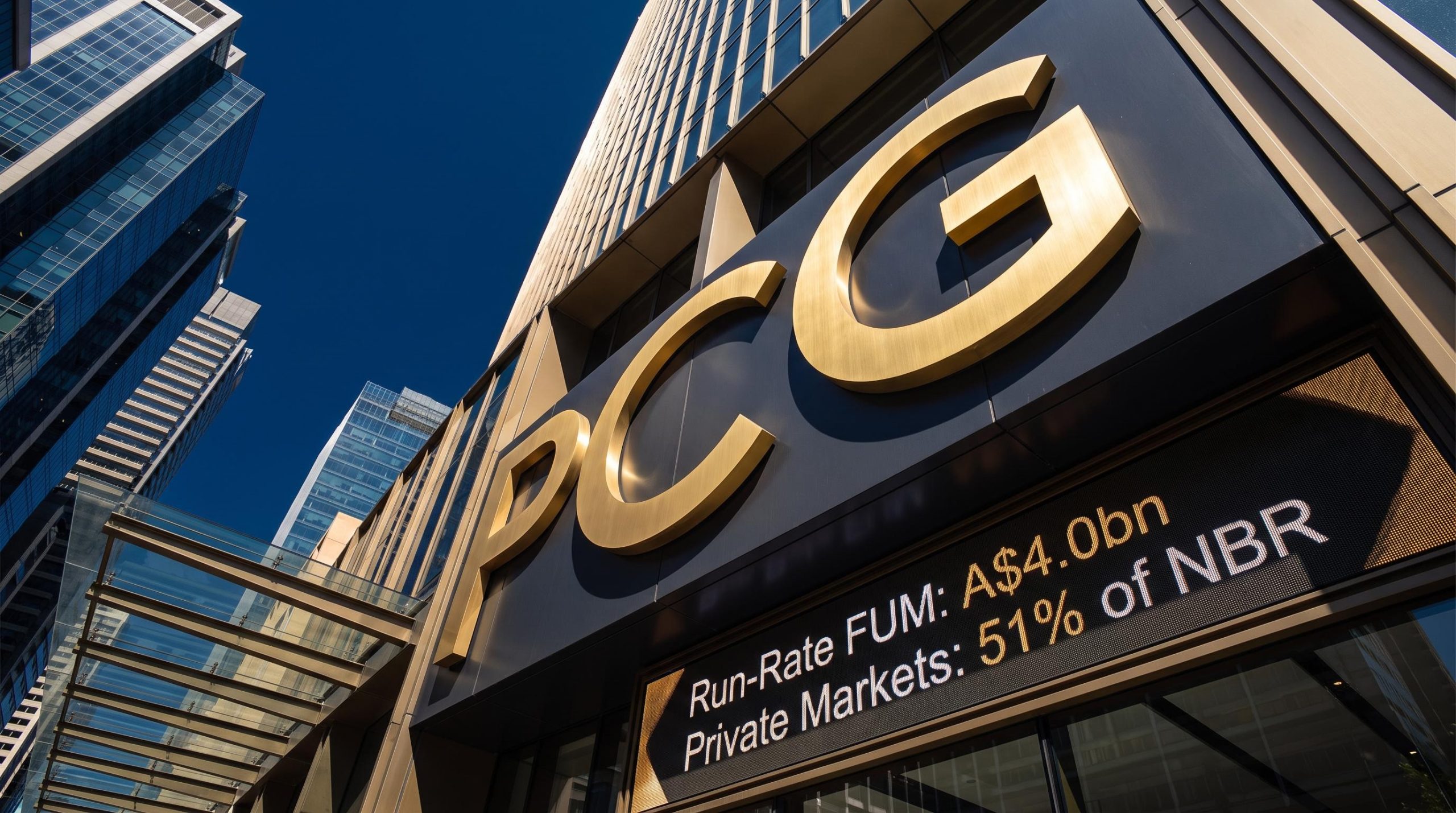
In its FY2026 investor presentation, Pengana Capital Group (ASX: PCG) detailed a business increasingly weighted toward higher-margin private markets, with run-rate funds under management (FUM) climbing 14.0% from $3.5bn to $4.0bn.
The presentation outlined that run-rate Net Base Revenue (NBR) rose 29.2% to $41.1m. Private market assets, spanning Global Private Credit and Global Private Equity, now represent 51% of run-rate NBR, achieving management’s stated objective of a majority of net revenues from this segment.
Founded in 2003, the group runs 17 unique investment strategies across public and private markets and reported A$3.9 billion AUM as at 31 July 2026. The presentation framed the business as repositioning toward higher-margin private markets, with earnings leveraged to growth.
When big ASX news breaks, our subscribers know first
FY2026 highlights — run-rate momentum vs reported results
The presentation drew a clear distinction between strong run-rate growth and softer reported figures, the latter influenced by substantial inflows landing late in the year. Management pointed to run-rate as the better current indicator of the business.
| Metric | 30 Jun 25 | 30 Jun 26 | Change | % Change |
|---|---|---|---|---|
| FUM ($m) | 3,517 | 4,009 | 492 | 14.0% |
| Gross base revenue ($m) | 42.7 | 52.9 | 10.1 | 23.8% |
| Net base revenue ($m) | 31.8 | 41.1 | 9.3 | 29.2% |
| NBR margin | 0.91% | 1.03% | — | 13.3% |
Where the flows came from
The presentation detailed the FUM movement over the 12 months across the group’s segments:
-
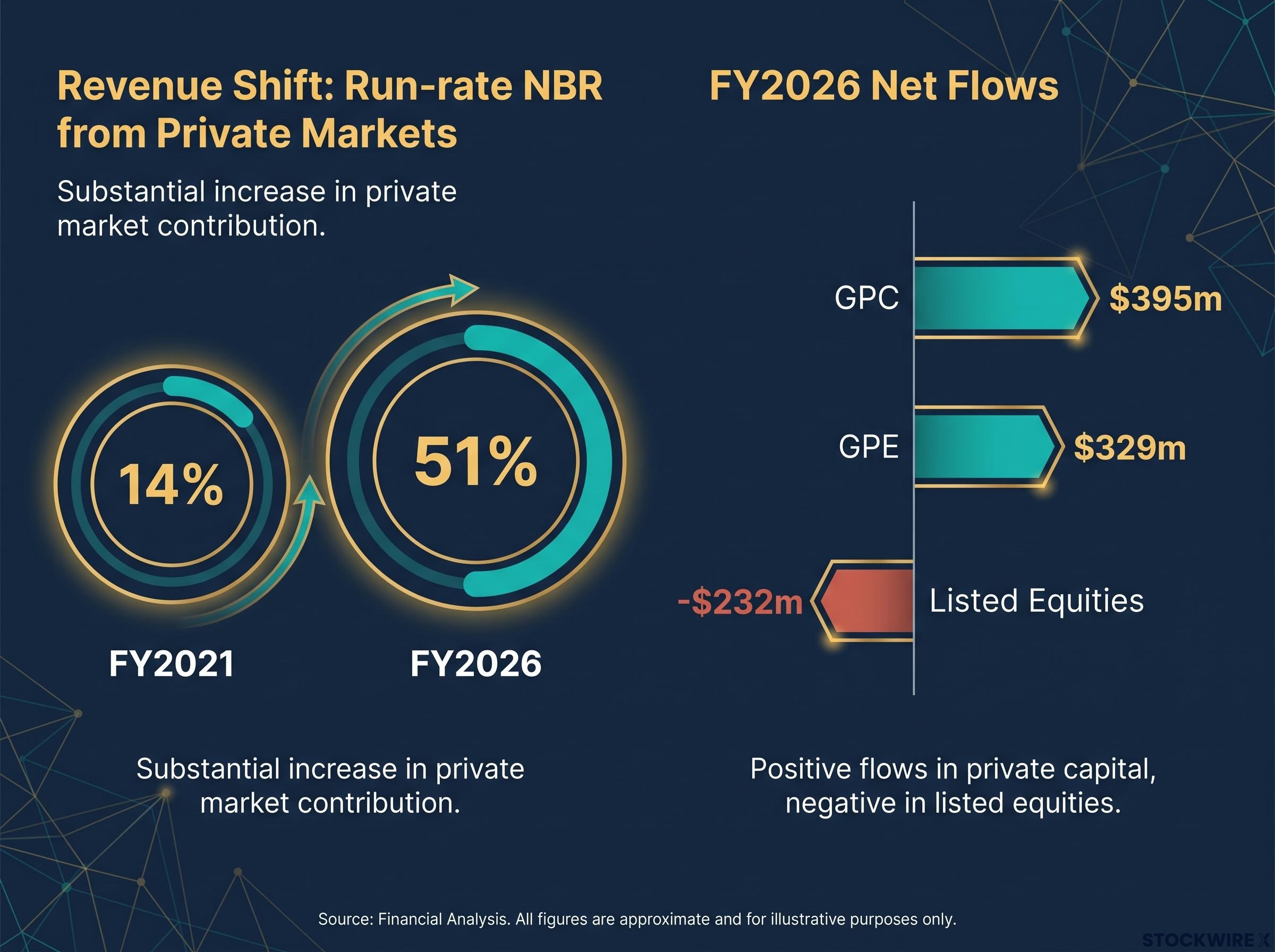
GPC net inflows: $395m
-
GPE net inflows: $329m
-
Listed Equities net outflows: $232m
On a reported basis, NBR grew only 4.0% (from $30.1m to $31.3m), because substantial inflows landed late in the year. This timing gap is why management highlighted run-rate as the more representative measure of current momentum.
Reported Operating EBITDA came in at negative $5.5m, driven by elevated product development expenses of $9.8m and lower performance fees. Statutory profit after tax was negative $5.6m, reflecting the group’s investment in new product and growth initiatives during the period.
Understanding run-rate and Net Base Revenue
For readers new to the terminology, FUM is the base driver of the group’s revenue, as base fees are earned on assets under management. The larger the FUM, the larger the base revenue.
The presentation used “run-rate” to capture the full value of inflows regardless of when they arrive during the year. Run-rate is calculated by taking actual FUM at a specified date and multiplying it by the expected annualised base revenue margin. This avoids understating the business when large inflows land late in the reporting period.
Net Base Revenue is Gross Base Revenue after profit share paid to the funds management teams. The presentation described the NBR margin as “the most significant ratio in the business.”
A rising NBR margin, from 91 basis points to 103 basis points, means each dollar of FUM is generating more net profit. Combined with FUM growth, margin expansion compounds the group’s earnings potential.
Private markets take the lead
The core strategic story outlined in the presentation is the shift in the source of run-rate NBR from private markets, rising from 14% in FY2021 to 51% in FY2026.
Global Private Credit (GPC) Platform
The presentation described Pengana as having built the leading GPC platform in the Australian market. The platform carries exposure to more than 4,500 underlying corporate loans across 3 distinct portfolios.
New GPC inflows over the 12 months carried an average NBR margin of 2.1%, generating $8.1m of additional NBR. Management noted a November 2025 entitlement offer for ASX-listed PCX, which continues to trade at a premium to net asset value (NAV), and the group’s first tailored mandate from a corporate super fund, a segment described as holding large FUM potential.
TermPlus fixed-term accounts
TermPlus is a direct-to-consumer (D2C) fintech within the group that invests FUM into the GPC Platform. Its technology infrastructure was designed and built in-house over the last 5 years and has been fully operational since 2024.
The presentation set out the following target rates, each a fixed margin above the variable RBA Cash Rate:
-
1 Year: 7.35% p.a. (RBA Cash Rate + 3%)
-
2 Year: 8.00% p.a. (RBA Cash Rate + 3.65%)
-
5 Year: 8.50% p.a. (RBA Cash Rate + 4.15%)
Because target rates are set as a fixed margin above the RBA Cash Rate, the delivered rate varies over the term as the cash rate moves.
Global Private Equity (GPE) — PE1 and AIX
The presentation described Pengana Global Private Equity Trust (ASX: PE1) as the only ASX-listed vehicle offering exposure to global private equity, with $520m of Net Tangible Assets.
AI Private Opportunities Trust (ASX: AIX) launched in June 2026 with $267m raised. The presentation described it as “the first ASX-listed vehicle offering dedicated exposure to private companies driving the artificial intelligence value chain.” Management noted the AIX launch leveraged the group’s established private markets platform and its “strategic relationship with Grosvenor Capital Management, L.P.”
The AIX cornerstone offer closed fully subscribed at $150 million, upsized from an original $100 million target after institutional demand exceeded expectations, before a public offer window opened to retail investors ahead of the July 2026 ASX listing.
Pengana Capital Group — FY2026 Investor Presentation
“Private Market Assets (i.e. GPC and GPE) now account for 51% of run-rate NBR, achieving Pengana’s objective of having majority of net revenues from this segment.”
The Listed Equities engine
The presentation positioned the Listed Equities business as a lower-growth but lucrative cash generator rather than a laggard. Operating since 2003, it is the origin of the Pengana brand and runs 9 active strategies with aggregate FUM of $2.5bn.
FUM has been broadly flat over the past 5 years, impacted by a difficult fund-raising environment for active funds. Management is targeting moderate growth over the medium term.
Performance fees remain a valuable, if unpredictable, component. Over the last 5 years the segment generated gross performance fees of $57.5m and net fees of $36m, an average of roughly $7m per year.
The largest three strategies by FUM were detailed as follows:
-
Pengana Emerging Companies (Australian Small Caps): $795m
-
Pengana Australian Equities (Australian Multi Caps): $418m
-
Pengana Axiom International Ethical: $408m
Outlook and how management frames value
The presentation set out the group’s forward strategy alongside a valuation framework. Both are presented as management’s framing rather than as fact or advice.
Group outlook
Management outlined the following segment priorities:
-
GPC — continued high NBR growth, with strong margins expected to persist.
-
TermPlus — accelerate adoption as an increasingly important source of high-margin FUM.
-
GPE — substantial growth opportunities leveraging the group’s brand and positioning.
-
Listed Equities — capacity-constrained, with sporadic performance fees expected to continue.
-
Expenses — operating costs anticipated to grow only marginally, meaning NBR growth largely drops through to profit given the fixed cost base.
The earnings-leverage story
Actual FY2026 Base Operating EBITDA was $5.7m. The presentation noted that run-rate NBR sits approximately $10m above the 12-month actual figure.
Assuming base operating expenses are held flat, the presentation indicated a run-rate Base Operating EBITDA of approximately $15.5m. The valuation framework also referenced roughly $21m of investable assets available to the group.
The framework illustrated how a largely fixed-cost infrastructure combined with rising NBR is intended to generate operating leverage as private markets FUM scales.
The FY2026 presentation reinforced a consistent theme: a diversified funds manager transitioning toward higher-margin private markets, with earnings leveraged to future growth.
Stay Ahead on ASX Finance and Fintech News
Get FREE breaking ASX announcements delivered to your inbox within minutes, complete with in-depth analysis already done for you. Join 20,000+ investors who rely on Big News Blast to stay ahead of market-moving news across Finance, Fintech, and beyond. Click the “Free Alerts” button to start receiving alerts the moment news breaks.