A stock paying a 6% dividend yield sounds like a gift until you realise the yield is only that high because the share price fell 20% last quarter. The dividend did not grow. The business got cheaper, and the maths did the rest.
That distinction sits at the heart of a free four-part webinar series launched this week by Morningstar Australia. Mark LaMonica, Director of Personal Finance at Morningstar Australia, delivered the opening session on Tuesday 18 August 2026, laying out a structured framework for building an income portfolio that actually holds up over time. The series runs on consecutive Tuesday evenings at 6pm AEST, and registration remains open for the three remaining sessions.
This article unpacks the core framework from Session 1 so you can apply it to your own portfolio this weekend. It also maps what the next three sessions cover, so you can decide which ones are worth your time.
Why the highest dividend yield is often the wrong target
Dividend yield is a simple formula: annual dividend per share divided by the current share price. That simplicity is precisely what makes it misleading. When the share price falls, the yield rises mechanically, even if nothing about the dividend itself has changed.
A headline yield sitting well above the sector average can trace back to one of three sources:
- A falling share price, where deteriorating business performance pushes the stock lower and inflates the yield figure
- An unsustainably high payout ratio, where the company is distributing more than it can comfortably afford from earnings and cash flow
- Financial or structural stress, where the business faces material threats to its ability to maintain payments at the current level
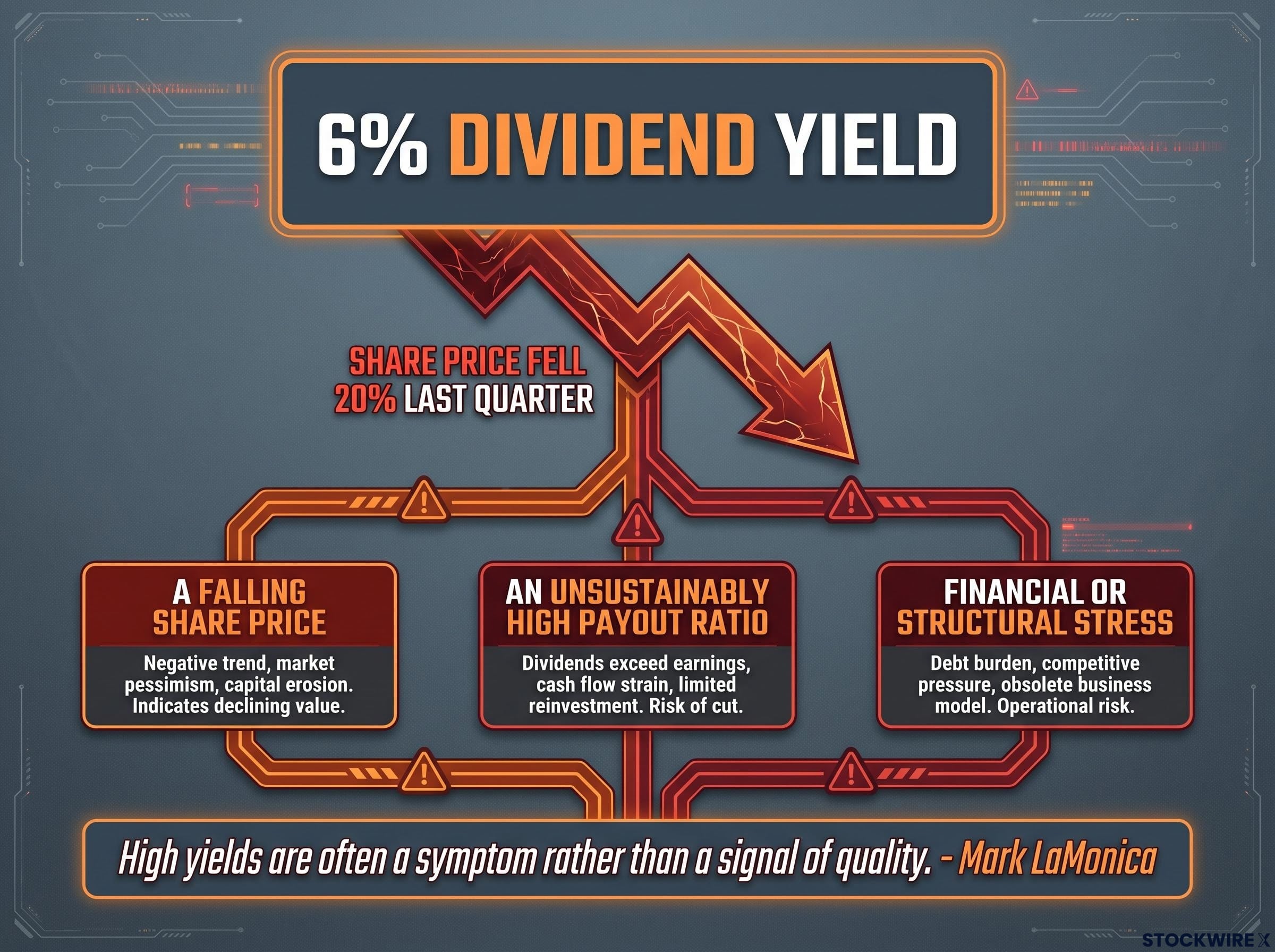
Mark LaMonica framed it plainly in Session 1: high yields are often a symptom rather than a signal of quality.
If you currently screen stocks by sorting yield from highest to lowest, an elevated number in that column should trigger deeper investigation, not immediate inclusion. For anyone relying on portfolio income, particularly in or approaching retirement, the repeatability of that income matters far more than the size of any single year’s payment.
When big ASX news breaks, our subscribers know first
The five-step framework for building a reliable income portfolio
The central output of Session 1 was a five-step methodology for constructing an income portfolio from the ground up. Each step resolves a gap the previous one leaves open. Together, they form a complete architecture you can apply to your holdings this weekend.
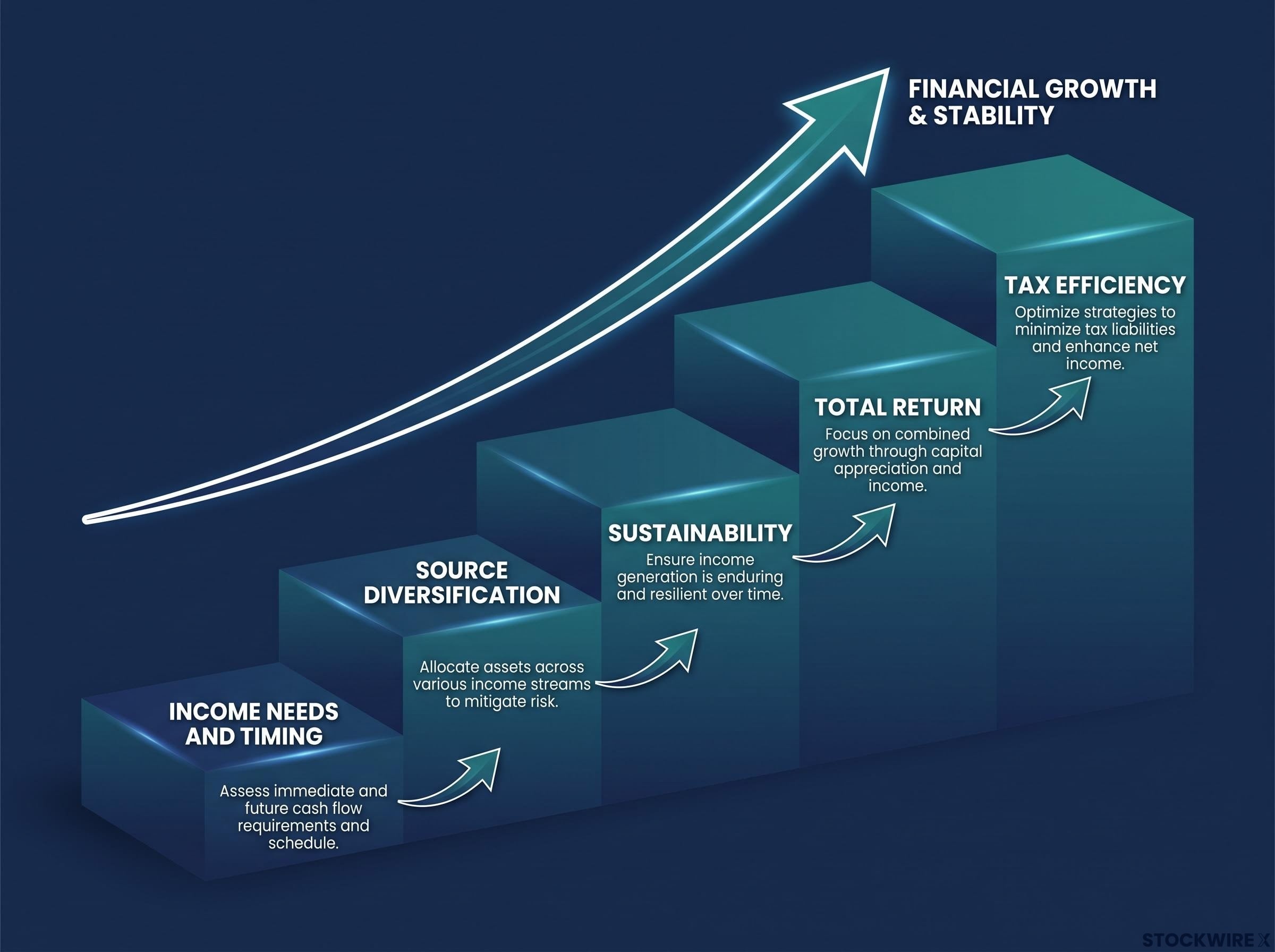
- Define your income needs first. Quantify how much annual income you actually require. Map the timing: do you need it monthly, quarterly, or annually? Assess your tolerance for variability, and factor in your life stage. A retiree drawing down capital has fundamentally different requirements from someone supplementing a salary.
- Diversify your income sources, not just your holdings. Spread exposure across sectors (financials, industrials, healthcare, infrastructure), asset classes (equities, bonds, cash, REITs, hybrids), and income mechanisms (dividends, bond coupons, property distributions, ETF distributions). Owning twenty stocks is not diversification if they all pay you from the same part of the economy.
Evaluating what you already own
Before moving to the assessment steps, apply Steps 1 and 2 to what you already hold. List every position by sector and asset class. The most common pattern for Australian investors is heavy concentration in major banks and mining companies. If your list reveals that pattern, it does not mean you sell everything tomorrow. It means you have identified which high-yield positions need deeper investigation, which is exactly what Steps 3, 4, and 5 provide.
- Assess sustainability over current yield. For each holding, check the payout ratio (is the company distributing a sensible portion of earnings?), earnings and cash flow coverage, balance sheet resilience through downturns, and the dividend track record across economic cycles. A moderate yield backed by strong fundamentals will almost always outperform a high yield resting on shaky ground.
- Account for total return, not only income. If a share pays you a generous dividend but its price steadily declines, your capital base, and therefore your future income potential, is eroding. Total return (income plus capital growth) must be sufficient to preserve your real wealth after inflation, fees, and tax.
- Consider tax efficiency, including franking credits. A fully franked 5% yield may deliver better after-tax income than a higher unfranked yield depending on your marginal tax rate. Portfolio construction for income is partly a tax-planning exercise.
| Step | What to assess | Key question to ask |
|---|---|---|
| 1 | Income needs and timing | How much do I need, when do I need it, and how stable must it be? |
| 2 | Source diversification | Am I earning income from multiple sectors, asset classes, and mechanisms? |
| 3 | Sustainability | Can each holding maintain its payout through a downturn? |
| 4 | Total return | Is capital growth preserving my real wealth, or is the price decline eating my income? |
| 5 | Tax efficiency | What does each income stream actually deliver after tax? |
Completing this five-step process is not a one-time audit. It is an ongoing discipline, particularly as your income needs and tax position change through different life stages.
The one risk Australian income investors consistently underestimate
The risk is not picking the wrong stock. It is sector concentration.
Many Australian investors believe they are well diversified because they hold fifteen or twenty different ASX names. But if a large proportion of those names are major banks and resources companies, the portfolio is earning its income from a narrow slice of the economy. When that slice comes under pressure, the income stream does not wobble. It collapses.
True diversification means spreading your income across three distinct dimensions:
- Sectors: financials, industrials, healthcare, infrastructure, and beyond
- Asset classes: equities, bonds, cash, REITs, hybrids
- Income mechanisms: dividends, bond coupons, property distributions, ETF distributions
Each of these mechanisms behaves differently in different economic conditions. Bond coupons hold steady when equity dividends are being cut. Property distributions respond to rental demand rather than commodity prices. The mix is what protects the overall stream.
If Australian banks were to cut dividends simultaneously during a downturn, and they have done so before, a portfolio heavily concentrated in that sector would see its income fall at precisely the moment you can least afford it. Concentration risk is not theoretical. For Australian income investors, it is the structural weakness most likely to be sitting unexamined in the portfolio right now.
Understanding franking credits as part of your income return
A franking credit represents company tax that has already been paid on corporate profits before those profits are distributed to you as a dividend. When you receive a franked dividend, you can use that credit to reduce your own personal tax liability on the income. In some cases, if your marginal tax rate is lower than the 30% corporate rate, you receive the difference as a tax refund.
This mechanism changes how you should compare yields across different income types. A fully franked 5% dividend and an unfranked 6% yield are not directly comparable using headline numbers alone. After tax, the franked yield may deliver more money into your account.
Comparing income investments by headline yield alone, without accounting for franking status, can leave your after-tax income meaningfully lower than a slightly more modest but fully franked alternative would deliver.
The same logic extends to other income streams in your portfolio. Bond interest, property distributions, and ETF distributions each carry different tax treatments. Evaluating them within your overall tax position, rather than in isolation, is where the real optimisation happens.
| Income type | Headline yield example | Franking credit benefit | After-tax consideration |
|---|---|---|---|
| Fully franked dividend | 5.0% | Full credit for corporate tax paid | May deliver higher after-tax income than a larger unfranked yield |
| Unfranked dividend | 6.5% | No franking credit available | Taxed at your full marginal rate; headline advantage may disappear |
| Bond interest | 5.5% | Not applicable | Taxed as ordinary income; no offset available |
Tax efficiency is not an afterthought you deal with at the end of financial year. It is an integral component of how you build the portfolio in the first place.
What the remaining three sessions cover and why each matters
The series is designed so each session gives you a distinct set of tools. Here is what is coming:
- Session 2: Individual income-generating shares (second Tuesday in the series). This session focuses on evaluating dividend sustainability at the company level: business quality, payout practices, dividend history, and how to optimise franking credits when you own ASX shares directly. If your portfolio leans toward direct shareholdings, this is the session built for you.
- Session 3: Income-focused ETFs (third Tuesday in the series). Covers ETF distribution patterns, the underlying strategies that drive them (dividend, fixed income, hybrid), the cost structures involved, and how ETF income compares to direct share ownership from a tax perspective. If you are weighing whether ETFs simplify your income strategy, this answers that question.
- Session 4: Alternative income investments (fourth Tuesday in the series). Explores listed investment companies (LICs), REITs, infrastructure, hybrids, and other structured income products. The session addresses where these vehicles enhance diversification and where their complexity or specific risk profiles may not suit every investor.
All sessions are free, run at 6pm AEST on consecutive Tuesdays, and are hosted on the Morningstar Australia YouTube channel. Registration remains open for each remaining session.
Taken together, the four sessions are designed to give you both the conceptual blueprint for thinking about income portfolios and the concrete analytical tools for evaluating specific investment types.
Building income you can count on, not just collect
The five-step framework from Session 1 shifts you from reactive yield-chasing to intentional portfolio design. Define your needs. Diversify your sources. Assess sustainability. Account for total return. Integrate tax. These five steps work together as a system, not as isolated checks you run once and file away.
Building a reliable income portfolio is an ongoing discipline. Your income needs evolve, your tax position changes, and the holdings that served you well in one cycle may not hold up in the next. The Morningstar webinar series provides structured support for investors at different stages of that process, and LaMonica’s presentation document from Session 1 is available to participants as a reference tool.
If you want to apply this framework immediately, start with a straightforward audit: list your current holdings, map them against the five steps, and identify where concentration, sustainability, or tax inefficiency may be quietly undermining your income. If you want deeper guidance on specific investment categories, register for the remaining sessions.
Reliable income is not an accident of screening for the highest yield. It is the product of deliberate, structured portfolio construction, and you now have a clear entry point into that process.
This article is for informational purposes only and should not be considered financial advice. Investors should conduct their own research and consult with financial professionals before making investment decisions.