
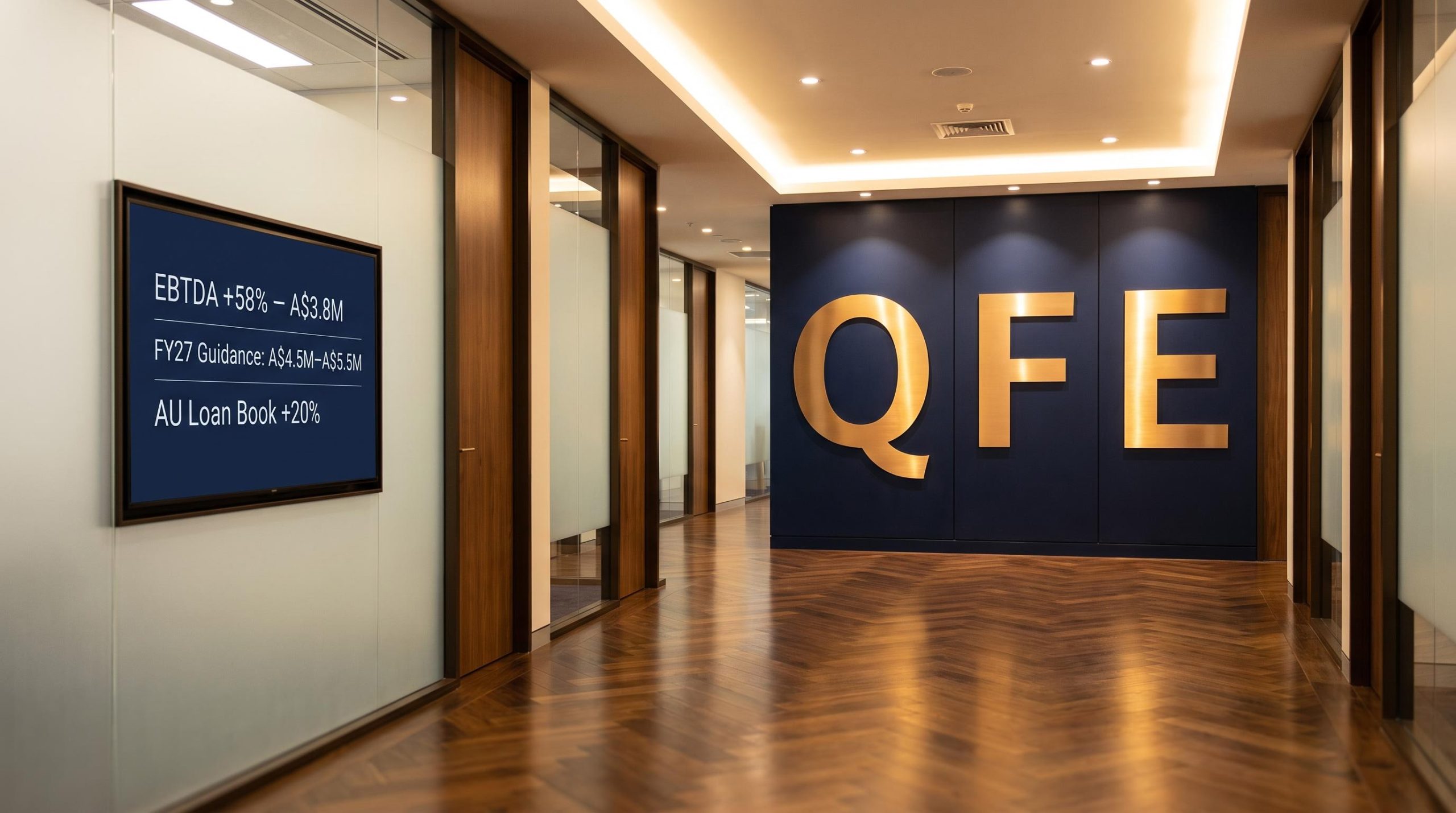
QuickFee returns to full-year profit as simplified model delivers 58% EBTDA lift
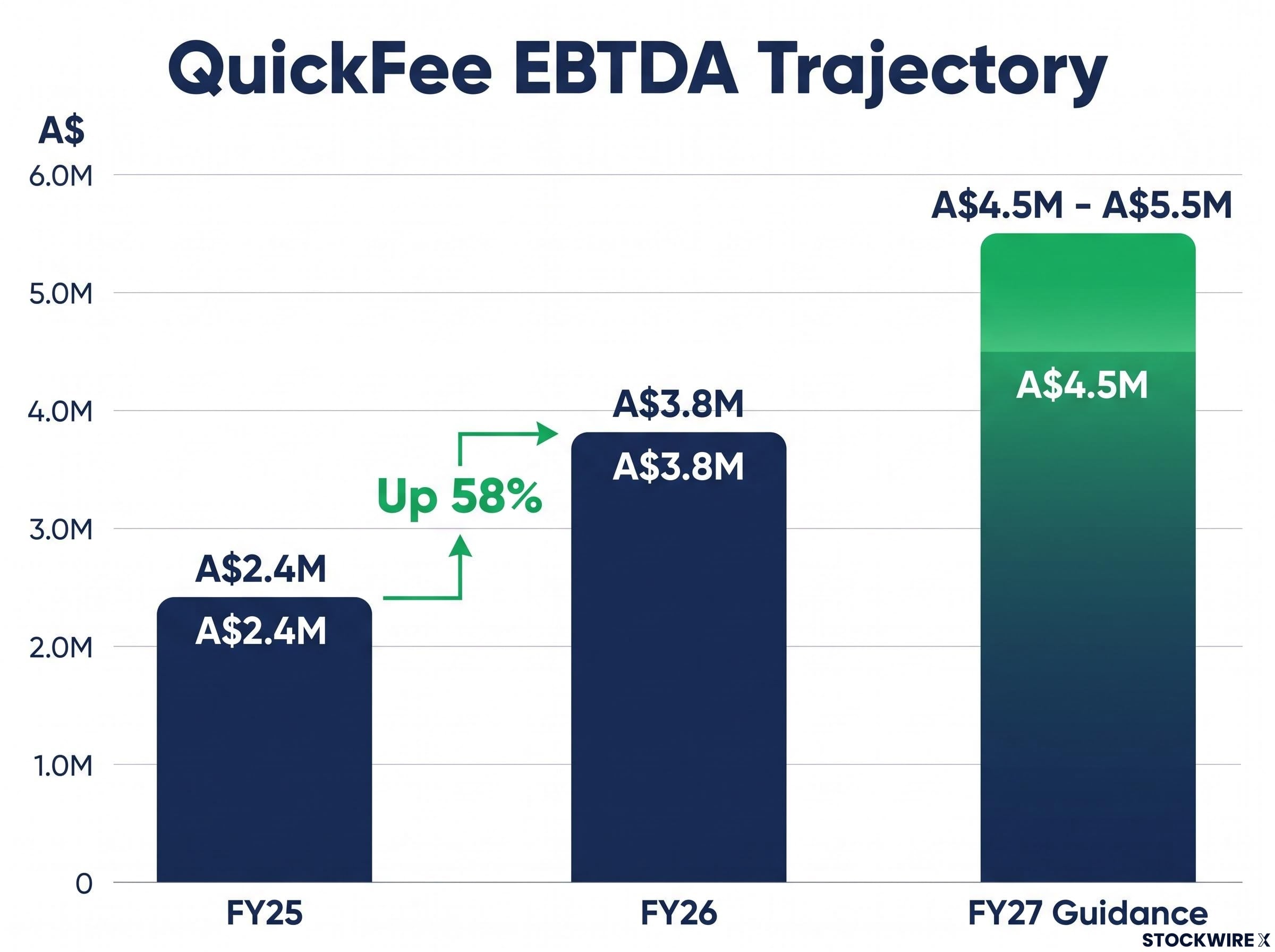
In its FY26 results presentation delivered on 21 August 2026, QuickFee Limited reported a return to full-year profitability for the year ended 30 June 2026, with EBTDA up 58% to A$3.8M and reported net profit after tax (NPAT) of A$39.3M. Chief Executive Officer Bruce Coombes and Chief Financial Officer Simon Yeandle confirmed that FY26 guidance was achieved.
The results followed a strategic pivot centred on the sale of the US Pay Now business, which management said created a simplified, low-risk, high-margin B2B fee-funding model focused on accounting and legal firms. QuickFee also commenced paying dividends during the year and set FY27 EBTDA guidance of A$4.5M–A$5.5M.
When big ASX news breaks, our subscribers know first
FY26 headline results at a glance
The presentation distinguished clearly between underlying earnings and the one-off gain from the divestment. Reported NPAT of A$39.3M was inflated by a A$35.6M profit on the sale of the US Pay Now business plus an income tax credit. Management noted that reported NPAT before profit on sale was A$3.7M, described as the first ever full-year positive NPAT result.
| Metric (A$M) | FY26 | FY25 | Movement |
|---|---|---|---|
| Total revenue | 18.4 | 25.3 | Down 27% |
| EBTDA (before significant items) | 3.8 | 2.4 | Up 58% |
| PBT (before significant items) | 1.2 | (0.9) | Up A$2.1M |
| Reported NPAT | 39.3 | (4.3) | Up A$43.6M |
| Diluted EPS (cents) | 10.4 | (1.3) | Up 11.7cps |
| Final dividend (cents) | 0.5 | – | New |
The 27% fall in total revenue was attributable to the US Pay Now divestment. Excluding that business, underlying revenue was down just 1% to A$16.8M, indicating a broadly stable top line beneath the headline decline.
The strategic reset: what the US Pay Now sale means
The transformational transaction was the sale of the US Pay Now business to Aiwyn for US$26.35 million (A$40 million), completed on 9 September 2025 and generating a profit on sale of A$35.6M. Aiwyn delivers payments, practice management and tax solutions to accounting firms.
Proceeds were deployed towards a capital return of 7.5c per share and debt reduction. Under the reseller agreement, QuickFee’s US Finance offering will be embedded into Aiwyn’s payments portal by 31 December 2026, with Aiwyn’s customers including approximately 300 of the CPA firms’ “Top 500”.
Management outlined the following strategic outcomes from the reset:
-
A simplified, low-risk, high-margin B2B lending model
-
Operating expenses down 45% to A$7.6M (normalised A$6.1M, down 56%)
-
Structurally profitable operations in both Australia and the US
-
Retained US growth optionality via the Aiwyn reseller channel
The change reframes QuickFee from a cash-consuming growth story into a leaner, profitable specialist lender.
Understanding QuickFee’s B2B fee-funding model
QuickFee provides payment and financing solutions to accounting and law firms across Australia and the US. Its products, “Pay Now” and “Pay Over Time / QuickFee Finance”, allow firms to collect receivables faster while their clients spread payments over 3 to 12 months. This helps firms reduce accounts receivable and convert outstanding invoices into cash.
A key growth product is Legal Disbursement Funding (DF), which funds law firms’ upfront costs, such as expenses on personal injury matters, with the loan repaid when the matter concludes. The law firm, rather than the client, is the borrower.
Net interest margin explained
Net Interest Margin (NIM) measures the gap between the interest QuickFee earns on its loans and the interest it pays to fund them. A steady NIM of 15.3% in Q4 FY26 reflects lending that management describes as high-margin, low-risk and price-inelastic.
Because the finance product is B2B only, it sits outside consumer credit regulations. Professional-firm counterparties operating in accredited, highly regulated environments carry low default risk, which management said underpins stable earnings.
Australia drives growth, led by legal disbursement funding
Australia was the group’s growth engine in FY26. Segment revenue rose 10% to A$13.6M, with Finance revenue up 11% to A$12.1M. The standout was disbursement funding, where the disbursement funding loan book grew 51% and the AU loan book increased 20% to A$56.5M.
Management attributed the surge to the recent signing of several major law firms, including two firms with revenue above $50 million. Because DF revenue is recognised over a period of up to three years, and Q4 FY26 TTV was up 40% on the prior corresponding period, a significant portion of interest income is expected to be recognised in FY27 and beyond.
The Q4 FY26 trading update, published in July 2026, had already flagged the disbursement funding surge, with legal disbursement funding TTV rising 134% in that quarter alone after several major personal injury law firms were signed to the platform.
Key Australian metrics detailed in the presentation included:
-
AU Finance TTV: A$70.4M (up 11%)
-
Finance plans: 13,110 (up 67%)
-
Active firms: 544 (stable)
-
Finance revenue yield: steady at 17.2%
-
AU loan book: A$56.5M (up 20%)
United States: leaner, structurally profitable, with embedded upside
The presentation framed the US as a reset rather than a retreat. US revenue fell 63% following the divestment, but gross margin improved 600bps to 71% and operating expenses were cut 69%, delivering positive underlying EBTDA of A$2.2M (before profit on sale of the US Pay Now business).
The Aiwyn reseller channel was positioned as the future US growth lever. QuickFee currently has 130 of the “Top 500” firms, while Aiwyn brings approximately 300. Integration is due by 31 December 2026, with the potential for stronger reseller volumes in H2 FY27. The US operation now runs a lean cost base of 3 staff with 12 years’ combined QuickFee experience.
Balance sheet strength and expanded funding capacity
QuickFee reported a materially strengthened financial position. Net assets rose 160% to A$14.3M, unrestricted cash stood at A$8.3M, and accumulated losses were cut from A$48.1M to A$10.2M.
Funding capacity to support loan book growth was detailed as follows:
-
Viola credit facility: A$81M committed (with optional expansion to approximately A$118M subject to approval), drawn to A$53.2M, maturity June 2028
-
Fancourt term loan: A$5M, fully drawn, maturity December 2028
-
Combined AU and US loan book growth funded with headroom remaining
The funding runway is intended to support continued loan book expansion.
FY27 outlook, dividends and the investment case
Management set FY27 EBTDA guidance in the range of A$4.5M–A$5.5M, implying continued growth on FY26’s A$3.8M. The continuing business is expected to keep operating expenses broadly in line with normalised FY26 levels.
On shareholder returns, QuickFee confirmed a final FY26 dividend of 0.5c per share and flagged an expected special dividend of up to 1c per share in Q4 CY26 from the balance of the US sale proceeds. Management also stated it continues to consider other potential inorganic opportunities.
Management’s key message from the presentation
QuickFee positioned itself as a simple, scalable, low-credit-risk B2B lender that is now structurally profitable and paying dividends, entering FY27 with a larger loan book, positive momentum and embedded US upside via the Aiwyn reseller agreement.
The presentation cited a dividend yield of 13%, based on a share price of 7.5 cents and dividends of 1c per share per annum. This basis is company-stated and should be read alongside that assumption.
Taken together, the FY26 results present QuickFee as a simplified, profitable, dividend-paying specialist lender heading into FY27 with a larger loan book and forward guidance for continued EBTDA growth.
Stay Ahead on ASX Fintech and Finance News
Get FREE breaking ASX announcements delivered to your inbox within minutes of release, complete with in-depth analysis already done. Join 20,000+ investors who never miss a market-moving update. Click the “Free Alerts” button at Big News Blast to get the next fintech and finance story before the market moves.