

Hansen delivers earnings growth in FY26 as it charts an AI-led transition and CEO handover
In its Full Year FY26 results presentation dated 19 August 2026, Hansen Technologies outlined a year of expanding profitability, a board-led CEO succession and a strategic pivot toward AI-enabled operations, all for the 12 months ended 30 June 2026.
The standout figures were Underlying EBITDA up 7.2% to $120m and Underlying NPATA up 15.9% to $66m, delivered despite a modest 1.5% dip in operating revenue to $386m. Operating cash flow surged 52% to $110m.
Three themes framed the update: improving earnings quality, a leadership transition, and a shift from software provider toward what management described as an intelligent operations partner.
When big ASX news breaks, our subscribers know first
FY26 financial highlights show quality earnings over top-line growth
The core story of the year was stable revenue paired with materially stronger profitability and cash generation. While operating revenue eased slightly, the mix shifted toward recurring income, with Support & Maintenance revenue up 13.4% to $230m.
Operating cash flow rose 52% to $110m, and cash conversion improved to 0.9x from 0.7x a year earlier, reinforcing the quality behind the reported earnings.
| Metric | FY26 | FY25 | Change |
|---|---|---|---|
| Operating Revenue | $386.5m | $392.5m | -1.5% |
| Support & Maintenance | $230.3m | $203.1m | +13.4% |
| Underlying EBITDA | $119.6m | $111.7m | +7.2% |
| Cash EBITDA | $106.2m | $93.4m | +13.7% |
| Underlying NPATA | $65.9m | $56.9m | +15.9% |
| Operating Cash Flow | $110.4m | $72.6m | +52.0% |
Rising recurring revenue combined with margin expansion points to higher earnings visibility, a factor investors typically value when assessing software businesses.
A new chapter of leadership: Stuart MacDonald appointed CEO
The presentation detailed a board-led succession process, with all changes taking effect 19 November 2026. The three moves reshape Hansen’s senior leadership while retaining long-standing strategic oversight.
-
Andrew Hansen → Executive Chair: CEO and Managing Director for more than three decades, he continues to lead long-term strategy and the M&A agenda.
-
Stuart MacDonald → Chief Executive Officer: Joining from TechnologyOne, where he served as Chief Operating Officer for the past nine years across sales, marketing, consulting, R&D and international operations.
-
David Trude → Chair, retiring from the Board: Chair for more than 15 years, having guided the Board through Hansen’s international expansion.
Management noted the Executive Chair structure “supports an orderly transfer of executive responsibility while maintaining continuity in strategic oversight, key customer relationships and the acquisition agenda.”
For investors, the structure signals continuity of the M&A agenda under Andrew Hansen, paired with fresh SaaS and AI leadership from MacDonald.
Inside Hansen’s shift from software provider to intelligent operations partner
Hansen provides industry-specific, mission-critical software for the global energy, utilities, communications and media sectors. Its platforms sit at the core of operations for large enterprises navigating complex, highly regulated markets.
The scale of the business is considerable, spanning hundreds of Tier 1 and Tier 2 customers across dozens of countries.
-
80M+ Energy & Utilities end-customers served
-
360M+ Communications & Media subscriptions supported
-
80+ countries; 600+ customers
-
25B+ minutes per year via Hansen’s Carrier Cloud
At the centre of the AI strategy is NOVA RAG, Hansen’s enterprise knowledge platform that connects the company’s global intellectual property into a searchable knowledge layer. Management framed the ambition as turning “50 years of intellectual property into a scalable asset,” a step it says supports its move toward becoming an intelligent operations partner.
Why does this matter commercially? The presentation linked platform convergence to lower cost, faster time to value and greater operating leverage, benefits that could compound as customers migrate to a common architecture.
The four pillars of Hansen’s AI vision
The company set out its strategic AI framework using four verbs:
-
UNIFY: Progressively upgrade customers to a unified, modular, AI-enabled product suite.
-
INNOVATE: Accelerate innovation by embedding governed AI into products, workflows and delivery.
-
INTEGRATE: Improve M&A onboarding by integrating acquired products, customers and teams faster and at lower cost.
-
SCALE: Scale into new markets with greater operating leverage and repeatable deployment models.
Management cited AI-driven operating leverage as a contributor to FY26 margin expansion. Looking ahead, the strategic AI vision includes a goal to improve M&A onboarding by integrating acquired products, customers and teams faster and at lower cost.
Segment performance — Communications & Media offsets Energy & Utilities softness
The two operating segments moved in opposite directions during the year. Communications & Media delivered growth, while Energy & Utilities softened.
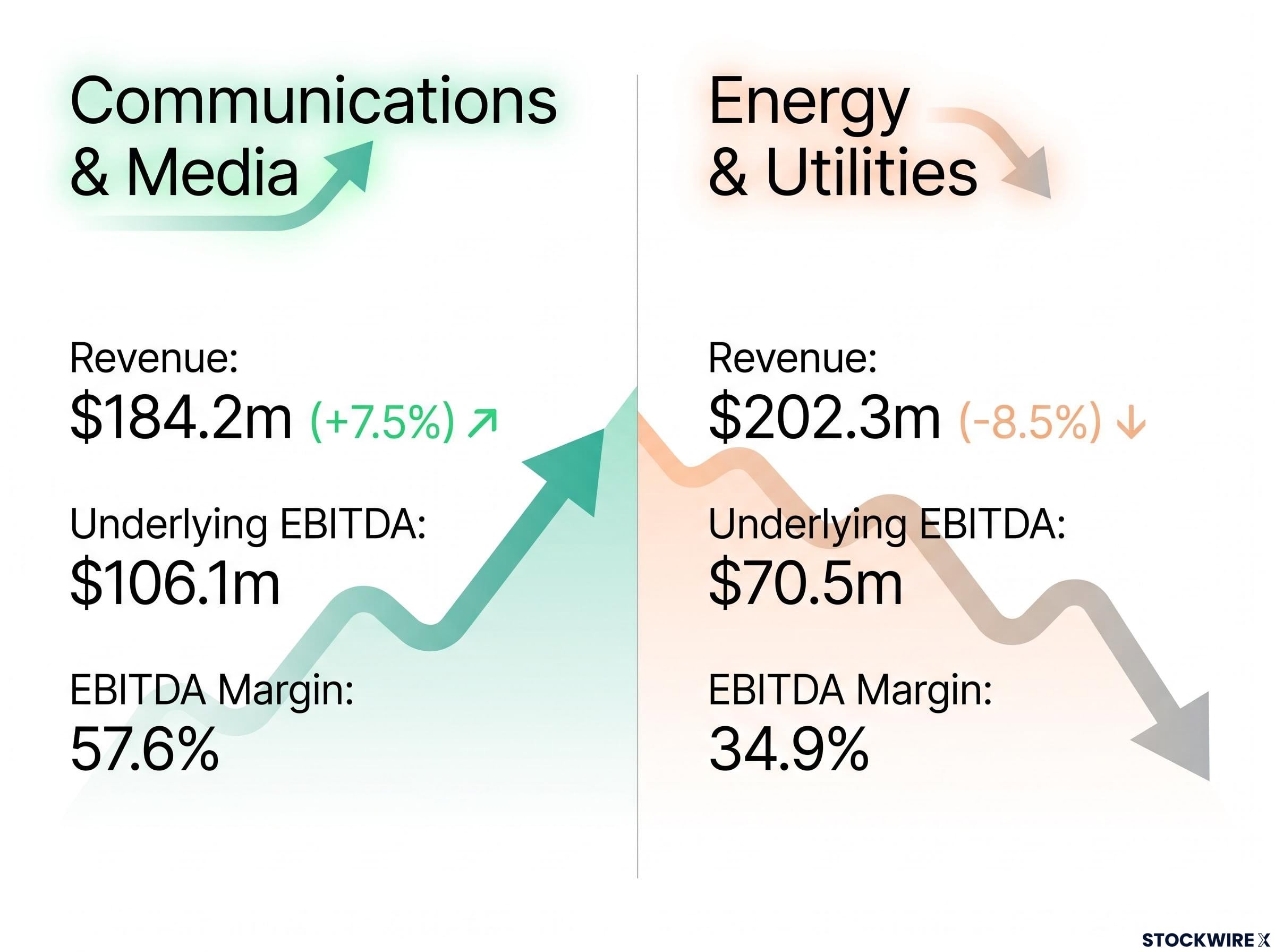
Communications & Media revenue rose 7.5% to $184.2m, with Underlying EBITDA up 15.1% to $106.1m at a margin of 57.6%. Management highlighted Digitalk performing strongly, VMO2 fully operationalised as a scaled reference point, and the Telefónica Germany renewal secured.
Energy & Utilities revenue fell 8.5% to $202.3m, and Underlying EBITDA declined 10.8% to $70.5m. The softness was attributed to FY25 project roll-offs and a slower-than-anticipated German smart meter rollout, compounded by some customer churn.
| Segment | FY26 Revenue | FY26 Underlying EBITDA | EBITDA Margin |
|---|---|---|---|
| Communications & Media | $184.2m | $106.1m | 57.6% |
| Energy & Utilities | $202.3m | $70.5m | 34.9% |
The prior-year segment EBITDA comparatives were restated to reflect a revised allocation of directly attributable corporate costs between operating segments. The restatement affects segment presentation only and has no impact on the Group’s total EBITDA or net profit.
Diversification across two essential-service verticals cushions the impact of single-market weakness, in this case Germany.
Balance sheet strength funds growth, acquisitions and dividends
Hansen ended the year with a disciplined capital position, reporting net debt of $16.9m and leverage of 0.1x after repaying $63.5m in borrowings during FY26.
Reinvestment continued at roughly 7% of revenue on R&D, of which $13.5m was capitalised. Shareholder returns included $19.3m in dividends paid during the year, alongside a FY26 final dividend of 5.0 cents per share, partially franked at 4.0 cents. Acquisition spend during the period included Digitalk, acquired for $67.1m.
Management commentary on capital allocation
Management noted that strong cash generation and conservative leverage preserve the flexibility to act with discipline on future acquisitions, innovation and long-term shareholder value creation. (No verbatim director quote was provided in the presentation.)
Capital position highlights included:
-
Net debt $16.9m; leverage 0.1x
-
Four strategic acquisitions completed since FY22
-
Cash conversion 0.9x
-
$105m in dividends paid across FY22–FY26
M&A playbook and acquisition performance
Management framed the company’s approach to acquisitions as a disciplined, repeatable value-creation playbook, emphasising that organic growth remains the priority while M&A adds scale, capability and market reach.
The presentation pointed to 14 successful transactions since 2008 and clear acquisition filters: mission-critical software, predictable or recurring revenue, long-term customer relationships and clear IP ownership. Hansen is also exploring a third vertical, with insurance software a key area of analysis.
The company provided a scorecard on three recent assets:
-
Digitalk: Performing ahead of expectations; successfully integrated into the Communications & Media vertical and delivering cross-sell benefits.
-
Dial AI: Building momentum and winning customers, supporting new wins across the US and Canada. Management cited City of Kingsport, Tennessee, with 16K+ calls handled within weeks and 60% end-to-end resolution.
-
powercloud: Below expectations amid a slower German energy transition. A cost base reset is underway, with a medium-term recovery expected as smart meter rollout drives demand.
FY27 outlook — an investment and transition year
Management described FY27 explicitly as an “investment and transition year” focused on improving revenue quality, enhancing scalability and positioning the business for sustainable long-term growth.
FY27 revenue is expected to be broadly stable relative to FY26, reflecting the ongoing transition from upfront Licence revenue to recurring consumption-based revenue streams alongside continued foreign exchange headwinds.
Key guidance points from the presentation include:
-
Support & Maintenance revenue is expected to grow approximately 6–8% in FY27.
-
FY27 Underlying EBITDA margin is expected to exceed 26%.
-
The Group expects to achieve a net cash position during Q2 FY27.
-
Revenue growth is expected in FY28, with Underlying EBITDA margin returning to Hansen’s 30%+ target.
The guidance sets clear expectations of a near-term reset ahead of a longer-term margin and growth recovery, backed by a strengthening balance sheet.
Taken together, the FY26 presentation positioned Hansen around three connected threads: improving earnings quality, leadership continuity through an orderly succession, and an AI-led strategy management believes can support greater scalability in the years ahead.
Don’t Miss the Next ASX Tech Winner
Big News Blast delivers FREE breaking ASX tech news and in-depth analysis directly to your inbox within minutes of release. Join 20,000+ subscribers already staying ahead of the market the moment announcements drop. Click the “Free Alerts” button at Big News Blast to get started today.