

Energy One caps FY26 with 17% recurring revenue growth and a near debt-free balance sheet
In its FY26 full-year results presentation, Energy One (ASX:EOL) detailed a result for the period ended 30 June 2026 built on high-quality recurring growth. Recurring revenue rose 17% to $63.5m, total revenue reached $69.9m (+14%), and underlying cash EBITDA climbed 42% to $14.9m. The standout was the balance sheet, with net debt effectively eliminated to a $(0.7)m net cash position. Management framed the year as validation of the company’s “one-stop-shop” strategy, delivered through a CEO leadership transition, and outlined targets for FY27.
When big ASX news breaks, our subscribers know first
FY26 scorecard: quality growth meets margin expansion
The presentation detailed a set of headline metrics showing profitable, recurring-led growth:
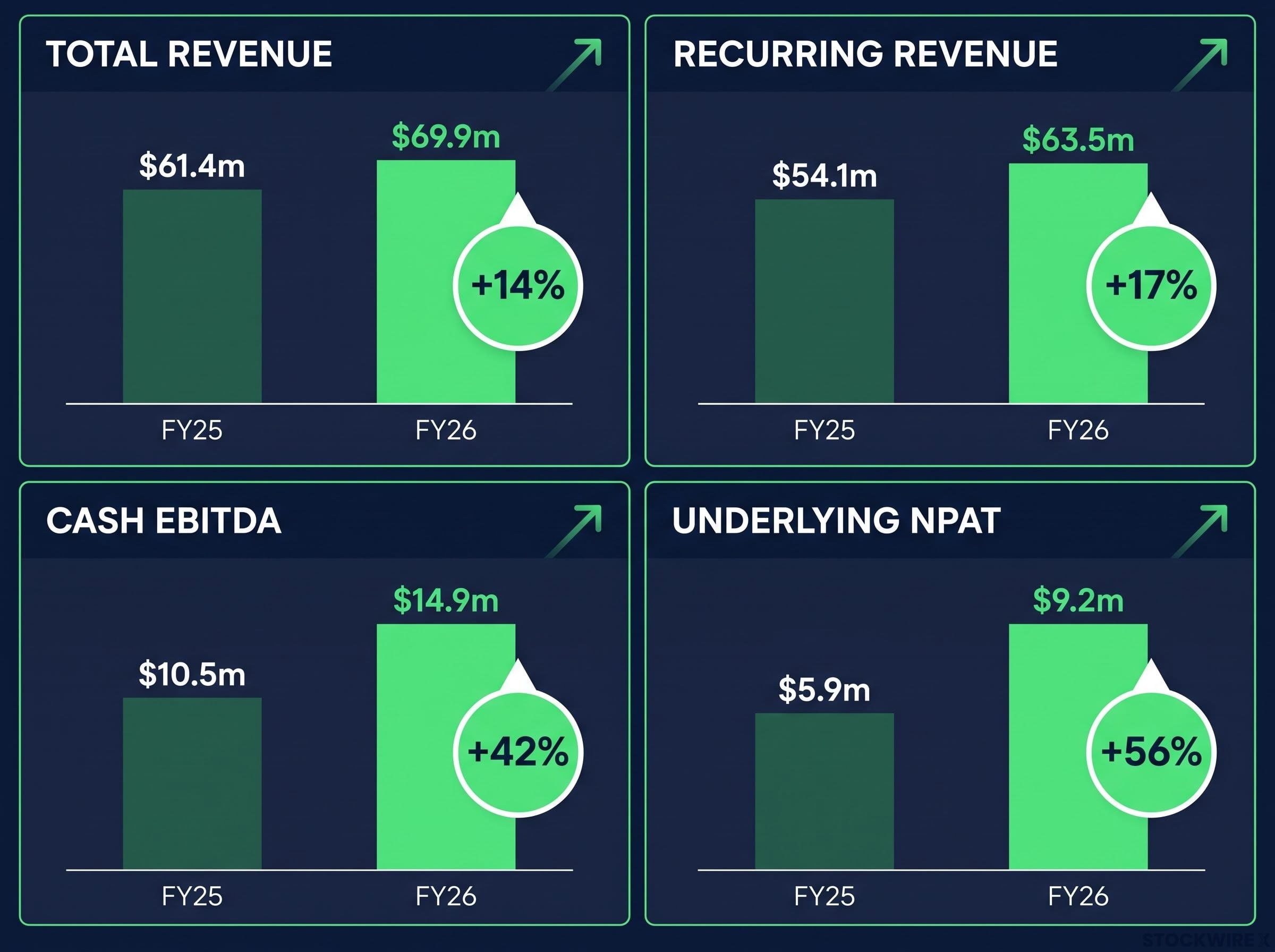
- Revenue of $69.9m, up 14% on FY25
- Recurring revenue of $63.5m (+17%), now 91% of total revenue, a new high
- Underlying cash EBITDA of $14.9m (+42%), a 21% margin (+4ppt), with a 23% exit run-rate
- Underlying NPAT of $9.2m (+56%) and underlying EPS of 29.2c (+55%)
- A Rule of 40 score of 47 on underlying EBITDA
Crucially, this growth was not bought with cost blowouts. Cash expenses rose just 7%, showing the model scaling rather than spending its way to revenue.
| Metric | FY26 | FY25 | % Change | Why it matters |
|---|---|---|---|---|
| Revenue | $69.9m | $61.4m | +14% | Broad-based growth across the group |
| Recurring revenue | $63.5m | $54.1m | +17% | 91% of total, a new revenue-quality high |
| Underlying EBITDA | $20.7m | $16.2m | +28% | Operating leverage flowing through |
| Underlying PBT | $12.5m | $8.3m | +51% | Cost discipline plus lower debt |
| Underlying NPAT | $9.2m | $5.9m | +56% | Earnings converting strongly |
| Cash EBITDA | $14.9m | $10.5m | +42% | Stronger cash earnings |
| Net debt / (cash) | $(0.7)m | $6.7m | n.m. | Net debt effectively eliminated |
What “one-stop-shop” actually means for investors
Energy One provides both software and services for wholesale energy trading, covering asset optimisation, scheduling and market access, trading and risk management, and 24/7 operations. The “one-stop-shop” strategy means selling several connected products to the same customer rather than a single tool.
For investors, bundling matters because it lifts revenue per customer, strengthens relationships and builds recurring revenue. The presentation pointed to several proof points: SaaS net revenue retention (NRR) reached 120%, average lifetime value (LTV) per customer rose to $3.7m, and ARR per install increased 14%.
ARR, or annual recurring revenue, measures the annualised value of subscription revenue. NRR shows how much existing customer revenue grows or shrinks over a year, with figures above 100% indicating expansion.
Operating leverage and a materially stronger balance sheet
This is the strategic core of the result. Cash expenditure fell to 80% of revenue (from 85% in FY25), while the cash EBITDA margin climbed to 21%, evidence that revenue is scaling faster than costs.
The balance sheet transformation was equally notable:
- Net debt was eliminated, with the company closing FY26 in a $(0.7)m net cash position (from $6.7m net debt)
- Leverage fell to 0.0x (from 0.6x)
- Facility headroom reached $17.1m, with the NAB facility renewed to July 2027
- Free cash flow of $10.8m (+27%), a 15% FCF margin
- Total equity rose 10% to $70.3m
Deleveraging combined with strong free cash flow gives Energy One flexibility to self-fund growth while retaining optionality for disciplined M&A.
Presentation commentary
Management characterised the FY26 result as proof the strategy is working, describing the improved operating leverage and near debt-free balance sheet as a stronger platform for the next phase of growth.
Regional performance: Australia and Europe both grow
Australia
The Australian business recorded revenue of $30.1m (+15%), ARR of $27.9m (+10%) and NRR of 106%. Management highlighted its BESS (battery energy storage) proposition as a differentiated, battery-agnostic optimiser, alongside enterprise upsell momentum. One example saw approximately $700K secured through expanded scope with an existing EnFlow customer.
Europe
Europe delivered revenue of $39.5m (+13%), ARR of $36.7m (+14% on a constant currency basis) and NRR of 105%. The presentation noted revenue timing delays but pointed to stronger enterprise demand and larger multi-product wins, including new ARR of approximately $500K from a green steel industrial transformation customer using enTrader, eZ-Ops and orchestration tools.
Together, the two regions operate as separate engines on one shared global platform, supporting a diversified recurring revenue base.
The honest note: attrition ticked up
The presentation addressed the one soft metric transparently. Attrition rose to 5.2% (from 4.0% in FY25), against an FY27 target of 4.5%.
Management noted the increase was concentrated in a small number of customer-specific events, two European and two Australian, several of which were outside Energy One’s control. In response, the company outlined three FY27 focus areas:
- Customer success and value realisation
- Renewal discipline and commercial governance
- Customer lifecycle management
With SaaS NRR at 120%, the presentation framed attrition as a manageable, identified issue with a clear remediation plan rather than a structural problem.
Looking ahead: FY27 targets and structural tailwinds
Management outlined two headline FY27 targets:
- Recurring revenue growth of ≥15%, underpinned by $5.1m of signed or contract-prepared ARR not yet billed (up 28% year-on-year, around 8% of FY26 ARR)
- A cash EBITDA margin run-rate of approximately 30% (exit rate) by the end of FY27
The presentation also detailed structural tailwinds expected to expand the addressable market to 2030, including a +80% increase in global renewable capacity, 4-6x growth in battery storage deployments and roughly 5x higher intraday trading volume. These trends are expected to grow Energy One’s core target market (A$500m to 1,500m per year) alongside adjacent markets in industrial energy, carbon capture and storage, and distributed energy resources.
A growing addressable market, a proven scalable model and a pipeline offering more than 3x coverage of the FY27 ARR target together point to a credible growth runway. As management summarised it, FY26 has laid a stronger platform for the next phase of growth.
The board’s confidence in the standalone strategy is not abstract: just days after FY26 results, it unanimously rejected the Volue takeover proposal of $17.00 per share, explicitly arguing the company’s standalone value exceeds what the all-cash bid reflects.
Don’t Miss the Next ASX Tech Winner
Big News Blast delivers FREE breaking ASX tech news directly to your inbox within minutes of release, complete with in-depth analysis. Join 20,000+ investors already staying ahead of the market. Click the “Free Alerts” button at Big News Blast to start receiving alerts the moment news breaks.