

Temple & Webster delivers record $665m revenue in FY26 as underlying earnings jump 28%
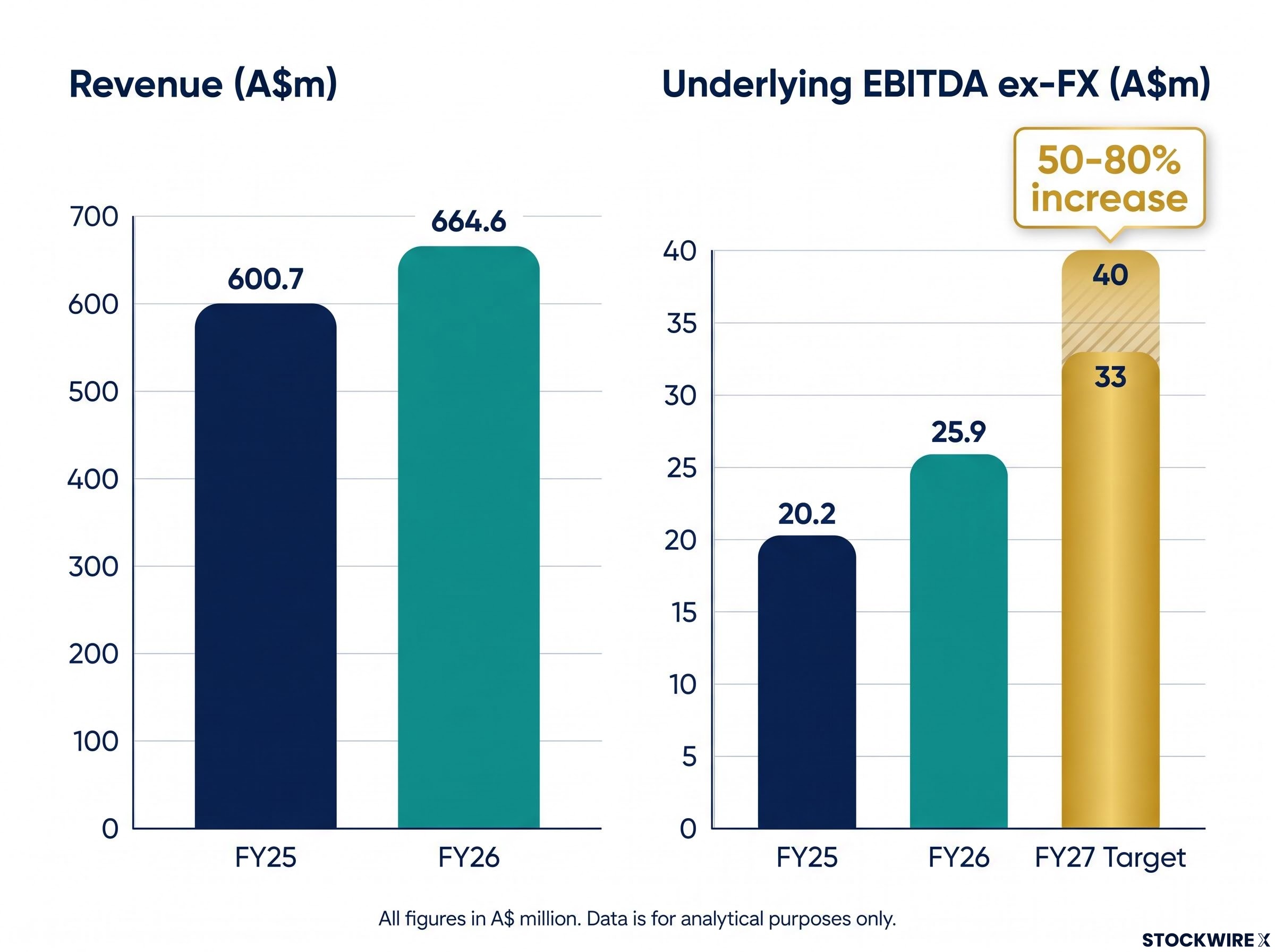
In its Appendix 4E for the full year ended 30 June 2026, Temple & Webster Group (ASX:TPW) reported record revenue of $665m, up 11% on the prior corresponding period, achieved against what management described as a challenging consumer environment. Reporting EBITDA reached $21.9m (up 17%), while Underlying EBITDA (ex-FX) rose 28% to $25.9m.
The company set a forward EBITDA target of $33–40m for FY27, an increase of approximately 50–80% over FY26. The release also coincided with a leadership transition, with new CEO Susie Sugden seven weeks into the role at the time of the announcement.
When big ASX news breaks, our subscribers know first
FY26 financial results at a glance
The headline financials for the year, released on 19 August 2026, are summarised below.
| Metric | FY25 (A$m) | FY26 (A$m) | Change |
|---|---|---|---|
| Revenue | 600.7 | 664.6 | +10.6% |
| Delivered Margin | 190.5 | 201.0 | +5.5% |
| EBITDA | 18.8 | 21.9 | +16.6% |
| Underlying EBITDA (ex-FX) | 20.2 | 25.9 | +28.0% |
| Underlying EBITDA (ex-FX) Margin | 3.4% | 3.9% | +53 bps |
| Cash and Cash Equivalents | 144.3 | 122.7 | (15.0%) |
Underlying EBITDA (ex-FX) is presented to reflect the core trading performance of the group. It excludes one-off Melbourne warehouse transfer costs of $0.9m, New Zealand start-up investment costs of $2.4m, and unrealised losses on foreign exchange hedging positions of $0.7m.
Operational performance, where the growth came from
The result was underpinned by broad-based gains across customer and market metrics through the period. Management noted that market share strengthened in the first half before weaker trading conditions in the second half.
Key operational metrics for FY26 included:
-
Market share up from 2.7% to 2.9%, driven by strong H1 growth offset by weaker H2 conditions
-
Active customers of approximately 1.3 million, up 5% on the prior corresponding period
-
Revenue per active customer of $494, up 8%
-
Repeat customers representing 62% of total orders, up from 59% in FY25
-
Exclusive products at approximately 51% of total revenue, up from 45%
-
Fixed costs down from 10.6% to 10.1% of revenue
Growth adjacencies pass $100m
Exclusive product lines and growth adjacencies now contribute well over $100m in annual revenue. Adjacent businesses contributed $117m in revenue to the group, up 30% on the prior year. Home improvement delivered $59m in revenue (up 39%), while Trade & Commercial contributed $56m (up 16%).
The company’s New Zealand operation, launched in October 2025, recorded $3m in revenue across more than 7,400 orders, with average order values comparable to Australia.
What “asset-light” and drop-shipping mean for investors
Temple & Webster operates a drop-shipping model, in which suppliers ship products directly to customers rather than the retailer holding stock. This is complemented by a private label range sourced directly from suppliers, giving the company a broader product range without carrying heavy inventory.
The term “asset-light” refers to this reduced need to hold physical stock and warehouse infrastructure. For investors, the significance lies in operating flexibility and cash conversion. Lower inventory requirements support stronger conversion of earnings into cash, which is particularly valuable in variable market conditions. The company pointed to $24m in operating cash flow during FY26 as evidence of that conversion.
Capital management and balance sheet strength
The business generated operating cash flow of $24m in FY26 and ended the period with a cash balance of $123m at 30 June 2026. The reduction in cash was partly deliberate, reflecting $30m deployed in on-market share buy-backs during the year to improve shareholder returns.
Longer-term capital management priorities remained unchanged, focused on investing in profitable growth and maintaining a competitive edge in technology, AI and innovation.
Executive Chair Mark Coulter
“Despite a challenging environment, we have been able to deliver record annual revenue of $665 million, while materially improving the underlying profitability of the business through several margin optimisation initiatives. These initiatives, combined with the flexibility of our operating model, resulted in our Underlying EBITDA (excluding unrealised foreign exchange losses) increasing by 28% vs pcp to $26 million.”
Trading update and the FY27 outlook
Financial year-to-date trading, covering the period from 1 July to 17 August 2026, was down 13% on a revenue basis compared with the same period last year. The company noted this figure reflects cycling 28% growth recorded at the start of FY26. Importantly, contribution margin dollars over the same period were up 10%.
The Temple & Webster CEO transition, announced in April 2026, saw co-founder Mark Coulter move into an Executive Chair role focused on strategy and capital allocation, with Sugden returning to the business after previously serving as Chief Commercial Officer and Chief Marketing Officer from 2016 to 2020.
Looking ahead, Temple & Webster is targeting EBITDA of $33–40m for FY27, an increase of approximately 50–80% over FY26. The stated strategic goal is to return the business to double-digit top-line growth, with further detail to be provided at the upcoming AGM and the H1 FY27 results briefing.
CEO Susie Sugden
“Through my first seven weeks as CEO, I have been excited and energised by the Temple & Webster team and the enormous market opportunity that sits ahead of us. The long-term opportunity for Temple & Webster to be a leader in the ~$40 billion furniture, homewares and home improvement markets remains unchanged, especially as a digital-first brand. The business has an amazing platform to build upon, including market leading customer satisfaction, broad customer reach and strong digital and AI capabilities. We are also significantly underpenetrated in our adjacencies, including home improvement and New Zealand.”
Specific details of the company’s forward strategy have not yet been disclosed, with management indicating these will be outlined at the AGM and H1 FY27 briefing.
Why the FY26 result matters for the investment case
The FY26 outcome combined record revenue in a difficult retail market with a marked improvement in underlying profitability, as Underlying EBITDA (ex-FX) rose 28%. A structural shift toward higher-margin exclusive products, now around 51% of revenue, and growth adjacencies contributing $117m supported the margin gains.
A balance sheet holding $123m in cash, alongside the $30m buy-back programme, provides financial flexibility heading into the new year. For investors, the $33–40m FY27 EBITDA target and the stated ambition of becoming the largest retailer in the category in Australia represent the forward catalysts to watch, with strategic detail expected at the AGM and H1 FY27 results briefing.
Don’t Miss the Next Consumer Discretionary Winner
Big News Blast delivers FREE breaking ASX news directly to your inbox within minutes of release, complete with in-depth analysis already done for you. Join 20,000+ investors who stay ahead of the market the moment announcements drop. Click the “Free Alerts” button to start receiving alerts across ASX consumer, tech, healthcare and more.