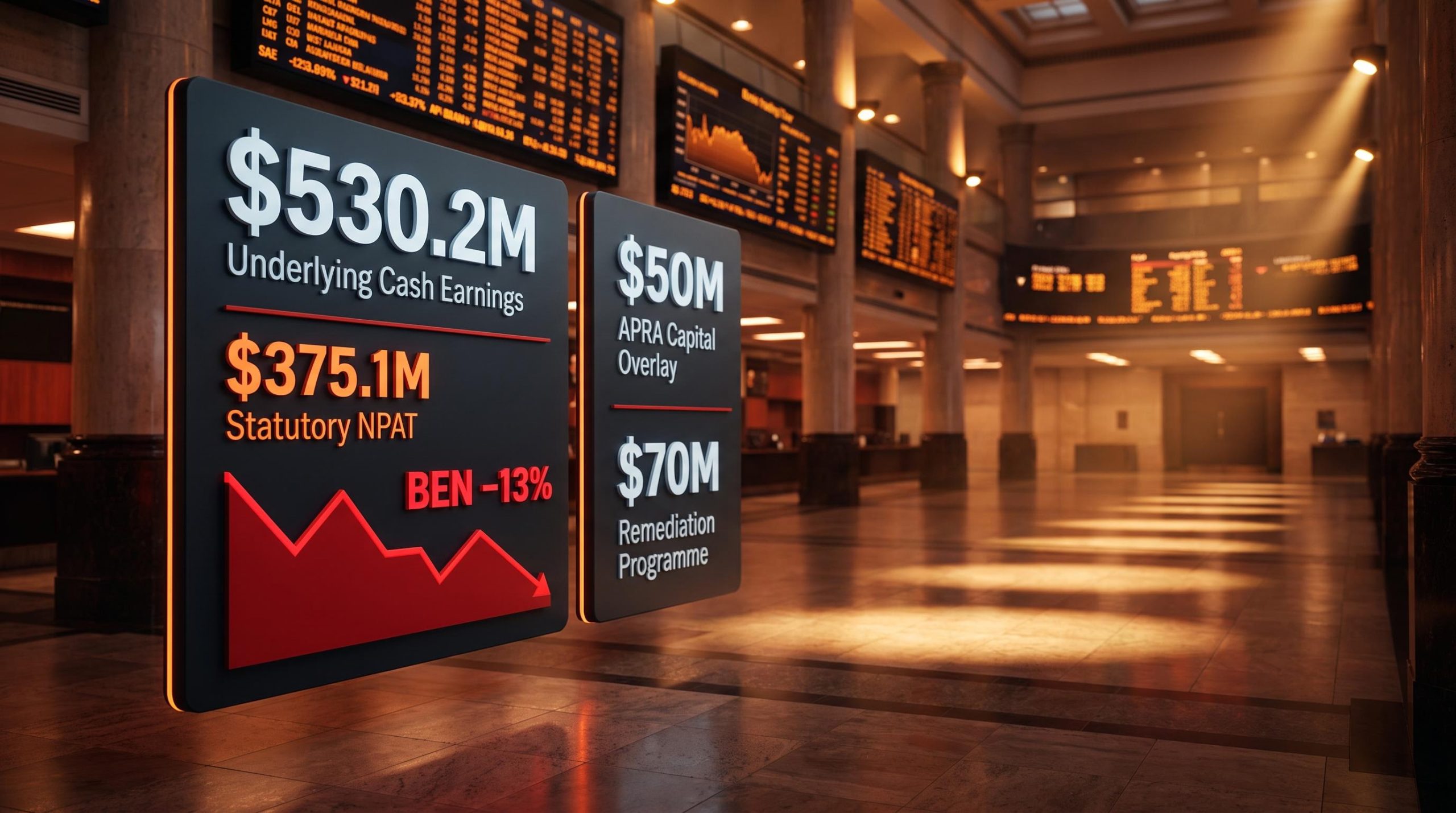
Bendigo and Adelaide Bank just reported $530.2 million in underlying cash earnings for FY26, but the number that investors are fixating on is $375.1 million in statutory profit. The $155.1 million gap between those two figures tells you almost everything about where the bank stands right now.
That gap is not accounting noise. It is the direct result of a $49 million after-tax risk remediation charge and a $9.8 million regulatory penalty provision, both tied to an active APRA enforcement action that has placed the bank under revised licence conditions and a $50 million capital overlay since 1 January 2026. BEN shares have shed around 13% of their value across the past year, a drawdown that tracks the weight of regulatory and cost pressures rather than any meaningful deterioration in the bank’s core business.
Here is a clear read on which parts of the result reflect a bank that is genuinely improving operationally and which parts reflect a clean-up that is not yet finished, so you can assess what is already priced into BEN shares and what still represents unresolved risk.
The number that matters: why cash earnings and statutory profit tell two different stories
Underlying cash earnings of $530.2 million, up 3% on FY25, represent the operating baseline Bendigo and Adelaide Bank is working from. Strip away the remediation charges and penalty provisions, and the bank grew earnings in a competitive lending environment.
Statutory net profit after tax (NPAT), the figure that hits the formal accounts, came in at $375.1 million. The bulk of the shortfall is explained by two items: a $49.0 million after-tax charge for the APRA-mandated risk rectification programme, and a further $9.8 million set aside against expected legal penalties.
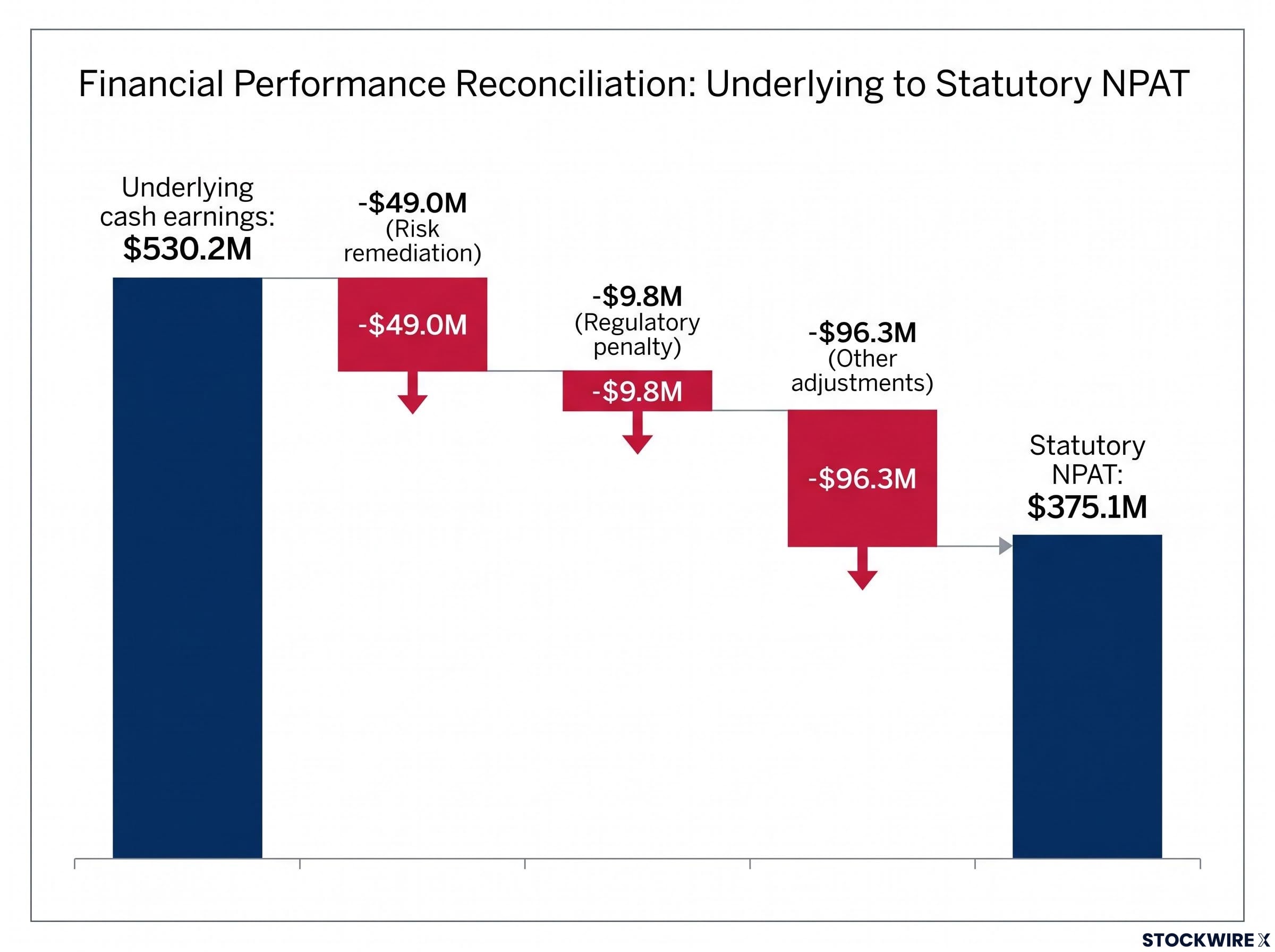
The earnings bridge
| Line item | Amount |
|---|---|
| Underlying cash earnings (FY26) | $530.2M |
| Less: risk remediation charge (after tax) | ($49.0M) |
| Less: regulatory penalty provision | ($9.8M) |
| Less: other adjustments | ($96.3M) |
| Statutory NPAT | $375.1M |
The rectification programme, with a total price tag of $70 million, has been positioned by management as a commitment that will span several years rather than resolve in a single reporting period. That means this gap between cash and statutory profit is not a one-off that closes in FY27. Investors reading only the headline statutory figure are looking at a number that understates the bank’s operational earnings power; but the remediation charges are real cash costs that will recur, so neither figure alone gives a complete picture.
When big ASX news breaks, our subscribers know first
What APRA found, and what it cost the bank to stay in the room
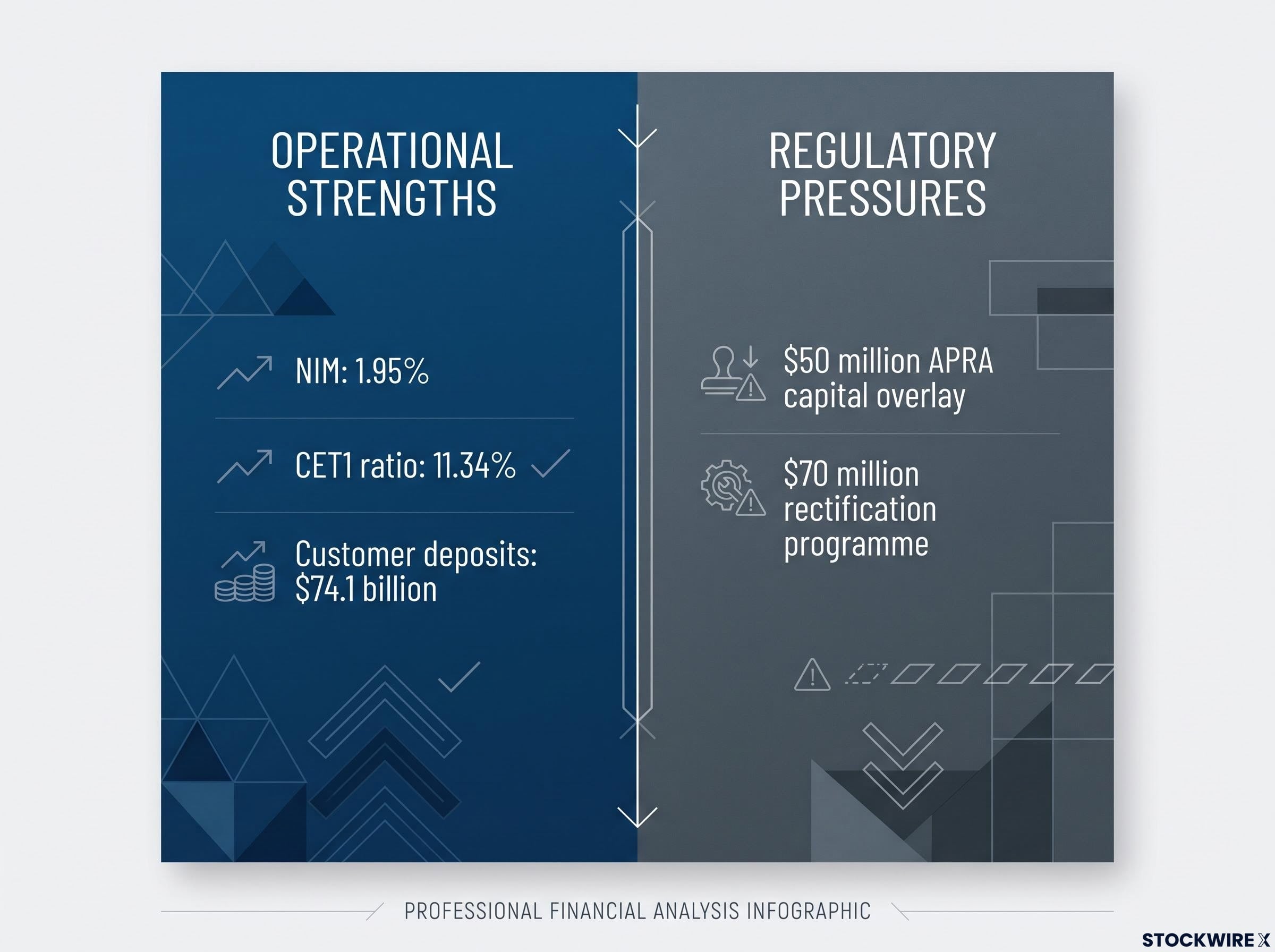
The Australian Prudential Regulation Authority (APRA) conducted a review of Bendigo’s non-financial risk management practices and found material deficiencies in governance and risk processes. The result was revised licence conditions, tighter supervisory oversight, and a $50 million operational risk capital add-on that has been in effect since 1 January 2026.
A capital overlay, in practical terms, is capital the bank must hold but cannot deploy. It cannot support lending growth, fund share buybacks, or underpin higher dividends. It sits quarantined on the balance sheet, directly constraining Bendigo’s return-on-equity potential until the regulator is satisfied the risk framework is fit for purpose.
CEO and Managing Director Richard Fennell acknowledged that non-financial risk capabilities require “significant improvement,” framing the remediation as a structural and cultural overhaul rather than a procedural fix.
That language matters. “Significant improvement” signals a depth of change that goes beyond ticking compliance boxes. The total estimated cost of the rectification programme stands at $70 million, and the APRA constraints will remain in place for as long as regulators judge the remediation to be incomplete. For any investor evaluating BEN shares at current levels, these sanctions are the single biggest external variable weighing on the bank’s equity valuation and return-on-equity trajectory.
What the underlying business actually looks like right now
Underneath the regulatory and cost narrative, the core franchise is in better shape than the statutory profit implies.
The bank’s net interest margin (NIM), a measure of the spread between interest earned on loans and interest paid on deposits, widened by 7 basis points across FY26 to reach 1.95%, with the second half alone coming in at 1.98%. A NIM trending toward 2% is a constructive signal for FY27 earnings power, because it means Bendigo is maintaining pricing discipline even in a competitive lending market.
- NIM (full year): 1.95%, up 7 basis points year-on-year
- NIM (2H FY26): 1.98%
- Loan book growth: 3.5% in 2H FY26, across residential, agribusiness, and portfolio funding
- Customer deposit balances: $74.1 billion, up 2.2% over the year
- CET1 ratio: 11.34%
Loan growth of 3.5% in the second half came across segments where Bendigo has historically been underweight, which matters because it shows the bank is gaining share rather than simply defending existing positions. Customer deposits of $74.1 billion reinforce a stable, relatively low-cost funding base.
Cost discipline and capital
Over the half-year period, operating expenses contracted by 2.1%, indicating that productivity initiatives are beginning to absorb cost inflation pressures, even as remediation charges push up the headline cost figure. Higher credit costs were recorded, though management characterised this as deliberate forward provisioning in response to macroeconomic and geopolitical uncertainty rather than evidence of any genuine deterioration in asset quality.
A Common Equity Tier 1 (CET1) ratio of 11.34%, the core measure of a bank’s capital strength relative to its risk-weighted assets, leaves Bendigo with a solid buffer even after accounting for the APRA capital charge. A NIM near 2%, loan growth in underweight segments, and a CET1 at that level tell you the bank is building earning capacity and capital resilience even while the regulatory clean-up consumes reported profit.
Understanding why the bank is carrying two separate cost headwinds at once
Two distinct cost programmes are running simultaneously, and the distinction matters because their trajectories are very different.
The first is the $70 million remediation programme, which is APRA-linked and focused on non-financial risk governance. These costs will eventually taper as APRA’s requirements are satisfied and the capital overlay is reduced or removed.
The second is broader programme spending, totalling $100 million to $123 million in guided FY27 expenditure, covering the RACQ Bank integration, investment in strategic partnerships, and a recalibration of the employee bonus equity scheme. The RACQ Bank integration, expected through the second half of calendar 2026 and into FY27, should eventually convert into earnings uplift if the acquisition delivers on its scale rationale. The remuneration scheme adjustment is a one-time alignment cost tied to the new risk and performance framework, not a recurring structural expense.
| Cost category | Estimated cost | Purpose | Expected duration |
|---|---|---|---|
| APRA remediation programme | $70M (total) | Non-financial risk governance overhaul | Multi-year; tapers as APRA requirements met |
| FY27 programme and integration costs | $100M-$123M | RACQ Bank integration, partnerships, remuneration alignment | FY27, with integration through 2H CY2026 into FY27 |
FY27 will be another elevated-cost year by design. The question for investors is not whether costs are high but whether the spending is building durable earnings capacity or simply absorbing regulatory penalties. The remediation costs taper; the integration costs should convert into earnings. Those are very different investment propositions.
What comes next: the 24 August results date, audited numbers, and the FY27 reporting shift
All figures reported so far are unaudited. The formal full-year result, including audited financials, a management briefing, and a results webcast, is scheduled for 24 August 2026.
- 24 August 2026: Audited FY26 results, management briefing, and results webcast
- FY27 onwards: A new financial reporting structure that brings Bendigo’s disclosures into closer alignment with peer banks, which may improve comparability but could require analysts to rebase existing historical models
- Key items to watch at the briefing: Dividend guidance, updated capital management commentary, and any movement on the APRA capital overlay or remediation timeline
For investors in BEN shares, the 24 August release is the first opportunity to see whether the audited numbers confirm the unaudited picture. More importantly, it is where management will have to answer directly on remediation progress, capital management, and dividend policy. What Fennell says about APRA’s posture at that briefing may carry more weight than the earnings numbers themselves.
Sizing up the BEN share price at this point in the remediation cycle
BEN shares have lost roughly 13% of their value over the 12 months to 18 August 2026, a repricing that reflects the regulatory and remediation pressures the market has been tracking. A decline of that magnitude, set against 3% cash earnings growth and an expanding NIM, suggests the market is applying a real equity discount for regulatory uncertainty.
Potential upside drivers:
- Sustained NIM around the 2% level supporting FY27 earnings power
- Successful RACQ Bank integration delivering scale benefits once one-off costs roll off
- Eventual removal or reduction of the $50 million APRA capital overlay
Key risks:
- Scope creep in the $70 million remediation programme, or extension of APRA conditions beyond current expectations
- Margin compression if competition intensifies or funding costs rise faster than loan repricing
- Credit-cycle deterioration adding to provisioning pressure and consuming capital
The question for investors is whether a 13% decline adequately compensates for the remaining remediation risk, or whether the overhang still has further to run. The operational metrics, a 1.98% exit NIM, a 11.34% CET1 ratio, and growing loan books, suggest the underlying franchise can support a recovery. The regulatory timeline is the variable the market cannot yet price with confidence.
Whether BEN shares reflect the full cost of the clean-up or just part of it
Two threads run through this result, and both are real. The operational story, NIM expansion, loan growth, cost discipline, and a solid CET1, points to a bank that is building earnings capacity. The regulatory and cost story, APRA conditions still in force, a $70 million remediation programme still running, and FY27 programme costs guided at $100 million to $123 million, points to a clean-up that is not yet finished.
The specific variables that will drive the next material re-rating of BEN shares are evidence that the APRA capital overlay is being reduced, remediation costs tracking toward completion rather than expanding, and RACQ Bank integration progressing on schedule. The 24 August audited results and management briefing represent the next checkpoint.
The variables that re-rate BEN are not primarily in the income statement at this point; they sit in the regulatory relationship. What management says about APRA progress at the August briefing may matter more than the earnings figures themselves.
For BEN shareholders, the next six months are likely to clarify whether the remediation overhang shrinks or extends. That clarification, more than any single earnings metric, will determine whether the 13% decline over the past year represents the floor or the beginning of a longer de-rating.
This article is for informational purposes only and should not be considered financial advice. Investors should conduct their own research and consult with financial professionals before making investment decisions. Past performance does not guarantee future results. Financial projections are subject to market conditions and various risk factors.