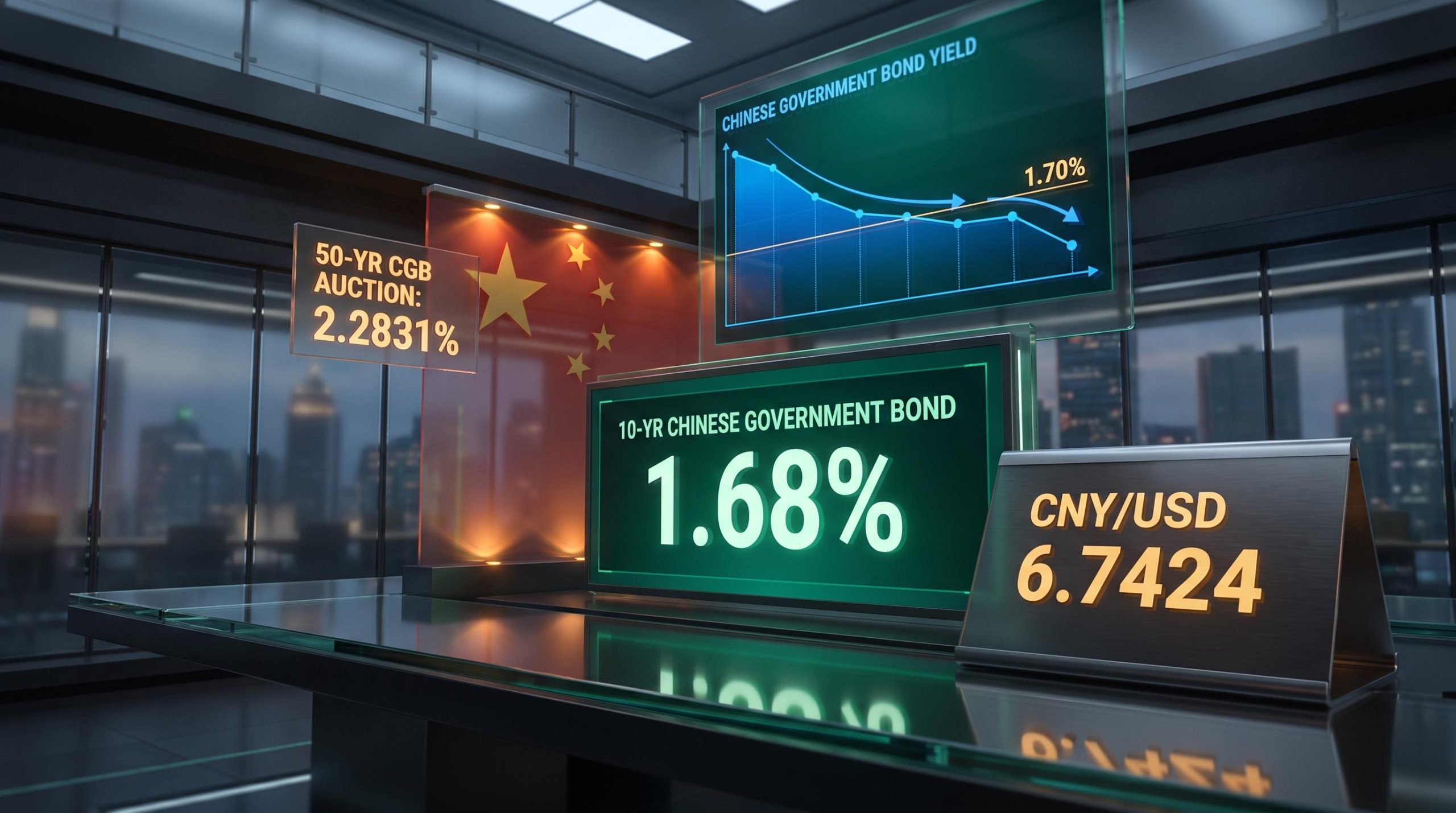
In mid-August 2026, two things happened simultaneously in China’s financial markets that most monetary policy frameworks would treat as contradictory. The 10-year Chinese government bond (CGB) yield fell below 1.70% for the first time in roughly a year, settling near 1.68%. At the same time, the yuan hit 6.7424 against the US dollar, its strongest level since February 2023.
Those two moves rarely coexist in the same policy cycle. Easier liquidity and compressed yields typically accompany currency softness, not strength. When a central bank pushes rates lower, the yield differential that attracts foreign capital narrows, and the currency tends to weaken. The fact that both are moving in the same direction simultaneously is the signal worth unpacking: what does this configuration tell you about what the People’s Bank of China (PBoC) is actually doing, and what it believes?
This piece gives you a working framework for reading PBoC signals through operational behaviour rather than official statements. It covers what the current alignment of falling yields and a firming yuan means for anyone allocating to Chinese fixed income or currency, and it identifies the specific risks and indicators that would change the view. The payoff is practical clarity on a market that sends ambiguous signals by design.
A rare alignment: why lower yields and a stronger yuan usually do not arrive together
The conventional playbook for accommodative monetary policy runs in one direction. A central bank injects liquidity, short-term funding costs fall, bond yields compress, and the currency weakens as the interest rate differential narrows relative to peers. Capital tends to flow toward higher-yielding alternatives, and the weaker currency acts as a secondary growth stimulus through cheaper exports.
What is happening in China right now breaks that sequence. A net liquidity injection of 348 billion yuan by the PBoC mid-month pushed the 10-year CGB yield through the 1.70% floor, a level it had not breached in around twelve months. The yield settled at roughly 1.68% following the operation. Simultaneously, the yuan reached 6.7424 against the dollar, and the PBoC set its daily midpoint fixing at its firmest levels in more than three years.
CNY/USD: 6.7424 marks the yuan’s peak since February 2023, a level achieved in tandem with, rather than in spite of, a substantial PBoC liquidity operation.
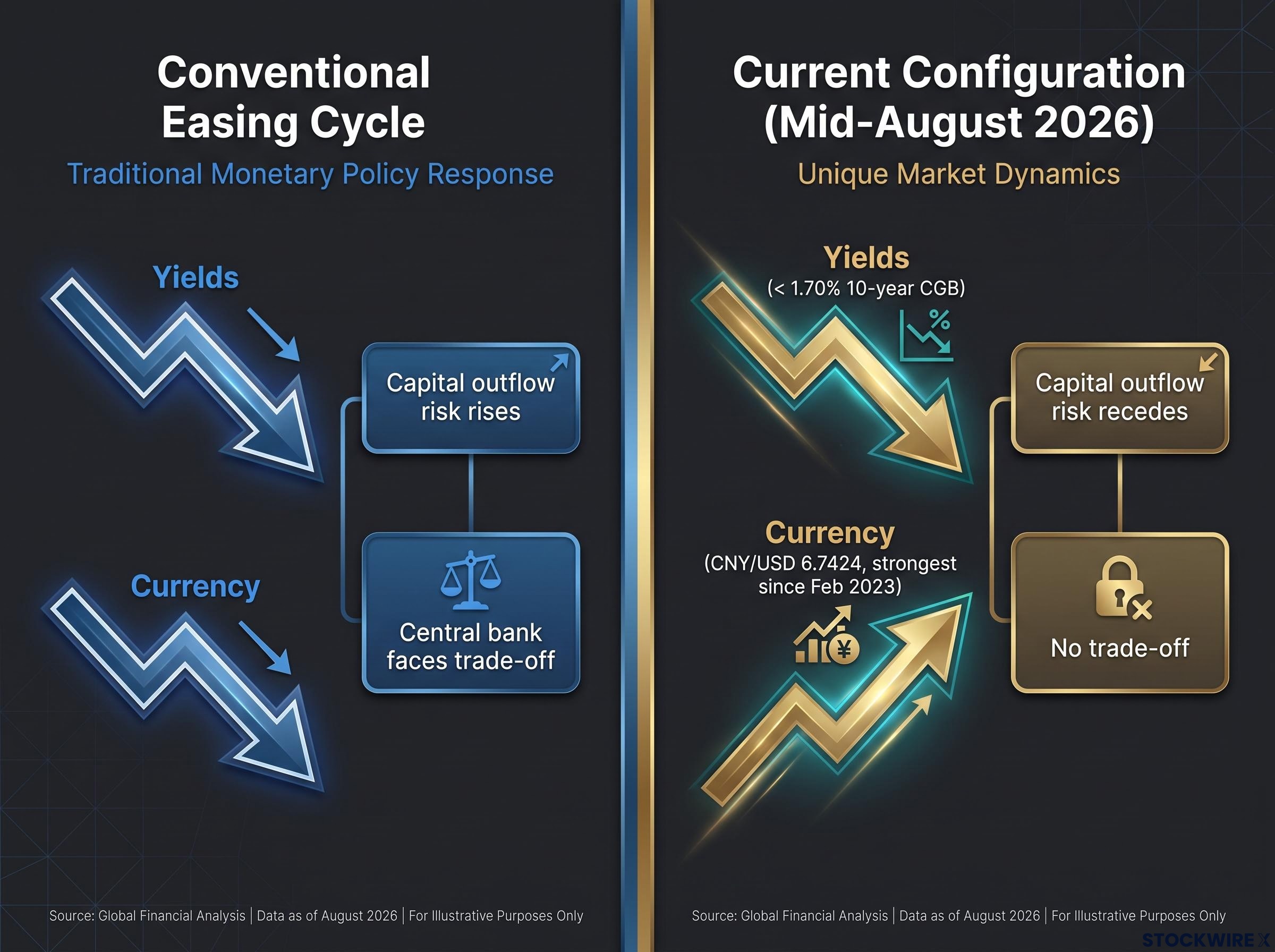
The coexistence of these two moves tells you the PBoC is actively managing both channels at once, which means the policy signal is more deliberate and more confident than a standard easing cycle would imply. Consider the contrast:
- Conventional easing cycle: yields fall, currency weakens, capital outflow risk rises, central bank faces a trade-off between domestic stimulus and FX stability
- Current configuration: yields fall, currency strengthens, capital outflow risk recedes, central bank appears to face no trade-off at all
Investors who treat this as a routine bond rally miss the currency dimension that changes the risk calculus entirely.
When big ASX news breaks, our subscribers know first
How the PBoC is actually moving: reading operational signals over official statements
In its most recent quarterly monetary policy implementation report, the PBoC signalled a continuing commitment to an easy policy environment and retained the flexibility to apply targeted support tools when conditions warrant. Notably absent from the report was any forward guidance on specific policy rate reductions or cuts to the reserve requirement ratio (RRR), a deliberate omission that preserves the central bank’s room to manoeuvre.
China’s macro divergence from major peers deepened in July 2026 when manufacturing and services PMIs both fell below the 50-point contraction threshold simultaneously, the first occurrence this cycle, adding structural weight to the PBoC’s case for sustained operational easing beyond the mid-August liquidity injection.
The more revealing indicator is what the central bank actually did. The gross reverse repo operation of approximately 349 billion yuan was conducted mid-month, off the standard operational cycle. Standard reverse repo operations follow a predictable schedule; an intervention at this scale and timing breaks that pattern.
What the off-cycle timing actually means
A mid-month operation at this scale signals the PBoC wanted to prevent money-market tightness proactively rather than respond to it after the fact. That is a different posture from passive liquidity management. The timing coincided directly with the yield move below 1.70%, making the causal link operationally visible.
On the fiscal side, the Ministry of Finance added further confirmation: a 50-year sovereign bond auction settled at an average yield of 2.2831%, drawing solid institutional participation and demonstrating that buyers are willing to hold long-dated Chinese paper at historically compressed levels.
For you, this means the PBoC’s next move will be visible in operational behaviour before it is announced. Three real-time indicators matter more than waiting for press conferences:
- Open-market operation size: the volume of reverse repo injections relative to maturing liquidity
- Off-cycle timing signals: mid-month or unscheduled operations that break the standard pattern
- Daily fixing level: the PBoC’s midpoint setting for CNY/USD, which functions as an active policy lever
What Chinese government bonds actually offer investors at sub-1.70% yields
At 1.68-1.70%, CGBs are not an income play. The coupon return at these levels is thin by any global standard. The primary return thesis is capital appreciation through further yield compression, or portfolio stabilisation in risk-off environments where high-quality sovereign duration performs well.
The policy backstop for that thesis is operationally credible. The scale and timing of liquidity injections, combined with strong long-dated auction demand, confirm the PBoC and Ministry of Finance are supporting current and slightly lower yield levels. Investor willingness to absorb 50-year sovereign paper at 2.2831% signals market comfort with prolonged low-rate conditions, which matters for how you should frame duration exposure in your broader portfolio.
| Asset | Current Yield | Primary Portfolio Role | Key Risk | Return Thesis |
|---|---|---|---|---|
| 10-year CGB | 1.69% | Duration / diversification | Dollar reversal, policy surprise | Capital gains via further compression |
| 50-year CGB | 2.28% | Long duration / risk-off hedge | Inflation surprise, curve steepening | Capital gains, deflation hedge |
| 10-year JGB | ~1.0% | Duration / yen hedge | BoJ policy normalisation | Safe-haven, low-vol duration |
An investor who enters CGBs at current yields is making a bet on further compression or risk-off performance, not on income. Your return horizon and portfolio role for this asset should reflect that distinction explicitly. Misidentifying CGBs as a yield play leads to position-sizing errors and misaligned expectations.
Duration exposure management becomes the central variable when CGBs are held for capital appreciation rather than income, since a bond with duration of 7 loses approximately 7% in price for every 1 percentage point rise in yields, making position sizing relative to your overall fixed-income book a more important decision than the entry yield level itself.
The yuan signal: what currency strength tells you about Beijing’s confidence
The PBoC setting its daily fixing at its firmest levels in more than three years is an active choice. The central bank could allow the yuan to soften alongside the liquidity injection, as it has in prior easing cycles. Instead, it is guiding CNY stronger while simultaneously pushing yields lower. That combination signals the PBoC believes currency strength is compatible with its growth and stability objectives.
The PBoC fixing mechanism operates through a countercyclical adjustment factor that allows Beijing to publish a midpoint stronger or weaker than raw market inputs would produce, making the gap between the published fix and model-implied values the most precise real-time readout of policy intent available to outside investors.
This distinguishes the current stance from previous easing cycles where currency weakness was tolerated or quietly encouraged as a growth stimulus. The policy mix this time is internally consistent rather than contradictory.
Societe Generale analysts have pointed to CNY’s sustained gains, observing that the currency has advanced to multi-year highs against the dollar even as the PBoC maintains an accommodative domestic policy posture.
Three factors are supporting current CNY strength:
- Broad US dollar weakness and lower US Treasury yields reducing the rate differential pressure
- Strong Chinese export performance providing fundamental demand for the currency
- PBoC fixing behaviour actively guiding the midpoint higher, functioning as a deliberate policy signal
For you, a PBoC that is comfortable with currency strength means the central bank is less likely to be forced into abrupt tightening to defend the yuan. That reduces the tail risk of a sudden yield spike tied to FX stress. It also lowers hedging costs and makes unhedged or partially hedged allocations to Chinese assets more defensible than in periods where the yuan is under pressure.
FX instability has historically been one of the main deterrents to China allocation for global investors. A firm yuan backed by deliberate fixing policy changes that calculus in a meaningful way.
Three risks that could break the current configuration
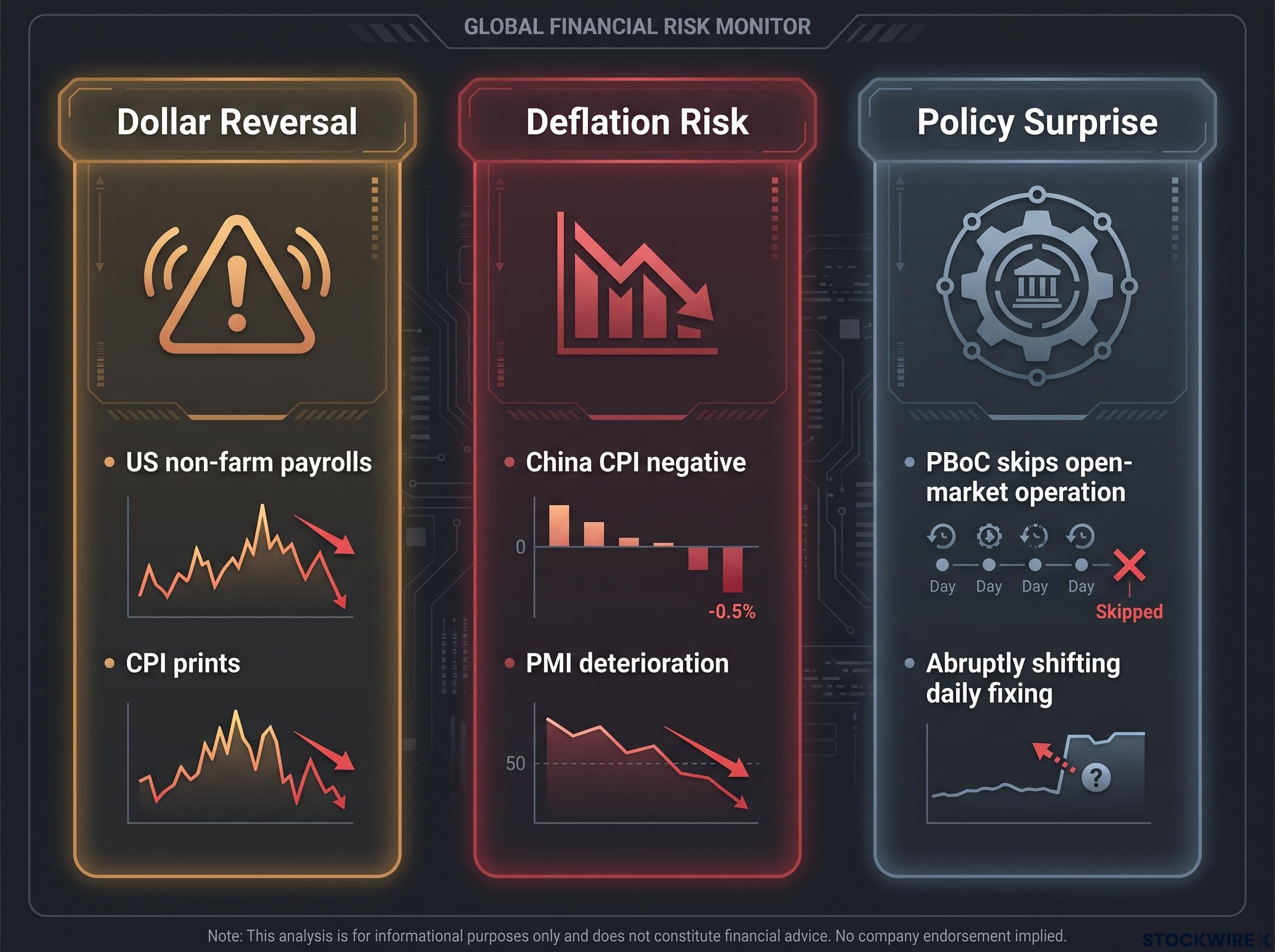
The current alignment of sub-1.70% yields, CNY at 6.7424, and PBoC fixing at three-year highs is constructive. It is not risk-free. Three specific risks could unwind it, and each has an observable early-warning indicator.
- US dollar reversal. The yuan’s recent strength is partly a function of dollar softness. A renewed dollar rally, driven by stronger US employment data, hawkish Federal Reserve repricing, or flight-to-quality flows, would likely cap or reverse CNY gains and could tighten financial conditions even if the PBoC remains accommodative. This is the most immediate external risk and the least controllable from Beijing’s perspective.
- Chinese deflationary or growth-downside scenario. Very low yields embed expectations of subdued inflation and modest growth. If those expectations slide into entrenched deflation, CGBs may still hedge portfolios, but broader China exposure (equities, credit, property-linked assets) could suffer meaningfully. Geopolitical and trade tensions, including technology export controls, can alter capital flows independently of fundamentals.
- Policy surprise in either direction. A larger-than-expected rate cut or RRR reduction could accelerate yield compression and introduce CNY volatility. An unexpected pause in liquidity injections or a sharper FX-defence stance could push yields higher abruptly. The PBoC’s preference for operational tools over explicit forward guidance leaves room for surprise both ways.
The indicator to watch for each risk
Each of these risks has a specific, observable data point that would signal it is materialising:
- Dollar reversal: US non-farm payrolls or CPI prints that surprise to the upside and reprice Fed rate expectations
- Deflation risk: China CPI trending into negative territory on a sustained basis, or a marked deterioration in PMI readings
- Policy surprise: The PBoC skipping a scheduled open-market operation or abruptly shifting the daily fixing weaker after a period of consistent strengthening
These risks are manageable if you know what to watch. A constructive macro backdrop is not the same as a risk-free one; understanding which external triggers could unwind the current alignment allows you to size positions appropriately and set clear exit or hedge triggers.
Where the weight of evidence points for allocators positioned in China now
The dual signal is clear. Operationally credible PBoC support, low and stable yields, and a deliberately firm currency create a broadly constructive backdrop for CGBs and CNY. The asymmetric risk profile tilts toward external shocks rather than domestic tightening.
The current configuration carries asymmetric risk: external shocks (dollar strength, geopolitical disruption, global risk-off) are the primary threat, not an imminent domestic tightening cycle. That distinction shapes how you should size and monitor any China allocation.
The positioning implications differ by investor type:
- Fixed-income investors: CGBs at sub-1.70% yields are a strategic duration and diversification tool with a capital-appreciation return thesis backed by a central bank inclined to keep conditions easy. The income profile is thin. The policy backstop is real and operationally visible, as confirmed by the 348 billion yuan net injection and strong 50-year auction at 2.2831%.
- Currency and multi-asset investors: The yuan at 6.7424 and firm official fixing reduce one major historical deterrent to China exposure, FX instability, while still requiring close monitoring of US dollar trends and policy surprises. The yuan is best understood as a tactical vehicle for expressing views on US-China rate differentials and global trade flows, not as a carry trade.
The PBoC’s preference for operational easing over explicit forward guidance means the market is unlikely to be blindsided by a sudden policy reversal. It also means you cannot fully front-run the next move. That makes position sizing and stop-loss discipline more important than directional conviction alone.
The current setup rewards investors who treat China exposure as a deliberate strategic allocation with clear monitoring triggers, not those who are either reflexively bullish on China or reflexively avoiding it.
For investors wanting to understand what the current risk-on rotation means for the broader positioning context around China assets, our full explainer on China inflow dynamics covers how $16 billion in weekly equity inflows and discretionary manager underweighting interact with the policy backdrop described here.
This article is for informational purposes only and should not be considered financial advice. Investors should conduct their own research and consult with financial professionals before making investment decisions. Past performance does not guarantee future results. Financial projections are subject to market conditions and various risk factors.