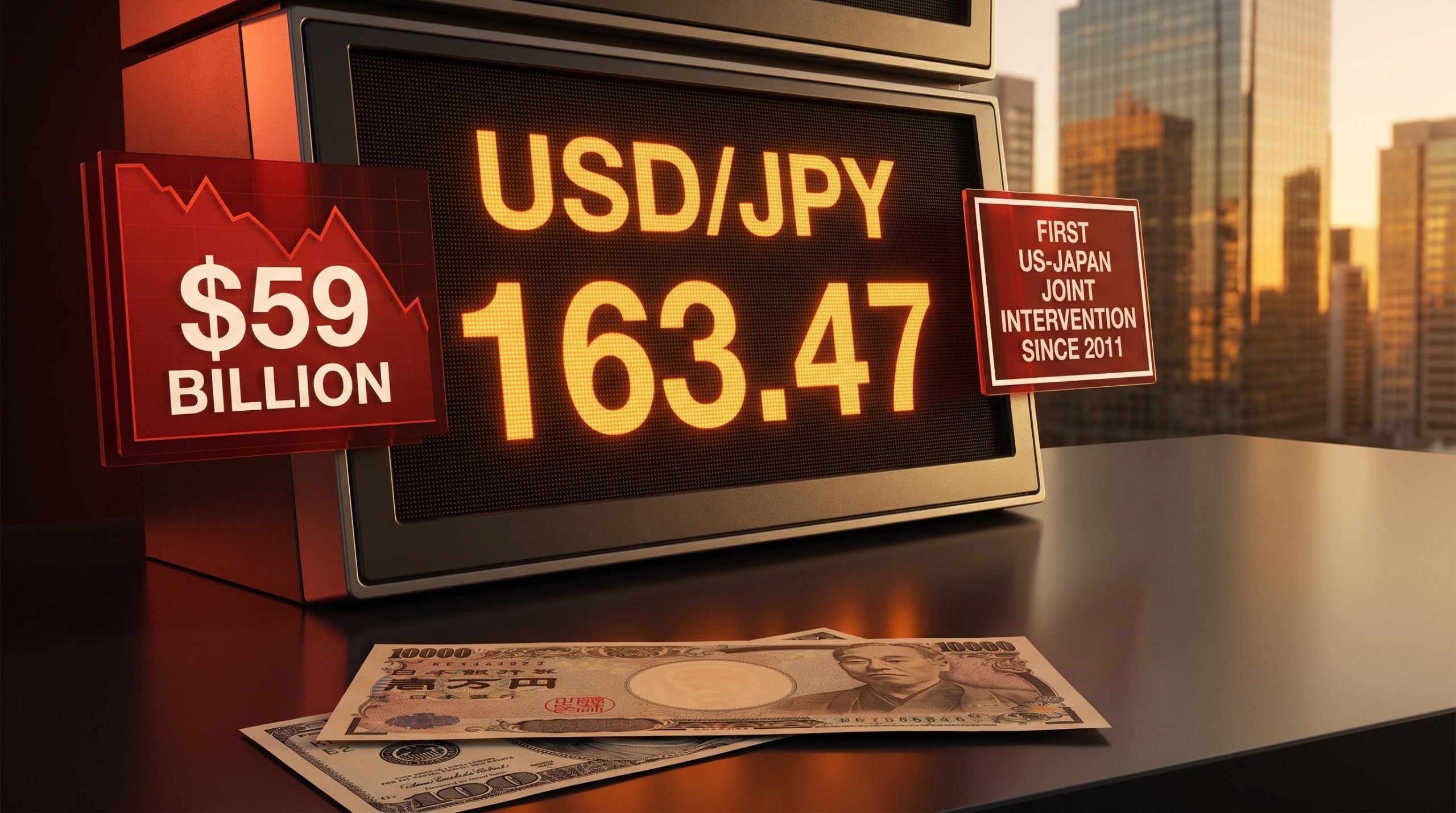
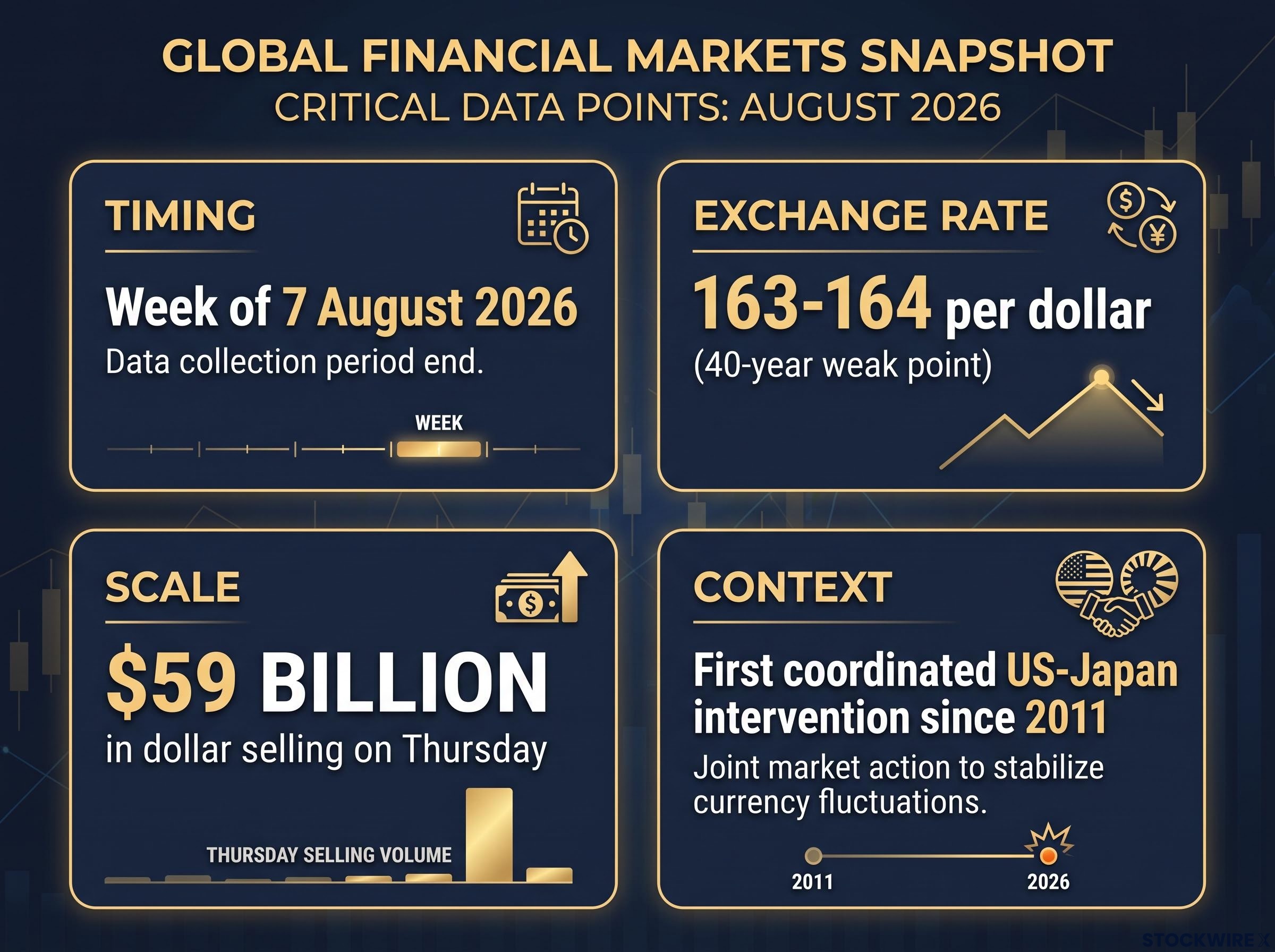
The yen hit approximately 163-164 per dollar this week, its weakest level in roughly 40 years. Japan’s response was immediate and enormous: an estimated $59 billion in dollar selling on Thursday alone, according to Bank of Japan settlement data. The United States joined the operation, making it the first coordinated US-Japan currency intervention since 2011.
Joint intervention at this scale is not routine diplomacy. It is a mechanism reserved for moments when one country acting alone would create collateral damage neither side can afford. Washington’s participation was not a favour to Tokyo. It was a defensive move to protect the US Treasury market from a supply shock that unilateral Japanese action would have triggered. The operation took place the week of 7 August 2026.
Here is what the intervention actually changes for different types of investors, and what it does not. The distinction between policy-driven currency smoothing and a genuine reversal in the yen’s direction is the filter that separates a measured response from an overreaction, and the sections below give you exactly that framework.
Why the yen’s decline forced policymakers to act
At approximately 163-164 per dollar, the yen sat at its weakest point against the US dollar in roughly four decades. This was not a gradual grind lower. The pace of the decline in recent weeks alarmed authorities in Tokyo far more than the level itself.
Three structural forces drove the weakness:
- The interest-rate differential between the US and Japan, which remains historically wide, making yen-denominated assets far less attractive to global capital than dollar-denominated alternatives
- Energy-price shocks, which hit Japan disproportionately hard as a major importer of oil and liquefied natural gas, amplifying domestic inflation
- Speculative positioning, with leveraged traders piling into short-yen bets as momentum accelerated
Japanese authorities described recent moves as reflecting “excessive volatility and disorderly movements.” That language matters. Intervention is not triggered by a currency reaching a particular number; it is triggered by the speed and disorder of the move. The same logic applies whenever any major central bank steps into a currency market. The rate of deterioration, not the destination, is what crosses the threshold.
The yen carry trade remains structurally intact despite the Bank of Japan’s rate increases, because the roughly 2.5-2.75 percentage point spread between US and Japanese policy rates continues to make yen-funded dollar positions one of the most persistent forces in global capital markets.
When big ASX news breaks, our subscribers know first
Why the United States agreed to intervene alongside Japan
The simplest explanation for US participation is also the most revealing: no foreign government holds a larger stock of US government debt than Japan. If Tokyo had intervened unilaterally at this scale, it would have needed to sell enormous volumes of US Treasuries to raise the dollars required for yen purchases. That would have flooded the Treasury market with supply, pushing US yields higher at precisely the wrong moment for Washington’s own fiscal position.
The two governments structured the operation jointly so that yen support could proceed without requiring Tokyo to offload its Treasury holdings at scale. That design directly addressed the systemic risk that a unilateral Japanese operation would have posed to US debt markets.
This was the first coordinated US-Japan currency intervention since 2011, underscoring how unusual the conditions were and how seriously both governments assessed the systemic risks.
Acting in parallel, Washington converted a portion of its euro holdings into yen purchases. That detail is important: Washington avoided selling either dollars or Treasuries directly, insulating its own balance sheet from the mechanics of the intervention. The US did not intervene to help Japan; it intervened to protect the US Treasury market from a supply shock. Those two objectives happened to align, which is exactly what makes coordinated intervention politically possible.
Inside the mechanics of the joint operation
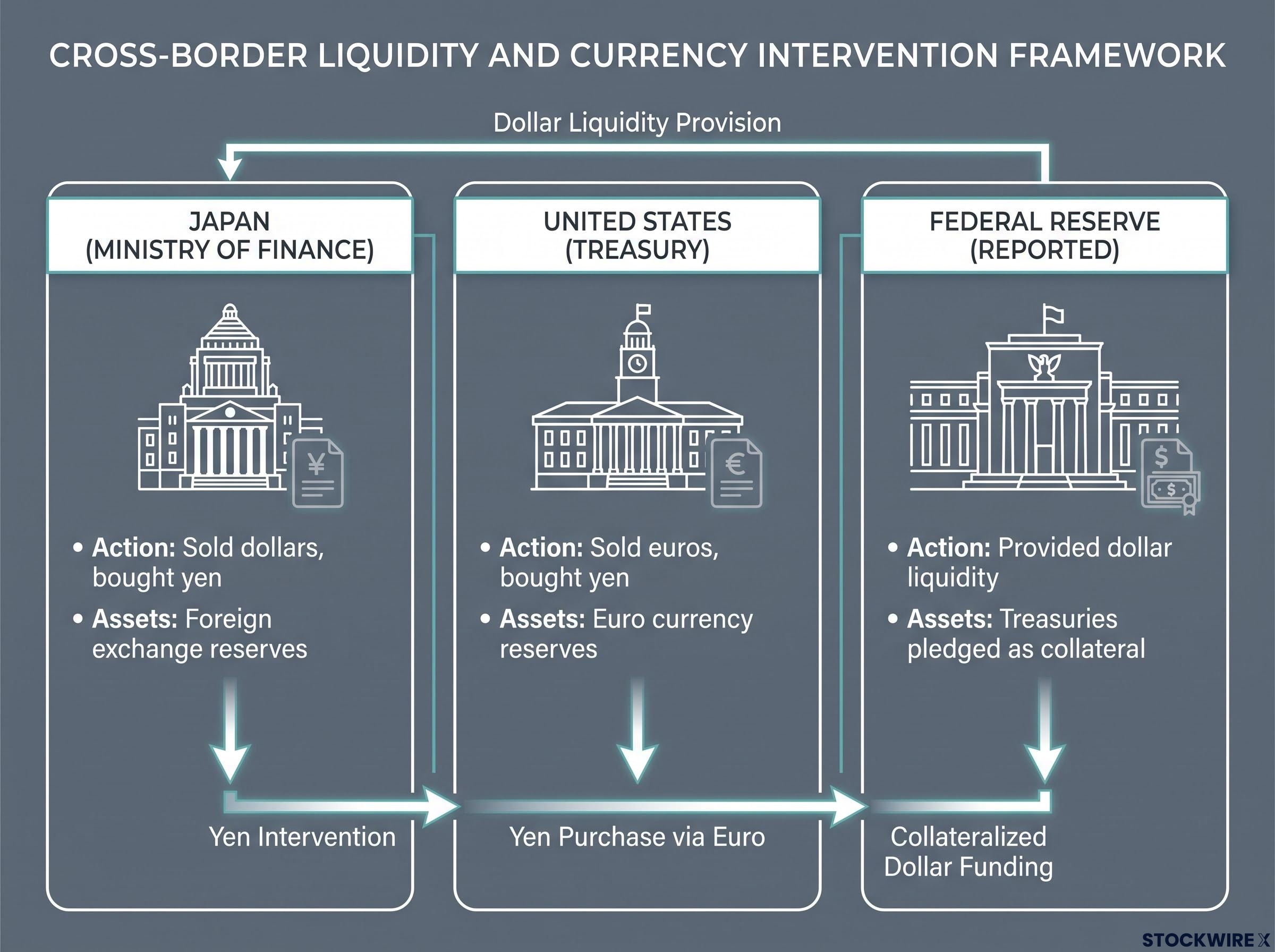
The confirmed mechanics are straightforward. Japan sold dollars from its foreign exchange reserves and bought yen in large size. Bank of Japan settlement data point to approximately $59 billion in dollar selling on Thursday alone, with additional action suspected on Friday. The United States, in parallel, sold euro reserves to purchase yen.
| Actor | Action taken | Assets used | Purpose |
|---|---|---|---|
| Japan (Ministry of Finance) | Sold dollars, bought yen | Foreign exchange reserves | Direct yen support |
| United States (Treasury) | Sold euros, bought yen | Euro currency reserves | Yen support without dollar or Treasury sales |
| Federal Reserve (reported) | Provided dollar liquidity via lending facility | Treasuries pledged as collateral (FIMA-style repo) | Allow Japan to obtain dollars without selling Treasuries outright |
One element remains unresolved. The original reporting asserts that Japan accessed a Federal Reserve lending facility, likely the FIMA repo facility, to fund its purchases. A FIMA repo facility allows a foreign central bank to pledge Treasuries as collateral in exchange for short-term dollar liquidity, giving Japan a route to the dollars required for intervention while keeping its Treasury portfolio intact. Independent public confirmation of how much, if at all, this facility was used in this specific episode was not available at the time of writing.
The Federal Reserve FIMA repo facility allows eligible foreign central banks to pledge US Treasury securities as collateral in exchange for short-term dollar liquidity, providing a mechanism that lets a government like Japan’s fund large-scale currency operations without liquidating its Treasury holdings outright.
Whether or not the Fed facility was used in full, the structural design of the intervention tells you something important: policymakers went to significant lengths to insulate the US Treasury market from any collateral damage. That effort alone signals how seriously they assessed the systemic risk of a disorderly yen collapse.
How much a coordinated intervention can actually move markets
Currency interventions make headlines, but the empirical record is sobering. Historically, FX interventions rarely reverse a currency’s long-run direction unless they are accompanied by a genuine shift in underlying fundamentals: interest rates, inflation trajectories, growth dynamics, or central bank policy.
The yen’s structural backdrop has not changed. US rates remain far above Japan’s. Neither the Bank of Japan nor the Federal Reserve has signalled an imminent policy shift large enough to narrow the differential. Japan’s energy-import dependence continues to amplify cost pressures. The forces that pushed the yen to 40-year lows are still in place.
This intervention is best understood as a speed bump rather than a secular turning point. Unless it foreshadows actual policy changes from either central bank, the structural pressure on the yen remains.
Three conditions would sustainably shift the yen’s trajectory:
- Bank of Japan rate increases large enough to narrow the yield gap with the US
- Federal Reserve rate cuts that reduce the attractiveness of dollar-denominated assets
- A fundamental shift in Japan’s energy-import economics that relieves the inflationary pressure a weak yen amplifies
For readers tempted to interpret this intervention as the beginning of a yen recovery, the rate-differential argument is the corrective lens. Until those differentials move meaningfully, the intervention moderates the pace of decline rather than turning the trend around.
The US-Japan rate differential is the single variable most capable of sustainably altering the yen’s direction, and Japan’s 10-year government bond yield rising from 0.2% to 2.77% since 2022 represents the clearest evidence that monetary normalisation is underway, even if the gap with US rates remains historically wide.
This article is for informational purposes only and should not be considered financial advice. Investors should conduct their own research and consult with financial professionals before making investment decisions.
What this episode means for equity, bond, and FX investors
The action required, or not required, differs sharply depending on where you sit.
FX traders and tactical macro investors face elevated two-way risk in USD/JPY. A repeat of joint intervention is a credible threat, which raises the cost of maintaining short-yen positions. Intraday moves during intervention windows can be violent, and leverage amplifies the damage. Position sizing matters more than directional conviction in this environment.
Bond investors, particularly those with US Treasury exposure, can note a modest positive. The intervention reduces the near-term tail risk that Japan would dump large blocks of Treasuries to fund yen support, a scenario that would have pushed US yields higher. That said, US deficit dynamics, Federal Reserve policy, and domestic inflation remain the primary yield drivers. This episode is secondary to those forces.
Equity investors in the US, Japan, or globally should treat this as a headline-driven volatility event, not a structural signal. According to Fisher Investments’ published commentary, currency movements in the yen are not among the primary forces shaping equity returns in either the US or Japanese markets. Over meaningful time horizons, earnings, valuations, economic growth, and policy are what drive equity returns. A modestly stronger yen could pressure Japanese exporter margins by reducing the yen value of overseas earnings, but modest moves relative to recent history are unlikely to dominate those larger forces.
The relationship between yen levels and Japanese exporter margins is more nuanced than simple directional logic suggests: the MSCI Japan Index returned 15.7% in USD terms in the first half of 2026 as the yen weakened toward 40-year lows, with Toyota and Honda both reporting record profits that explicitly cited favourable exchange rates.
| Investor type | Direct exposure level | Near-term consideration | Long-term priority |
|---|---|---|---|
| FX / tactical macro | High | Elevated two-way risk; repeat intervention credible | Rate-differential direction |
| Bond (US Treasuries) | Moderate | Reduced tail risk of Japan Treasury liquidation | Fed policy, US deficit dynamics, inflation |
| Equity (US, Japan, global) | Low | Headline volatility; no strategic reallocation warranted | Earnings, valuations, economic growth |
For diversified long-term investors, the correct response is to maintain perspective rather than react. The FX and bond framing gives you tools to interpret what you see in the broader market around this event.
What the next signals will tell you about the yen’s real direction
Three forward-looking signals will determine whether this intervention marked a pause or a turning point:
- Whether the yen drifts back toward prior highs near 160+ per dollar. If it does, markets are testing policymakers’ resolve. A repeat of joint intervention at that level would signal an implicit floor, raising the cost of yen-short positioning for traders.
- Whether the Bank of Japan or Federal Reserve shift policy in ways that narrow the rate differential. Watch Bank of Japan meeting outcomes and Fed communications closely. This is the only condition that would sustainably alter the yen’s direction rather than temporarily stabilising it.
- Whether official disclosures clarify how Japan funded the intervention. If public data confirm significant use of Federal Reserve lending facilities, it reveals the depth of institutional coordination and the lengths policymakers will go to protect the Treasury market.
The most recent Bank of Japan rate decision, an 8-1 hold at 1.0% on 31 July 2026, included a named dissenter pressing for an immediate hike to 1.25%, compressing the perceived timeline to the next move and making BoJ meeting outcomes one of the sharpest forward signals for yen direction.
As a secondary signal, any G7 or IMF communication on acceptable levels of FX volatility could frame the formal boundaries within which further coordinated action might occur. Readers watching these three signals will be better positioned to distinguish between the yen stabilising because of policy and the yen stabilising because of fundamentals, a distinction that matters for any decision with a horizon beyond the next few weeks.
The intervention steadied the yen; the fundamentals will determine what happens next
The purpose of this intervention was to arrest a disorderly decline, not to unwind the underlying forces that produced it. That distinction should govern how you interpret yen moves in the weeks ahead. What investors can take away durably is the importance of separating temporary policy-driven price stabilisation from a genuine change in the currency’s structural direction.
The conditions that would represent a real inflection are specific: a meaningful narrowing of the US-Japan rate differential, either through Bank of Japan tightening or Federal Reserve easing. Until those conditions materialise, the intervention remains what the evidence says it is, a speed bump on a road whose direction has not changed.
Past performance does not guarantee future results. Financial projections are subject to market conditions and various risk factors.