
Noxopharm’s new preclinical data validates immune-amplifying cancer technology
Noxopharm (ASX:NOX) has announced new preclinical data demonstrating that its TLR8-potentiating oligonucleotides can trigger an immune response to otherwise “immune-silent” cellular RNA. The proof-of-principle result, released on 4 August 2026, showed the combination induced a TLR8-driven immune response exceeding fourfold (437%) the level observed in untreated cells.
The study was carried out in collaboration with the Hudson Institute of Medical Research, Noxopharm’s key strategic partner in the development of the Sofra™ technology platform.
When big ASX news breaks, our subscribers know first
Inside the breakthrough — teaching the immune system to see cancer
The latest study delivered a proof-of-principle finding: Noxopharm’s short synthetic RNA sequences helped immune cells recognise cellular RNA that would normally go unnoticed. This validates the company’s immune-amplifying oligonucleotides strategy.
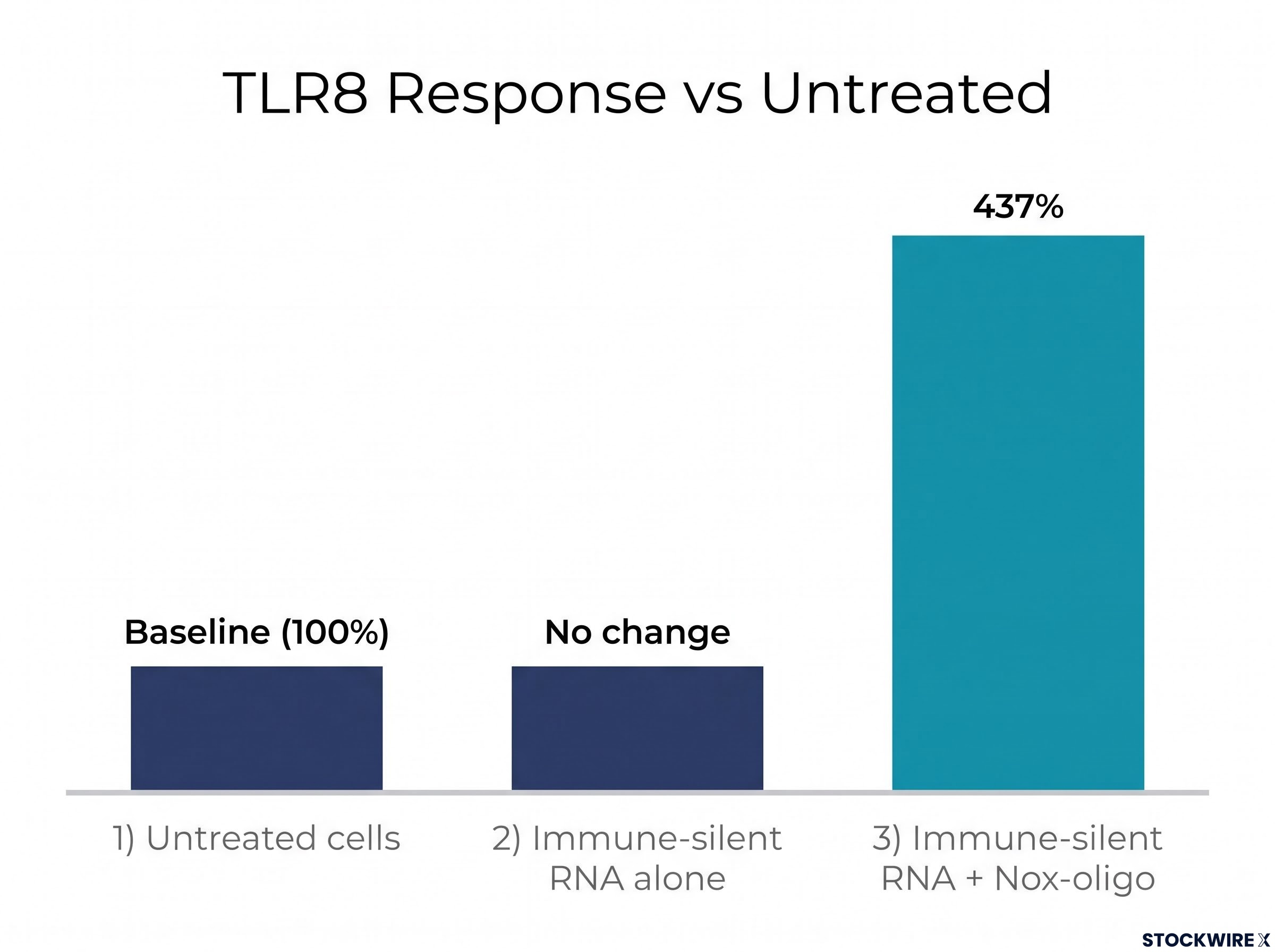
The test was conducted in vitro. RNA alone failed to activate a TLR8-driven immune response, as expected. When the same RNA was combined with one of Noxopharm’s TLR8-amplifying oligonucleotides, it induced a strong TLR8-mediated response reaching 437% of the level measured in the untreated group.
This result builds on earlier work. Earlier this year, Noxopharm and its collaborators published research in Nature Immunology showing how immune-silencing RNA limits immune system activation, and identified a way to counter it by boosting TLR8 activity.
The Nature Immunology publication, secured earlier in 2026 with endorsement from globally recognised TLR8 expert Professor Arthur Krieg, provided independent top-tier validation of the immune-silencing RNA mechanism that the August proof-of-principle result now builds directly upon.
| Test Condition | RNA Used | Oligonucleotide Added | TLR8 Response vs Untreated |
|---|---|---|---|
| Untreated cells | None | None | Baseline (100%) |
| Immune-silent RNA alone | Total cellular RNA | None | No change |
| Immune-silent RNA + Nox-oligo | Total cellular RNA | TLR8-potentiating oligonucleotide | 437% |
Professor Michael Gantier, Hudson Institute of Medical Research
“This exciting finding is proof-of-principle that the anti-inflammatory nature of cellular RNA we recently discovered can be overcome by specific oligonucleotides. While follow-up work is underway to show how these potentiators could increase anti-tumoral responses, this finding establishes the validity of this concept.”
What TLR8 and oligonucleotides mean for cancer treatment
The immune system plays a vital role in fighting cancer. While many treatments focus on destroying cancer cells directly, some cells escape or become resistant to treatment. Training the immune system to recognise and attack those cells could help remove them throughout the body.
When cancer cells die, they leave behind cellular debris, including RNA, a molecule found in all cells. The problem is that cancer cells also carry abundant immune-silencing RNA, allowing them to avoid triggering a cancer-targeted immune response. Immune cells simply cannot distinguish cancerous debris from the debris of healthy cells.
Toll-like receptor 8 (TLR8) is a key sensor that helps the immune system recognise potential threats. Boosting its activity could help unmask cancer RNA that would otherwise go undetected. Oligonucleotides, the short synthetic RNA sequences at the centre of this work, are designed to mimic natural regulators of the body’s defence system.
The mechanism can be summarised in a few steps:
-
Cancer cells die following treatment and leave behind RNA debris.
-
Immune-silencing RNA within that debris hides the cancer from the immune system.
-
Noxopharm’s TLR8-potentiating oligonucleotide unblinds immune cells to the cancer RNA.
-
The immune system can then better initiate its anti-cancer response.
For investors, the significance lies in the strategy this supports. The technology is designed to work alongside existing standard-of-care therapies such as chemotherapy and radiotherapy, addressing a large patient population already receiving cancer cell-killing treatments.
Why this matters for the Noxopharm investment case
The data connects to a broader pipeline built on what the company describes as an “elegant scientific symmetry.” The same innate immune pathway is modulated in opposite directions: TLR8-potentiating oligonucleotides enhance immune recognition in oncology, while inhibitory oligonucleotides are designed to suppress inappropriate immune activation in autoimmune disease.
Noxopharm operates two technology platforms. Sofra™ targets inflammation, autoimmunity, mRNA drug enhancement and oncology, while Chroma™ focuses on oncology.
The addressable markets referenced in the announcement are substantial:
-
Global autoimmune disease therapeutics market: US$163.2 billion in 2024, projected to reach US$219.6 billion by 2035.
-
Worldwide immuno-oncology market: US$43 billion in 2023, projected to reach US$284 billion by 2033.
Dr Olivier Laczka, CEO, Noxopharm
“We are very encouraged by the new findings as they significantly broaden the potential applications of our TLR8-potentiating technology. We have now shown that the technology enables TLR8 activation in response to the sensing of RNA, which has potentially significant benefits given that cancer patients around the world are already being treated with cancer cell-killing therapeutics.”
What’s next for Noxopharm
Follow-up work is underway to demonstrate how these potentiators could increase anti-tumoral responses, according to Professor Gantier. The current result establishes the validity of the concept and supports continued development of the Sofra™ platform in collaboration with the Hudson Institute.
Noxopharm’s human-relevant TLR8 animal model, announced in July 2026, was built specifically to address the recognised limitation of standard mouse models where TLR8 is inactive, and represents the translational bridge intended to carry the in vitro RNA-sensing results into in vivo cancer settings.
The announcement did not disclose clinical trial timing, funding detail, or commercial milestones. At this stage, the data represents early preclinical validation rather than a clinical or commercial result.
The strategic positioning remains a potential new type of cancer treatment designed to work alongside existing therapies, helping the immune system better recognise and respond to cancer that current treatments may leave behind.
Don’t Miss the Next Healthcare Breakthrough
Big News Blast delivers FREE breaking ASX healthcare news directly to your inbox within minutes of release, complete with in-depth analysis already done. Join 20,000+ subscribers staying ahead of market-moving announcements the moment they drop. Click the “Free Alerts” button at StockWire X to start receiving alerts today.