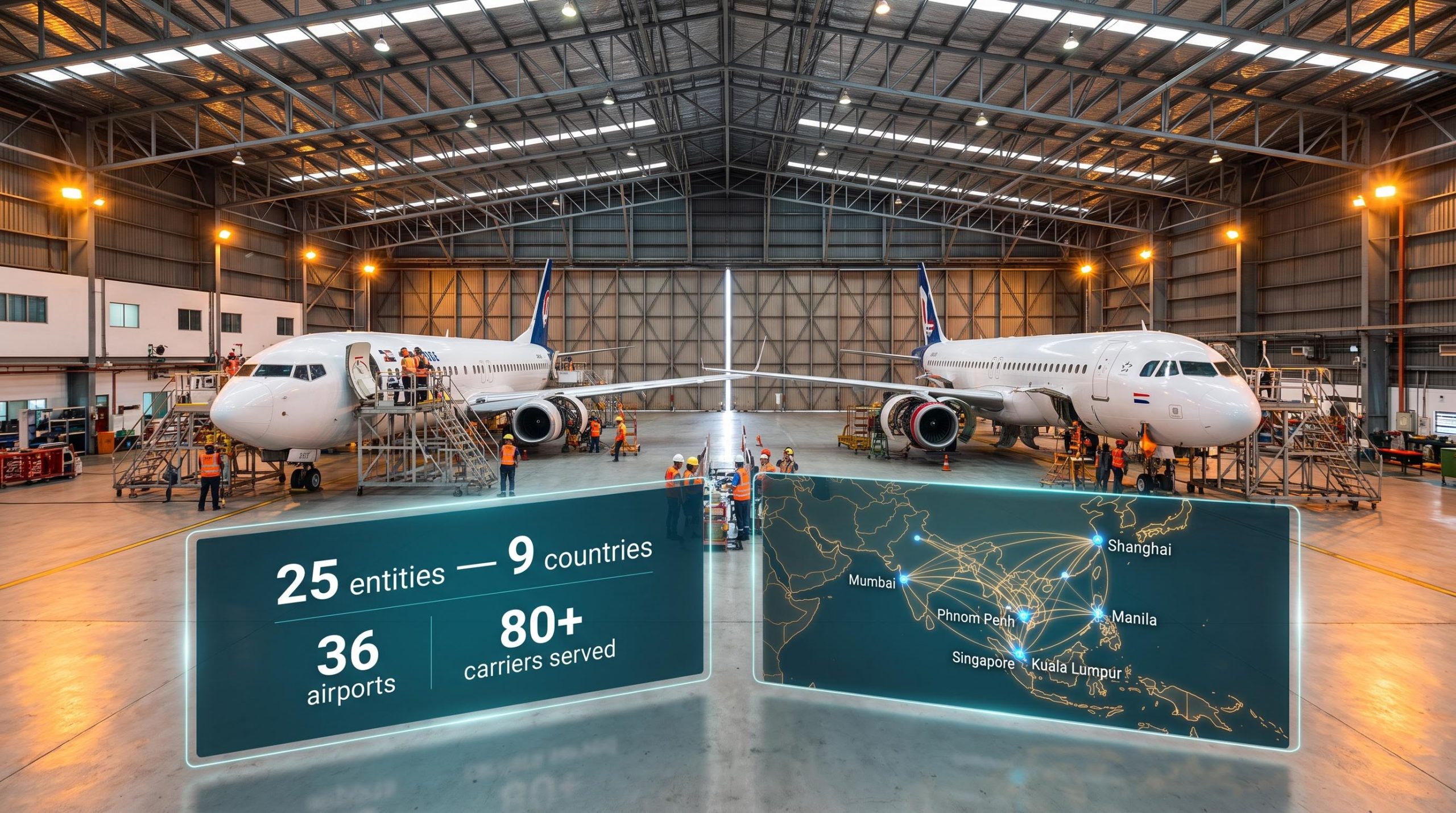
SIA Engineering Company has been expanding across five markets simultaneously, yet almost none of that activity registers in a single quarter’s headline numbers. If you have been watching quarterly results and wondering why the company’s strategic narrative feels larger than the profit and loss statement suggests, the disconnect is not accidental. It is structural.
Asia-Pacific maintenance, repair and overhaul (MRO), the business of keeping aircraft airworthy through mandated inspections, component servicing and heavy structural checks, is not experiencing a cyclical uptick. It is undergoing a multi-decade demand shift driven by fleet expansion, delivery delays and regulatory mandates that persist regardless of airline profitability. SIAEC has spent the past two years building the regional infrastructure to capture that demand, growing from a Singapore-centric operator into a 25-entity network across 9 countries.
Here is a clear framework for evaluating whether SIAEC’s joint venture-led expansion represents genuine long-duration value creation or capital scattered across markets without a coherent logic. The answer depends on understanding three layers: the structural demand backdrop, the specific mechanics of the JV model, and how the individual market positions fit together as a portfolio.
Why Asia-Pacific MRO demand is not a cycle: it is a structural shift
The supply-demand dislocation in Asia-Pacific aviation maintenance is not theoretical. Airlines across Southeast Asia, India and China are ordering aircraft faster than manufacturers can deliver them, and the aircraft already in service cannot be grounded while replacements sit in delayed production queues. That creates a compounding maintenance requirement that has little to do with whether airline ticket sales had a strong quarter.
Four structural drivers underpin this demand:
- Fleet expansion across Southeast Asia, India and China: Rising passenger volumes and the proliferation of low-cost carriers are generating sustained growth in aircraft numbers requiring scheduled and unscheduled maintenance.
- Delivery delays forcing extended service on older aircraft: Supply chain constraints have pushed new aircraft deliveries back by months or years, raising maintenance intensity on ageing fleets that cannot be retired on schedule.
- Policy support for in-region MRO capacity: Countries such as India are actively promoting domestic and regional maintenance capability to reduce historical reliance on European and North American providers.
- Non-discretionary, regulator-mandated maintenance spending: Civil aviation authorities require airlines to complete inspections and heavy checks on fixed schedules. Airlines cannot defer this work without grounding aircraft.
Airbus and Boeing delivery backlogs now represent approximately 12 years of outstanding orders as of mid-2026, with supply chain constraints, engine shortages and labour gaps widening the gap between airline demand and manufacturer output, directly extending the service life of existing fleets and compounding maintenance requirements.
ICAO continuing airworthiness requirements under Annex 8 establish the framework that national civil aviation authorities use to mandate scheduled maintenance programs, meaning airlines have no legal discretion to defer heavy checks regardless of their own financial pressures.
SIAEC’s own strategy explicitly lists expanding its Asia-Pacific presence as one of three core pillars, alongside next-generation aircraft capability and strengthening core operations. Its line maintenance network is targeting 36 airports in 9 countries as new JVs and stations come online.
The distinction between cyclical airline profitability and structural MRO demand matters because it changes the time horizon and risk profile of the investment thesis. This is not a bet on airline traffic recovering. It is a bet on whether SIAEC can position itself as the regional MRO provider of choice before that structural demand fully materialises. Investors who conflate MRO spending with airline cycle exposure will systematically undervalue the business at precisely the wrong points in the cycle.
Falling jet fuel prices have created misleading aviation demand signals in mid-2026, with Singapore spot prices down nearly 50% from their April peak yet remaining approximately 33% above 2025 averages, and hedging contracts locked in near peak levels mean airline margin recovery lags spot price declines by months.
When big ASX news breaks, our subscribers know first
How SIAEC built a Southeast Asian network and why the logic is cumulative
SIAEC’s Southeast Asian expansion is not three isolated facility announcements. It is a connected system where each new market node reinforces the competitive position of the others.
Malaysia is the cost-competitive anchor. Base Maintenance Malaysia Sdn Bhd, a wholly owned subsidiary, secured a 15-year lease for two hangars in Subang. The facility officially opened in May 2026, with both hangars now operational, enabling capacity for up to six simultaneous aircraft checks. Subang offers heavy maintenance at a lower cost base than Singapore, directly addressing the narrow-body fleet growth across the region.
The Philippines provides both heavy maintenance depth and gateway coverage. SIA Engineering (Philippines) Corporation, a 65% joint venture with Cebu Pacific, operates hangars at Clark for narrow-body work, with wide-body capability in development. In September 2025, SIAEC commenced operations at Manila’s Ninoy Aquino International Airport (NAIA), extending coverage to the country’s main international gateway and broadening the non-parent customer base.
Cambodia adds the network’s newest node. TIA Engineering Services Company Limited, a line maintenance joint venture incorporated in early 2025, commenced operations at the new Techo International Airport, contributing to SIAEC’s target network of 36 airports in 9 countries.
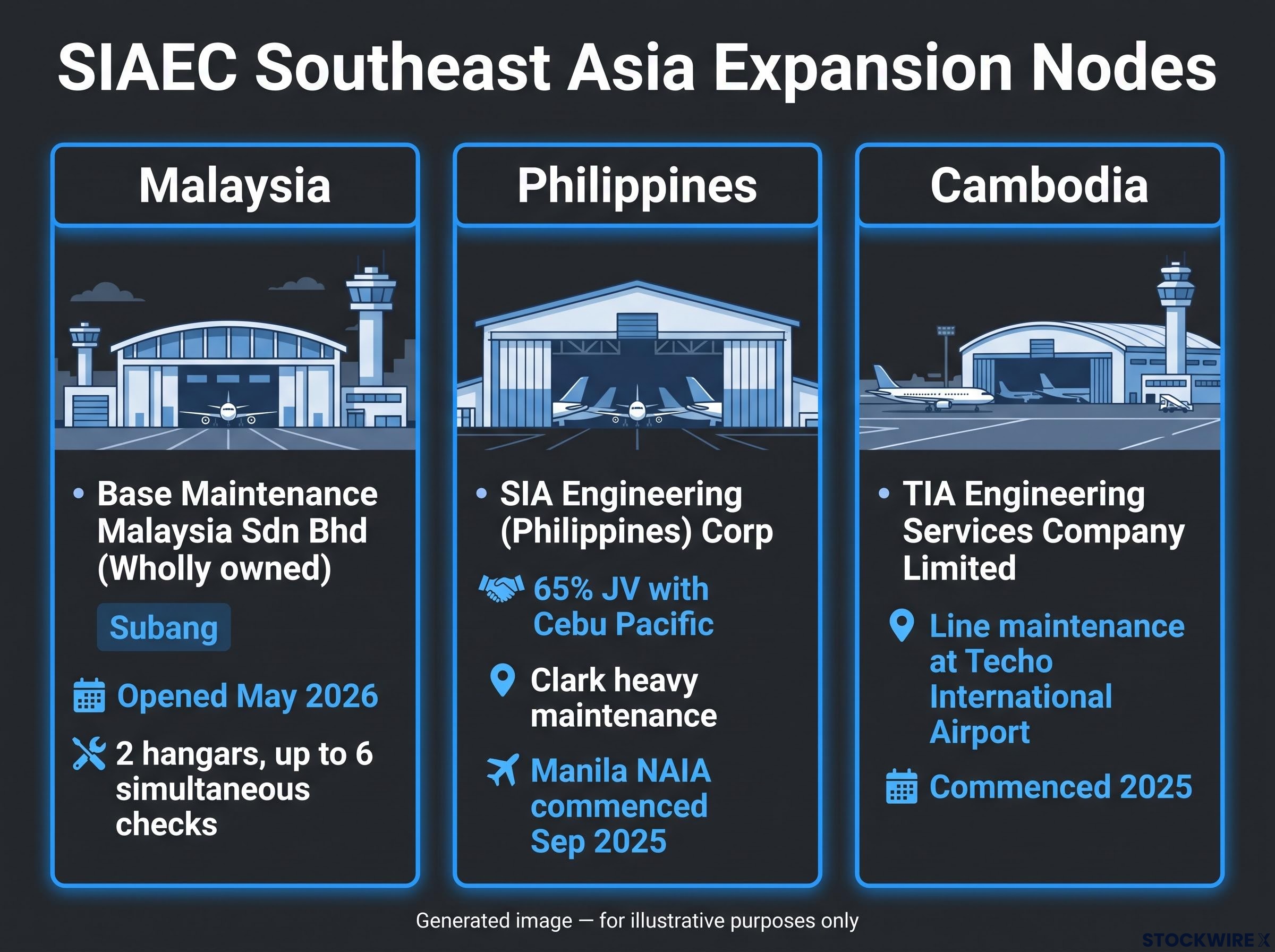
| Country | Facility / JV Name | Ownership | Capability | Status (mid-2026) |
|---|---|---|---|---|
| Malaysia | Base Maintenance Malaysia Sdn Bhd | Wholly owned | Heavy base maintenance (2 hangars, up to 6 checks) | Operational (opened May 2026) |
| Philippines | SIA Engineering (Philippines) Corp / Manila NAIA | 65% JV with Cebu Pacific | Narrow-body heavy maintenance; line maintenance at NAIA | Clark operational; NAIA commenced Sep 2025 |
| Cambodia | TIA Engineering Services Company Limited | JV (line maintenance) | Line maintenance at Techo International Airport | Operational (commenced 2025) |
The network logic behind multi-market coverage
Read these three markets together rather than separately and the strategic logic sharpens. An airline operating routes across Malaysia, the Philippines, Cambodia and Singapore can now hold a single MRO relationship with SIAEC at stations along its key route nodes. That is qualitatively different from assembling a patchwork of country-by-country providers.
Switching costs rise with each additional node in the network. The more routes an airline operates across SIAEC’s coverage footprint, the more disruptive it becomes to replace SIAEC with a fragmented set of single-market providers. This is where near-term earnings contribution is most visible, and it explains why the Malaysia and Philippines expansions are not redundant capacity additions but reinforcing competitive positions.
What the joint venture model actually does for SIAEC, and why it is hard to replicate
Most investors know SIAEC uses joint ventures. Fewer understand why the JV structure functions as a durable competitive barrier rather than a mere administrative arrangement for splitting costs.
The JV model addresses three specific entry barriers that any MRO provider faces when entering a new market:
- Regulatory certification and approvals: National civil aviation authorities require extensive licensing before an MRO provider can operate. Local partners accelerate this process by bringing familiarity with the regulatory framework and existing relationships with authorities.
- Customer trust and track record: Airlines select MRO providers based on proven capability. Partnering with a local carrier or airport group gives SIAEC an immediate installed customer base and credibility that a greenfield entrant would need years to build.
- Local knowledge of labour markets, logistics and regulatory nuances: Domestic partners reduce execution risk by providing on-the-ground operational understanding that foreign entrants cannot easily acquire.
Beyond market entry, the JV model is capital-efficient. SIAEC explicitly cites entering new markets through partnerships and joint ventures as its mechanism for expanding geographic reach while avoiding the full capital cost of wholly owned greenfield facilities. This preserves balance sheet flexibility for the parent company while still establishing a substantive presence.
The replication barrier is not a capital problem. A competitor cannot replicate SIAEC’s regional position by writing a large cheque. It would need to simultaneously build years of certifications, train engineers to airline-grade standards, establish supply chains and cultivate local partner relationships across multiple jurisdictions. That is a time and relationship problem, which is a qualitatively different kind of defensibility.
By mid-2025, SIAEC had grown to 25 subsidiaries and joint ventures across 9 countries, serving over 80 international carriers and aerospace manufacturers, with partners including Safran Aircraft Engines, Cebu Pacific and Air India. For a commercial-intent reader evaluating competitive moat, this is the analytical core of the thesis: the JV model creates durable positioning, not just temporary first-mover advantage.
India and China as long-duration options on the two largest Asian aviation markets
India and China are not earnings contributors today. But they are the reason a long-duration holder evaluates SIAEC differently from an operator focused solely on near-term return on capital.
India: a parent-group-aligned anchor opportunity
SIAEC has been appointed Air India’s strategic partner for developing base maintenance facilities in Bangalore, with operations anticipated around 2026. A memorandum of understanding signed in July 2026 deepens the collaboration, linking SIAEC’s emerging engine capabilities and line and base maintenance support to Air India’s expanding fleet.
The structural alignment runs deeper than a customer contract. Singapore Airlines holds approximately 21.5% of Air India, creating group-level alignment that lowers partner risk for SIAEC. India’s policy environment actively supports domestic and regional MRO capacity, and the Air India partnership gives SIAEC both an immediate customer anchor and a platform for broader in-country growth.
China: an option position, not a commitment
China is Asia’s largest single aviation market, and SIAEC is proceeding with deliberate caution. The company signed a memorandum of understanding with Xiamen IPORT Group in 2023 to explore MRO collaboration in Fujian. In March 2026, that MoU-to-JV pathway resulted in SIAEC securing a 30% stake in the Arport Aircraft Maintenance and Engineering (Fujian) joint venture.
The 30% stake is a measured entry. Rather than deploying large upfront capital into an unfamiliar regulatory environment, SIAEC used a local partner to navigate certification, introduce its technical capabilities, and retain capital flexibility while testing market dynamics.
Staged ownership structures, where an initial minority stake includes a contractual pathway to majority control at a future date, allow companies to validate market dynamics before committing full capital, a design that mirrors the optionality logic behind SIAEC’s 30% entry into the Fujian joint venture.
The contrast between these two market entries matters for sizing the thesis:
- India: Policy-supported, parent-group-aligned, clear customer anchor, near-term facility timeline.
- China: Smaller initial stake, greater regulatory complexity, more optionality than certainty at this stage.
- Shared characteristic: Both represent positions whose contribution could become material over a 5-10 year horizon in a way that is not yet visible in any current financial metric.
What this tells you is that these are not positions to evaluate on current returns. They are the optionality layer of the SIAEC thesis, and their value lies in the asymmetric upside of early positioning in markets where MRO demand is expected to be very large.
The risks that matter most when evaluating this expansion thesis
The expansion thesis is coherent, but coherent does not mean friction-free. Four specific risk categories warrant attention.
- JV governance complexity: Shared control means SIAEC cannot unilaterally accelerate or redirect JV strategies. Across 25 entities in 9 countries, the probability of partner misalignment in at least one jurisdiction is not trivial. Joint ventures require ongoing negotiation, and the outcomes are not always visible in public disclosures.
- Regulatory and political environment risk in India and China: Both markets have regulatory frameworks that can shift in ways affecting foreign participation in infrastructure sectors. Policy support for in-region MRO is a tailwind today; whether it remains so for a foreign-linked operator over a full decade is not guaranteed.
- Competitive intensity: SIAEC does not have Asia-Pacific MRO to itself. ST Engineering and other major independent MRO players are pursuing similar regional strategies. First-mover advantage narrows if competitors replicate coverage in overlapping markets.
- Multi-currency and cross-border operational complexity: Operations spanning Singapore, Malaysia, the Philippines, Cambodia, India and China introduce currency translation effects and cross-border cost variability that can obscure underlying business performance in any given quarter.
Geopolitical risk in Asian equities has a direct bearing on fleet deployment decisions across the region; the June 2026 US-Iran truce triggered the largest single-session Asian equity rally since the conflict began, but with Iran’s nuclear file deferred to a separate track, the risk premium that affects fuel costs and route economics remains contingent rather than resolved.
These risks do not invalidate the thesis. But they do mean the path to realising India and China optionality is likely to be non-linear, with regulatory, governance and competitive friction creating periods where progress is harder to read from quarterly results alone.
This article is for informational purposes only and should not be considered financial advice. Investors should conduct their own research and consult with financial professionals before making investment decisions.
Reading SIAEC’s expansion as a portfolio of bets, not a single growth story
The clearest way to evaluate SIAEC’s regional strategy is to stop treating it as a single growth story and start reading it as a deliberately diversified portfolio with three distinct layers.
The near-term layer is Southeast Asia: Subang’s ramp-up, the Philippines’ expanding Clark and Manila coverage, and Cambodia’s Techo operations. These are the facilities closest to contributing incremental earnings. Per Phillip Securities Research, analyst expectations for core net profit growth are driven by new engine and component capabilities, the Subang ramp-up, and new JVs in Cambodia and Malaysia.
The medium-term layer is India: the Air India anchor in Bangalore, backed by group-level alignment through Singapore Airlines’ stake.
The long-duration layer is China: a 30% JV stake in Fujian that functions as optionality on Asia’s largest aviation market.
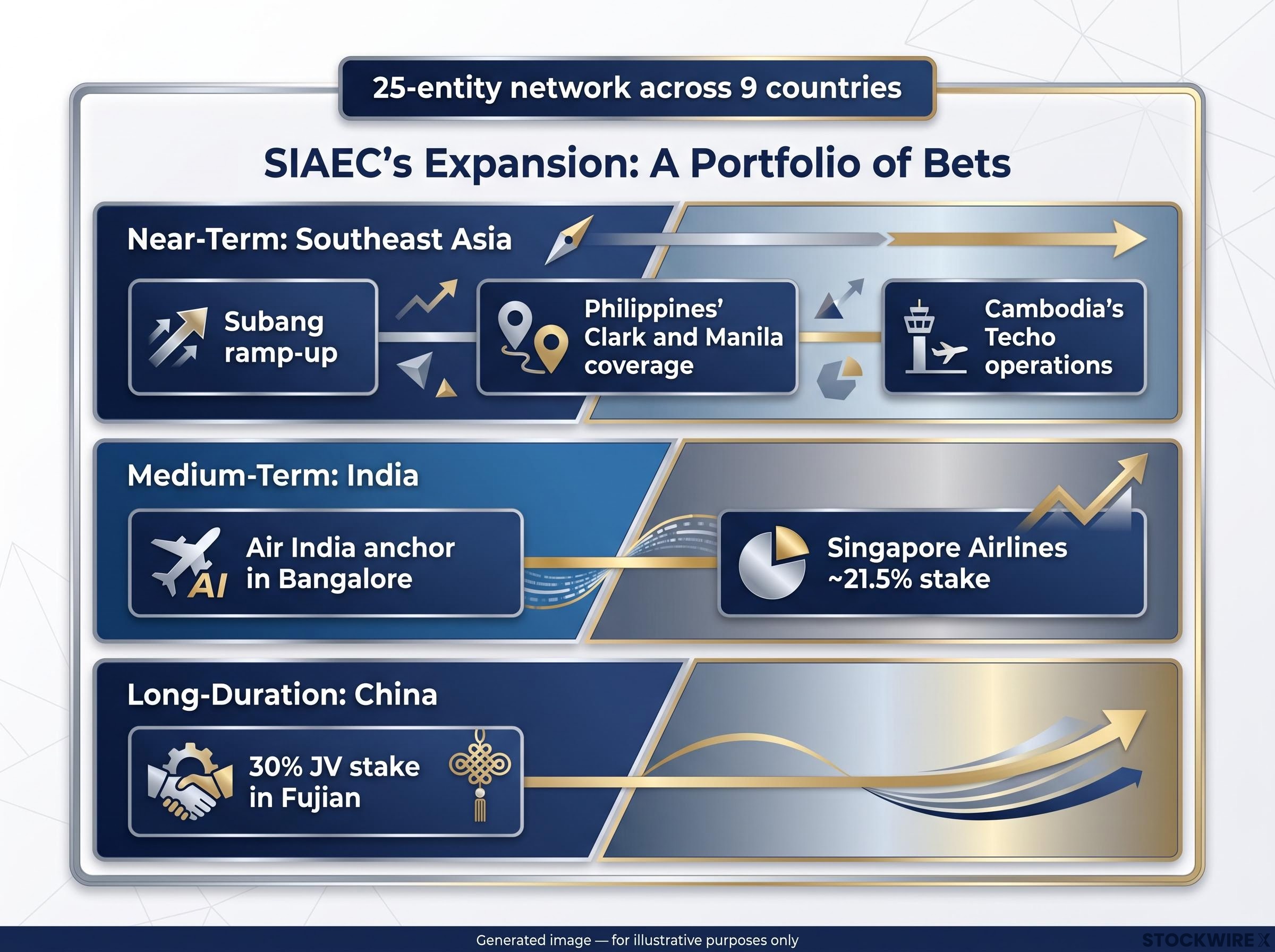
SIAEC’s three stated strategic pillars: expanding Asia-Pacific presence, building next-generation aircraft capability, and strengthening core operations.
The capital efficiency of JV-led entry is what allows SIAEC to hold positions across all three layers simultaneously without overextending its balance sheet. The question for an investor is not whether Asia-Pacific MRO will grow. The evidence on that is clear. The question is whether SIAEC’s multi-market positioning and JV execution capability are sufficient to capture a disproportionate share of that growth relative to what the current market valuation implies.
The right way to evaluate this strategy is not to ask whether each individual JV is accretive in the short term. It is to ask whether the combined footprint creates a regional MRO platform that becomes more valuable as Asia-Pacific fleet growth compounds over the next decade. That is the analytical frame that separates a short-term trade from a long-duration holding.
Forward-looking statements regarding SIAEC’s expansion plans and market positioning are subject to execution risk, regulatory developments, and competitive dynamics. Past performance does not guarantee future results.