

Garvan preclinical data strengthens the case for Amplia’s narmafotinib in pancreatic cancer
A comprehensive preclinical manuscript on narmafotinib in pancreatic cancer is now publicly available on the biology preprint server bioRxiv. The paper details research conducted by Professor Paul Timpson and colleagues at the Garvan Institute of Medical Research, Sydney, offering deeper insight into the mechanisms through which the drug may act.
For Amplia Therapeutics (ASX: ATX; OTCQB: INNMF), the findings strengthen the scientific rationale underpinning its ongoing clinical programme. This is not a new trial result, but further validation of the drug’s mechanism of action.
When big ASX news breaks, our subscribers know first
Four key findings from one of narmafotinib’s most comprehensive preclinical evaluations
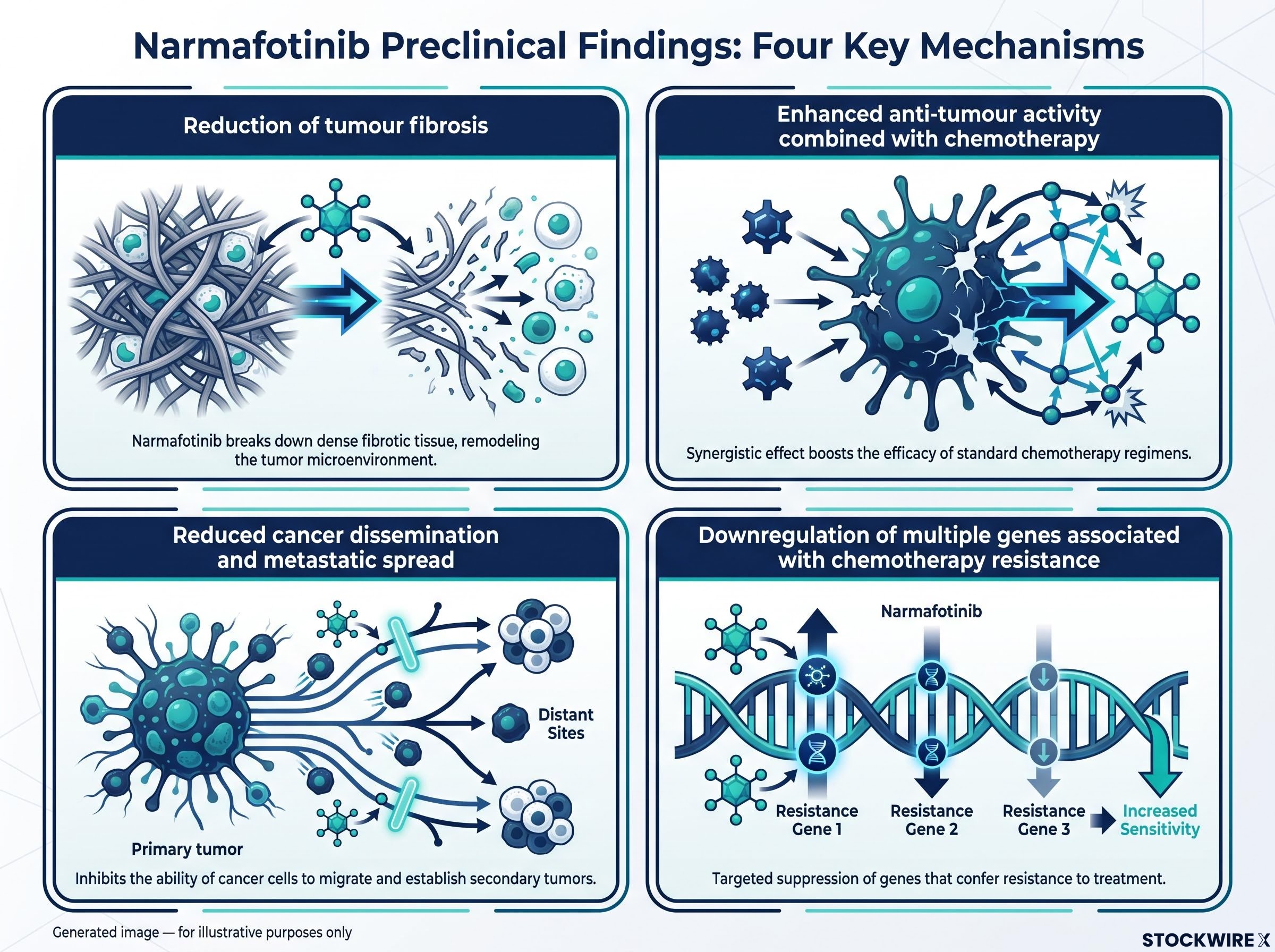
The publication represents one of the most comprehensive preclinical evaluations of narmafotinib undertaken to date. According to the manuscript, the research reported four key findings:
-
Reduction of tumour fibrosis, a hallmark of pancreatic cancer that contributes to treatment resistance and impaired drug delivery.
-
Enhanced anti-tumour activity when combined with chemotherapy across multiple preclinical pancreatic cancer models.
-
Reduced cancer dissemination and metastatic spread in a model of metastatic pancreatic cancer.
-
Downregulation of multiple genes associated with chemotherapy resistance.
Collectively, these mechanisms support the biological rationale for combining narmafotinib with chemotherapy and other drugs, the combination-therapy approach at the heart of Amplia’s clinical trials.
| Finding | What It Showed | Investor Relevance |
|---|---|---|
| Tumour fibrosis reduction | Lowered the dense tissue that impairs drug delivery | May help chemotherapy reach tumours more effectively |
| Anti-tumour activity | Enhanced effect when combined with chemotherapy | Supports the combination-therapy trial design |
| Reduced metastatic spread | Less cancer dissemination in a metastatic model | Addresses a key driver of poor outcomes |
| Gene downregulation | Reduced expression of chemo-resistance genes | Reinforces rationale for chemotherapy combinations |
Dr Chris Burns, CEO and Managing Director
“We are delighted that the extensive research conducted by Professor Timpson’s team at the Garvan Institute over recent years is now being shared with the broader scientific community. Importantly, these studies strengthen the scientific rationale for the clinical development of narmafotinib, and provides further insight into the multifaceted mechanisms through which narmafotinib can act in the treatment of this devastating disease.”
What FAK inhibition means and why fibrosis matters in pancreatic cancer
Narmafotinib works by targeting a protein called Focal Adhesion Kinase (FAK). FAK is over-expressed in pancreatic cancer and is a drug target gaining increasing attention for its role in solid tumours.
Narmafotinib (AMP945) is Amplia’s best-in-class inhibitor of FAK, described as a highly potent and selective inhibitor of the protein. It has shown promising data across a range of preclinical cancer studies.
Fibrosis presents a particular problem in pancreatic cancer. The disease is characterised by dense, fibrous tissue that can block the delivery of drugs to the tumour and drive resistance to treatment. Reducing this fibrosis may allow chemotherapy to work more effectively.
This mechanism helps explain why the preclinical findings support the combination approach being tested in Amplia’s clinical trials. If narmafotinib can soften the tumour environment and downregulate resistance genes, chemotherapy partners may deliver stronger results.
How the findings connect to Amplia’s clinical program
The preclinical mechanisms described in the manuscript reinforce the design of Amplia’s live clinical pipeline. Rather than delivering new trial results, the research provides the underlying biological justification for the combination strategies already in the clinic.
-
ACCENT trial — narmafotinib combined with the chemotherapies gemcitabine and Abraxane in first-line patients with advanced pancreatic cancer. The trial has reported a 36% response rate, superior to chemotherapy alone, alongside a median overall survival (mOS) of 11.1 months.
-
AMPLICITY trial — narmafotinib combined with the chemotherapy FOLFIRINOX in advanced pancreatic cancer patients, running at sites in Australia.
-
PRROSE trial — narmafotinib combined with standard-of-care chemotherapy in ovarian cancer, set to open shortly.
The gene-downregulation and fibrosis findings from the Garvan research provide the biological rationale for these chemotherapy-combination trials. The 36% response rate and 11.1-month mOS figures from ACCENT are prior reported results, not new data from this announcement.
The ACCENT trial results, independently verified by central review, recorded an 8% complete response rate, approximately 40 times higher than the standard gemcitabine and nab-paclitaxel benchmark, alongside a 70% disease control rate that substantially exceeded the MPACT comparator.
What this means for Amplia investors
Research from a leading medical institute strengthens confidence in narmafotinib’s mechanism ahead of continued clinical readouts. For investors, this type of external validation supports the scientific foundation of the wider pipeline.
Publishing the work on bioRxiv also broadens awareness within the scientific community. While not a market-moving clinical result, it acts as a soft credibility signal that reinforces the existing investment thesis.
With the ACCENT and AMPLICITY trials underway and the PRROSE ovarian cancer trial set to open shortly, the manuscript underlines the biological case for Amplia’s combination-therapy strategy as the company progresses through its clinical development programme.
A registration-enabling Phase 2b trial designed in alignment with FDA feedback is the direct next step from the ACCENT proof-of-concept, with daily dosing of narmafotinib combined with gemcitabine and Abraxane being investigated across Australian sites ahead of a broader registrational programme.
Ready to Explore the Science Behind Amplia’s Narmafotinib Programme?
The Garvan Institute’s preclinical findings offer compelling biological validation for narmafotinib’s combination-therapy approach, reinforcing the rationale behind Amplia’s active clinical trials in pancreatic and ovarian cancer. With a 36% response rate already reported in the ACCENT trial, the scientific case for FAK inhibition continues to build.
Investors seeking to understand the full scope of Amplia’s pipeline, including the ACCENT, AMPLICITY, and PRROSE trials, can explore the latest research and investor updates at Amplia Therapeutics’ official site for a deeper look at the company’s clinical development strategy.