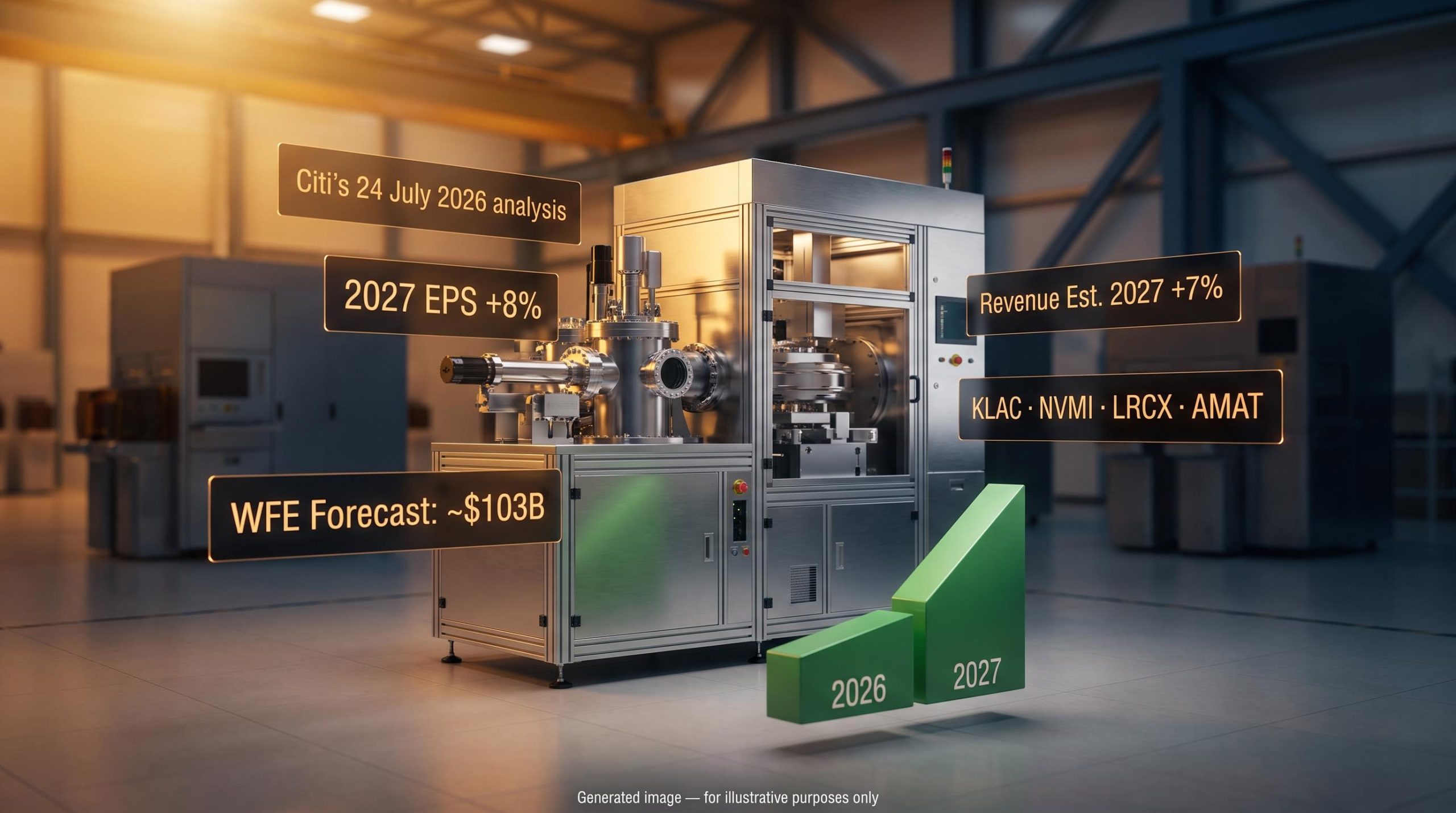
Citi published fresh analysis on 24 July 2026 arguing that the recent semiconductor stock pullback is not a warning sign but a window, and that one corner of the chip sector offers meaningfully better odds than the rest.
Semiconductor equities have come under selling pressure as higher oil prices, tightening bond markets, and questions about how long AI-related capital spending can sustain its current pace have all weighed on sentiment. But Citi’s analysts say the underlying earnings estimates for semiconductor capital equipment stocks are moving in the opposite direction, upward, which is the core of the bullish case. The firm is directing attention specifically to capital equipment names, where it sees stronger estimate revision momentum and more durable revenue visibility than in chipmakers themselves.
This covers the data behind Citi’s call, the demand-segment logic that explains why equipment stocks look more attractive than chipmakers right now, and which specific names the firm is flagging. Whether you already hold chip exposure or are weighing whether to add it, the distinction Citi is drawing matters for how you evaluate the sector from here.
The gap Citi spotted: estimates rising while prices fall
The semiconductor sector is doing something unusual right now. Share prices are falling while the professional forecasting community is revising earnings expectations higher. That contradiction is the foundation of Citi’s entire call.
The SOX performance context matters here: the index posted its strongest first-half on record through June 2026 before pulling back more than 20% from its peak, creating the precise conditions where macro-driven price dislocations and rising fundamental estimates can coexist in the same sector simultaneously.
Looking at results published so far this reporting season, the numbers Citi compiled show a consistent upward trend in forward estimates among companies that have already reported:
- Consensus revenue forecasts for 2026 rose 4%; 2027 estimates increased 7%
- EPS estimates for 2026 were revised upward 7%; 2027 EPS estimates climbed 8%
Citi characterised the pullback as a “healthy reset” rather than the beginning of a deeper downturn.
Those revision numbers tell you something specific. The analysts who build detailed earnings models for these companies are becoming more confident in chip sector profitability at the same moment share prices are declining. The market may be pricing in a deterioration that the fundamentals do not yet support, and that gap between sentiment and substance is where Citi sees the opportunity.
When big ASX news breaks, our subscribers know first
Why capital equipment companies sit in a different risk category than chipmakers
Citi is not making a blanket call on semiconductor stocks. The firm is drawing a line between chipmakers and the companies that build the tools chipmakers use, and that distinction carries real structural weight.
Capital equipment companies, the firms that manufacture lithography, etch, inspection, and deposition equipment, sell to fabs and foundries. Their customers are companies like Intel, TSMC, and Tesla, not end consumers. That positioning insulates them from the quarterly swings in device demand that hit chipmakers directly.
Bernstein’s correlation data on equipment and memory divergence shows the two sub-sectors have moved apart by as much as 49 percentage points across a single cycle, reinforcing why Citi’s preference for capital equipment over chipmakers reflects a structurally distinct risk-reward profile, not a minor tilt.
What capex commitments mean for order visibility
The revenue model is different in a way that matters. When a foundry commits to a multi-year fab investment programme, equipment suppliers lock in orders that stretch well beyond the current quarter. Chipmakers, by contrast, generate revenue tied more directly to how many devices sell through in a given period.
Citi flagged capex commentary from three specific sources as supporting signals for equipment makers:
- Intel: ongoing advanced-node investment
- TSMC: continued capacity expansion
- Tesla: rising fab-related spending
According to Citi’s own analysis, the firm favours semiconductor capital equipment names over chipmakers, with “higher estimate revisions driven by capex increases” cited as the primary reason for that preference. The firm has also raised its 2025 wafer fabrication equipment (WFE) forecast, the total global spending on chip manufacturing tools, to approximately $103 billion, up 3% versus the prior year. That $103 billion figure tells you that equipment suppliers are locked into a larger addressable market than share prices currently reflect, and that this revenue base is more predictable than chip sales into a volatile consumer cycle.
What chip demand actually looks like right now, broken down by end market
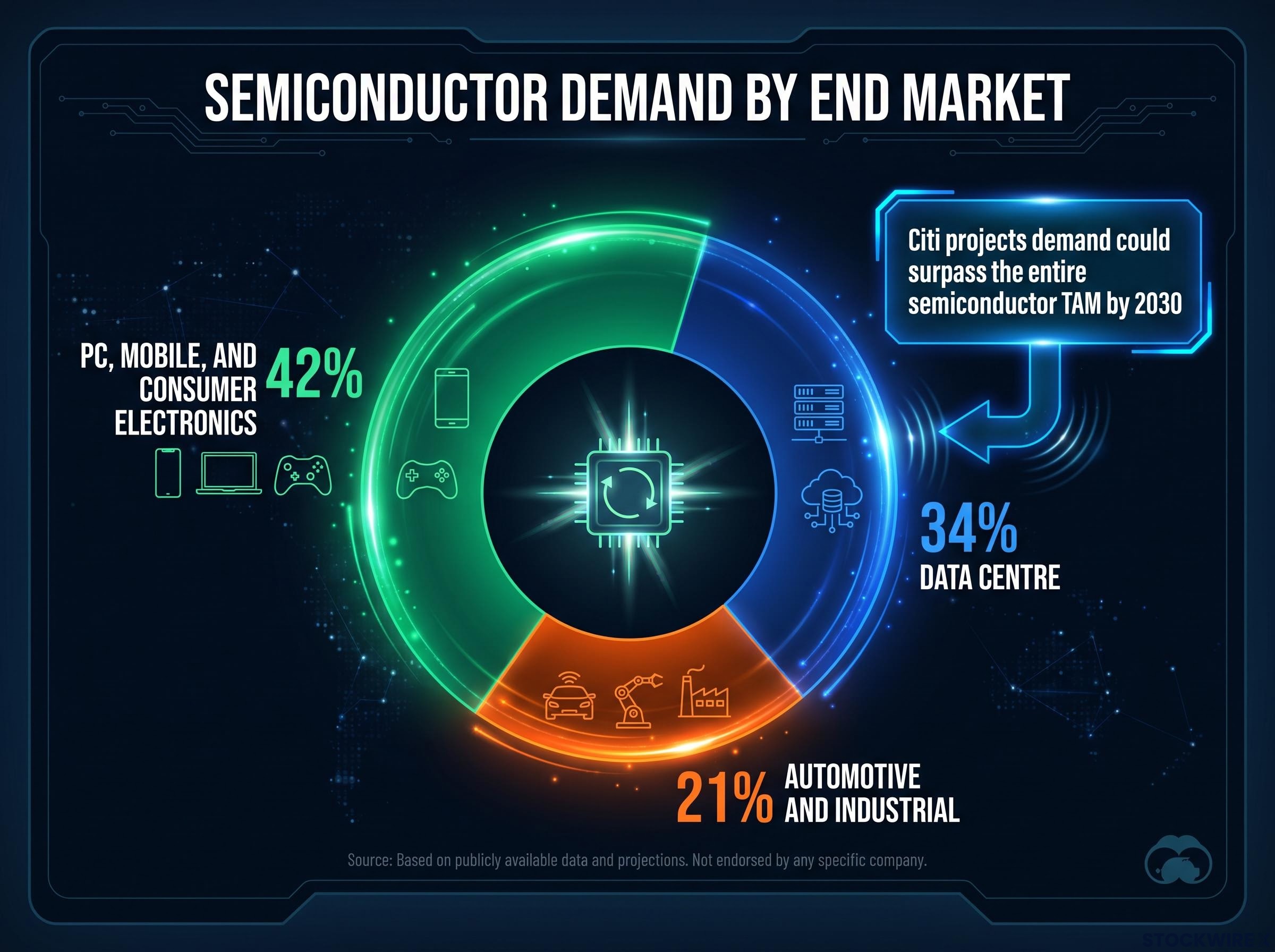
Not all semiconductor demand is created equal. Citi’s analysis breaks total chip demand into three segments, and the outlook for each is strikingly different. That variation is why a broad “buy semiconductors” call misses the point.
| End Market | Approximate Share of Demand | Citi’s Outlook |
|---|---|---|
| Data Centre | 34% | Structural growth; Citi projects this segment’s demand alone could surpass the entire semiconductor TAM by 2030 |
| Automotive and Industrial | 21% | Bouncing back after a prolonged inventory destocking cycle |
| PC, Mobile, and Consumer Electronics | 42% | Cautious; demand softening as memory cost inflation and tightening supply conditions squeeze the segment |
The data centre segment is the structural story. Citi’s projection that data centre demand alone could exceed the current total semiconductor market by 2030 means this is not being priced as a cycle but as a multi-year expansion. Exposure to data-centre-adjacent chip and equipment names carries a fundamentally different risk-reward horizon than exposure to consumer electronics names, where Citi is explicitly cautious.
Automotive and industrial sits somewhere in between: recovering, but not yet a leading growth engine. Knowing which of these segments a specific semiconductor holding is primarily exposed to is the practical filter that turns Citi’s sector-level optimism into a portfolio-level decision.
The stocks Citi is flagging by name
Citi’s capital equipment preferences are not generic. Each name carries a differentiated rationale, and understanding those differences matters if you are weighing one against another.
- KLA (KLAC): Buy rating. Citi’s top capital equipment pick, reflecting broad confidence in inspection and process control demand across advanced nodes.
- Nova (NVMI): Buy rating. Also a top capital equipment pick, positioned in metrology and process control.
- Lam Research (LRCX): Moved up in Citi’s rankings specifically on stronger NAND spending prospects, a sub-segment thesis rather than a broad equipment call.
- Applied Materials (AMAT): Highlighted as a beneficiary of ongoing AI infrastructure and fab investment, with exposure across multiple equipment categories.
Citi stated it prefers semiconductor capital equipment stocks over chipmakers, citing “higher estimate revisions driven by capex increases.”
The Lam Research upgrade is worth noting in particular. It is explicitly tied to NAND memory spending, which means Citi’s equipment preferences reflect specific sub-segment bets. If you are evaluating these names, each one carries a distinct demand driver, and they should not be treated as interchangeable alternatives. These are Citi’s analytical preferences, not investment recommendations.
What the macro headwinds are, and why Citi says they do not break the thesis
The bear case is real and Citi does not dismiss it. Three specific macro pressures are weighing on the sector:
- Surging energy costs putting pressure on industrial margins and household budgets
- Higher government bond yields increasing the hurdle rate for long-duration growth equities
- Lingering doubt over whether AI infrastructure investment can maintain its current pace once the initial buildout matures
Each of these is a legitimate reason for the recent selloff. Citi’s counter-argument is not that these pressures will disappear. It is that they are sentiment and macro drivers, not fundamental earnings deteriorators.
Why rising estimates matter more than falling sentiment
The analytical logic is straightforward. Over time, estimates lead prices. When earnings estimates are rising in a falling-price environment, it creates a valuation reset toward cheaper entry points. The price declines driven by macro sentiment are happening at the same time that the companies themselves are reporting stronger-than-expected results.
Bank of America’s Savita Subramanian reached a parallel conclusion using earnings revision momentum as the central metric, finding that semiconductor estimates were revised upward by more than 20% in 2026 while positioning remained at roughly half the 2017 cycle peak, a combination that undercuts the bubble framing Citi is also pushing back against.
Citi’s conviction rests on this estimate-price divergence being resolved through price recovery rather than estimate downgrades. That is not guaranteed, but it is the specific pattern that historically precedes outperformance in analyst-favoured names. Macro-driven price dislocations in structurally advantaged names are entry points per Citi’s framework, not signals to reduce exposure.
What this means for investors already holding chip sector exposure
Citi’s framework translates into a set of diagnostic questions you can apply to your own holdings rather than a simple buy list. Three filters matter:
- End-market mix: Is your holding primarily exposed to data centre demand, or to the weaker PC, mobile, and consumer electronics categories?
- Estimate revision direction: Are consensus estimates for this specific name moving up or down during the current earnings season?
- Capex commitment visibility: Does the company benefit from locked-in, multi-year customer capex programmes, or is its revenue tied to near-term device sell-through?
These are the three lenses that distinguish names Citi considers structurally advantaged from names that are simply cheap after the pullback. The capital equipment names Citi has flagged, KLAC, NVMI, LRCX, and AMAT, are the specific instruments it identifies as meeting all three criteria. This is Citi’s analytical framework, not investment advice, and your own circumstances should inform any portfolio decisions.
This article is for informational purposes only and should not be considered financial advice. Investors should conduct their own research and consult with financial professionals before making investment decisions.
The equipment thesis in context: what to watch as the cycle develops
Citi’s call is not a trade. It is a multi-year structural bet, and the variables that will confirm or challenge it are specific enough to track:
- WFE order activity: Citi’s current forecast of approximately $103 billion for 2025 is the baseline. Rising order books validate the thesis; declining orders would challenge it.
- Estimate revision direction: The 2026 and 2027 EPS and revenue revision trajectory during subsequent reporting periods is the near-term signal. Continued upward revisions support the entry-point argument.
- Hyperscaler capex guidance: Upcoming earnings calls from major cloud and AI infrastructure spenders will either reinforce or soften the demand picture for equipment makers.
The 2030 data centre total addressable market projection means this thesis is measured in years, not quarters. Investors who evaluate it on short-term price movements are measuring the wrong thing.
For investors wanting a structured framework for timing entries and exits across the full semiconductor cycle, our dedicated guide to semiconductor cycle investing covers the five-indicator system used to identify peak-cycle conditions before the 2027-2029 supply wave arrives.
The single sharpest distinction Citi has drawn remains this: equipment stocks benefit from capex commitments that are already in place. That makes them less dependent on near-term demand surprises than chipmakers, and it is the structural reason Citi believes the current pullback is a buying opportunity rather than a signal to step back.
Past performance does not guarantee future results. Financial projections are subject to market conditions and various risk factors.