ServiceNow crossed a threshold on Wednesday that separates a company talking about AI from one earning from it. AI-related annual contract value (ACV), the total annualised value of contracts tied to AI products, exceeded $1 billion in Q2 2026.
Enterprise software investors have spent the past two years watching whether AI products generate real contract value or remain a pitch deck talking point. ServiceNow’s second-quarter results give the clearest answer yet from a major platform vendor, arriving alongside a headline financial beat across revenue, earnings, and forward bookings, plus a raised annual outlook that management characterised as conservative.
Three signals stand out from the results: AI monetisation at ServiceNow is accelerating quarter on quarter, the beat was spread across every major metric rather than concentrated in one line, and the only meaningful headwind into Q3 is a currency translation effect rather than any softness in customer demand.
The $1 billion AI threshold and what it actually signals
This is not a vanity number. AI-related ACV exceeding $1 billion in a single quarter marks a status change for ServiceNow’s revenue base. It means AI products are no longer an add-on feature generating incremental upsell; they are a material contributor to the company’s contracted revenue.
The milestone did not arrive overnight. The number of agentic AI deployments, in which software agents carry out tasks on their own initiative rather than waiting for human instruction, expanded by nine times over the nine months before this quarter. That pace reflects sustained commercial adoption across large enterprises, not a single-deal surge or a lumpy government contract.
ServiceNow has built out an “AI Control Tower” architecture for enterprise customers, through which organisations can oversee, roll out, and expand AI applications spanning IT, security, and operations within a unified platform layer. The breadth of that positioning is what makes the $1 billion figure structurally significant rather than headline-significant.
CEO Bill McDermott indicated on the earnings call that AI ACV is on track to reach approximately $1.5 billion by year-end 2026.

The $1 billion crossing and the ninefold agentic deployment growth together tell you that enterprise AI spending at ServiceNow is compounding, not plateauing. If you have been weighing whether AI adoption across enterprise software is front-loaded, this quarter’s trajectory is the strongest counter-evidence yet from a scaled vendor.
When big ASX news breaks, our subscribers know first
What the Q2 numbers showed across revenue, EPS, and deal activity
The pattern across ServiceNow’s Q2 results was consistent enough to be its own signal. Total revenue, subscription revenue, non-GAAP earnings per share, and current remaining performance obligations (cRPO), the total value of contracted revenue yet to be recognised, all came in above analyst consensus or prior guidance.
| Metric | Q2 2026 Result | Consensus / Prior Guidance | Year-over-Year Growth |
|---|---|---|---|
| Total Revenue | $3,987M | ~$3,930M (consensus) | 24% |
| Subscription Revenue | $3,877M | Above prior guidance | 24.5% (23% constant currency) |
| Non-GAAP EPS | $0.90 | $0.86 (consensus) | ~11% |
| cRPO | $13.2B | Above high end of guidance | 21% |
Non-GAAP operating margin landed at approximately 29.5%, confirming the company is growing at 24% without sacrificing profitability to get there.
The deal-volume line is worth isolating. In Q2 2026, ServiceNow logged 123 transactions valued above $1 million in net new ACV, a count that was nearly 40% higher than the same period a year ago. That figure matters because it represents new commitments from large organisations expanding their platform spend, not renewals cycling through the base.
The breadth of this beat, spanning revenue, EPS, cRPO, and deal count simultaneously, tells you this was not a single-line outperformance. A quarter where only the top line beats can be explained by deal timing. A quarter where every metric beats is harder to dismiss as noise.
How ServiceNow’s guidance raise changes the full-year picture
The updated full-year 2026 outlook puts subscription revenue in a range of $15.76 billion to $15.78 billion, which works out to roughly 22.5% reported growth and approximately 21% on a constant-currency basis. The raise is real, but it is measured.
- Full-year 2026 subscription revenue: $15.76B-$15.78B (approximately 22.5% implied reported growth)
- Q3 2026 subscription revenue midpoint: approximately $3.98 billion
- Q3 FX headwind to cRPO: approximately $35 million, attributed to a stronger U.S. dollar
Some analysts characterised the raise as incremental rather than dramatic, positioning it as management confidence without a full-year reset of expectations. That is consistent with ServiceNow’s track record of guiding conservatively and beating, but it also means the stock’s next catalyst depends on whether Q3 execution repeats the pattern.
The $35 million FX drag on Q3 cRPO is worth understanding clearly. It is a technical reporting effect caused by the stronger U.S. dollar reducing the reported value of contracts denominated in other currencies. It is not a signal of demand softness. If you separate those two things, you are reading the Q3 setup more accurately than investors who treat the headline cRPO figure at face value.
Why large enterprise deal momentum matters more than it looks
The 123 deals exceeding $1 million in net new ACV deserve more than a single line in a results table. In enterprise SaaS (software as a service, where companies pay recurring fees for cloud-hosted software), deals of this size represent multi-year commitments from large organisations expanding their platform spend. These are not pilot contracts. They are not renewals. They are new money committed over extended terms.
In Q2 2026, ServiceNow reported 123 net new ACV transactions above $1 million, a figure that came in nearly 40% ahead of the prior-year quarter.
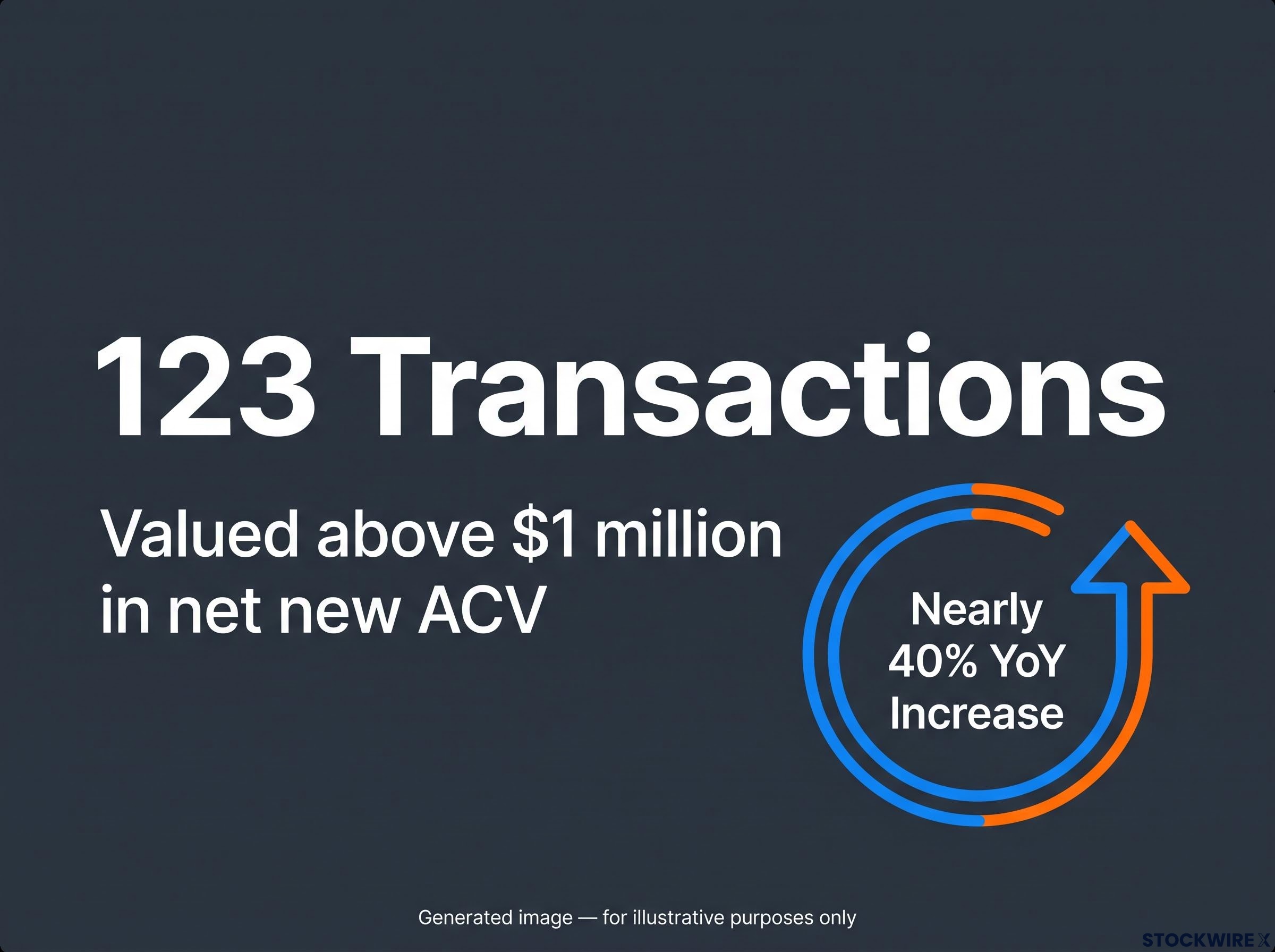
That nearly 40% year-over-year increase connects directly to the cRPO figure. cRPO grows when large customers sign larger, longer contracts, because those commitments sit on the balance sheet as future revenue waiting to be recognised. The $13.2 billion cRPO figure is not just a number; it is the product of deal momentum like this compounding quarter after quarter.
Demand is also not concentrated in a single product category. Cybersecurity and IT operations product lines are contributing alongside AI workflows, which means the growth base is diversified across use cases rather than dependent on one narrative.
A nearly 40% jump in large deals tells you the enterprise customer base is not just renewing its ServiceNow spend but actively expanding it. That distinction is what makes cRPO credible as a leading indicator of future revenue rather than a lagging measure of past commitments.
Stock reaction and what the session told investors about market positioning
The stock move around the print tells its own story about how the market was positioned coming in.
- ServiceNow (NOW) closed the prior session on 22 July 2026 at approximately $95.46, down roughly 6.47%
- Shares gained approximately 4.5% in premarket trading on 23 July 2026
- Different sources measured slightly different premarket percentage gains (approximately 3.4% to 4.5%), reflecting different measurement points in the post-market session
The 6.47% drop into the print followed by a 4.5% premarket recovery is the signature of a relief rally against elevated pre-earnings caution. The market had priced in execution risk going into the report and found that risk alleviated by the broad beat.
That framing matters. This was not a euphoric re-rating. Analyst characterisation of guidance as incrementally rather than dramatically raised suggests the stock’s next move depends on whether Q3 cRPO growth meets expectations after the FX headwind is absorbed. If you are tracking NOW around earnings, the sequential context of how the stock moved into and out of the print helps you calibrate whether the reaction reflects a genuine upgrade in sentiment or a technical recovery from oversold conditions.
Q3 and year-end benchmarks that define what a strong follow-through looks like
A strong quarter does not tell you what happens next. The specific variables that will confirm or challenge the bullish read from Q2 are measurable and worth naming:
- AI ACV progress toward the $1.5 billion year-end target. The $1 billion crossing was the proof point. The trajectory toward $1.5 billion is the durability test.
- Q3 cRPO growth after the approximately $35 million FX headwind is absorbed. If constant-currency cRPO growth holds above 21%, the demand signal is intact regardless of dollar strength.
- Large-deal run-rate above 100 deals per quarter. The 123-deal figure in Q2 set a high bar. Sustaining triple-digit large-deal counts confirms that enterprise expansion, not just AI enthusiasm, is driving contracted revenue.
The guidance raise functions as a floor, not a ceiling. ServiceNow has a history of guiding conservatively and beating, and the current setup is consistent with that pattern.
At $1 billion in AI ACV and 24.5% subscription revenue growth at scale, ServiceNow is not a story about AI potential. It is a story about AI monetisation already in progress. Investors who leave this quarter watching AI ACV and large-deal counts rather than headline revenue growth are tracking the metrics that will confirm whether that monetisation is compounding or front-loaded.
This article is for informational purposes only and should not be considered financial advice. Investors should conduct their own research and consult with financial professionals before making investment decisions. Forward-looking statements, including management’s AI ACV target and full-year guidance, are subject to change based on market developments and company performance.