

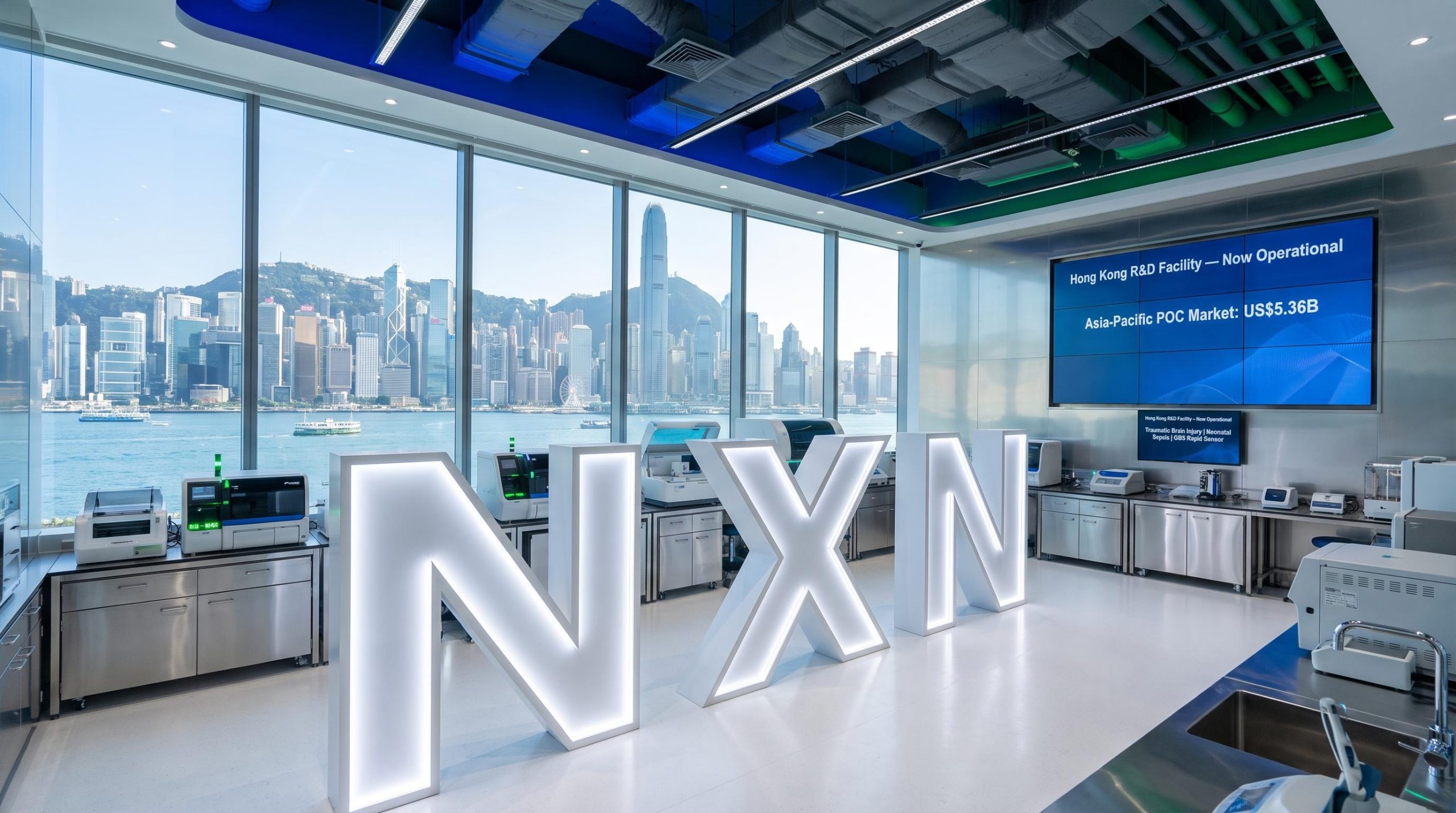
Nexsen opens Hong Kong R&D facility, targeting US$5.36 billion Asia-Pacific diagnostics market
Nexsen Limited (ASX:NXN), an emerging leader in rapid point-of-care diagnostics, has established its next-generation research and development facility in Hong Kong, marking a significant milestone in the Company’s Asia-Pacific growth strategy. The facility becomes Nexsen’s principal laboratory for Asia and delivers a strategic gateway into the US$5.36 billion Asia-Pacific point-of-care testing market.
Alongside the launch, the Company has expanded its diagnostics pipeline into two new programs targeting Traumatic Brain Injury and neonatal sepsis. The laboratory complements Nexsen’s existing Australian operations, creating an integrated Australia–Hong Kong innovation platform.
When big ASX news breaks, our subscribers know first
A strategic gateway into Asia’s healthcare ecosystem
Hong Kong was selected for its globally recognised research capability, internationally accredited healthcare system and strategic position as a gateway into major Asian healthcare markets. The facility embeds Nexsen within the regional healthcare ecosystem, positioning the Company closer to target populations, clinicians, regulators and distribution partners as it advances towards regional market entry.
The establishment builds on the Company’s previously announced Hong Kong expansion, including the award of a HK$6 million Ignite grant, providing “non-dilutive” funding for the Company’s Hong Kong activities and a pathway to pursue additional non-dilutive grant opportunities within Hong Kong’s innovation ecosystem.
For investors, the non-dilutive nature of this funding is significant. It supports regional expansion without diluting existing shareholders. The facility also positions Nexsen closer to future commercial markets across several strategic dimensions:
-
Proximity to future commercial markets
-
Access to regulatory agencies
-
Access to distribution networks across Asia
Expanding the diagnostics pipeline into two large unmet markets
The Hong Kong laboratory supports two significant new diagnostic programs that address large, underserved global healthcare needs.
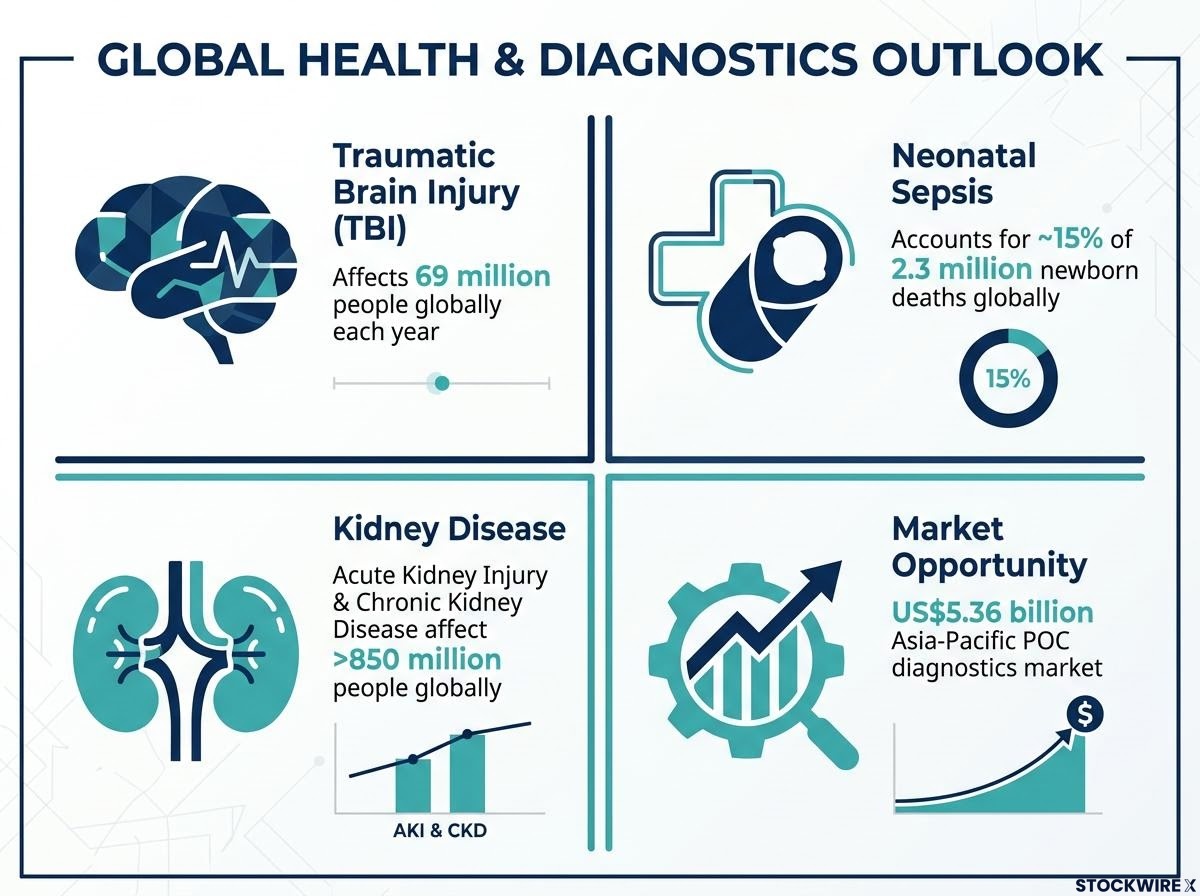
Traumatic Brain Injury (TBI) affects an estimated 69 million people globally each year, yet early diagnosis remains a significant clinical challenge. Rapid diagnosis is critical in emergency care settings, where fast decision-making guides treatment and can improve patient outcomes.
Neonatal Sepsis Spectroscopy targets one of the leading causes of newborn mortality worldwide. An estimated 2.3 million newborns die each year, with sepsis accounting for approximately 15% of newborn deaths globally. The World Health Organisation recently identified improved neonatal sepsis diagnostics as a global priority to reduce infant deaths and unnecessary antibiotic use.
The existing portfolio continues to advance
The facility also supports ongoing development across Nexsen’s existing diagnostics portfolio:
-
Group B Streptococcus (GBS)
-
Acute Kidney Injury
-
Chronic Kidney Disease
-
Bovine Mastitis
-
Biosecurity and Food Safety
These programs leverage Nexsen’s proprietary biosensing platform across new clinical applications, extending the Company’s scalable rapid diagnostics platform into globally significant healthcare markets.
Managing Director, Mark Muzzin
“The establishment of our Hong Kong facility is an important step in building Nexsen’s presence across Asia and expanding the reach of our rapid diagnostics platform. By creating a dedicated local R&D base, we can work more closely with our university, clinical and healthcare partners, bringing together the expertise, patient access and translational capability already established through Nexsen Hong Kong. This positions us to advance our existing portfolio, develop new programs in Traumatic Brain Injury and neonatal sepsis, and move innovation closer to the populations, regulators and healthcare markets we intend to serve.”
Understanding point-of-care diagnostics — and why it matters
Point-of-care (POC) diagnostics refer to rapid medical testing delivered at or near the patient, rather than in a centralised laboratory. Traditional lab-based testing often involves delays while samples are transported, processed and analysed, which can slow clinical decisions.
Speed matters in medicine. Faster diagnosis can improve patient outcomes and reduce pressure on healthcare systems, particularly in time-sensitive settings such as emergency and maternal care.
Nexsen is developing a suite of rapid diagnostics for conditions that have traditionally depended on delayed laboratory testing. Its lead diagnostic is the GBS Rapid Sensor, a rapid point-of-care test for detecting Group B Streptococcus, addressing a critical unmet need in maternal health.
The StrepSure commercialisation strategy targets simultaneous market entry across the U.S., Hong Kong, Malaysia, India, and Africa, with an FDA 510(k) submission targeted for Q4 2026 and initial manufacturing capacity of approximately one million devices per annum already established.
The Company is also developing rapid kidney function diagnostics for Acute Kidney Injury and Chronic Kidney Disease, two conditions that affect more than 850 million people globally and remain underserved by slow, lab-based testing.
The scale of the opportunity underlines why a regional R&D presence is strategically valuable. The Asia-Pacific POC diagnostics market alone is valued at US$5.36 billion, providing a substantial addressable market for Nexsen’s technologies as they advance towards commercialisation.
An integrated Asia-Pacific R&D network
The facility provides a physical base for Nexsen’s growing network of university, clinical and healthcare partnerships in Hong Kong. It will be operated by a dedicated local team of full-time Nexsen researchers, establishing permanent on-the-ground R&D capability in the region.
Nexsen Hong Kong has established collaborations with four of Hong Kong’s leading universities, each supporting distinct areas of the diagnostics pipeline.
| University | Research Focus |
|---|---|
| University of Hong Kong (HKU) | Microbiology research & clinical validation of GBS diagnostics |
| Chinese University of Hong Kong (CUHK) | Neonatal intensive care, microbiology & neonatal sepsis spectroscopy |
| City University of Hong Kong (CityU) | Aptamer characterisation & biosensor development |
| Hong Kong Metropolitan University (HKMU) | Applied research & translational collaboration |
These relationships provide access to specialist expertise, clinical networks and relevant patient populations across multiple areas of the pipeline. The Hong Kong hub also complements the Company’s UM–Nexsen Joint Research Facility with Universiti Malaya, creating a broader Asia-Pacific innovation network spanning Hong Kong and Malaysia.
For investors, this integrated network is designed to accelerate the translation of research into clinically validated and commercially scalable diagnostics across key Asian markets.
What comes next for Nexsen
The Company continues to evaluate future manufacturing expansion opportunities from Hong Kong as demand across Asian markets grows. The facility supports the development, clinical validation and future commercialisation of rapid diagnostic technologies for some of the region’s largest healthcare challenges.
It also provides a pathway to pursue additional non-dilutive grant opportunities within Hong Kong’s innovation ecosystem. The broader strategic thesis combines Australian scientific capability with direct access to one of Asia’s leading healthcare and life sciences ecosystems.
At this stage, no specific commercialisation timelines or revenue figures have been disclosed. Investors will likely monitor progress across the pipeline and any further developments regarding regional manufacturing and market entry.
Don’t Miss the Next Healthcare Breakout
Big News Blast delivers FREE breaking ASX healthcare news directly to your inbox within minutes of release, complete with in-depth analysis already done for you. Join 20,000+ subscribers who stay ahead of the market on every major announcement. Click the “Free Alerts” button at StockWire X to start receiving real-time alerts the moment news breaks.