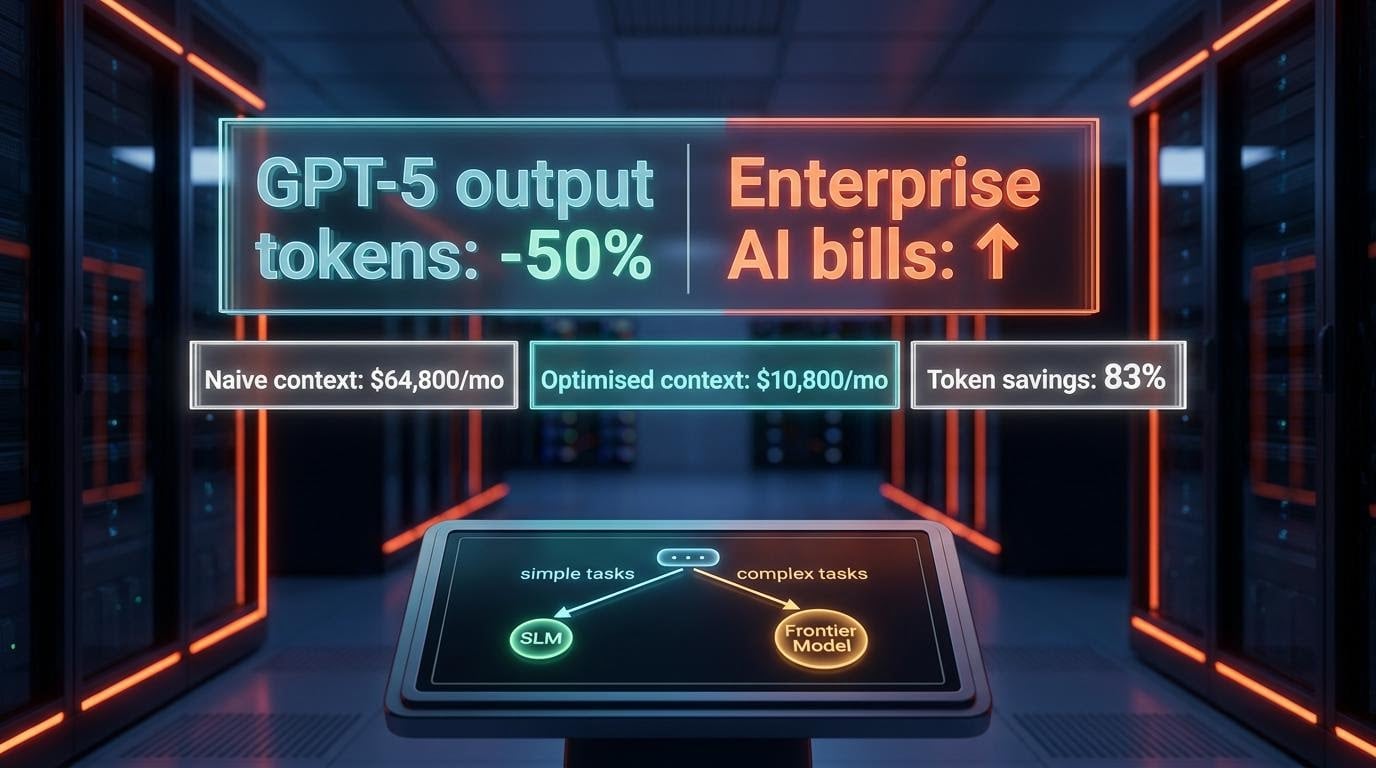
AI token prices are falling. Enterprise AI bills are climbing. That contradiction sits at the centre of every serious conversation about AI infrastructure spending in 2026, and resolving it is the difference between understanding which software vendors are structurally positioned and which are riding a narrative.
Piper Sandler analyst Rob Owens flagged this dynamic in July 2026, identifying it as the force behind growing enterprise concern over AI return on investment. More specifically, Owens pinpointed the paradox as the mechanism creating structural opportunity for a particular class of infrastructure software vendors, the ones that sit between the model and the enterprise’s data.
Here is the framework for understanding what is actually driving enterprise AI spend higher, which layer of the stack captures the resulting value, and why that distinction matters before acting on any analyst note about infrastructure software.
The paradox at the heart of enterprise AI economics
Every token an enterprise sends to or receives from a large language model (LLM), a token being the smallest unit of text a model processes, is metered and billed. LLM pricing is roughly linear in total tokens processed. That means the per-token price is only half the equation. The other half is volume.
Per-token prices are falling. GPT-5 output token pricing sits approximately 50% below GPT-4, according to Piper Sandler. That sounds like good news for enterprise budgets. It is not.
Hyperscaler capex commitments of approximately $725 billion across 2026 confirm that the model layer is being treated as a volume infrastructure play, with linear token pricing meaning total revenue grows with session counts even as per-token rates fall, a dynamic that simultaneously validates the infrastructure layer thesis by establishing that raw compute supply will continue expanding.
According to Piper Sandler, the roughly 50% reduction in GPT-5 output token pricing relative to GPT-4 has been outweighed by a dramatic rise in total consumption, driven by the greater reasoning demands of newer AI models.
Three forces are pushing total token consumption sharply higher even as the unit price drops:
- Interaction volume: Enterprises are scaling from thousands to millions of AI sessions per month as they move from pilots to production.
- Prompt size: Each interaction now incorporates multi-system context, long documents, and tool calls, sending far larger input payloads to the model.
- Reasoning depth: Agentic workloads, where AI systems plan, self-correct, and execute multi-step tasks, generate additional intermediate tokens at every stage.
Agentic workloads already consume 10-100x more tokens than a simple chat exchange. In most production agent deployments, the majority of cost sits on the input side: when answers are short, input tokens dominate the bill. The 50% price drop in output tokens is arithmetically overwhelmed by a volume increase measured in orders of magnitude. That is why total enterprise AI bills are rising despite cheaper per-token rates, and why AI spend is becoming a material operational line item rather than a fixed innovation budget.
When big ASX news breaks, our subscribers know first
What a context bill actually looks like in production
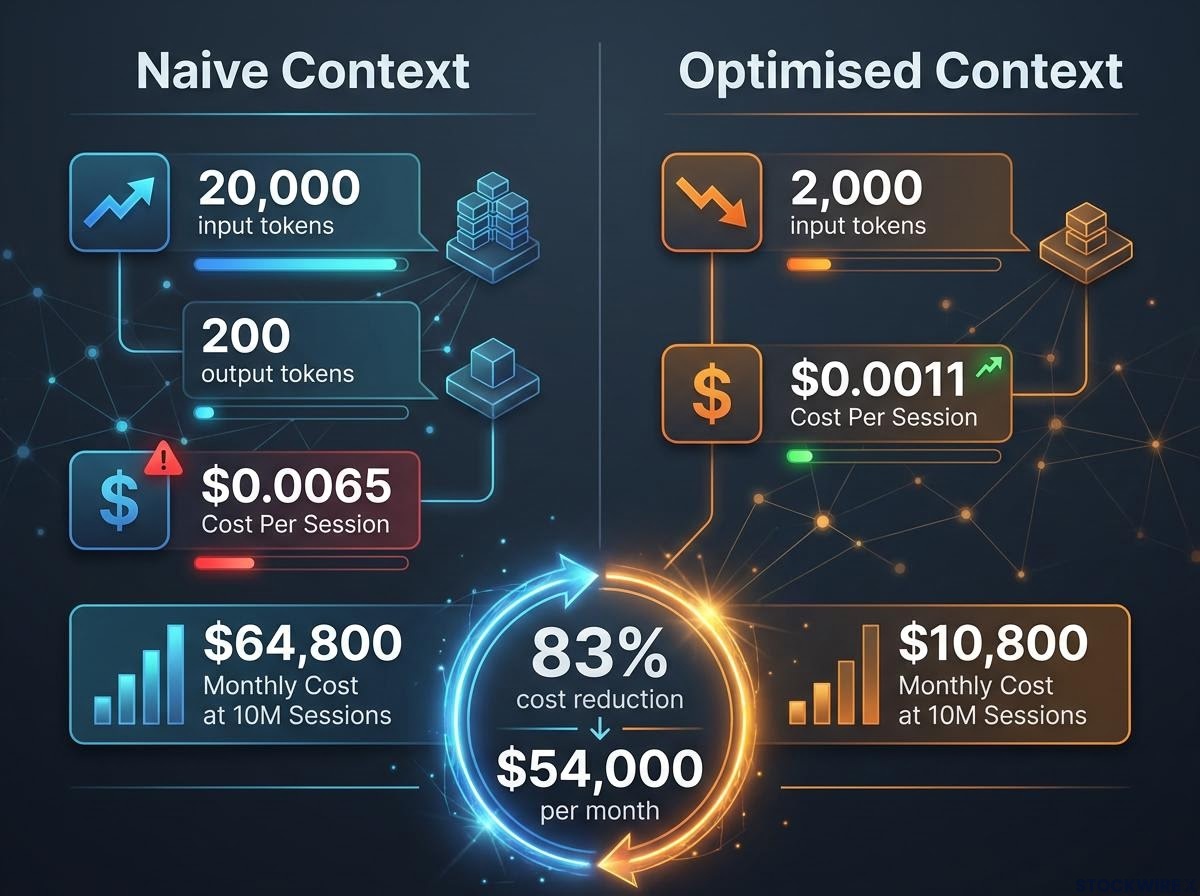
The abstraction becomes concrete when you run the numbers at scale. Consider two architectures handling the same task at 10 million sessions per month.
| Scenario | Cost Per Session | Monthly Cost at 10M Sessions |
|---|---|---|
| Naive context (20,000 input tokens) | $0.0065 | $64,800 |
| Optimised context (2,000 input tokens) | $0.0011 | $10,800 |
The naive implementation stuffs approximately 20,000 input tokens plus 200 output tokens into every call. The optimised version delivers the same answer quality with 2,000 input tokens. No model change. No quality trade-off. The difference is purely architectural: how much context gets loaded into the prompt window.
That difference is approximately $54,000 per month, an 83% cost reduction, at just 10 million sessions. Scale to the hundreds of millions of monthly interactions a large enterprise runs across customer service, analytics, and internal operations, and context architecture becomes the single largest variable on the AI budget line. This is not a marginal efficiency gain. It is a make-or-break budget variable for any enterprise scaling AI into production, and it explains why CFOs and CIOs now evaluate AI infrastructure vendors on token efficiency, not just model performance benchmarks.
How enterprise data context layers change the economics
The cost arithmetic above raises an obvious question: how do you get from 20,000 input tokens to 2,000 without losing answer quality?
The answer is the enterprise data context layer: governed infrastructure that gives AI systems the metadata, business definitions, lineage, and policies a human analyst would already know. It sits between an enterprise’s data systems and the AI models that query them.
A context layer performs three core functions:
- Aggregation and modelling: Pulls data from operational systems (CRM, ERP, ticketing, documents) and organises it into semantic models and governed catalogues, maintaining business meaning, relationships, and lineage so models do not have to rediscover this context on every query.
- Context retrieval and compression: At runtime, retrieves only the relevant nodes and attributes for a given question, assembles a minimal context package, and calls the LLM. This lazy-loading approach ensures only necessary context enters the model window, dramatically reducing token consumption.
- Governance and safety: Enforces privacy, compliance, and usage constraints, ensures data quality, and exposes lineage and ownership, preventing agents from hallucinating metrics or violating governance rules when touching enterprise data.
According to Piper Sandler, initial deployments of enterprise data context layers have achieved token consumption cuts of between 50% and 75% in tested use cases. Broader industry reports are consistent, indicating organisations have halved inference costs by pre-materialising and indexing domain knowledge into a context layer.
Why context layers become sticky over time
Vendors price their data context layers on a consumption basis, which Piper Sandler described as a compelling growth opportunity that simultaneously deepens longer-term competitive moats. That pricing structure matters because it means the vendor’s commercial incentive is structurally aligned with the customer’s token efficiency goal, a rare alignment in enterprise software worth understanding before evaluating any vendor relationship.
Consumption-based pricing is the commercial model that makes context-layer vendor incentives structurally different from legacy per-seat SaaS: revenue scales directly with AI usage volume, aligning the vendor’s growth with the customer’s deployment success rather than with headcount expansion.
Building and validating a unified semantic, lineage, and policy model is a multi-year exercise involving subject matter experts and cross-system reconciliation. Once an enterprise’s proprietary data and business logic are structured within a context platform, recreating that on a competing platform is costly and slow. Every AI agent that runs through the layer generates more metered traffic through that platform, growing revenue organically as AI usage expands. The deeper the integration, the higher the switching cost, and the more durable the revenue stream.
Model routing: the second lever on the enterprise AI bill
Context engineering controls how much data goes into each call. Model routing controls which model handles each call. The two work as a system.
The routing decision follows a sequential logic:
- A lightweight model classifies the incoming query by complexity, domain, and risk level.
- Simple, well-defined tasks (tagging, field extraction, translation, ranking) route to cheaper small language models (SLMs), which handle classification, extraction, and structured output at a fraction of the cost and latency of frontier models.
- Ambiguous, high-stakes, or multi-step reasoning tasks escalate to frontier models (GPT-class, Claude-class), which are reserved as reasoning powerhouses for complex analysis and multi-step planning.
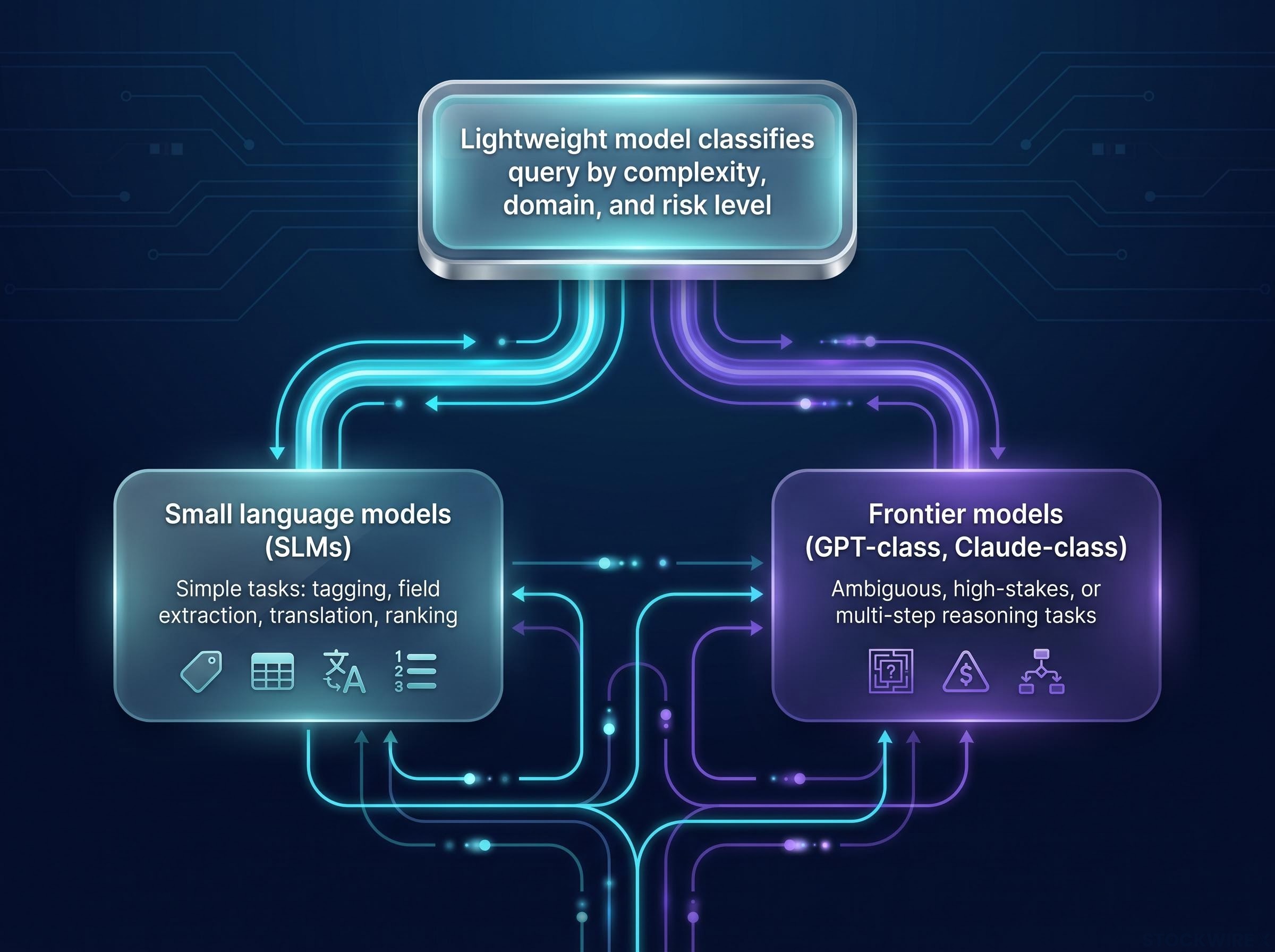
Piper Sandler observed that the industry is shifting away from maximising token volume toward leaner, more targeted spending approaches, with model routing identified as a primary tool enterprises are deploying to contain costs.
Using a frontier model for every task regardless of complexity is the equivalent of sending a surgical specialist for a routine blood pressure check. Routing eliminates that inefficiency by matching each query to the cheapest model capable of handling it correctly.
Combined with a context layer, routing ensures the right data is retrieved, the right model is used, and the fewest necessary tokens are consumed. What this tells you is that the enterprise AI stack is becoming a tiered, managed system rather than a direct pipe to one expensive model. Understanding that shift explains why orchestration platform vendors are gaining strategic relevance independent of which underlying model wins the next benchmark race.
Which players are positioned to capture this shift
The mechanisms above do not benefit all AI software vendors equally. Value concentrates in the infrastructure layer above the model and below the application.
| Beneficiary Group | Mechanism of Benefit | Key Risk or Limit |
|---|---|---|
| Context-layer platforms | Consumption-based pricing scales with AI usage; deep semantic and lineage integration creates high switching costs; central role in AI governance | Multi-year build cycles mean slower initial adoption; value depends on enterprise AI usage actually scaling |
| Orchestration and routing platforms | Occupy the “cost governor” role; by reducing customer spend via smarter routing, they justify their own platform fee | Model providers could bundle routing natively, compressing the standalone opportunity |
| Hyperscalers and model providers | Even as token prices fall, agentic workloads drive more sessions and larger input volumes; linear pricing means total revenue grows with volume | Per-token price compression accelerates; value capture depends on volume growth outpacing price declines |
| Thin application wrappers | Limited; simply expose frontier model capabilities without context or routing differentiation | Face margin pressure as customers scrutinise token bills; easily displaced by integrated platforms offering context, routing, and governance |
Piper Sandler highlighted that enterprises investing in context and routing infrastructure are able to expand AI deployment without triggering a proportional rise in costs. The corollary is that vendors without a defensible position at the infrastructure layer face structural margin pressure regardless of the underlying AI boom. For anyone evaluating analyst notes on AI infrastructure, the first question worth asking is which tier of the stack a given vendor occupies, because that determines whether its position is structurally defensible or exposed to model-layer competition.
Foundation model economics exhibit a structural tension that makes the infrastructure layer above them increasingly attractive: as token prices compress toward commodity levels, the providers that meter, govern, and optimise token consumption capture margin that the model layer itself cannot defend.
Models as inputs, infrastructure as the control point
As AI moves from experiment to metered operational infrastructure, the economic and strategic gravity of the stack shifts from the model layer to the context and orchestration layer above it. Three dimensions of that shift matter most:
- From model selection to context architecture: The biggest cost lever is not which model you choose but how much context you send it.
- From benchmark performance to token efficiency: CFOs and CIOs evaluating AI spend now care about governed, cost-efficient outcomes, not raw model scores.
- From innovation spend to metered operational infrastructure: AI is becoming a billable utility, and the vendors that meter, govern, and optimise that utility hold the strategic position.
Orchestration platforms are model-agnostic by design. They can swap underlying LLMs as prices and capabilities evolve, insulating their strategic position from any single model provider’s competitive moves. Building and validating a context layer is a multi-year exercise, making it inherently slower to displace than any individual model contract. Piper Sandler framed this as a longer-term revenue and defensibility opportunity for infrastructure software vendors, not a short-cycle trade.
Ecosystem switching costs, not hardware versus software categorisation, are the variable that determines whether an infrastructure vendor’s position is durable; the multi-year build cycle required to validate a semantic and lineage model places context-layer platforms squarely in the high-switching-cost category that historically compounds better than commodity infrastructure.
That model-agnosticism is precisely why the infrastructure layer retains strategic value even if the model at the centre of today’s analyst note is displaced by a cheaper competitor tomorrow.
This article is for informational purposes only and should not be considered financial advice. Investors should conduct their own research and consult with financial professionals before making investment decisions. These statements are speculative and subject to change based on market developments and company performance.