


Actinogen’s Xanamem depression data published in the British Journal of Psychiatry
Actinogen Medical (ASX: ACW) has had the results of its Phase 2 depression proof-of-concept trial published as a peer-reviewed article in the British Journal of Psychiatry, announced on 20 July 2026.
The publication reported that the trial demonstrated meaningful anti-depressant activity in a “difficult-to-treat” patient population. The study examined Xanamem (emestedastat) in participants with major depressive disorder (MDD) and cognitive impairment (CI).
The British Journal of Psychiatry is described as a leading international journal in behavioural and psychiatric medicine.
When big ASX news breaks, our subscribers know first
What the published trial showed
Trial design and population
The proof-of-concept trial followed a standard Phase 2a MDD design, with one distinctive feature separating it from conventional depression studies.
- A six-week treatment period followed by a further four weeks of blinded follow-up
- A unique element studying participants with both measurable cognitive impairment AND depression, assessing potential Xanamem benefit on both
- Enrolment of 165 participants characterised as having “difficult-to-treat” MDD, with clinically significant residual MDD and measurable CI
- Most participants were taking another anti-depressant in addition to the trial treatment
This design allowed the researchers to test whether Xanamem could deliver benefits across two connected conditions at once.
Efficacy results
The trial produced statistically significant anti-depressant signals, with the strongest effect emerging during the blinded follow-up phase.
| Measure | Result | p-value | When observed |
|---|---|---|---|
| Anti-depressant benefit vs placebo (MADRS) | 2.7 points | p < 0.05 | Week 10 (blinded follow-up) |
| Benefit in background SSRI subgroup (46% of patients) | 4.2 MADRS points | p < 0.05 | — |
MADRS refers to the Montgomery-Åsberg Depression Rating Scale, a validated tool for measuring depression symptom severity. SSRI (Selective Serotonin Reuptake Inhibitors) is the most common class of anti-depressant currently in use.
The publication noted a “lag” in Xanamem’s benefit on depression scores, with the effect maximal at Week 10. According to the article, this delayed response is consistent with the known timeframe of onset and reversal of chronic cortisol-related effects, similar to what is observed when starting or stopping chronic prednisolone treatment.
A larger than previously reported placebo group improvement in cognitive impairment symptoms was also observed, with no evidence of Xanamem treatment benefit on cognition. Xanamem was reported to be safe and well-tolerated. The compound remains an investigational product and has not been approved by any regulatory authority.
Why cortisol control matters, the science explained
Xanamem’s novel mechanism is to control elevated levels of cortisol, commonly known as the “stress hormone,” inside the brain. It does this by inhibiting the cortisol synthesis enzyme 11β-HSD1, without affecting the production of cortisol by the adrenal glands, which is essential for the body’s normal functioning.
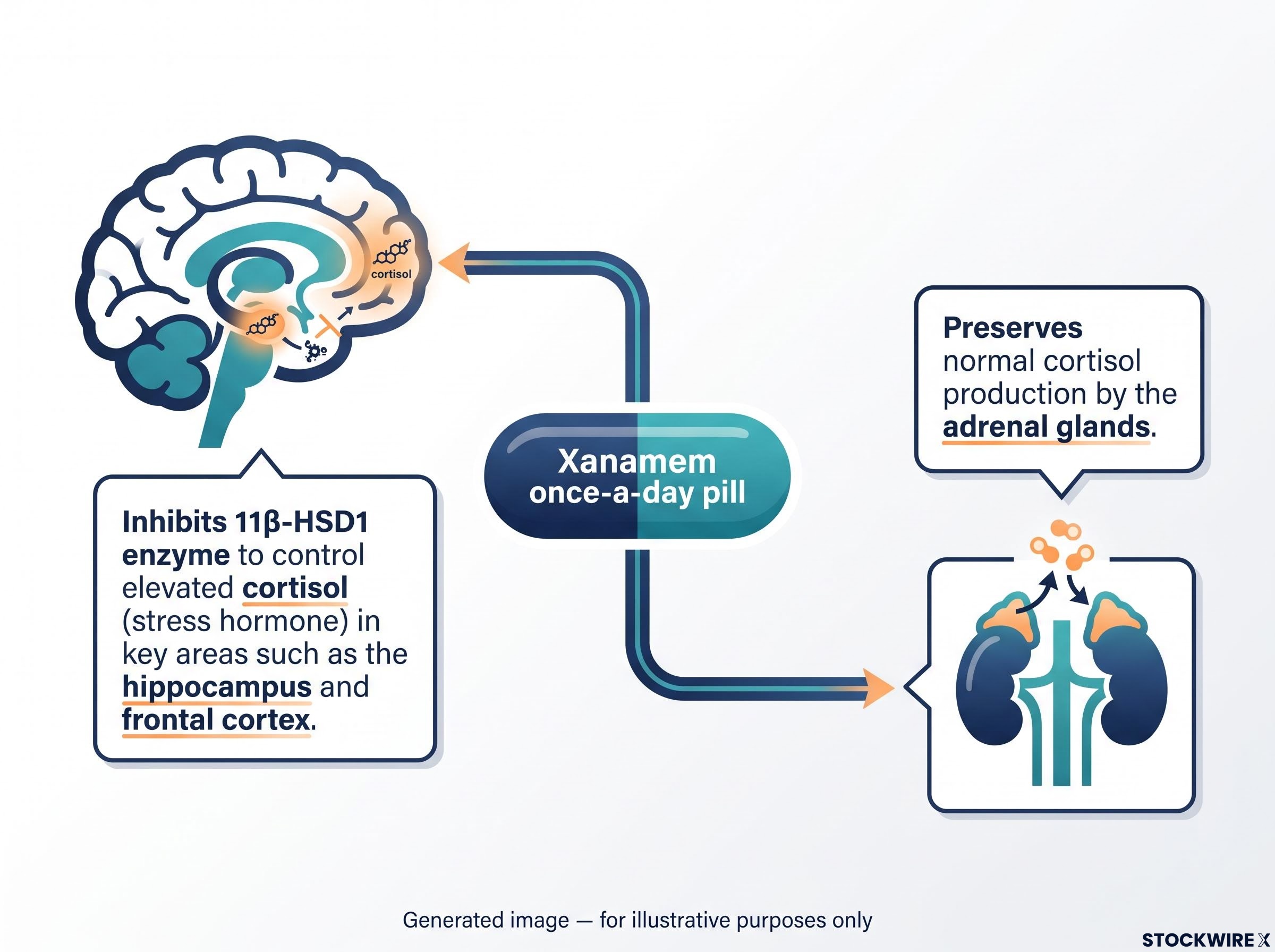
Chronically elevated cortisol is associated with depressive symptoms and is known to be toxic to brain cells. By targeting cortisol at the source within key brain regions, the therapy aims to address a biological driver rather than only the symptoms.
Xanamem is described as a first-in-class, once-a-day pill designed to deliver high levels of cortisol control in key areas of the brain such as the hippocampus and frontal cortex. For investors, a novel mechanism that could potentially be safely combined with existing depression treatments points to a differentiated positioning in a field with substantial unmet need.
What management said
Professor Michael Berk AO, academic psychiatrist and co-author
“These results are highly encouraging for the Xanamem 10 mg daily dose that is also being used in the Alzheimer’s disease program. The trial demonstrates that the drug penetrates the brain and there is a signal of clinically meaningful activity to improve depression symptoms in a difficult-to-treat MDD patient population. There remains a significant unmet medical need for therapies such as Xanamem that have a novel mechanism of action and can be safely combined with existing depression treatments.”
Dr Dana Hilt, Chief Medical Officer
“Depressive symptoms also occur frequently in patients with Alzheimer’s disease. Anti-depressant activity may be a useful feature of Xanamem treatment for Alzheimer’s disease and help to improve well-being and quality of life in these patients. The first pivotal phase 2b/3 trial of Xanamem in Alzheimer’s disease is due to report topline results in November 2026 including initial evaluation of its effects on psychiatric symptoms.”
The read-through to Alzheimer’s and what comes next
The strategic significance of the depression data lies in the dose. The 10mg daily dose validated in this trial is the same dose used across the company’s Alzheimer’s program, and the depression results support both brain penetration and clinical activity at that level.
That connection matters ahead of a major near-term catalyst. The XanaMIA Phase 2b/3 Alzheimer’s trial enrolled 247 patients with mild-to-moderate Alzheimer’s disease and progressive disease, over a 36-week treatment period. The trial is now closed to participant recruitment and has passed an independent Data Monitoring Committee safety and efficacy futility review.
The most recent independent Data Monitoring Committee safety review, completed in June 2026, cleared Xanamem for the third consecutive time with no protocol amendments requested, and confirmed that more than 100 participants had completed the full 36-week treatment course ahead of the November topline readout.
Final topline results are expected in November 2026, including initial evaluation of the drug’s effects on psychiatric symptoms. The open-label extension, XanaMIA-OLE, commenced in March 2026 and is open to former and current participants in the Phase 2b/3 trial.
The broader clinical dataset supporting Xanamem to date includes several data points relevant to investors:
-
Xanamem has been studied in more than 500 volunteers and patients across eight clinical trials
-
The compound has demonstrated clinical activity in patients with depression, patients with biomarker-positive Alzheimer’s disease and cognitively normal volunteers
-
High levels of target engagement in the brain have been shown at doses as low as 5mg daily in a human PET imaging study
The company noted that further Xanamem trials in MDD will depend on future funding and partnership arrangements. Xanamem remains an investigational product and is not approved for use outside of a clinical trial by the FDA or any global regulatory authority.
For investors watching Actinogen, the pivotal Alzheimer’s topline results due in November 2026 stand as the key event on the horizon, with the newly published depression data reinforcing the scientific rationale behind the company’s lead program.
For investors exploring the longer-term data generation strategy beyond the November pivotal readout, our dedicated guide to the XanaMIA open-label extension covers the commencement of the OLE in March 2026, the 25-month treatment window available to all 247 participants, and the long-term safety and CDR-SB efficacy data it is designed to generate for a potential regulatory submission.
Don’t Miss the Next ASX Healthcare Breakthrough
Big News Blast delivers FREE breaking ASX healthcare news directly to your inbox within minutes of release, with in-depth analysis included. Join 20,000+ subscribers already staying ahead of the market on biotech and healthcare announcements. Click the “Free Alerts” button at StockWire X to receive the next market-moving update the moment it drops.