
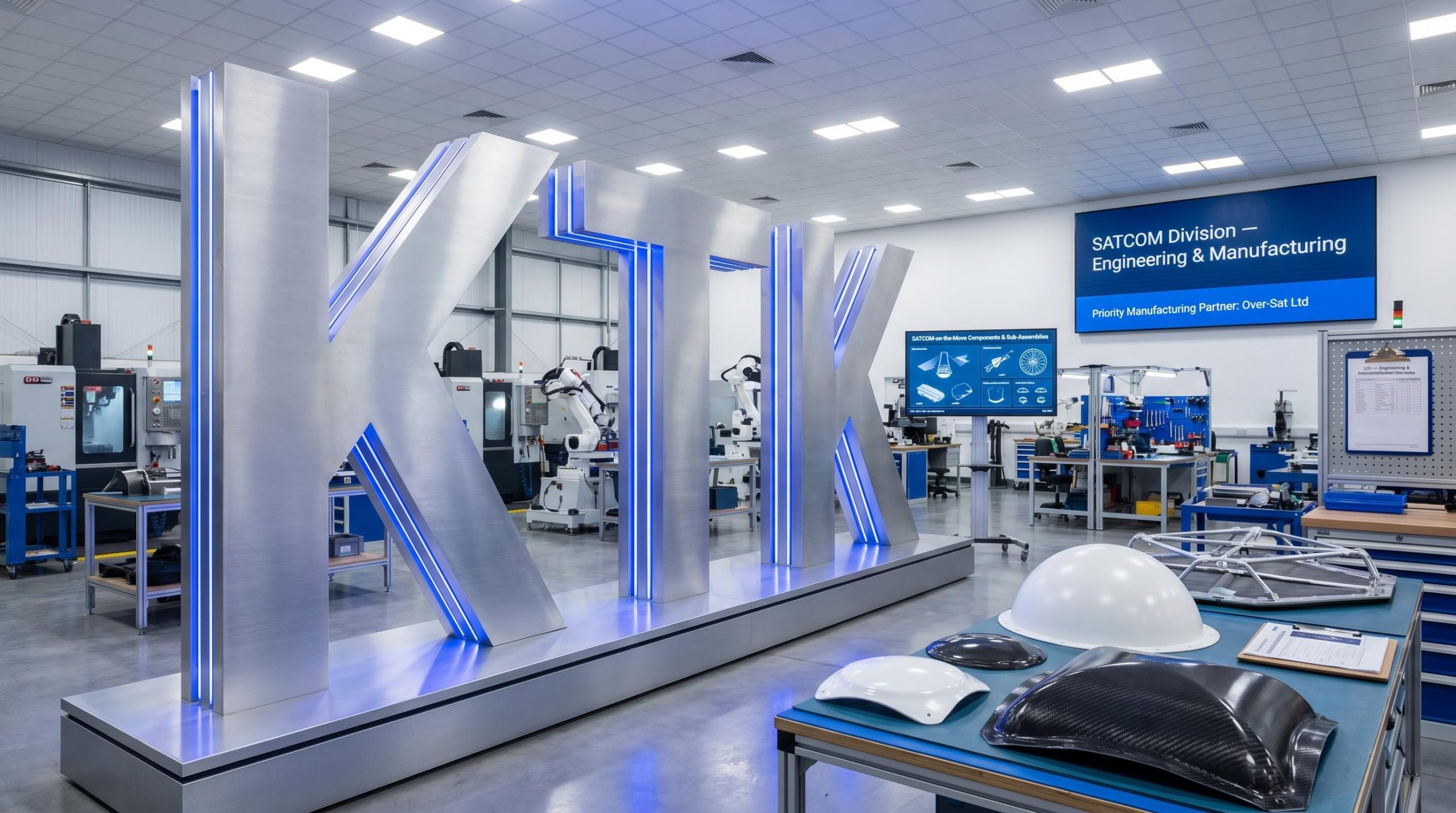
KTEK enters SATCOM market with new business unit and Over-Sat agreement
KTEK Aerosystems (ASX: KTK) has established a new business unit to design and manufacture SWaP (Size, Weight and Power)-efficient SATCOM components and sub-assemblies for defence and commercial customers. The move extends the Tier-2 UAV specialist’s engineering platform into satellite communications hardware.
The capability launches alongside a Letter of Intent (LOI) signed with Over-Sat Ltd, an Israeli developer of advanced SATCOM terminals. Under the LOI, KTEK will provide engineering, manufacturing and industrialisation services for selected components of Over-Sat’s MANTIS and PYTHON systems. Importantly, the LOI contains no committed order volumes or minimum revenues, with revenue generated only as individual work orders are agreed and executed.
When big ASX news breaks, our subscribers know first
Inside the Over-Sat arrangement
Work under the arrangement will be defined through individual work orders agreed between the parties, each setting out scope, deliverables, schedule, pricing and quality requirements. This structure keeps the relationship flexible, with commercial activity flowing on an as-needed basis rather than through a fixed volume commitment.
Beyond the initial work orders, the parties intend to cooperate on the strategic development of Over-Sat’s products, production readiness and future manufacturing needs. The source notes: “Subject to agreement on commercial terms, Over-Sat intends to give KTEK priority for the manufacturing of parts and assemblies arising from this cooperation.”
Both companies are rooted in the same Israeli defence engineering ecosystem, the network through which KTEK’s existing Tier-1 contractor relationships were established. This shared foundation provides a natural basis for the collaboration.
What the cooperation may cover
The LOI outlines a broad potential scope of work, which may include:
-
Engineering and manufacturing support
-
Design-for-manufacturing improvements
-
Structural and mechanical parts
-
Composite materials and assemblies
-
Electromechanical assemblies
-
Tooling, jigs and fixtures
-
Prototype, pilot and serial production
Dekel Keisar, Founder and Managing Director, KTEK Aerosystems
“SATCOM is a natural and strategically important extension of KTEK’s existing aerospace and defence capabilities. Weight and size reduction is a non-negotiable requirement across every modern UAV and unmanned program we work in, and communications hardware is under constant engineering pressure to become lighter and more compact without sacrificing performance. By combining our expertise in lightweight structures, RF-transparent radomes, electromechanical assemblies and production industrialisation, we can support customers from development through to serial manufacture.”
Why Over-Sat’s Luneburg Lens technology matters
SATCOM-on-the-Move refers to keeping air, sea and ground platforms connected via satellite while they are in motion, rather than only when stationary. This capability is increasingly sought across defence and commercial mobility applications.
Over-Sat’s proprietary Luneburg Lens antenna technology is fabricated using advanced 3D printing of metamaterials, enabling ultra-compact, multi-band and multi-orbit connectivity. The terminals operate across GEO, MEO and LEO satellite networks, spanning the full range of orbital altitudes.
The design removes two limitations common to conventional antennas: RF feed blockage and scan losses. This maintains consistent performance across the full elevation range, including when the target satellite sits low on the horizon, the point at which conventional antennas are typically least effective.
For investors, the significance lies in form factor. The compact design allows the systems to be fitted to small and medium platforms, such as UAVs, USVs and AUVs, that larger conventional SATCOM equipment cannot accommodate. This represents a growing share of defence and commercial mobility demand as smaller, moving and unmanned platforms proliferate.
Over-Sat’s customer and deployment credentials
Over-Sat’s terminals have secured deployments and selections across multiple defence markets, underlining the calibre of KTEK’s new partner.
| Milestone | Detail |
|---|---|
| Elbit Systems Seagull USV | Operational deployment on the Seagull unmanned surface vessel. Elbit Systems (NASDAQ/TASE: ESLT) is a US$8 billion+ global defence technology company, with the Seagull used by multiple navies including a US Navy exercise in Bahrain. |
| Major European Navy | Selected to supply 150cm Ku+Ka maritime stabilised VSAT systems. |
| Strategic Asian defence customer | Order for next-generation PYTHON-5 and MANTIS-10 terminals, described as “the world’s first SATCOM terminals built on Luneburg Lens antenna technology”. |
| Rangsons Aerospace (India) | Investment and strategic collaboration agreement. Rangsons holds US$34 million in institutional funding and supplies ISRO, Boeing and the Indian Armed Forces. |
How this fits KTEK’s asset-light model
The new capability establishes SATCOM as KTEK’s fifth product line, joining composite airframes, electromechanical assemblies, rugged defence systems, and systems integration and kitting. The SATCOM offerings comprise RF-transparent radomes, lightweight antenna structures and integrated assemblies for mobile defence and commercial platforms.
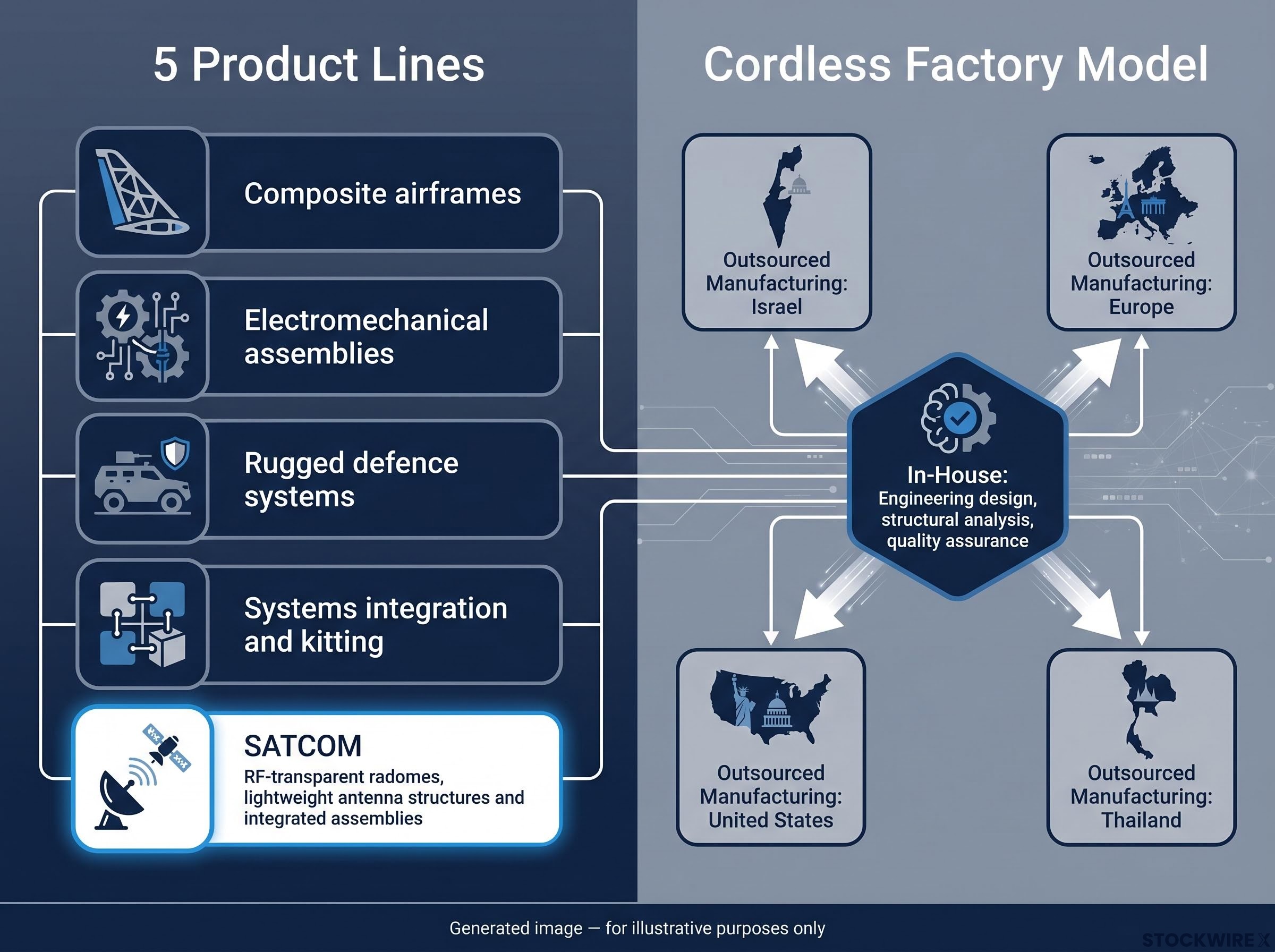
The expansion extends KTEK’s platform into the SATCOM-on-the-Move market without requiring a material change to its asset-light operating model. This preserves the capital discipline that underpins the company’s positioning.
KTEK’s composite airframe deliveries resumed in May 2026 following Middle East supply chain disruptions, with an initial A$500,000 shipment dispatched from European facilities and a five-stage ramp targeting 150 units per month, demonstrating the production industrialisation capability now being extended into the SATCOM line.
Central to that discipline is KTEK’s “Cordless Factory” model, which retains engineering design, structural analysis and quality assurance in-house while outsourcing physical manufacturing to a certified global partner network spanning Israel, Europe, Thailand and the United States. The structure is designed to enable rapid production scaling in response to new customer demand without the capital intensity of a traditional Tier-1 defence manufacturer.
KTEK’s US manufacturing presence, established through a Los Angeles production and engineering facility secured in June 2026, adds a domestic sourcing footprint that strengthens the company’s positioning with US aerospace and defence customers who require locally-based suppliers under government procurement regulations.
The approach reinforces KTEK’s “picks and shovels” positioning within the defence ecosystem, benefiting from structural tailwinds in global military spending and UAV adoption without the complexity of direct government contracting.
What comes next
The parties will progress initial work orders and continue discussions regarding the broader strategic cooperation contemplated by the LOI. KTEK has stated it will update the market as material work orders are received, in accordance with its continuous disclosure obligations.
Investors should note the arrangement’s non-binding nature. The LOI does not contain committed order volumes or minimum revenue obligations, and there is no certainty as to the timing or value of work orders that may be issued. The LOI may be terminated by either party on 30 days’ written notice and, other than agreed provisions relating to confidentiality, intellectual property, customer protection and manufacturing priority, does not oblige either party to proceed with future transactions unless and until specific work orders are agreed.
The arrangement offers a potential entry point into the growing SATCOM-on-the-Move market and the foundation for a scalable product line serving airborne, maritime and land-based platforms. As with any LOI-stage agreement, the ultimate value will depend on execution and the conversion of intent into agreed work orders.
Don’t Miss the Next Defence Tech Breakout on ASX
Big News Blast delivers FREE breaking ASX defence and technology news directly to your inbox within minutes of release, complete with in-depth analysis. Join 20,000+ subscribers already staying ahead of the market. Click the “Free Alerts” button at Big News Blast to get the next market-moving announcement the moment it drops.