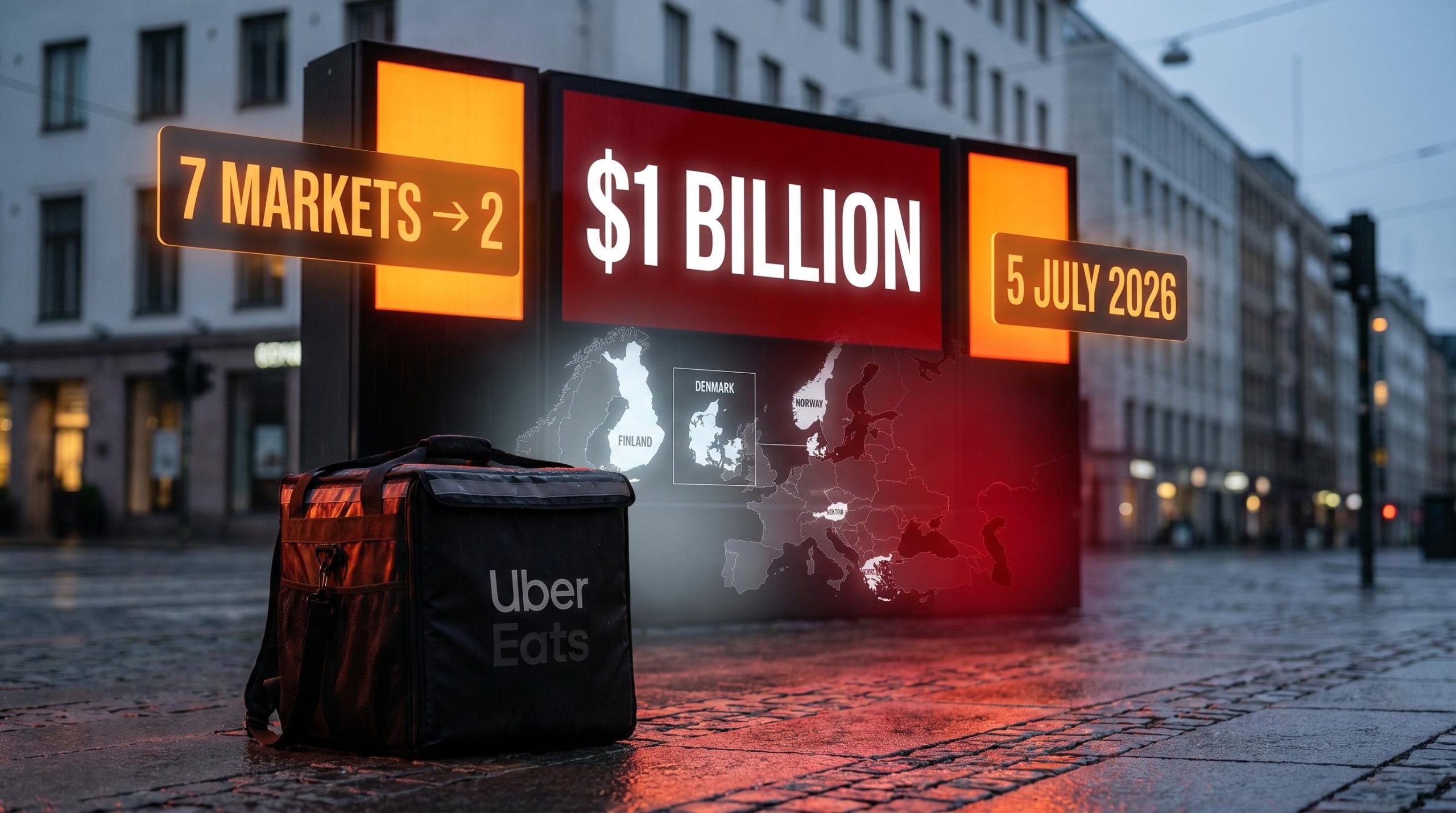
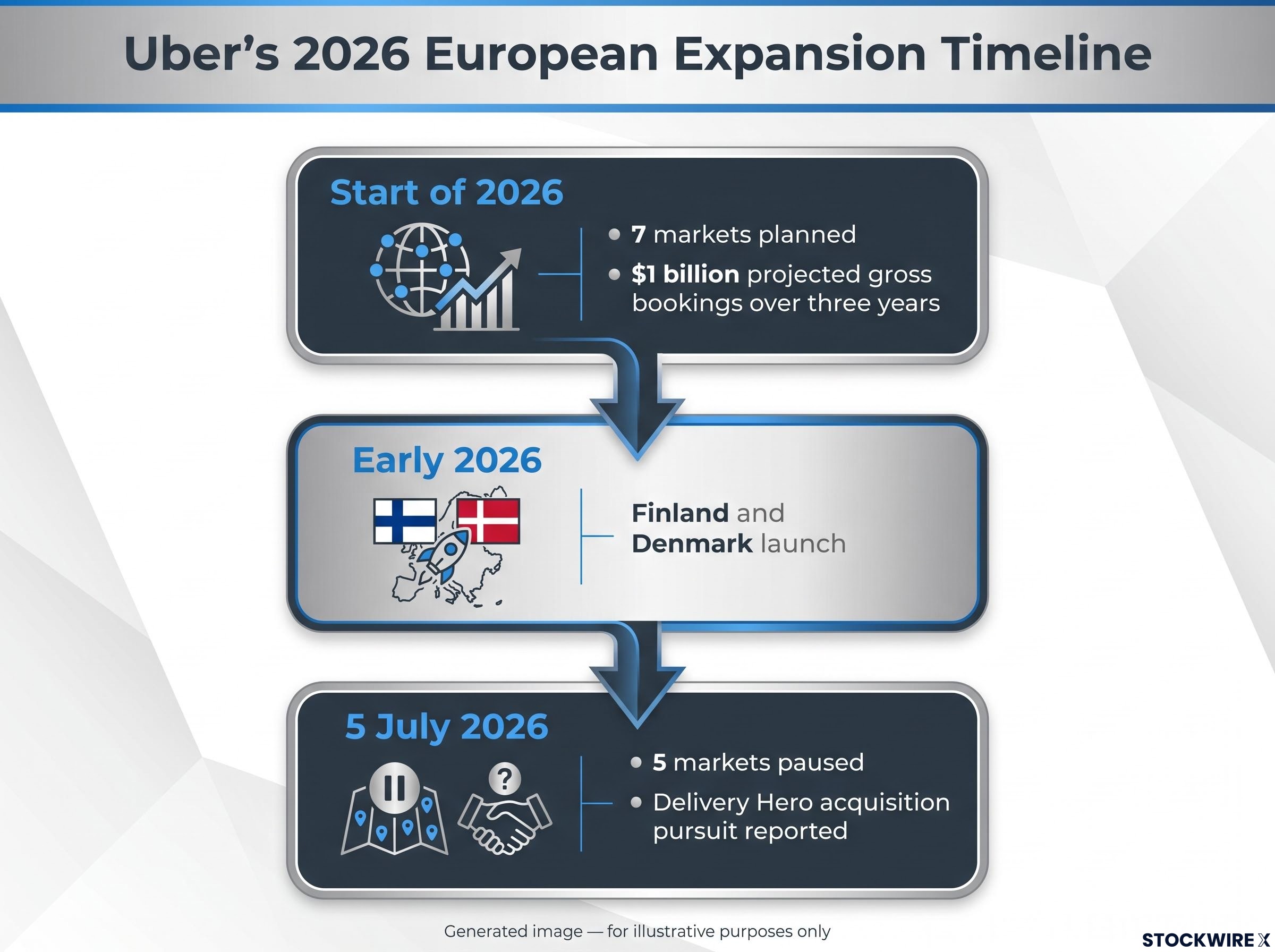
At the start of 2026, Uber set out plans to bring food delivery to seven new European markets. When 5 July 2026 arrived, five of those planned entries had been shelved. The Financial Times reported the pause, Reuters relayed the story the same day, and a $1 billion gross bookings projection suddenly applied to a much smaller map.
The original plan covered Austria, Denmark, Finland, Norway, the Czech Republic, Greece, and Romania. The $1 billion figure was tied to all seven. With five markets now on hold, the near-term revenue potential from this initiative looks materially different from what Uber laid out months ago. The Reuters report carried a caveat that its journalists had been unable to confirm the FT’s findings, and Delivery Hero made no public statement on the matter.
Here is what the reporting confirms, which markets are affected, and what the decision to keep only Finland and Denmark tells you about where Uber is actually placing its European food delivery bets right now.
The five markets Uber has paused, and the two it is keeping
According to the FT’s account, as carried by Reuters on 5 July 2026, three of the paused countries are named outright: Austria, Norway, and Greece. The article noted that a further two countries from the original seven had also been removed from the expansion plan, without disclosing which ones.
Because Finland and Denmark are confirmed as active, the only remaining candidates from the original plan are the Czech Republic and Romania. That is a logical inference, not a confirmed fact from the FT or Reuters coverage.
$1 billion in projected gross bookings over three years was the figure attached to the full seven-market expansion. That number now applies to a two-market reality.
| Country | Original plan status | Current status | Notes |
|---|---|---|---|
| Austria | Planned | Paused | Explicitly named in FT report |
| Norway | Planned | Paused | Explicitly named in FT report |
| Greece | Planned | Paused | Explicitly named in FT report |
| Czech Republic | Planned | Status unclear (inference only) | Not identified in reporting; logical candidate |
| Romania | Planned | Status unclear (inference only) | Not identified in reporting; logical candidate |
| Finland | Planned | Active | Confirmed focus market |
| Denmark | Planned | Active | Confirmed focus market |
For anyone tracking Uber’s growth outlook, the gap between a seven-market projection and a two-market reality is the number that matters most. The $1 billion figure has not been revised, but five fewer markets means the near-term upside from this initiative is materially smaller than what the company projected earlier this year.
When big ASX news breaks, our subscribers know first
Why Finland and Denmark changed Uber’s calculus
In comments to the FT, Uber described the rollouts in Finland and Denmark as a “huge success” and said the business would “focus on continuing the momentum” it had built in those two markets, rather than pressing ahead with further launches. Both launched within the 2026 expansion window, before the 5 July pause announcement.
Strong early traction in food delivery typically reduces the incentive to spread capital across multiple simultaneous market builds. When two markets are working, pouring resources into five more that have not yet proven demand becomes harder to justify. What “focusing on momentum” usually looks like in practice:
The leverage Uber Eats holds in commercial negotiations is visible in other markets too: Uber Eats commercial terms secured in Australia with Guzman y Gomez earlier in 2026 included exclusivity provisions and joint investment commitments that directly improved franchisee unit economics, illustrating how the platform uses scale to anchor strategic partnerships.
- Deepening restaurant and merchant partnerships to expand selection
- Building courier density to improve delivery speed and reliability
- Driving consumer repeat rates through targeted promotions and loyalty features
Uber has not framed Finland and Denmark as a formal proof-of-concept template for the rest of Europe. But the logic is consistent with that kind of consolidation: when a company cites its best-performing new markets as the reason to pause everything else, it is telling you that capital efficiency has become the priority over the speed of geographic footprint growth.
What new market entry actually costs in food delivery
The decision to pause five launches at once makes more sense when you understand what each one demands. New food delivery market entries typically require heavy upfront investment across four categories:
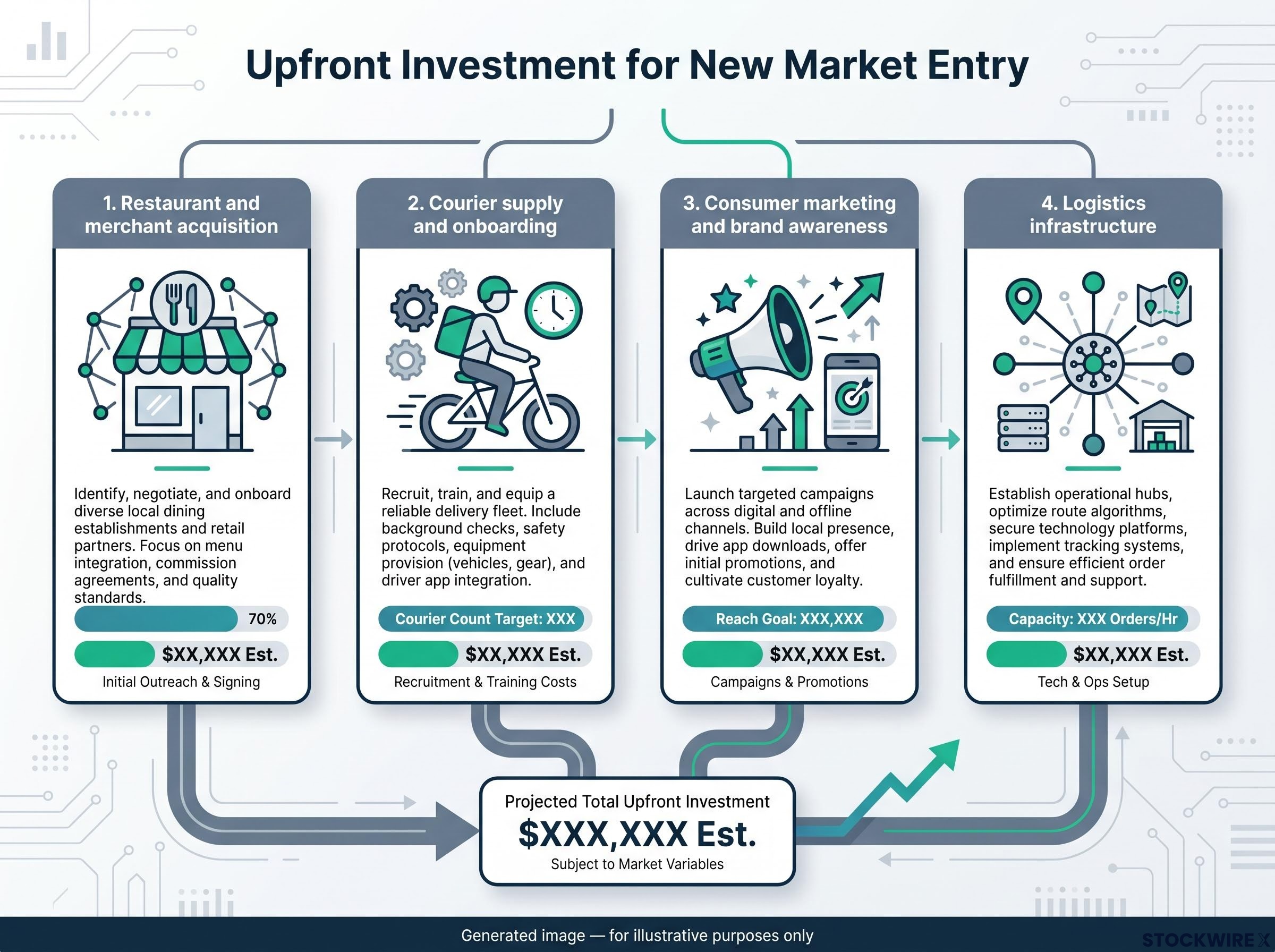
- Restaurant and merchant acquisition: Signing partnerships with enough venues to make the platform worth opening.
- Courier supply and onboarding: Recruiting, vetting, and training enough delivery drivers to meet demand reliably.
- Consumer marketing and brand awareness: Spending to make people aware the service exists and giving them a reason to try it.
- Logistics infrastructure: Building the operational backbone for order routing, payment processing, and customer support in a new regulatory environment.
Each of those costs compounds if early performance signals are weak. A market that is not generating strong repeat orders in its first months becomes a cash drain with no clear path to profitability, and the food delivery sector has faced sustained investor pressure to demonstrate margin improvement over raw scale since the post-pandemic correction.
For anyone watching Uber’s bottom line, each halted launch is also a set of costs that will not be incurred in the near term. Pausing five markets is not just a geographic decision; it is a capital allocation decision.
These operational points represent established food delivery sector analysis, not content drawn directly from the FT or Reuters coverage of this specific event.
The Delivery Hero backdrop and what it adds to the picture
Reuters reported the expansion pause alongside a separate thread: Uber remains in active pursuit of an acquisition of Delivery Hero. The two stories ran in the same context, and that proximity matters.
However, no statement from Uber links the pause directly to the Delivery Hero negotiations. The connection is contextual in the reporting, not a stated corporate rationale. The FT’s account was one Reuters journalists were unable to corroborate independently, and Delivery Hero issued no comment in response.
Sourcing note: Reuters stated it could not independently verify the Financial Times report on the expansion pause. Delivery Hero declined to comment.
If Uber is simultaneously pursuing a major acquisition and pulling back on organic market entry, the company may be managing its available bandwidth and capital with a larger move in mind. That reading is plausible, but it is an inference from the reported facts, not something Uber has confirmed.
For investors reading the Delivery Hero pursuit alongside the expansion pause, European equity positioning in mid-2026 carries its own complexity: institutional money has remained structurally underweight European stocks even as the Barclays upgrade in July 2026 cited broadening sector participation, a dynamic that shapes the capital environment in which Uber is making these allocation decisions.
For investors, the Delivery Hero context changes how you should read the pause: not necessarily as a retreat from Europe, but potentially as a reallocation of attention toward an inorganic growth path that could reshape Uber’s European footprint faster than seven individual market builds ever would.
What the pause tells investors about Uber’s growth priorities in 2026
The pattern here is straightforward. Uber planned seven markets, launched two successfully, and halted the rest. The Uber Eats growth story in Europe now hinges on deepening performance in proven markets rather than adding new flags to the map.
A pause is not a cancellation, but no new timetable for the halted markets has been disclosed. That absence is itself a data point: investors who priced in the full seven-market expansion now have no public guidance on when, or whether, those launches will proceed. No public statement from Uber or Delivery Hero has addressed the broader strategic rationale, leaving that dimension of the decision without official confirmation.
The open questions worth tracking from here:
- Whether Finland and Denmark sustain or accelerate their early momentum
- Progress on the Delivery Hero acquisition and what it would mean for Uber’s European delivery footprint
- Any revised gross bookings guidance reflecting the two-market reality
- A timetable, or lack of one, for the paused markets
One success story out of seven is not a failed expansion
Uber is not exiting European food delivery. It is consolidating around its two demonstrated successes before deciding whether and how to extend further. The $1 billion gross bookings projection, however, now needs to be read against a two-market near-term reality rather than the seven-market plan it was built on.
The questions that define the next chapter are unresolved: whether Finland and Denmark can sustain momentum, whether Delivery Hero changes the equation entirely, and whether the paused markets ever receive a revised launch date. Until Uber provides that clarity, the gap between the original ambition and the current scope is where the real story sits.
This article is for informational purposes only and should not be considered financial advice. Investors should conduct their own research and consult with financial professionals before making investment decisions.