
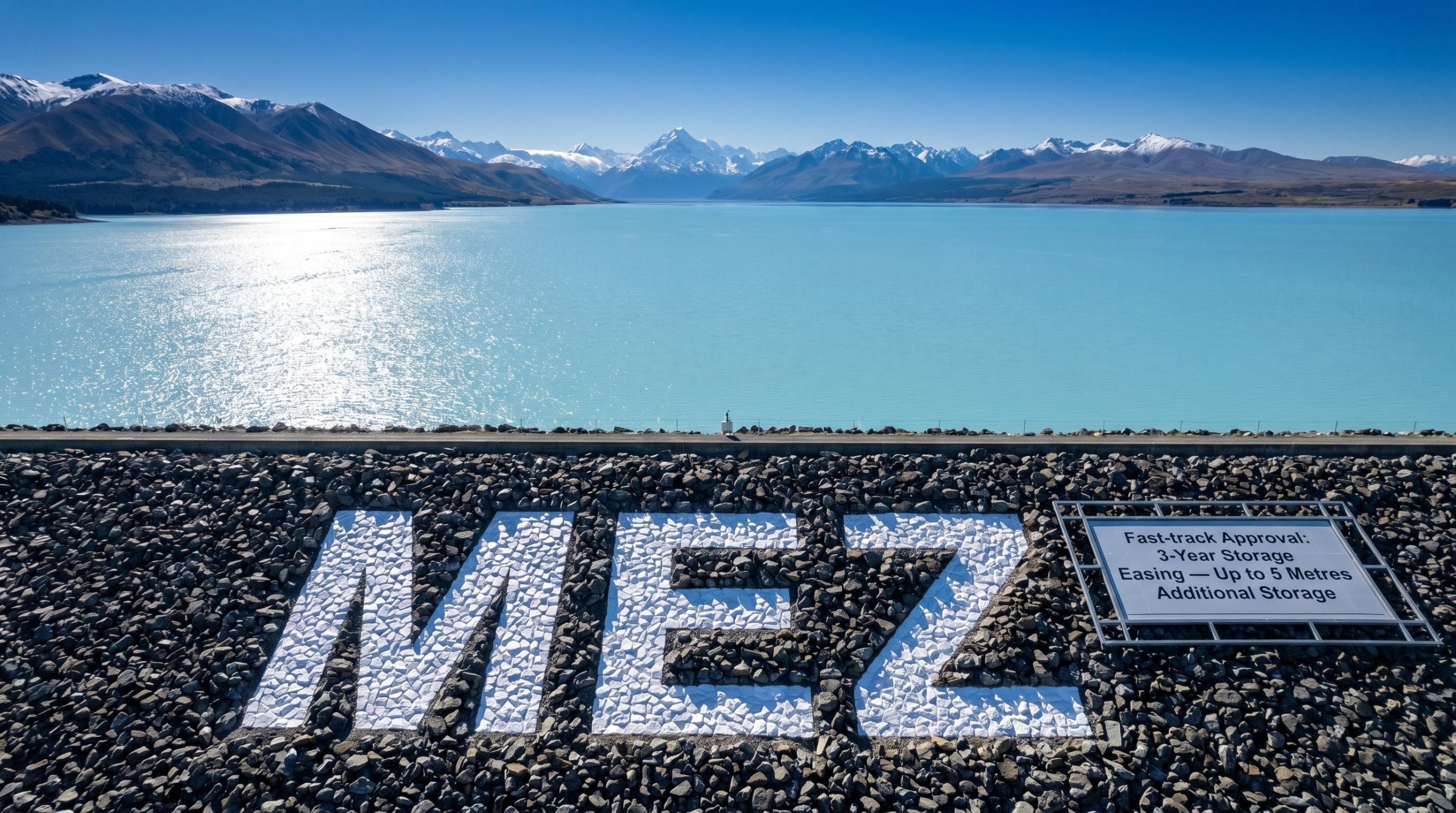
Meridian secures three-year easing of Lake Pūkaki storage restrictions
Meridian Energy has received the Fast-track Panel’s final decision confirming the easing of access restrictions on Lake Pūkaki hydro storage for a three-year period, announced on 3 July 2026. The approval represents a de-risking measure aimed at reducing dry-year risk and related extra insurance price impacts.
The final decision covers two components. The first is the easing of access restrictions on Lake Pūkaki storage. The second grants Meridian permission to permanently install rock armouring at Pūkaki Dam.
The easing is positioned to reduce dry-year risk and extra insurance price impacts through to Winter 2028, while new generation capacity is constructed.
When big ASX news breaks, our subscribers know first
Why the decision matters for security of supply
Chief Executive Mike Roan framed the easing as a measure to reduce dry-year risk and related extra insurance price impacts through to Winter 2028, providing additional security for the system while more new generation capacity is built. In practical terms, the additional storage acts as a buffer during periods when lake levels come under pressure.
The Waitaki Power Scheme reconsenting, secured through the Environment Court in June 2026, locked in 1,553 MW of hydro capacity through to the 2060s and preserved all existing storage levels, providing the long-term consent certainty that underpins Meridian’s capacity to invest in additional storage and generation.
CEO Commentary
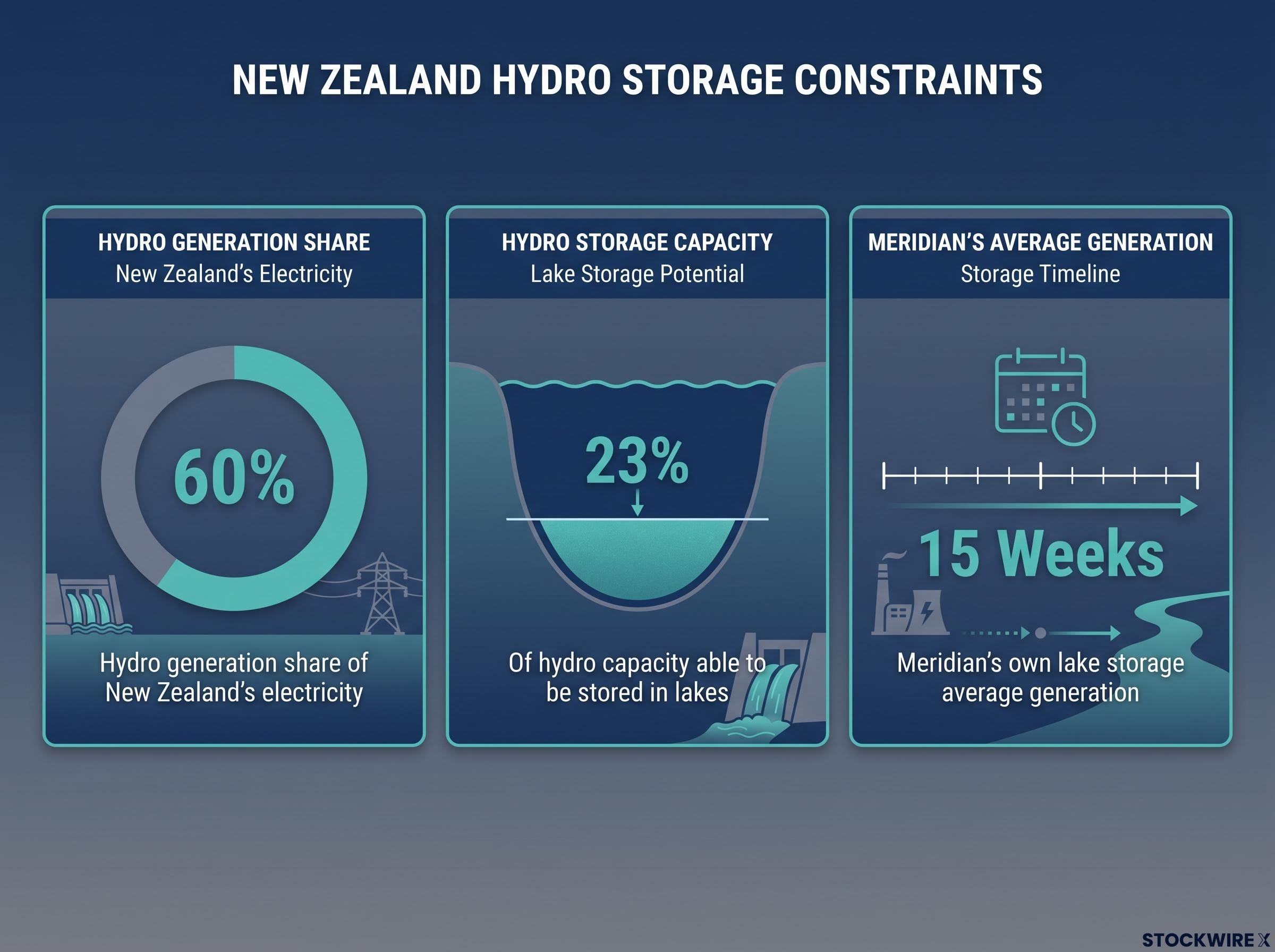
“Hydro generation provides around 60% of the country’s electricity and offers storage that can play a key role when alternative sources like solar and wind are not available. Its challenge is that only 23% of that capacity can be stored in lakes, and Meridian’s own lake storage equates to only 15 weeks of average generation. Today’s announcement gives us a buffer if a dry year puts pressure on that storage,” said Mike Roan, Chief Executive.
The storage context underscores why the buffer carries operational weight:
-
Hydro generation provides around 60% of New Zealand’s electricity
-
Only 23% of that capacity can be stored in lakes
-
Meridian’s own lake storage equals only 15 weeks of average generation
-
Five metres of additional storage is available this year
The numbers behind the decision
The following summarises the key terms of the Fast-track Panel’s approval.
| Element | Detail |
|---|---|
| Storage access easing period | Three years |
| Price impact relief through to | Winter 2028 |
| Additional storage available (2026) | Five metres |
| Expected 2026 usage | No more than half of the five metres |
| Dam works approved | Permanent rock armouring at Pūkaki Dam |
Meridian has committed to a disciplined-use approach. The company has stated it will only use the extra storage over the remainder of 2026 if there is heightened risk to security of supply. Even then, given current lake levels, it does not expect to use more than half of the five metres available this year.
Educational: how hydro storage works and why dry years matter
For a hydro generator, “storage” refers to the volume of water held in lakes that can be released to drive turbines and produce electricity. Higher lake levels create a buffer, allowing generation to continue even when rainfall and inflows fall short.
This buffer becomes important during dry years. With only 15 weeks of average generation able to be stored, extended periods of low inflows can place pressure on supply. A larger storage allowance provides more room to manage those conditions.
Solar and wind cannot always fill the gap because they are intermittent, generating only when the sun shines or the wind blows. Hydro storage plays a key role precisely when those sources are unavailable, offering dispatchable capacity that can respond to demand.
From an investment perspective, a larger storage buffer lowers the risk and cost of managing supply during dry years. This supports system reliability while new generation capacity is constructed.
What the rock armouring approval adds
The Fast-track Panel’s final decision also grants Meridian permission to permanently install rock armouring at Pūkaki Dam. The purpose is to ensure the dam’s resilience to wave erosion when operating the lake at lower levels.
This represents a long-term asset resilience measure. By protecting the dam under lower-level operating conditions, the works support the operational flexibility that the eased storage access enables.
What comes next
The approval sets out a clear framework for the period ahead:
-
The easing of access restrictions applies for a three-year period
-
Relief on extra insurance price impacts extends through to Winter 2028
-
Extra storage will only be used in 2026 if heightened supply risk emerges
-
The Panel’s final decision is published on the Fast-track website
The decision provides a security-of-supply buffer while new generation capacity is constructed, reflecting Meridian’s careful storage management approach. As Roan noted, the company already manages its hydro storage carefully and intends to apply the same discipline to the additional allowance.
The Bunnythorpe Solar Farm consent, secured in May 2026 for a 120 MW project generating around 225 GWh per year, represents one pillar of the new generation capacity that the Pukaki storage buffer is designed to bridge toward, with a board investment decision targeted for Q4 2027.
Don’t Miss the Next ASX Utilities Mover
Big News Blast, the FREE alert service from StockWire X, delivers breaking ASX announcements directly to your inbox within minutes of release, complete with in-depth analysis already done. Over 20,000 active subscribers stay ahead of the market across Tech, Healthcare, Utilities, and more. Click the “Free Alerts” button to start receiving real-time alerts the moment market-moving news breaks.