

Sofra™ platform validation as Hudson Institute lands $1M grant for childbirth injury project
A Hudson Institute of Medical Research team has been awarded a $1 million Medical Research Future Fund (MRFF) grant for a three-year project involving Noxopharm Limited’s (ASX:NOX) proprietary Sofra™ platform. The MRFF is an Australian Government research fund aimed at improving lives, building the economy and supporting health system sustainability.
Importantly, the grant was awarded to the Hudson Institute team, Noxopharm’s strategic partner in the development of the Sofra technology, rather than to Noxopharm directly. For the clinical-stage biotech, the value lies in external validation and the demonstrated versatility of its core technology across new and sizeable markets.
The award signals third-party institutional backing for the Sofra platform through government funding.
When big ASX news breaks, our subscribers know first
What the grant means for the Sofra™ platform
The three-year project aims to address birth injuries that lead to chronic and debilitating pelvic floor disorders (PFDs) in women. The Hudson Institute team will explore incorporating Noxopharm’s Sofra oligonucleotides into a topical cream designed to reduce the inflammation associated with the development of PFDs and enable conditions for tissue regeneration.
According to the announcement, this novel cream concept, described as easy to use, scale up and distribute, “has never been explored before in maternal pelvic health and obstetrics care.”
Key details of the project include:
-
Grant value: $1 million over three years
-
PFDs affect approximately one in four women, with currently no cure
-
The global PFD treatment market is currently worth US$2.8 billion and is expected to grow to around US$4.3 billion by 2032
The project reflects an outside institution backing the Sofra technology, providing independent validation of its potential applications.
The Hudson Institute grant is not the only instance of external institutional interest in the Sofra platform: a CSL conference presentation at the world’s largest influenza conference in Washington DC in August 2026 will showcase Sofra technology data, representing a second independent signal of credibility from a recognised global biopharma name.
CEO Commentary
“Hudson Institute is at the forefront of inflammation-related research in Australia, and this is yet another example of their innovative approach to ongoing public health challenges. It also shows the versatility inherent in the Sofra platform, and how our technology can be used in a wide variety of circumstances to tackle inflammation,” said Noxopharm CEO Dr Olivier Laczka.
How the Sofra™ technology works
The Sofra technology platform was developed from a discovery in innate immunology, translating a new understanding of innate biology into targeted therapeutics that enable precision control of disease-relevant signalling. It is based on the use of synthetic nucleic acids, known as oligonucleotides, to mimic natural regulators of the body’s defence system.
In plain terms, the approach enables what Noxopharm describes as “selective and modular tuning of immune sensors,” reducing or stimulating their associated biological responses. This allows the platform to target a broad range of diseases linked to inflammation, while also enhancing RNA-based therapies.
The childbirth project mirrors Noxopharm’s own development of SOF-SKN™, which the company states recently successfully completed a Phase I clinical trial. Both approaches apply anti-inflammatory oligonucleotides in a skin cream format.
For investors, the appeal is structural: a single technology base with multiple potential applications provides several market opportunities from one platform.
The market opportunity behind Sofra™
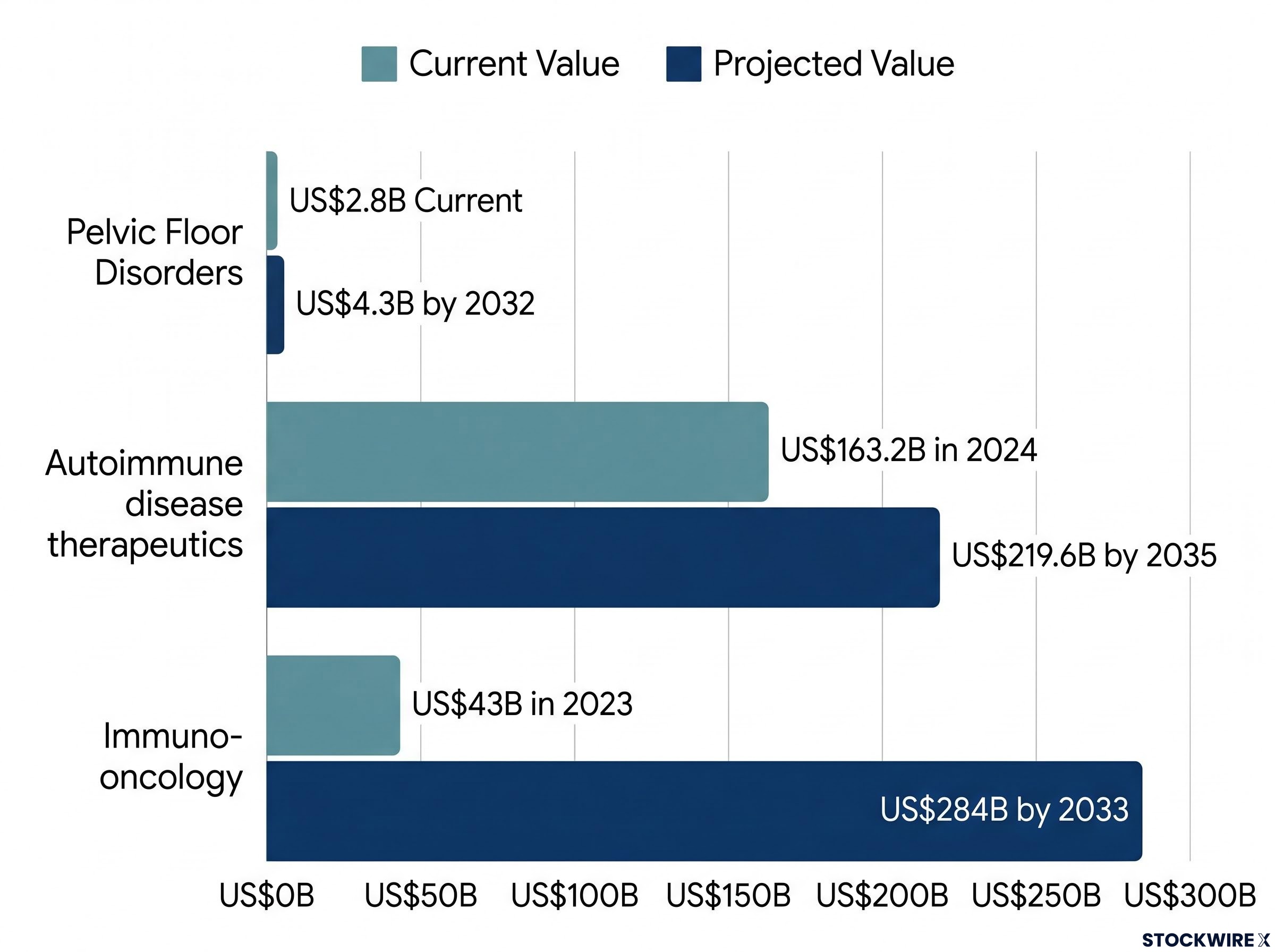
The Sofra platform is focused on inflammatory and autoimmune diseases such as rheumatoid arthritis, lupus and diabetes, as well as immuno-oncology for cancer treatment. Each of these areas represents a substantial addressable market.
| Market | Current Value | Projected Value | Timeframe |
|---|---|---|---|
| Pelvic Floor Disorders | US$2.8B | US$4.3B | by 2032 |
| Autoimmune disease therapeutics | US$163.2B (2024) | US$219.6B | by 2035 |
| Immuno-oncology | US$43B (2023) | US$284B | by 2033 |
The grant demonstrates that the platform can extend into adjacent, sizeable markets beyond Noxopharm’s core pipeline. Each additional application broadens the technology’s potential reach across multiple therapeutic categories.
What’s next for Noxopharm and Sofra™
The Hudson Institute project runs over a three-year timeline, during which the team will investigate the topical cream approach for treating birth injuries.
Noxopharm continues to advance its dual-platform pipeline, comprising Sofra™ (inflammation, autoimmunity, mRNA drug enhancement and oncology) and Chroma™ (oncology). The company describes itself as a clinical-stage Australian biotech leveraging specialist in-house capabilities and strategic partnerships with leading researchers to build a growing pipeline of proprietary drugs.
Each new Sofra application expands the platform’s total addressable opportunity, and in this instance, that expansion has been supported by external government funding.
For investors exploring how Noxopharm intends to commercialise the Sofra platform beyond research partnerships, our detailed coverage of the SOF-SKN FDA strategy outlines the company’s pre-IND engagement with the FDA and its explicit approach to using regulatory milestones to attract global licensing partners.
Don’t Miss the Next Healthcare Breakthrough
Big News Blast delivers FREE breaking ASX healthcare news to your inbox within minutes of release, complete with in-depth analysis already done for you. Join 20,000+ investors who stay ahead of the market the moment announcements drop. Click the “Free Alerts” button to start receiving real-time coverage across ASX healthcare and beyond.