
Australia’s financial system was deliberately subjected to more stress than it has experienced in half a century of banking history. Not because regulators feared an imminent collapse, but because they needed to see what happens when banks and superannuation funds pull against each other at the same moment.
The Australian Prudential Regulation Authority’s (APRA) 2025 cross-sector stress test was the first exercise of its kind in this country, covering the four major banks and six large superannuation funds simultaneously. Superannuation has grown into a force capable of both stabilising and destabilising the financial system, depending on how funds behave under pressure. Regulators needed evidence of which way it would go.
Here is what the results actually found, where the fault lines sit, and what it all means for the safety of Australian deposits and retirement savings. The system held up. It also revealed specific vulnerabilities that will not fix themselves, and your super fund’s behaviour in a crisis now matters to the entire economy.
Australia’s first system-wide stress test, explained
APRA has historically tested banks and super funds in isolation. The 2025 exercise changed that, marking the first time both sectors were tested together in a single integrated scenario. The aim was not to pass or fail individual institutions on their capital buffers; it was to observe how their behaviours interact when everything goes wrong at once.
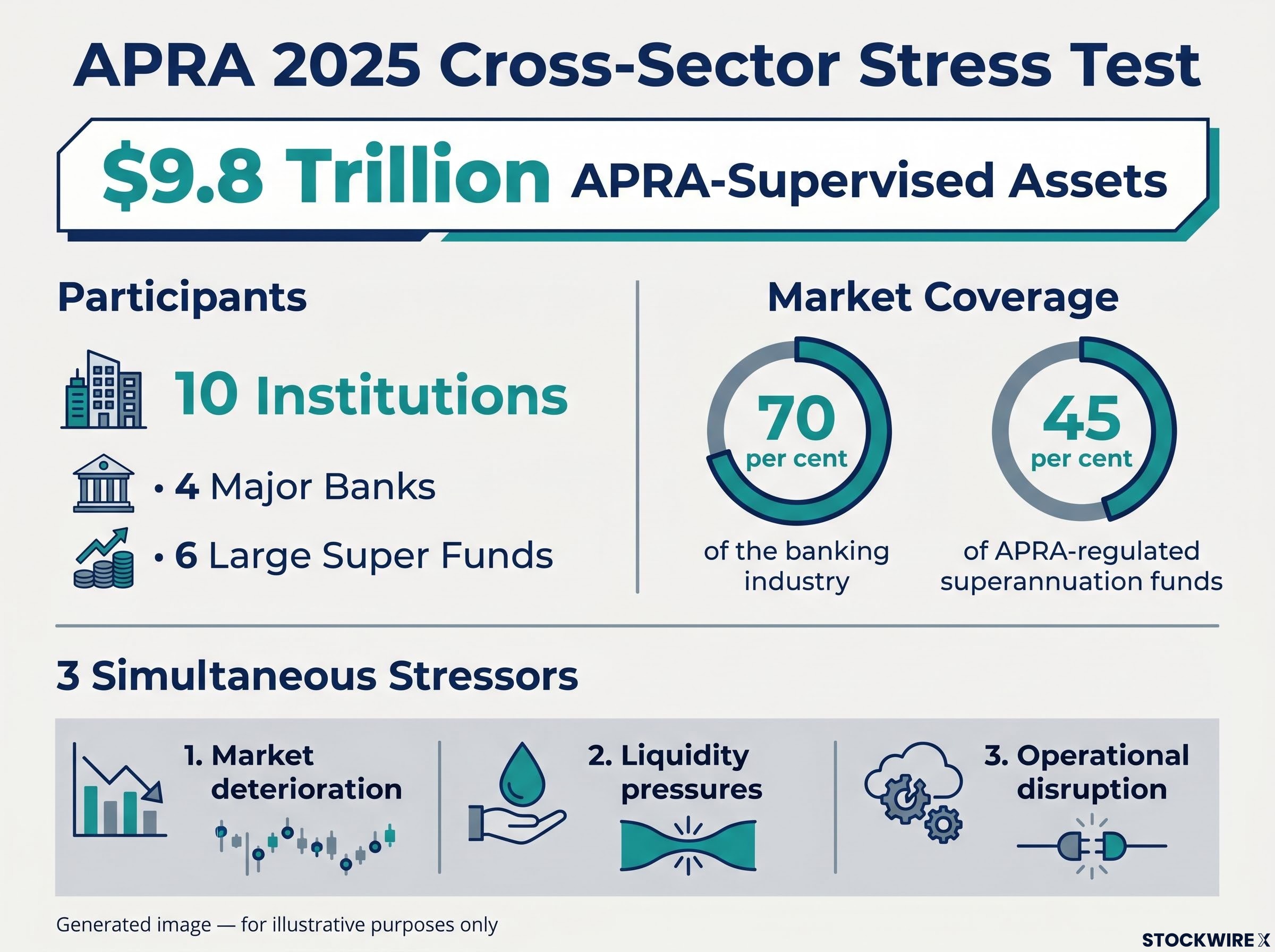
The scenario combined three simultaneous stressors:
- A severe deterioration in market conditions, including falling asset prices and broad macro-financial stress
- Intense liquidity pressures, with large, rapid outflows from both banks and super funds
- An operational disruption at a major shared third-party service provider, testing technology and cyber resilience across multiple institutions at the same time
The scenario subjected banks to funding pressures beyond anything their large Australian counterparts had faced across the prior 50 years. For superannuation funds, the modelled member outflows and switching activity were substantially more severe than what the sector recorded during the COVID-19 period.
How the test was designed
Ten institutions participated: the four major banks and six large super funds, representing approximately 70 per cent of the banking industry and 45 per cent of APRA-regulated superannuation funds. The exercise assumed no change in government policy or exceptional support.
This was an exploratory scenario, mirroring system-wide exercises used by the Bank of England. Phase 1 findings were published on 20 November 2025. Phase 2 results are due by mid-2026.
The severity of the scenario is the point. APRA was not testing for likely conditions but for extreme ones. That makes the resilience finding more meaningful, and the remaining vulnerabilities far more telling.
Confidence-sensitive funding dynamics are not new to financial crises: the Panic of 1907 demonstrated that a contained loss in a single commodity trade could cascade into system-wide collapse precisely because trust companies relied on short-duration, confidence-dependent funding with no central backstop, a structural parallel to the liquidity amplification the 2025 stress test was specifically designed to stress.
When big ASX news breaks, our subscribers know first
The headline finding: resilient, but the stress fractures are real
Every one of the 10 participating institutions proved capable of honouring their financial commitments and rebuilding their liquidity buffers throughout the scenario. For depositors and superannuation members, the headline is genuinely reassuring: in APRA’s modelled crisis, the institutions holding your savings did not fail.
That reassurance, though, has limits.
The same exercise that confirmed resilience simultaneously exposed structural fault lines that do not disappear simply because the scenario stopped short of institutional failure. APRA identified four specific categories of vulnerability:
- Liquidity amplification dynamics: individually rational funding withdrawals by multiple institutions, collectively intensifying stress at a single point
- Behavioural mismatches: divergence between what one institution assumes a counterparty will do under stress and what that counterparty actually plans to do
- Concentration risk: multiple institutions heavily exposed to the same counterparties and asset classes, increasing the potential for correlated losses
- Shared service provider dependencies: banks and super funds relying on the same technology platforms and outsourced services, meaning a single operational failure could impair multiple institutions simultaneously
Both sectors were found to require further investment in their stress-testing frameworks. APRA-supervised institutions collectively hold approximately $9.8 trillion in assets on behalf of depositors, policyholders, and superannuation members. The fault lines identified tell you where future stress could be most damaging if these gaps are not addressed before the next real shock arrives.
Superannuation balance benchmarks contextualise what is at stake in the regulatory discussion: the average Australian aged 50-54 holds approximately $198,400, already more than $430,000 below the ASFA comfortable retirement threshold, meaning any amplification of losses through poor crisis-period behaviour lands on a member cohort with limited runway to recover.
How superannuation became a systemic wildcard
Superannuation now accounts for a large and growing share of Australia’s financial system. A small number of very large funds wield significant influence over markets and counterparties. APRA Chair John Lonsdale has noted that as superannuation’s share of the financial system continues to grow, gaining a clearer picture of how funds are likely to behave during severe stress, and the knock-on effects those decisions could have on other parts of the system, has become a central regulatory concern.
The complication is that super funds play two opposing roles under stress, and which one dominates depends entirely on the nature of the crisis.
When funds stabilise the system
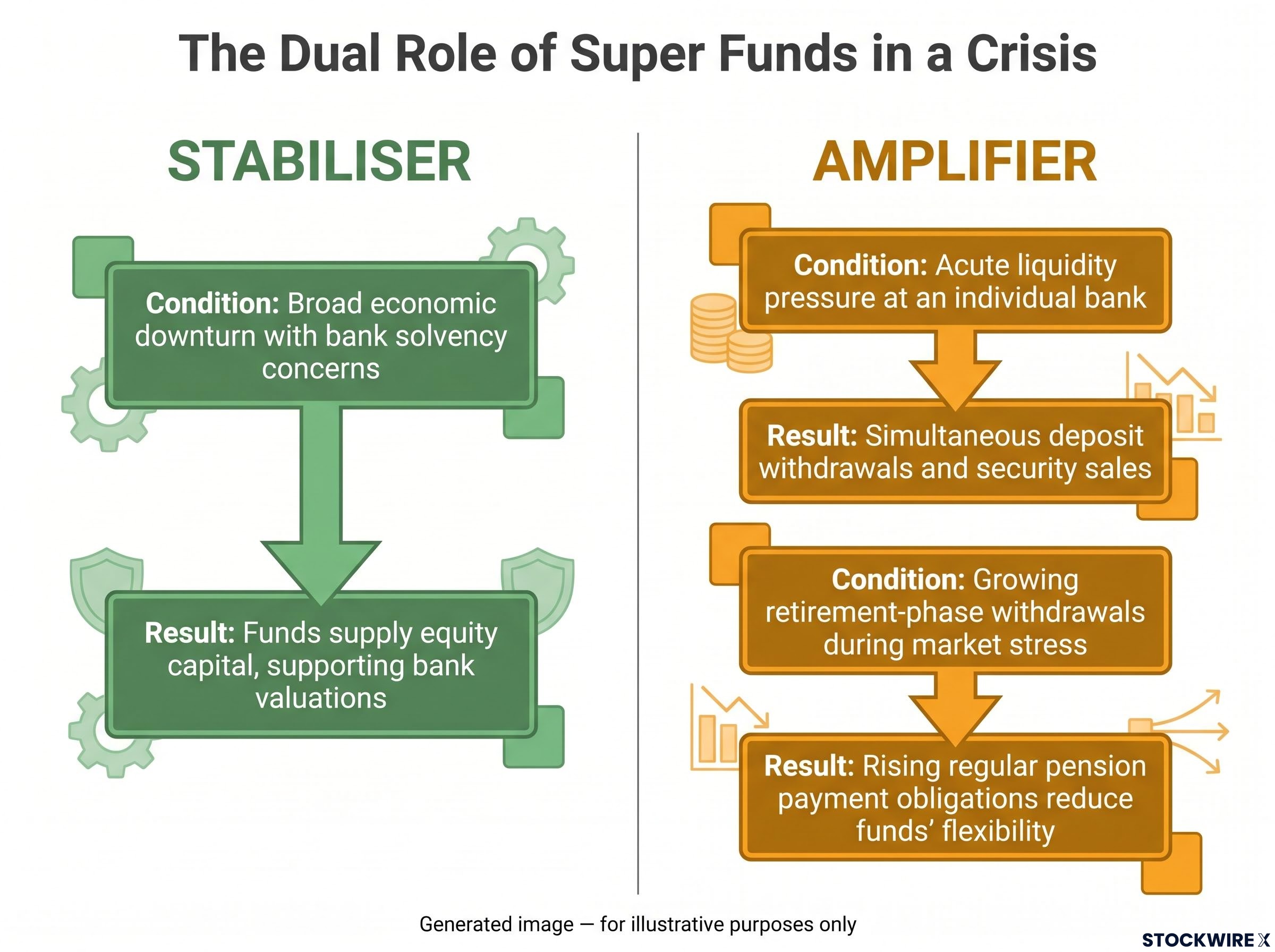
During periods of broad economic deterioration and bank solvency stress, large super funds can serve as a source of equity capital when other investors withdraw. Their long investment horizons allow them to absorb bank shares that shorter-term investors are offloading, which helps to steady bank valuations and reduce the spread of systemic risk.
When funds amplify the problem
When a single bank comes under intense liquidity pressure, the dynamic reverses. When numerous super funds each independently reduce their exposure to that bank, through deposit withdrawals or security sales, those individually cautious decisions combine to deepen the institution’s funding difficulties. Each fund is acting prudently. The aggregate effect is destructive.
| Stress condition | Super fund role |
|---|---|
| Broad economic downturn with bank solvency concerns | Stabiliser: funds supply equity capital, supporting bank valuations and containing systemic risk |
| Acute liquidity pressure at an individual bank | Amplifier: simultaneous deposit withdrawals and security sales by multiple funds intensify the bank’s funding crisis |
| Growing retirement-phase withdrawals during market stress | Amplifier: rising regular pension payment obligations reduce funds’ flexibility to maintain exposures |
When members move from the accumulation phase into retirement, funds face growing obligations to pay pensions regularly and meet higher volumes of withdrawals, which shifts their liquidity profile away from patient, long-term investing toward a schedule of ongoing outflows. That shift means your fund’s crisis-response behaviour now carries consequences well beyond your own account balance, extending to the stability of the banks holding your mortgage or savings.
When crisis plans point in opposite directions
The cross-sector design surfaced something that no single-sector stress test could: the crisis plans of banks and super funds are, in specific scenarios, directly contradictory.
Some banks’ internal stress models assumed that large super funds would maintain their funding and deposits through a shock. Those same super funds had plans to reduce their exposures to stressed institutions in the very same scenario.
This mismatch is not a marginal finding. It is a structural gap. If a bank’s liquidity planning assumes counterparty funding will hold steady, and the counterparty’s own risk framework dictates withdrawal, the bank’s actual resilience is weaker than its internal models suggest.
APRA flagged this divergence in behavioural assumptions as a central finding, observing that as the financial system grows more interconnected, actions taken within one sector can ripple through to institutions in other sectors and to the service providers they share. The cross-sector methodology was specifically designed to surface these discrepancies.
The implication is direct: the financial system’s resilience depends not just on what individual institutions hold in reserve, but on whether their crisis plans are compatible with each other. Being well-capitalised individually is insufficient if your counterparties’ plans are pulling in the opposite direction from your assumptions.
What the test means for regulatory reform and your savings
APRA has signalled that the stress test findings will drive concrete policy changes, not just supervisory guidance. The three reform tracks, in order of immediacy, are:
- Bank liquidity requirements: In March 2026, APRA announced a public consultation on proposed enhancements to the prudential framework for authorised deposit-taking institutions (ADIs), focusing on capital adequacy and liquidity requirements, including consideration of a new Pillar 2 liquidity framework. APRA had committed to putting these changes out for consultation within 12 months of the November 2025 System Risk Outlook publication.
- Superannuation fund supervision: APRA indicated supervisory activities will increasingly target stress-testing capability, liquidity management, and crisis behaviour planning within super funds. John Lonsdale confirmed the findings would be integrated into APRA’s ongoing supervisory work covering both banks and super funds.
- Third-party and operational resilience: Shared service provider risk is now treated as a systemic concern, not an internal IT matter. The operational disruption scenario underscored the relevance of APRA’s existing programme of work on material service provider arrangements and operational risk management across both sectors.
Shared service provider risk extends beyond the operational disruption scenario modelled in the 2025 test: APRA’s April 2026 supervisory letter identified AI vendor concentration across banks, insurers, and superannuation trustees as a distinct externally-originating threat, where a failure cascading through a dominant provider could simultaneously impair fraud detection, credit decisioning, and compliance monitoring across multiple institutions.
APRA indicated it would take proposed bank liquidity amendments to public consultation within 12 months of the November 2025 System Risk Outlook, a concrete timeline that signals the urgency regulators attach to these findings.
Phase 2 results, due mid-2026, will extend the analysis further. For savers, the regulatory response is itself a signal: APRA considers these vulnerabilities serious enough to require structural rule changes, which is the most direct evidence that the fault lines identified are material, not theoretical.
What the 2025 findings change, and what they do not
The test confirms something meaningful. Australia’s major banks and large super funds held up under a scenario more severe than any real-world shock the banking system has faced in half a century. Operating without any assumed government support, every one of the 10 institutions demonstrated it could honour its obligations and rebuild its liquidity position. That is a result worth acknowledging.
What the test does not change is equally important:
- Confirmed: Major institutions can absorb a severe, multi-dimensional shock without failing
- Still open: Liquidity amplification dynamics remain a live vulnerability, growing as superannuation’s systemic weight increases
- Confirmed: APRA’s cross-sector methodology can surface behavioural mismatches invisible to single-sector tests
- Still open: Those mismatches exist right now and require coordination that has not yet been formalised
- Confirmed: Shared service provider dependencies are recognised as systemic risk
- Still open: Operational resilience standards across both sectors remain a work in progress
Phase 2 results, due mid-2026, and the regulatory consultation process already underway represent the next observable signals for anyone following this space. APRA’s framing is clear: resilience will increasingly hinge on cross-sector coordination, liquidity management, and operational planning, not just the capital buffers of individual institutions.
The 2025 cross-sector findings confirm resilience against domestically-generated shocks, but imported systemic risks from geopolitical transmission channels and offshore private credit exposures operate through pathways that domestic scenario design was not built to fully stress, a distinction APRA’s May 2026 System Risk Outlook makes explicit.
The $9.8 trillion in APRA-supervised assets is a reminder of the scale at stake. The stress test result is not a clearance certificate for the financial system. It is a calibration point, showing where the system is strong and, more precisely, where it is not.
This article is for informational purposes only and should not be considered financial advice. Investors should conduct their own research and consult with financial professionals before making investment decisions.