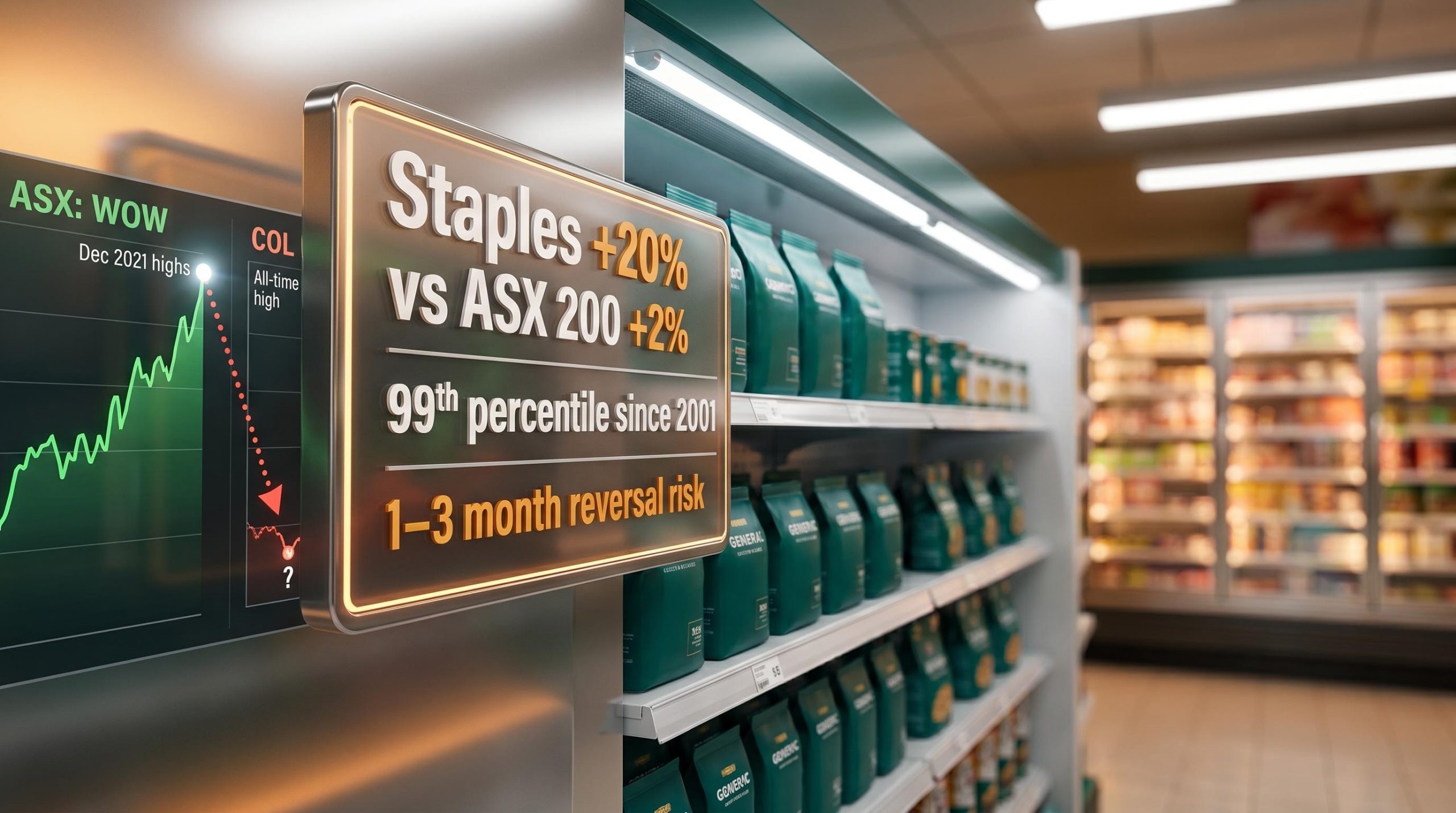
In just seven weeks, the ASX 200 Consumer Staples index has surged by roughly 20%, while the broader ASX 200 gained only about 2% across the same period. The resulting spread has climbed to the 99th percentile of all readings going back to 2001. The sole episode that produced a wider gap was the March 2020 pandemic selloff, which generated a spread of approximately 26 percentage points.
But that was a defensive rotation during a market crash. The current move belongs to a rarer, structurally different category, one where staples surge while the broader market stays positive. That distinction matters more than the headline number.
Here is what the historical data actually shows after moments like this, broken into the two regimes that define the dataset, so you can assess whether holding, adding, or reducing your ASX consumer staples exposure makes sense right now.
What just happened, and why this spread is almost unprecedented
The scale of the Consumer Staples rally is worth grounding in specific numbers before any interpretation:
- Staples index return: approximately 20% over roughly seven weeks to late June 2026
- ASX 200 return: approximately 2% over the same period
- Current one-month spread: approximately 99th percentile since 2001
- 95th percentile threshold: 5.8 percentage points, comfortably surpassed
- Largest spread on record: approximately 26 percentage points in March 2020
- Total episodes exceeding the 95th percentile since 2001: 20 (19 prior plus the current)
The rally lifted individual names sharply: Woolworths (ASX: WOW) traded back to levels not seen since December 2021, while Coles (ASX: COL) pushed through to an all-time price high.
The structural context behind the current spike matters here: staples sector underperformance over the five years to 2026 averaged -1.17% annually against +4.21% for the broader ASX 200, meaning the sector was deeply out of favour before this rally began and the re-rating may carry a catch-up component that complicates pure mean reversion assumptions.
The March 2020 spread of approximately 26 percentage points remains the only recorded reading larger than the current episode. That spike came during a full-scale market crash. The current one arrived with the ASX 200 in positive territory, making it structurally different and, in some respects, harder to explain away as temporary.
This is not background noise. Across 25 years of data, readings above the 95th percentile have occurred roughly once per year. The current reading clears that threshold by a wide margin, placing it in genuinely rare territory. That makes this a decision point, not a data point to file away.
When big ASX news breaks, our subscribers know first
Two very different histories sit behind the same headline number
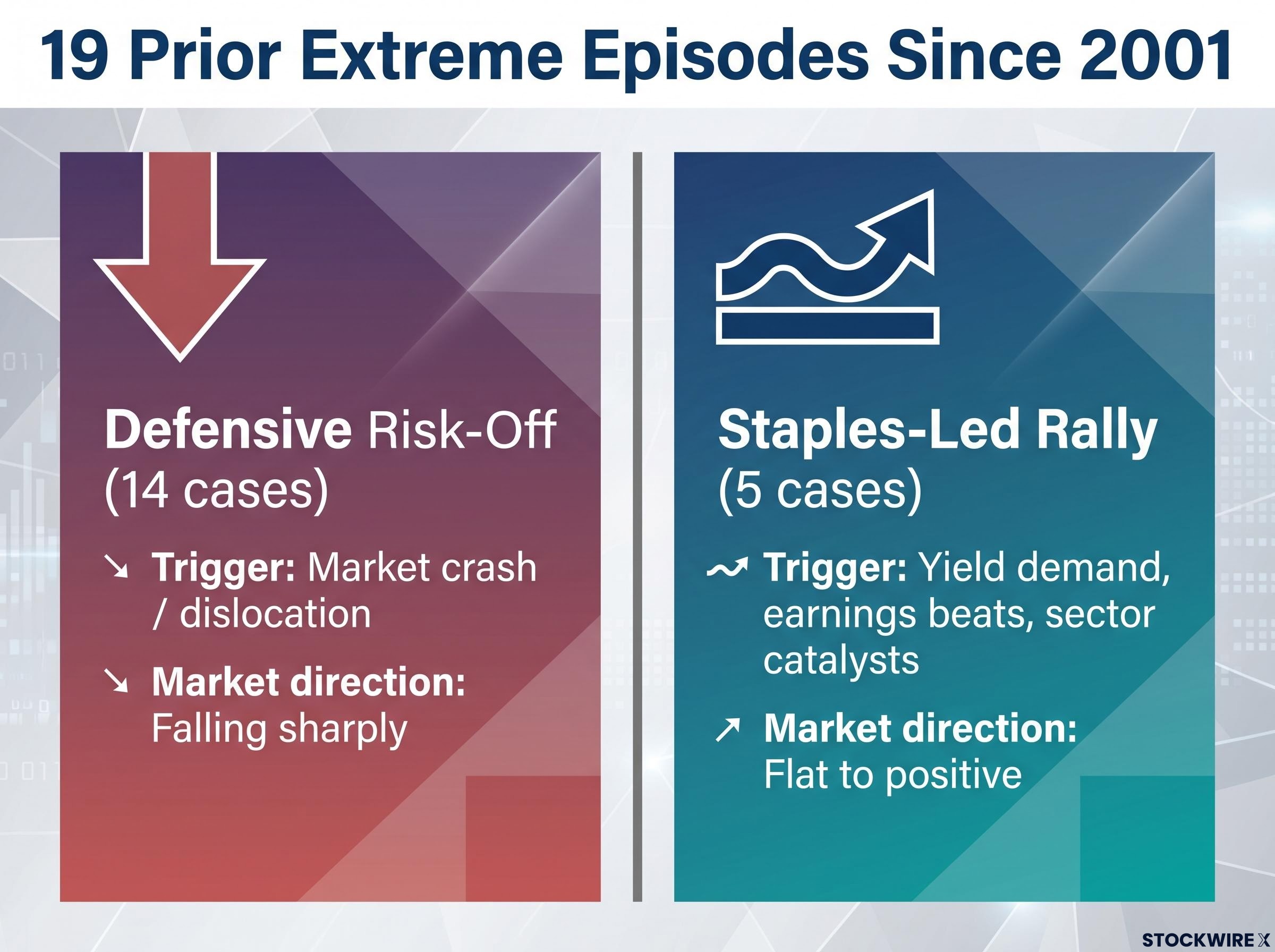
Treating all 19 prior extreme episodes as a single group produces misleading conclusions. The dataset splits into two distinct regimes, and correctly identifying which one applies to the current moment changes the forward return picture entirely.
| Regime | Trigger type | Prior count | Broader market direction | Representative episodes |
|---|---|---|---|---|
| Defensive Risk-Off | Market crash / dislocation | 14 | Falling sharply | 2008 GFC, 2020 pandemic, April 2025 tariff shock |
| Staples-Led Rally | Yield demand, earnings beats, sector catalysts | 5 | Flat to positive | Sep 2006, Sep 2012, Mar 2013, two in 2019 |
Regime 1: the defensive crash rotation (14 cases)
The more common pattern is straightforward. Broad market losses trigger a flight to earnings stability, with staples holding their ground while the rest of the index slides. This pattern accounts for 14 of the 19 prior episodes and maps onto the major dislocations you would expect: the 2002 dot-com trough, the 2008 global financial crisis, the 2011 European debt crisis, the 2016 Chinese currency devaluation, the 2020 pandemic, the 2022-23 rate tightening cycle, and the April 2025 tariff shock.
The mechanism is fear. The reversal, when it comes, is sharp.
Regime 2: the staples-led rally (5 cases, analogous to now)
The rarer pattern looks different at every level. Here, the index is broadly flat to positive, yet staples move higher in absolute terms, propelled by yield-seeking flows, merger and acquisition speculation, regulatory tailwinds, or earnings outcomes that justify a re-rating on their own merits. This set covers only five of the prior 19 episodes: September 2006, September 2012, March 2013, and two separate occasions in 2019.
The current episode belongs here. The ASX 200 is positive, not falling. That classification carries meaningfully different forward return expectations, and conflating it with a panic rotation would point you toward the wrong probabilistic framework.
What the forward return data actually shows across 19 prior episodes
The historical record separates cleanly by regime and by time horizon. The pattern emerges most clearly when the data is laid out rather than summarised.
Following the 14 defensive risk-off episodes, the ASX 200 staged a strong recovery on average, posting a 5.1% gain over three months and 11.6% across the following twelve months. The Staples index, by contrast, declined through the one-to-six month period as capital cycled back into cyclicals and higher-beta names, finishing the twelve-month window with an average gain of just 3.2% and a positive outcome in only roughly 50% of cases.
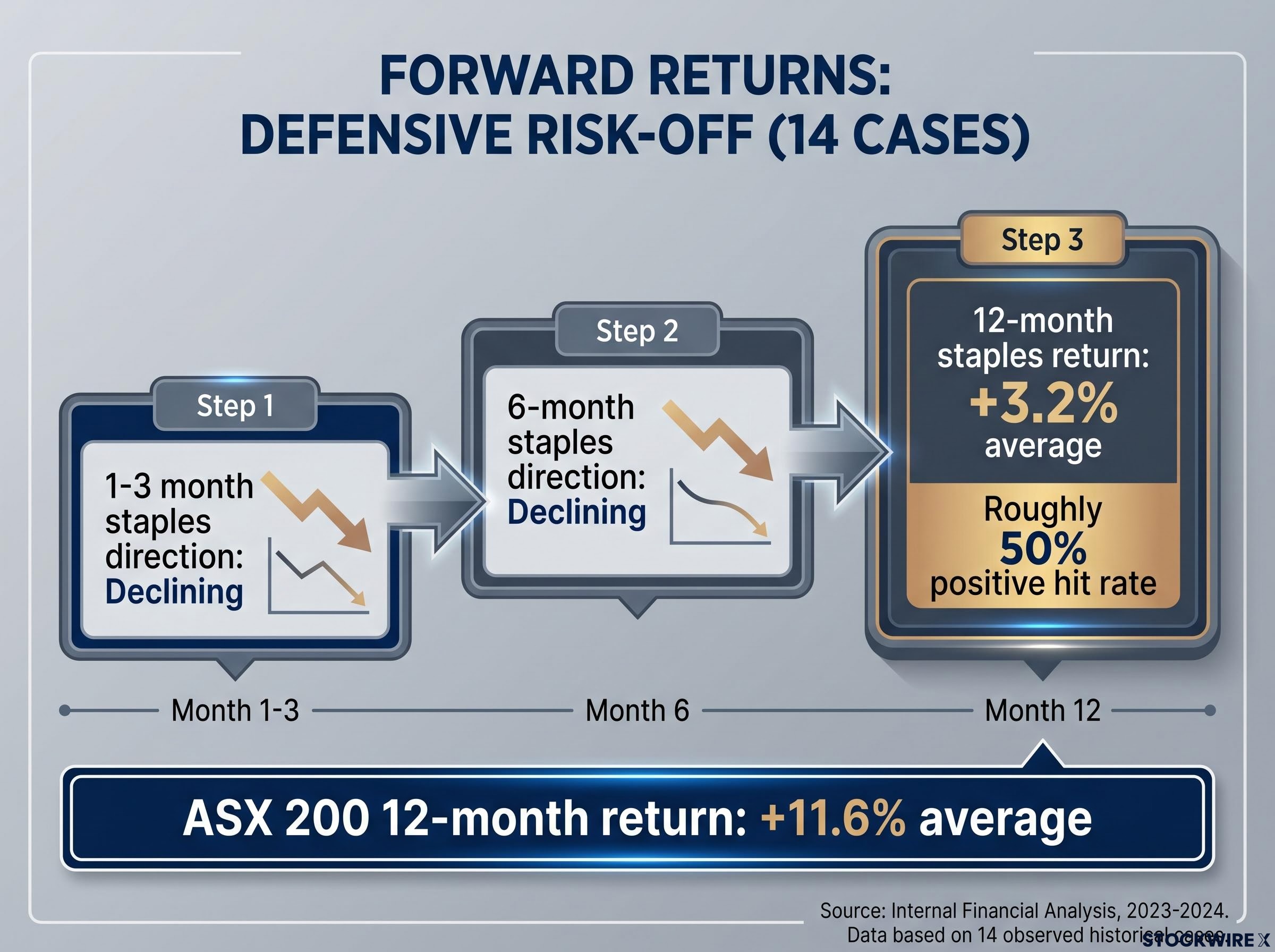
A 50% positive hit rate at twelve months after defensive episodes reframes the “safe haven” narrative. In half of all cases, holding staples through the post-spike period produced a negative outcome over the following year.
In the 5 staples-led rally episodes (the category analogous to the current move), both the index and the staples sector faced headwinds in the near term, with weakness concentrated in the first one to three months. The sector edged toward modest relative recovery by the six-month point, while twelve-month results varied considerably across the small sample.
| Regime | 1-3 month staples direction | 6-month staples direction | 12-month staples return | ASX 200 12-month return |
|---|---|---|---|---|
| Defensive Risk-Off (14 cases) | Declining | Declining | +3.2% average | +11.6% average |
| Staples-Led Rally (5 cases) | Struggling | Slight relative recovery | Mixed | Mixed |
The shared finding across both regimes is clear: the 1-3 month window post-spike has been the most consistent period of staples underperformance or outright weakness. If you are sitting in staples positions today, that is the window where the historical odds tilt most firmly against you on a relative basis.
Why the staples-led rally classification changes the risk calculation
Knowing this episode belongs to the staples-led category does not remove the mean reversion risk. It changes the likely shape of the reversal.
Defensive unwinds snap back. When fear drove the original rotation, the abatement of fear drives the reversal, and capital exits staples quickly as risk appetite returns. Staples-led rallies fade more gradually. The move was partially driven by genuine fundamentals, whether earnings surprises, yield appeal, or sector catalysts, which means the stretched valuation reprices slowly rather than collapsing.
The difference in reversal dynamics:
- Defensive unwind: Sharp, fast, driven by fear abatement and aggressive rotation into cyclicals
- Staples-led fade: Gradual, moderate, driven by repricing of stretched valuations as incremental catalysts slow
There is also an institutional flow argument. If rate cut expectations, yield demand, or macro hedging drove the current move, much of that institutional repositioning is likely already expressed in the price. The buyers who were going to buy have largely bought. Incremental upside from here requires new fundamental or macro surprises, not continuation of the existing narrative.
When the stock-level story diverges from the sector call
Woolworths and Coles may have independent justifications for their current prices. Margin improvement, earnings revisions, and competitive positioning are company-level drivers that the sector-level data does not capture.
Regulatory risk for Woolworths and Coles has become a structural feature rather than a cyclical overhang since the ACCC supermarket inquiry, with legislation effective July 2026 adding compliance costs and potential margin drag that may not appear immediately in reported earnings and therefore may not be fully captured in current valuations.
The historical caution applies to the staples basket as a whole. If you hold WOW or COL specifically, the right question is whether their individual earnings and margin trajectories support the current valuation, not whether the sector momentum will continue.
For investors wanting to build a structured framework for evaluating WOW and COL on their own earnings trajectories, our dedicated guide to ASX share valuation methods covers the five-step sequence from P/S screening through DCF and dividend discount modelling, with specific guidance on how franking credits affect intrinsic value estimates for Australian resident investors.
What this actually means if you own or are considering staples exposure right now
The historical evidence translates into three distinct positions. Locate yourself in the one that fits.
- New entrants: Entering the staples basket at a 99th percentile spread has historically produced poor relative returns, particularly in the 1-3 month window. In prior staples-led rallies, both the market and staples struggled in that immediate period. The odds favour some degree of mean reversion before the next leg higher.
- Existing holders: The staples-led rally classification works in your favour in one specific way: the reversal, if it comes, is more likely to be gradual than violent. A hold decision is more defensible here than it would be after a panic-driven rotation. That said, trimming into strength has historically been a rational response to 99th percentile readings. The question is how much conviction you have in the individual names versus the sector basket.
- Individual stocks versus the sector basket: The historical data argues against chasing the basket on momentum. But WOW and COL positions should be evaluated on their own earnings and margin trajectories. The sector-level headwind is real; it does not automatically override a well-founded stock-level thesis.
The 1-3 month window is the primary risk period, drawn from the historical pattern across both regimes. This is the specific timeframe where mean reversion has been most consistent, and it applies whether you classify the current episode as defensive or staples-led.
A five-case analogous sample is suggestive, not definitive. Weight it accordingly. This is a probability tool, not a rulebook.
The case for discipline at historic extremes, whatever the next catalyst turns out to be
Across 25 years and two structural regimes, extreme staples outperformance has consistently been followed by mean reversion. The 1-3 month window has been the most reliable period of underperformance. The current staples-led classification moderates but does not remove that risk.
The honest limits of a five-case analogous sample deserve acknowledgement. The pattern is directionally consistent, and the broader 19-episode dataset reinforces the mean reversion tendency. But five data points do not constitute a high-confidence statistical guarantee.
Three variables could alter the base case from here:
- RBA rate cut trajectory: An unexpected acceleration in cuts could reignite the yield demand that drove the move, extending the rally
- Macro conditions: A fresh shock that reignites defensive demand would shift the episode closer to the crash-rotation regime, which carries a sharper reversal profile
- WOW and COL earnings results: Company-specific catalysts in the near-term reporting calendar could justify the sector re-rating on fundamental grounds, particularly if margins surprise to the upside
The RBA tightening trajectory diverges sharply from the Fed, ECB, and Bank of England, which all held rates steady in the same week the RBA raised to 4.35%, a divergence that affects the yield differential driving Australian defensive equity demand and has direct implications for how quickly rate cut expectations could reverse the current institutional positioning in staples.
The six-month mark is where the risk-reward picture in prior staples-led episodes began to stabilise, conditional on fundamentals holding. Disciplined caution at statistical extremes is not pessimism about staples; it is a probabilistically sound response to a dataset that has consistently rewarded patience over momentum-chasing in the months immediately following these spikes.
This article is for informational purposes only and should not be considered financial advice. Investors should conduct their own research and consult with financial professionals before making investment decisions. Past performance does not guarantee future results. Forward return data is drawn from a limited historical sample and is subject to change based on market developments and macroeconomic conditions.