

Carnegie advances CETO assembly ahead of October 2026 ocean deployment
Carnegie Clean Energy (ASX: CCE) has confirmed that assembly of its ACHIEVE CETO Unit is underway, with staged ocean deployment set to begin in October 2026. Power Take-Off (PTO) assembly is progressing in Germany through partner SKF, before the unit returns to the Basque Country for deployment at the Biscay Marine Energy Platform (BiMEP).
The milestone validates 3 years of intensive project-specific design and construction of the CETO wave energy technology, moving the system closer to in-water validation.
When big ASX news breaks, our subscribers know first
Where the CETO Unit assembly stands now
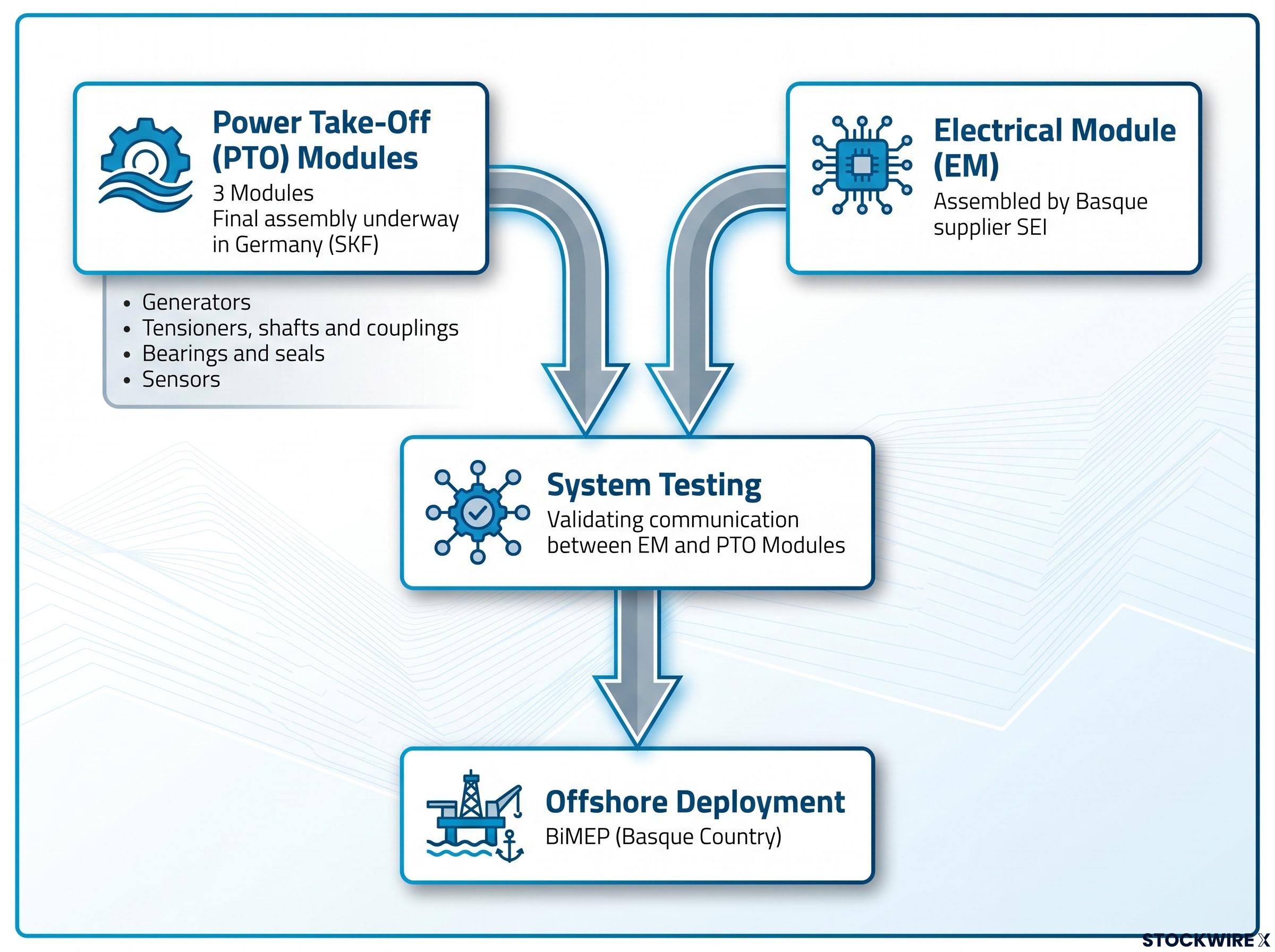
Fabrication of the ACHIEVE CETO Unit’s PTO Modules is nearing completion in the Basque Country. The first of the three PTO Modules has been delivered to one of SKF’s global manufacturing facilities in Germany, where final assembly works are being undertaken.
Delivered through Carnegie’s partnership with global precision manufacturer SKF, the assembly works involve integrating all power-generating equipment into each module. This step essentially connects the internal components that produce electricity.
The PTO equipment being integrated includes:
-
Generators
-
Tensioners, shafts and couplings
-
Bearings and seals
-
Sensors
The current PTO works follow the previously completed assembly of the Electrical Module (EM), undertaken with local Basque supplier SEI. As the PTO assembly advances, system testing will be carried out to validate communication between the EM and PTO Modules ahead of offshore deployment.
Staged deployment roadmap into October 2026
Carnegie has outlined a staged deployment and commissioning process for the ACHIEVE CETO Unit. The sequence begins with deployment of the foundations at Carnegie’s BiMEP berth in the coming quarter.
The first stage of the CETO Unit’s ocean deployment is planned for October 2026, followed by progressive ocean deployment, commissioning, testing and optimisation stages that will complete the system over time.
Carnegie is currently procuring specialist marine contractors to install the foundations and mooring systems, connect to the existing export cable, and install the CETO Unit. Timing of the ocean deployment will be subject to prevailing contractor availability, supply chain and weather conditions.
Spanish authority approvals at BiMEP represented a meaningful regulatory hurdle cleared earlier in 2026, with Spain’s National Energy and Coastal Authorities granting specific deployment authorisation for the CETO device at the site ahead of the current assembly phase.
| Stage | Activity | Timing |
|---|---|---|
| Assembly | PTO Module final assembly (Germany, SKF) | Underway |
| Foundations | Deployment at BiMEP berth | Coming quarter |
| Deployment | First stage CETO ocean deployment | October 2026 |
| Commissioning | Progressive testing & optimisation | Post-October 2026 |
CEO commentary
Carnegie’s CEO Jonathan Fievez has recently returned from site visits to inspect assembly activities and meet with key suppliers and stakeholders.
Jonathan Fievez, CEO
“There is a growing sense of excitement amongst our talented team that offshore deployment is getting closer. We look forward to meeting the goal of having our world leading offshore power generation device in the water in 2026. Delivery of CETO will position Carnegie at the forefront of ocean energy and provide a strong platform for commercial project opportunities into the future.”
What CETO is and why it matters
CETO is a wave energy technology that captures energy from ocean waves and converts it into electricity. According to Carnegie, the system uses artificial intelligence and electric machines to control the technology and generate electricity as efficiently as possible.
Wave energy is an emerging class within renewables. The central hurdle for any developer is grid-connected, open-ocean validation, demonstrating that a device can survive harsh marine conditions while producing usable power. The data collected from operating the CETO prototype at BiMEP is intended to validate performance and propel the technology along the commercialisation pathway.
The ACHIEVE Programme is being delivered through Carnegie’s subsidiaries CETO Wave Energy Ireland (under contract by the EuropeWave Buyers Group) and Carnegie Technologies Spain, with support from the Spanish Government’s RENMARINAS Demos Programme and the Basque Government through the Ente Vasco de la Energía (EVE).
The investment case: from prototype to commercial platform
The October deployment sits at the centre of the broader thesis. Data from open-ocean operation is intended to validate CETO’s performance and underpin future commercial project opportunities.
Fievez framed delivery of the unit as positioning Carnegie “at the forefront of ocean energy” and providing “a strong platform for commercial project opportunities into the future.”
The wider market backdrop is supportive. EuropeWave, which combines over €22.5m of national, regional and EU funding, is aligned with the European Commission’s targets of 100MW of ocean energy by 2027 and at least 1GW by 2030. This represents the addressable market context for the sector rather than a Carnegie-specific contract.
With assembly underway and a staged roadmap mapped out, attention now turns to the October 2026 goal of placing the CETO Unit in the water, subject to the contractor, supply chain and weather conditions Carnegie has flagged.
Don’t Miss the Next Clean Energy Breakout
Get FREE breaking ASX clean energy news delivered to your inbox within minutes of release, complete with in-depth analysis already done for you. Join 20,000+ subscribers staying ahead of the market by clicking the “Free Alerts” button at Big News Blast to receive alerts the moment market-moving announcements hit.