

Recce Pharmaceuticals has received Human Research Ethics Committee (HREC) approval to advance its Australian clinical trial of RECCE® 327 Topical Gel (R327G) from Phase 2 to pivotal Phase 3 status for Diabetic Foot Ulcer Infections (DFI). The registrational study is designed to generate safety and efficacy data required to support regulatory approval applications and is being conducted to both TGA and US FDA regulatory standards. The Company now operates two parallel Phase 3 programs in Australia and Indonesia, forming the cornerstone of its global DFI registration strategy.
Recce Pharmaceuticals advances Australian DFI trial to pivotal Phase 3 status
HREC approval has elevated the R327G clinical trial from Phase 2 to a pivotal Phase 3 registrational study for Diabetic Foot Ulcer Infections. This advancement represents a significant de-risking of the R327G asset, positioning the Company closer to commercialisation across multiple jurisdictions.
The trial has completed 18 patients of an anticipated 200-patient study, with an interim analysis planned at 50% patient completion. Expected full enrolment is targeted by the end of 2027. The study is being conducted to both TGA and US FDA regulatory standards, enabling the data to support approval applications across multiple markets including Australia, the United States, MENA, and ASEAN regions.
With two concurrent Phase 3 programs now operating in Australia and Indonesia, Recce has accelerated its path toward global regulatory approvals. A Phase 3 pivotal trial represents the final clinical hurdle before seeking regulatory approval, materially reducing development risk and positioning the Company for potential commercial partnerships and licensing agreements.
When big ASX news breaks, our subscribers know first
Protocol expansion broadens patient eligibility and study power
The HREC-approved protocol amendment expands patient eligibility to include Moderate DFI patients in addition to Mild DFI patients. According to Lavery et al. (2007), Mild and Moderate DFI collectively account for approximately 80% of DFI presentations, significantly broadening the recruitment patient population and accelerating enrolment timelines.
Given R327G’s favourable safety profile, the study has also been expanded to include infected ulcers below the knee in addition to infected foot ulcers. This expansion enables an additional primary endpoint analysis at the individual ulcer level, increasing study power and enhancing the probability of success.
The protocol expansion includes three key amendments:
- Moderate DFI inclusion: Expands eligibility from Mild DFI only to both Mild and Moderate DFI severity classifications
- Below-knee ulcers: Broadens anatomical scope from foot ulcers only to include infected ulcers below the knee
- Ulcer-level endpoint: Introduces an additional primary endpoint analysis based on individual ulcers, increasing statistical power
The primary endpoint assesses clinical response according to the Lipsky Scale, with secondary endpoints evaluating total wound score and the safety profile of R327G. By targeting 80% of DFI presentations, the expanded protocol significantly enlarges the addressable market and accelerates the path to full enrolment.
Prior Phase 2 data underpins Phase 3 advancement
The advancement to Phase 3 status builds upon the previously completed Phase 2 ABSSSI/DFI clinical trial, which demonstrated strong efficacy and a clean safety profile. The study achieved a 93% primary efficacy endpoint at Day 14 and 86% clinical response by Day 7 in ABSSSI/DFI patients, with no serious adverse events reported.
The favourable safety profile observed in Phase 2 justified the expanded protocol parameters approved by HREC, including the inclusion of Moderate DFI patients and below-knee ulcers. The 93% Day 14 response rate represents a compelling dataset for regulatory discussions and provides clinical validation that reduces Phase 3 execution risk.
James Graham, Chief Executive Officer
“Receiving HREC approval to expand and accelerate our Australian Phase 3 program is a significant milestone for Recce and for patients with diabetic foot infections. With two concurrent Phase 3 programs now operating in Australia and Indonesia, we are moving with pace toward global registration. The expansion to Moderate DFI materially broadens the patient population and the market we are targeting. This is a program that is advancing rapidly, and the commercial opportunity is growing with it.”
The strong Phase 2 efficacy and safety data provide a foundation for regulatory confidence and commercial partner interest ahead of Phase 3 data readouts.
What is a pivotal Phase 3 trial and why does it matter?
A pivotal or registrational Phase 3 trial represents the final stage of clinical development before seeking regulatory approval from agencies such as the TGA or FDA. These studies are specifically designed to demonstrate that a therapy is both safe and effective for its intended use in a larger patient population than earlier-phase trials.
Unlike exploratory Phase 1 and Phase 2 studies, which aim to establish safety, dosing, and preliminary efficacy signals, pivotal Phase 3 trials generate the comprehensive safety and efficacy data that regulatory authorities require to approve a drug for commercial use. The term “registrational” indicates the trial is designed to support a marketing authorisation application.
Conducting the Australian trial to US FDA standards is significant because it enables the data to support approval applications in multiple jurisdictions simultaneously, including the United States. This regulatory alignment accelerates the path to global market access without requiring duplicate trials in each region.
For investors, Phase 3 pivotal status represents the transition from clinical development risk to registration execution. Success at this stage typically triggers commercial partnerships, licensing deals, and significant valuation re-ratings as the probability of approval increases materially.
Dual Phase 3 programs anchor global registration strategy
Recce now operates two parallel Phase 3 programs in Australia and Indonesia, together forming the cornerstone of the Company’s global DFI registration strategy. These programs target approvals across Australia, the United States, MENA, and ASEAN markets, demonstrating a multi-jurisdictional commercialisation approach.
The Company recently executed a non-binding licensing term sheet with a leading Middle Eastern pharmaceutical company for exclusive commercialisation rights across 12 MENA countries. This agreement validates commercial interest ahead of Phase 3 data readouts and demonstrates confidence in R327G’s regulatory and commercial potential.
Running parallel registrational programs across two geographies accelerates the path to global approvals and enables the Company to engage with regulators and commercial partners in multiple regions simultaneously.
| Region | Trial Status | Regulatory Standard | Target Enrolment |
|---|---|---|---|
| Australia | Pivotal Phase 3 (active) | TGA / US FDA | 200 patients |
| Indonesia | Phase 3 (active) | Local / US FDA aligned | Not disclosed |
The dual Phase 3 structure provides geographic diversification, regulatory optionality, and enhanced commercial leverage for licensing discussions across target markets.
Diabetic foot infections present substantial unmet medical need
Diabetic Foot Infections represent a leading cause of hospitalisation and lower extremity amputation in people living with diabetes, carrying significant morbidity and reduced life expectancy. The clinical burden creates strong regulatory and commercial tailwinds for novel therapies.
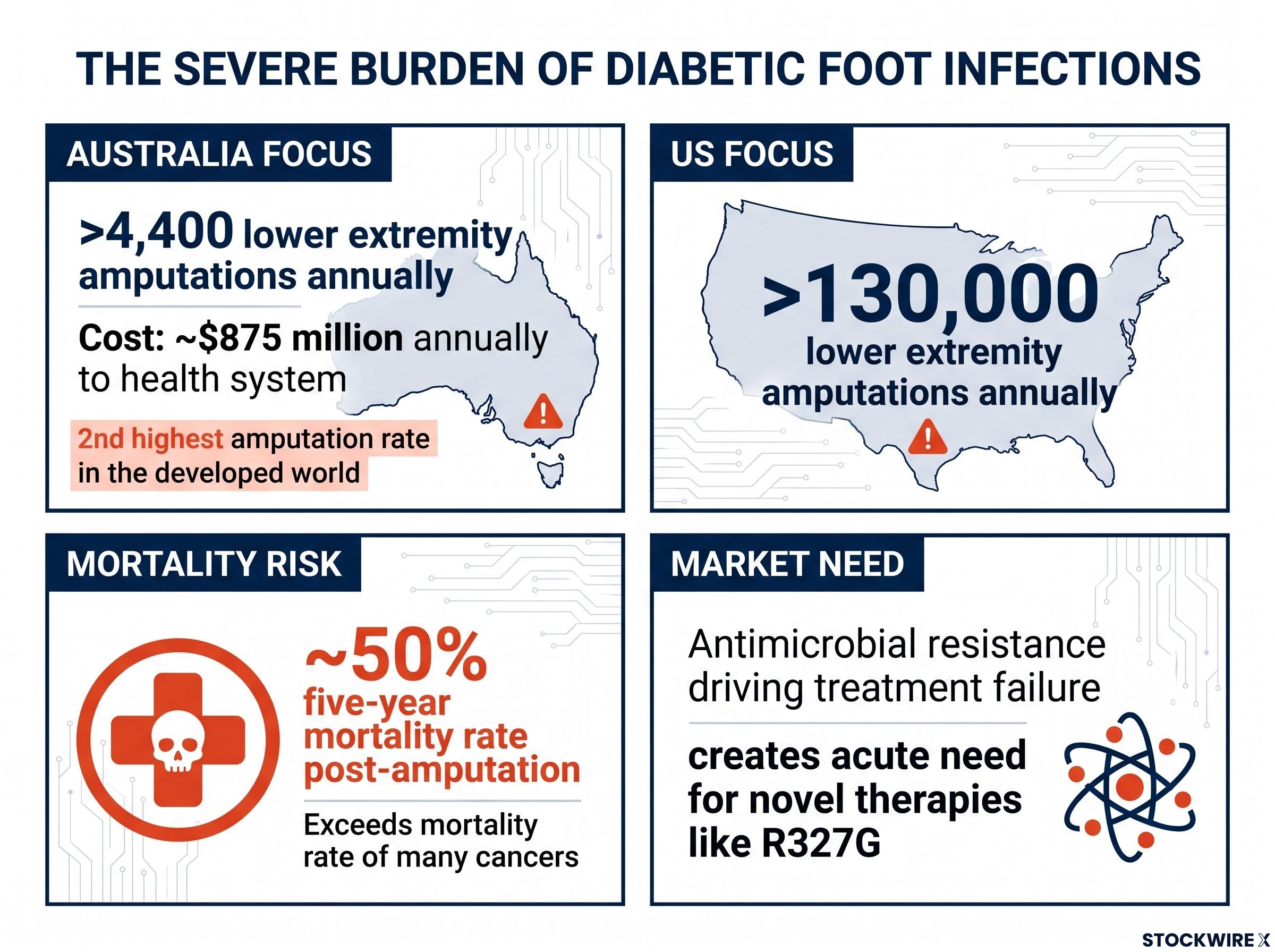
Key burden-of-disease statistics include:
- Australia: More than 4,400 lower extremity amputations annually from diabetes-related foot infections
- United States: More than 130,000 lower extremity amputations annually from diabetes-related foot infections
- Post-amputation mortality: Approximately 50% five-year mortality rate, exceeding the mortality rate of many cancers
- Australian healthcare cost: Approximately $875 million annually to the health system
- Global context: Australia has the second highest amputation rate in the developed world
With antimicrobial resistance driving treatment failure in DFI, the need for novel topical anti-infective therapies is acute and growing. Existing antibiotics face increasing resistance challenges, creating a significant unmet medical need for new mechanisms of action such as R327G’s synthetic polymer approach.
The severe clinical outcomes and healthcare cost burden create a compelling case for regulatory priority review and commercial adoption if R327G demonstrates efficacy and safety in Phase 3 trials.
Path forward and key milestones
The Australian pivotal Phase 3 trial has completed 18 patients of the anticipated 200-patient study, with full enrolment expected by the end of 2027. An interim analysis will be performed when 50% of patients have completed treatment, providing an earlier catalyst for potential partnership discussions or market re-rating.
The expanded protocol parameters, including Moderate DFI inclusion and below-knee ulcers, are expected to significantly accelerate patient recruitment timelines compared to the original Mild DFI-only protocol. The broader eligibility criteria enable recruitment from a larger patient pool, reducing the time to full enrolment.
Data from both the Australian and Indonesian Phase 3 programs will support multi-market registration filings across Australia, the United States, MENA, and ASEAN regions. The 2027 enrolment target provides visibility on data readout timing.
Want the Next Biotech Breakthrough in Your Inbox?
Join 20,000+ investors receiving FREE breaking ASX healthcare and biotech news within minutes of release, complete with in-depth analysis. Click the “Free Alerts” button at Big News Blast to get real-time alerts the moment clinical trial updates and regulatory approvals hit the market.