
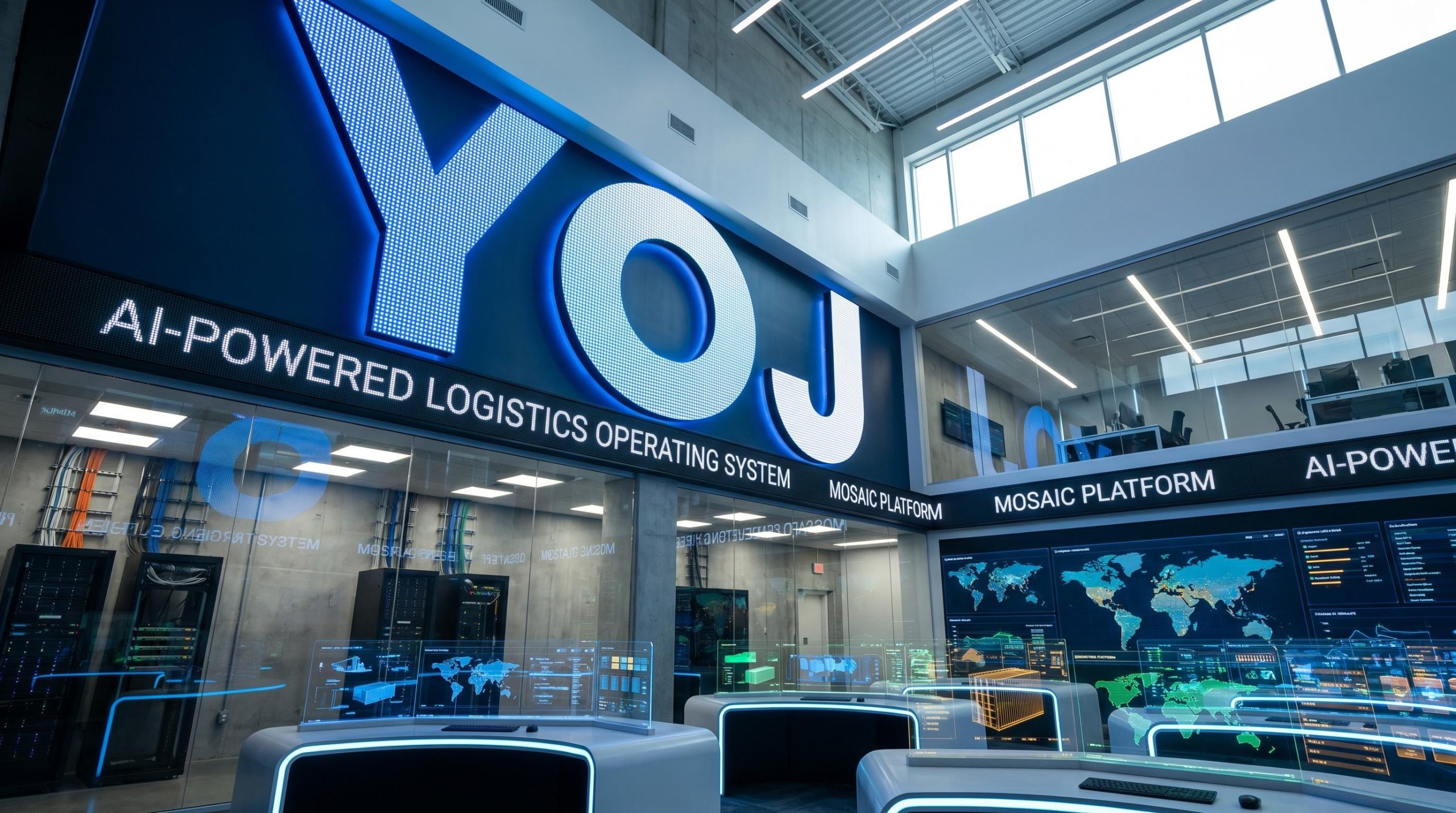
Yojee Limited (ASX: YOJ) has outlined its artificial intelligence strategy for the Mosaic platform, positioning the technology as an embedded core capability rather than a standalone feature. The update, released on 18 June 2026, responds to growing interest from customers, partners and the market in how logistics technology providers are applying AI. The Company is evolving Mosaic from logistics software into a Logistics Operating System that combines workflow behaviour, orchestration across the freight lifecycle, and operational intelligence on a single shared domain model.
What is a Logistics Operating System?
A Logistics Operating System differs from traditional logistics software by integrating three elements: workflow behaviour, orchestration across the freight lifecycle, and operational intelligence. These components operate on a single shared domain model, which allows logistics operators managing complex multi-party supply chains to access unified data and workflows rather than switching between disconnected tools.
For investors, this distinction matters commercially. Platforms with embedded intelligence typically command higher valuations and lower customer churn than standalone software tools. The Logistics Operating System positioning suggests Yojee is pursuing a higher-value platform play in the logistics SaaS space rather than competing on point solutions, which could strengthen pricing power and customer stickiness over time.
When big ASX news breaks, our subscribers know first
AI as a teammate — Yojee’s differentiated product philosophy
Yojee has adopted an “AI as a teammate” approach, characterising the technology as assistive and domain-aware rather than an autonomous replacement for human operators. Accountability for decisions remains with operators and brokers in the regulated, relationship-heavy freight forwarding and customs environment.
The Company’s view is that AI changes the task mix before it changes the profession. The technology is designed to accelerate document-heavy, repetitive work whilst human expertise remains essential for judgement, exceptions, compliance and customer relationships. Yojee is developing AI to identify potential issues, exceptions and operationally valuable insights early, shifting effort from reactive firefighting towards earlier, better-informed decisions.
The near-term benefit pursued is throughput and productivity, enabling lean operators to grow output without adding headcount in lockstep. This positioning may address a practical commercial barrier, as logistics operators concerned about AI replacing human judgement in compliance-sensitive workflows may be more receptive to a “teammate” model that preserves accountability.
Three-layer AI architecture across the Mosaic platform
The Company is developing AI capability across three layers:
- Behaviour — AI embedded in day-to-day workflows to accelerate routine, high-friction steps
- Orchestration — coordinating multi-step operational flows across bookings, transport, customs, documentation and finance with fewer manual handoffs
- Intelligence — surfacing operationally meaningful signals such as schedules, anomalies and exceptions tied to the operator’s next action
The first production AI use case is AI-assisted document processing, which converts inbound freight documents into structured operational data. This is characterised as an initial use case demonstrating the approach, with further workflow capabilities to be developed over time. Human review applies where data quality, compliance or commercial risk requires it.
| Layer | Function | Operator Benefit |
|---|---|---|
| Behaviour | AI embedded in day-to-day workflows | Accelerates routine, high-friction steps with greater consistency |
| Orchestration | Coordinates multi-step operational flows | Reduces manual handoffs across bookings, transport, customs and finance |
| Intelligence | Surfaces operationally meaningful signals | Highlights schedules, anomalies and exceptions tied to next action |
The layered architecture suggests a roadmap for progressive AI feature rollout. Each layer represents potential future monetisation through premium pricing or expanded use cases as the Company moves from initial document processing towards deeper workflow integration.
Governance framework designed for trust and data boundaries
Yojee treats AI governance as a product and commercial enabler, not only a security control. The governance framework includes data classification, permission boundaries, tenant isolation, auditability, and human approval for compliance-sensitive actions.
A key principle separates shared logistics intelligence, which can improve the product for all customers, from customer-specific commercial information such as rates, contracts and customer relationships. This customer-specific data remains within customer boundaries and subject to consent.
Mosaic’s extensible design provides a connector layer with governed, auditable interfaces for partner and regulatory system integrations on open, standards-aligned foundations. Robust data governance may be a prerequisite for enterprise customer acquisition in regulated logistics, potentially reducing sales friction with compliance-conscious prospects.
Enterprise contract validation across mission-critical supply chains, such as Yojee’s multi-country HAVI Freight Management deployment spanning Singapore, China and Hong Kong, demonstrates the commercial environment in which Mosaic’s governed integration surfaces and trust controls must perform.
Current capability versus strategic direction
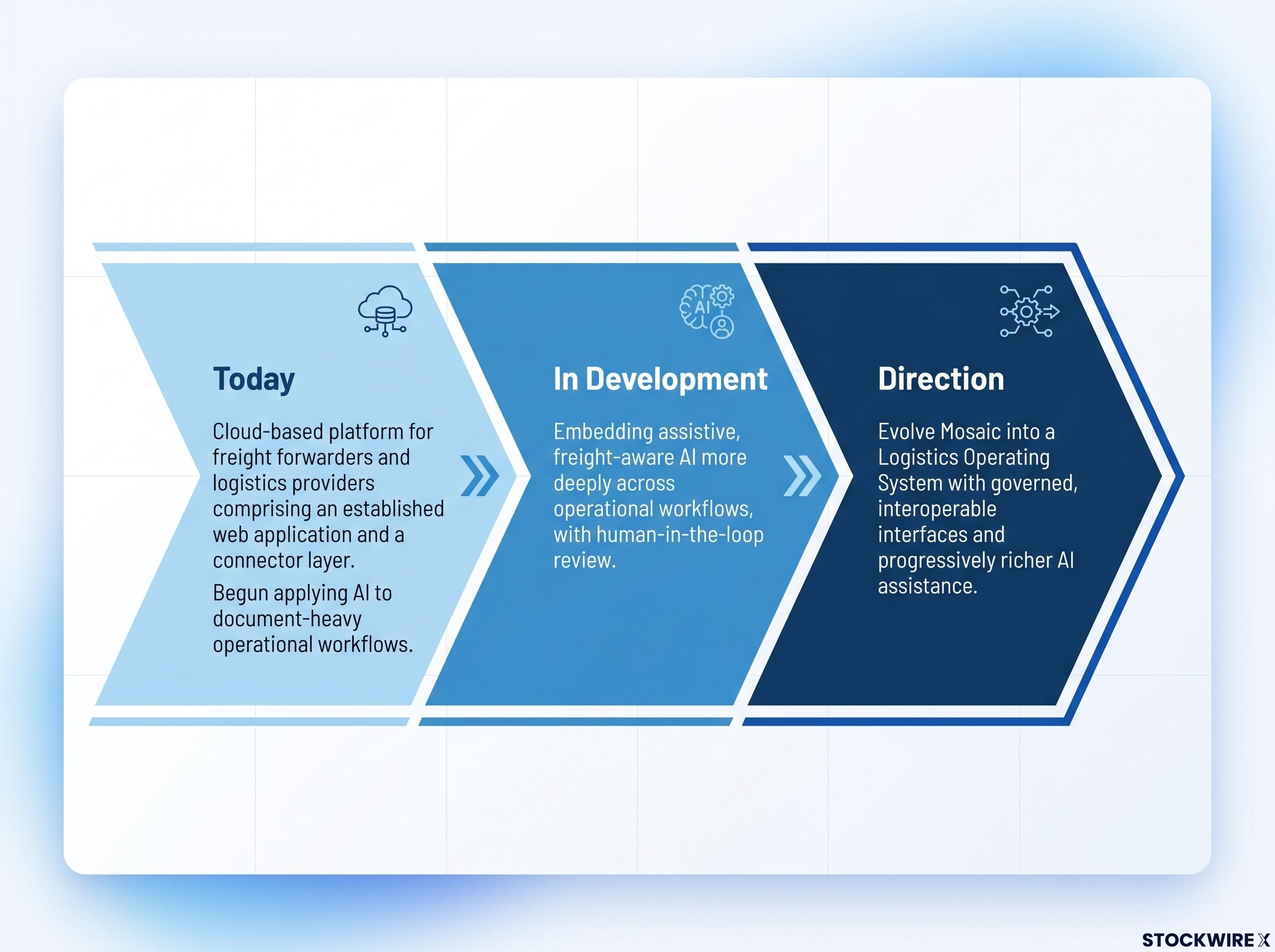
The Company has drawn a clear distinction between what exists today and what is under development:
- Today: Mosaic is a cloud-based platform for freight forwarders and logistics providers, comprising an established web application and a connector layer that enables partner and regulatory integrations. The Company has begun applying AI to document-heavy operational workflows.
Mosaic’s second commercial customer, Wayfinder Cargo Solutions, completed the platform’s coverage across the full freight matrix, spanning air import, air export, ocean import and ocean export, ahead of a September 2026 revenue launch.
-
In development: Embedding assistive, freight-aware AI more deeply across operational workflows, with human-in-the-loop review where appropriate.
-
Direction: Continuing to evolve Mosaic into a Logistics Operating System with governed, interoperable interfaces and progressively richer AI assistance.
This transparency about current state versus planned development helps investors calibrate expectations. The full Logistics Operating System vision remains under development rather than representing deployed capability today.
CEO outlines competitive differentiation thesis
Yojee believes durable advantage in logistics AI comes from combining freight-forwarding domain depth, source-linked operational data, governed integration surfaces, and trust controls rather than from any single model or technology. The Company has adopted a disciplined development approach, prioritising measurable operational value such as time saved, error reduction, throughput and exception detection over capability claims.
Mark Connell, CEO
“Most of the AI conversation in logistics is about replacing people. That’s not our approach. The work is regulated, complex, and relationship-driven — a good AI is a good teammate, not a substitute for judgement. And to be a good teammate in freight, AI has to genuinely understand the domain: the exceptions, the compliance, the handoffs. That’s not something you shortcut. We’re building it properly, with real customers, in production — because the platform advantage comes from doing that well, not from being first to put AI in a press release.”
The CEO’s framing explicitly distances Yojee from “AI hype” positioning, instead emphasising domain depth and production deployment. This signals to investors a focus on execution over announcements, with the Company committing to update the market on material developments in the ordinary course.
Don’t Miss the Next Tech Breakout
Join 20,000+ investors getting FREE breaking ASX tech news delivered within minutes of release, complete with expert analysis. Click the “Free Alerts” button at Big News Blast to receive market-moving announcements the moment they drop, with the analysis already done for you.