
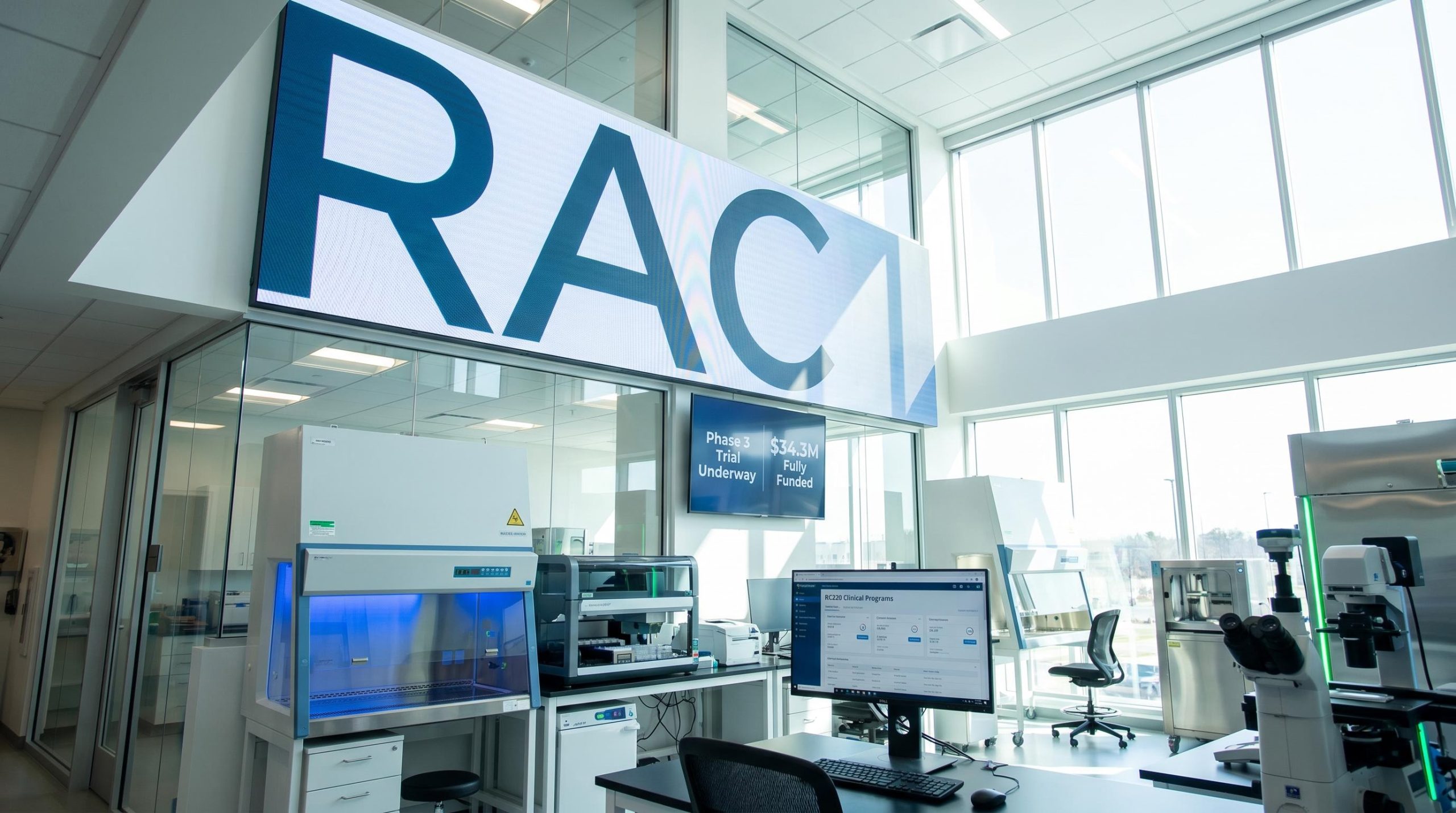
Racura raises $34.3 million to fund three oncology clinical trials
Racura Oncology has secured $34.3 million in total capital to fully fund its announced clinical programs targeting Acute Myeloid Leukaemia (AML), EGFRm non-small cell lung cancer, and anthracycline cardioprotection in solid tumour patients. The funds were raised directly from shareholders over a two-year period since June 2024, with zero broker or underwriter fees paid across any of the capital raising mechanisms.
The funding removes near-term dilution risk and execution uncertainty for investors tracking multiple Phase-stage readouts across the company’s RC220 clinical pipeline. Racura’s ability to raise capital directly from its shareholder base, without traditional intermediary costs, demonstrates both investor confidence and management’s capital discipline.
The raising comprised Bonus and Piggyback Option conversions, private placements, and option underwriting executed across the two-year timeframe. This extended fundraising period allowed the company to build a strong cash balance whilst limiting shareholder dilution through staged capital deployment.
When big ASX news breaks, our subscribers know first
How the capital was raised
The $34.3 million total was accumulated through four distinct fundraising mechanisms, all executed without paying broker or underwriter fees. The company had previously entered into an Underwriting Agreement for any Piggyback Options shortfall on 28 May 2026. However, by mutual agreement with the Underwriter, Racura elected to partially place 509,205 of the 631,201 shortfall Options, contributing an additional $636,506.25 to the total raised whilst limiting shareholder dilution.
The four fundraising mechanisms were:
- Bonus Option conversions
- Piggyback Option conversions
- Private placements
- Option underwriting (partial placement of shortfall)
Management’s decision to not place the full shortfall demonstrates active capital discipline and shareholder alignment. By electing to place 509,205 of the 631,201 shortfall Options, Racura avoided unnecessary dilution whilst still securing sufficient funding to execute its clinical strategy.
The absence of broker or underwriter fees across all raisings preserves shareholder value by directing capital entirely towards clinical execution rather than transaction costs. For investors, this approach signals management’s focus on maximising the productive deployment of raised capital.

What is G4-DNA targeting in oncology?
Racura’s lead asset, (E,E)-bisantrene, formulated as RC220, works through a mechanism called G4-DNA and G4-RNA binding. This approach silences the MYC oncogene, described as an important cancer growth regulator. In practical terms, the drug binds to specific DNA and RNA structures within cancer cells, preventing MYC from driving uncontrolled cell growth.
The company’s ability to target this pathway addresses a significant gap in oncology drug development.
(E,E)-bisantrene has demonstrated therapeutic activity in cancer patients with a well-characterised safety profile from prior clinical use. This existing safety data reduces development risk compared to novel molecules entering the clinic for the first time. Recent composition of matter IP filings provide 20 years of patent protection over (E,E)-bisantrene, establishing long-dated commercial runway.
For investors, the 20-year patent protection timeline provides substantial exclusivity for potential commercialisation across multiple indications. The combination of validated safety data, a novel mechanism targeting MYC, and extended IP protection creates a differentiated clinical and commercial profile.
Three clinical programs now fully funded
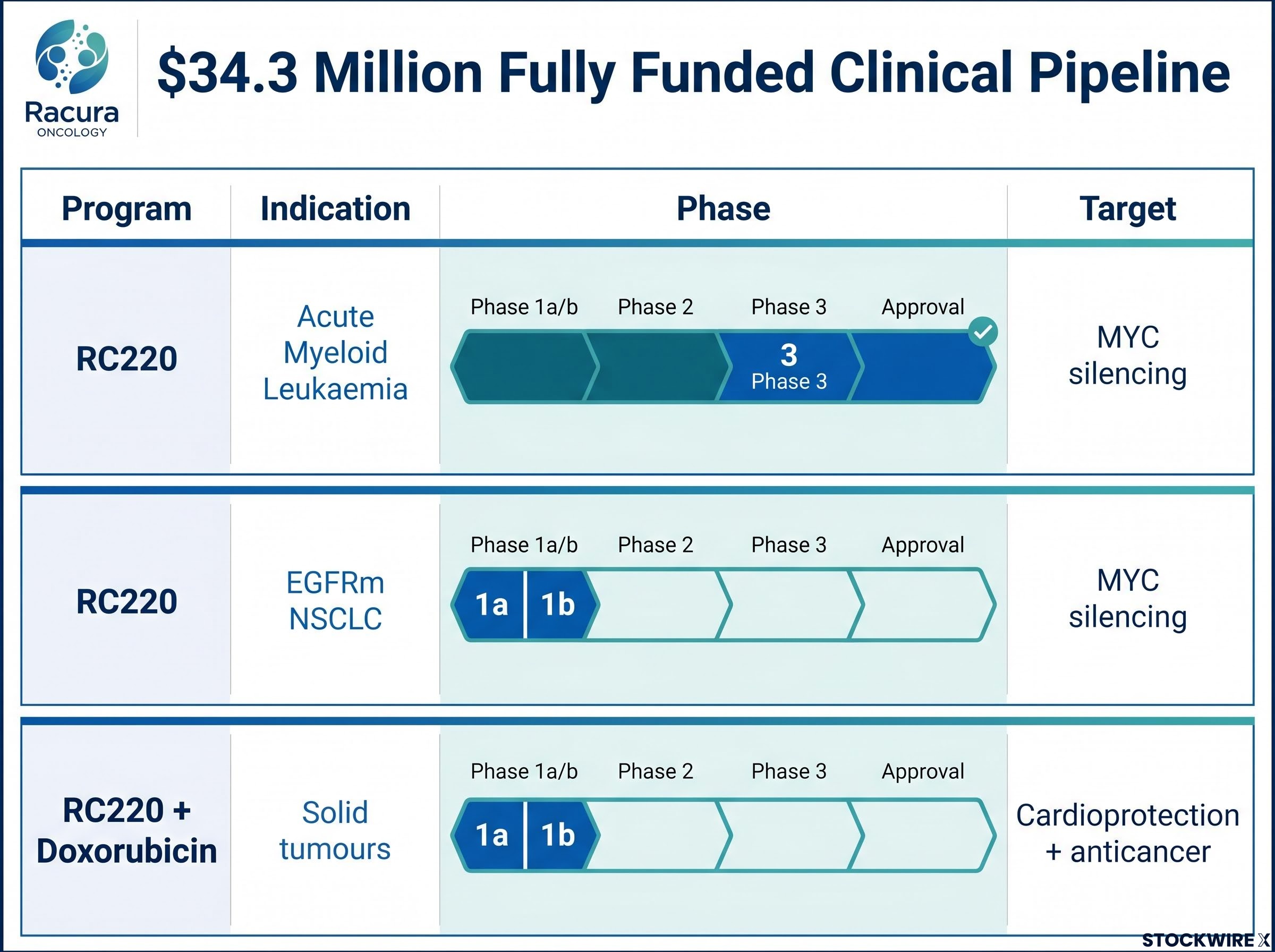
Racura is advancing RC220 across three distinct clinical programs, each targeting different patient populations and stages of development. The $34.3 million raised provides full funding for all three programs, eliminating near-term capital raising requirements.
Phase 3 in Acute Myeloid Leukaemia (AML)
The most advanced program is the Phase 3 clinical trial in AML, a haematological malignancy representing significant unmet need. AML patients face poor prognosis with existing treatment options, particularly in relapsed or refractory settings. The Phase 3 stage positions this program as the nearest potential catalyst for clinical readouts and regulatory progression.
Phase 1a/b in EGFRm non-small cell lung cancer
This program targets patients with EGFR-mutant lung cancer, a molecularly defined subset of non-small cell lung cancer. The Phase 1a/b stage focuses on establishing safety, tolerability, and initial efficacy signals in this genetically selected patient population. EGFRm lung cancer represents a well-validated oncology target with existing approved therapies, providing a clear regulatory pathway.
The HARNESS-1 trial enrolled its first patient at Monash Health in Victoria, testing RC220 in combination with osimertinib to prevent or delay resistance development in EGFR-mutant NSCLC patients, a population with no currently approved solution for acquired osimertinib resistance.
Phase 1a/b anthracycline cardioprotection in solid tumours
The third program combines RC220 with doxorubicin, an anthracycline chemotherapy agent. The dual aim is cardioprotection and enhanced anticancer activity for solid tumour patients. Anthracycline-induced cardiotoxicity is a known limitation of current chemotherapy regimens, often forcing dose reductions or treatment discontinuation. If RC220 demonstrates both cardiac protection and improved tumour response, it addresses a major clinical challenge in oncology practice.
CPACS dose escalation to 80 mg/m2 was cleared by Racura’s Safety Review Committee after zero dose-limiting toxicities were recorded across all three Cohort 1 patients, providing an early clinical signal that RC220 can be combined with doxorubicin without compromising tolerability.
| Program | Indication | Phase | Target |
|---|---|---|---|
| RC220 | Acute Myeloid Leukaemia | Phase 3 | MYC silencing |
| RC220 | EGFRm NSCLC | Phase 1a/b | MYC silencing |
| RC220 + Doxorubicin | Solid tumours | Phase 1a/b | Cardioprotection + anticancer |
Having three shots on goal across different indications and phases diversifies clinical risk. The Phase 3 AML program offers the nearest potential catalyst, whilst the two Phase 1a/b programs provide optionality across solid and haematological malignancies.
CEO commentary
Dr Daniel Tillett, CEO and Managing Director
“We are deeply grateful for the enormous support shown by our shareholders. Raising more than $34 million directly from our shareholders over the past two years demonstrates exceptional confidence in us and our mission. We look forward to updating investors on RC220’s clinical progress in the coming months.”
Management has flagged clinical updates “in the coming months,” signalling near-term newsflow for investors to monitor. The reference to shareholder support and mission confidence reinforces the alignment between management and the capital base.
Collaboration network and commercial pathway
Racura has established research collaborations with:
- Astex
- Emory University
- Purdue University
- MD Anderson
- Sheba City of Health
- UNC School of Medicine
- University of Wollongong
- University of Newcastle
The company is actively exploring partnerships, licence agreements, or commercial M&A to accelerate patient access to RC220 globally. This strategic flexibility indicates management is focused on value realisation pathways beyond standalone development. For investors, active pursuit of partnerships or M&A could provide earlier liquidity or de-risking events, particularly if a larger pharmaceutical partner validates RC220’s clinical potential through an upfront payment or equity investment.
The collaboration network across leading academic and clinical institutions provides external validation of RC220’s scientific rationale and clinical potential. These relationships also support future trial design, patient recruitment, and data generation across multiple geographies.
Don’t Miss the Next Biotech Breakthrough
Join 20,000+ investors getting FREE breaking ASX news delivered to your inbox within minutes, complete with in-depth analysis. Click the “Free Alerts” button at StockWire X to start receiving alerts the moment market-moving announcements break across Healthcare, Technology, Finance, and beyond.