

Emyria charts path to clinic profitability as national rollout accelerates
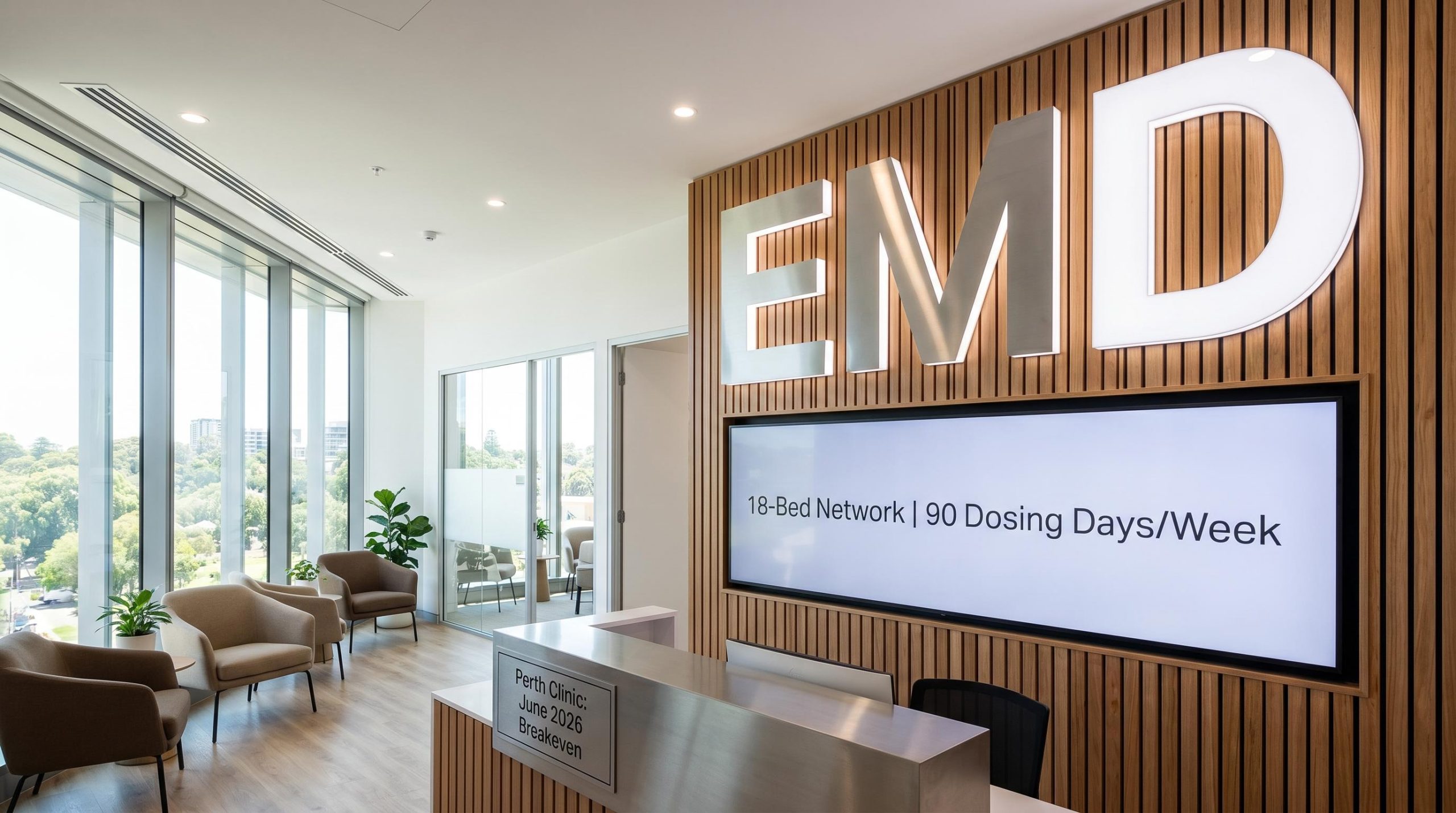
In its June 2026 investor presentation at the Gold Coast Investment Showcase, Emyria outlined a significant operational milestone: its Perth clinic is on track to reach standalone breakeven in June 2026, with 30 dosing days booked for the month. The company highlighted its expanding national network of psychedelic-assisted therapy clinics, now comprising 18 beds across five locations—two in Perth, and one each in Brisbane, Mornington (Victoria), and Sydney—capable of delivering up to 90 dosing days per week when fully operational.
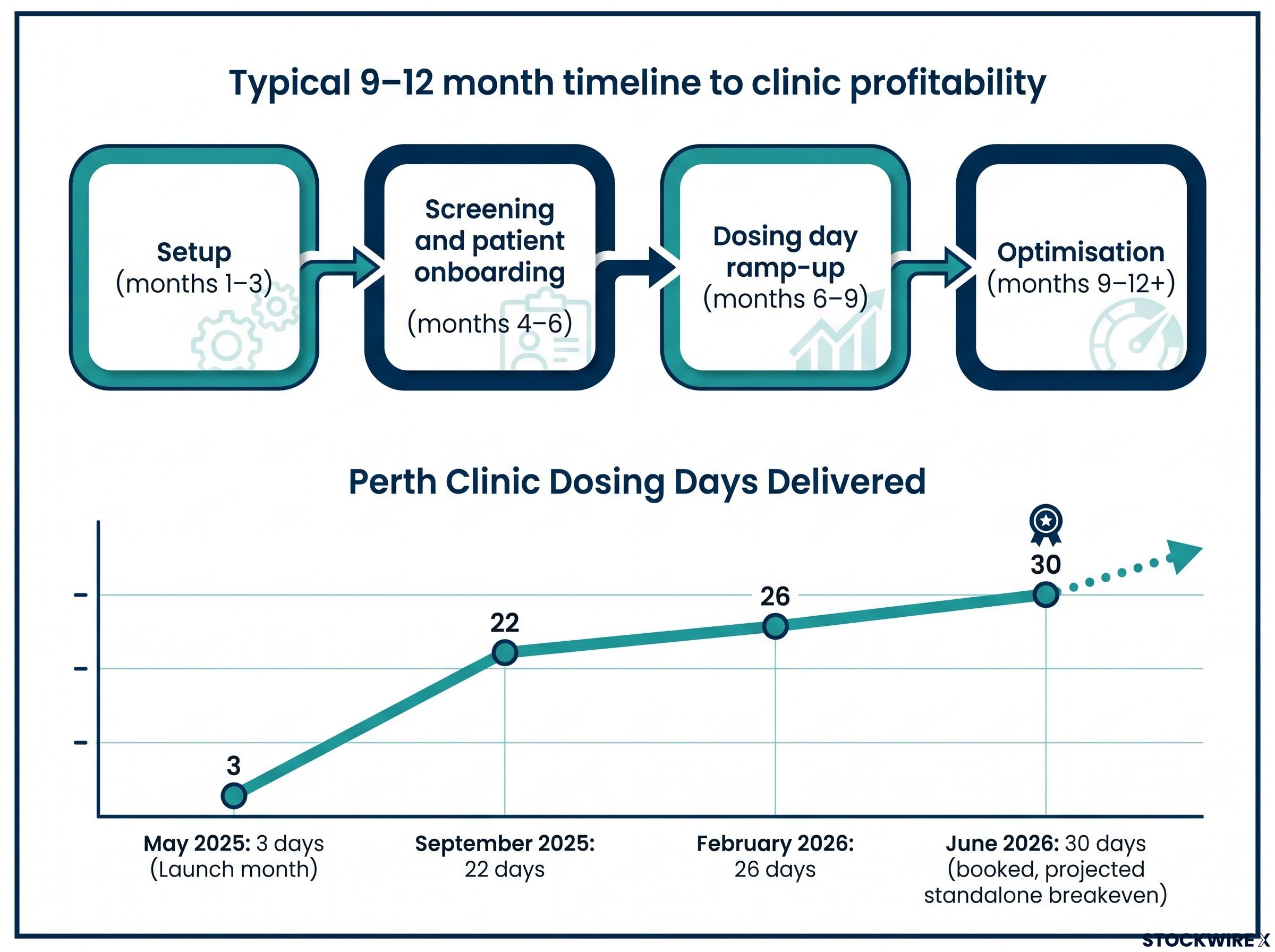
Management detailed the Perth clinic’s maturation trajectory, which has scaled from 3 dosing days in its May 2025 launch month to the projected breakeven figure 13 months later. The presentation positioned this as validation of the company’s unit economics model, providing a template for scaling the remaining clinics through the same 9–12 month maturation pathway. Emyria reported a cash position of approximately $9 million as at its March 2026 quarterly report, with a market capitalisation of around $35 million.
Emyria’s record H1 FY26 revenue of $1.55 million, representing 136% year-on-year growth, provided the financial foundation from which the current national rollout is being executed, with dual reimbursement pathways already active across multiple states heading into the second half.
When big ASX news breaks, our subscribers know first
What is psychedelic-assisted therapy and why does it matter?
Psychedelic-assisted therapy (PAT) combines medication with approximately 90 hours of supervised intensive psychotherapy over a structured treatment programme. Australia became the first jurisdiction globally to reschedule MDMA and psilocybin for therapeutic use under the Therapeutic Goods Administration (TGA), enabling psychiatrists to prescribe MDMA-assisted therapy for PTSD and psilocybin-assisted therapy for treatment-resistant depression.
The addressable market in Australia is substantial: approximately 1.1 million adults live with major depression (around 4% of the population), and an estimated 1.5 million adults experience PTSD (approximately 7%). Each dosing day generates around $10,000 in revenue, with total treatment costs per patient reaching approximately $33,000 for PTSD programmes and $22,000 for treatment-resistant depression.
Australia’s regulatory first-mover status creates a competitive moat in a market where few approved treatment alternatives exist for these patient cohorts. The company presented this as a strategic advantage in developing scalable clinical infrastructure ahead of global peers.
Perth clinic dosing trajectory validates expansion model
The presentation detailed the Perth clinic’s progression from its May 2025 launch through to its June 2026 projected breakeven month. Management outlined a typical 9–12 month timeline to clinic profitability, structured across four development phases: setup (months 1–3), screening and patient onboarding (months 4–6), dosing day ramp-up (months 6–9), and optimisation (months 9–12+).
| Month | Dosing Days Delivered | Phase | Notes |
|---|---|---|---|
| May 2025 | 3 | Ramp-up | Launch month |
| September 2025 | 22 | Ramp-up | — |
| February 2026 | 26 | Optimisation | — |
| June 2026 | 30 (booked) | Optimisation | Projected standalone breakeven |
The Perth clinic’s trajectory provides visibility on the maturation timelines for Brisbane (currently in months 6–9 of the ramp-up phase), Mornington (months 4–6, screening phase), and Sydney (months 1–3, setup phase). The company positioned this validated ramp-up model as evidence of repeatable unit economics across its expanding network.
Third-party funding momentum supports revenue visibility
Emyria highlighted three confirmed funding pathways supporting patient access: Medibank (private health insurance), the Department of Veterans’ Affairs (DVA), and Workers’ Compensation schemes. Medibank became the first private health insurer to fund psychedelic-assisted therapy treatments, a development the company positioned as a significant de-risking milestone for the revenue model.
The presentation detailed the scale of institutional spending on mental health: Medibank spent $219 million on mental health in 2024 alone, with $2 billion allocated over the past decade. The DVA spends approximately $300 million per year on veteran mental health, whilst life insurers paid out more than $2.2 billion in retail mental health claims in 2024.
Management emphasised the cost-effectiveness positioning of Emyria’s programme—approximately $33,000 per year for PTSD treatment—compared to typical standard-of-care interventions, which can exceed $60,000 per year when accounting for multiple hospital admissions, ongoing specialist appointments, and neurostimulation therapies. This cost comparison underpins the company’s engagement with additional private health insurers and funding bodies currently in progress.
Clinical outcomes reinforce treatment durability
The company presented 12-month PTSD outcome data from its real-world patient dataset (as of December 2025), measured using the PCL-5 (PTSD Checklist for DSM-5), an industry-standard self-report tool. Key metrics included:
- More than 66% of patients no longer meet criteria for PTSD diagnosis
- Approximately 76% of patients demonstrate clinically significant improvement
- Patients continue to show improvement after active treatment has ended
Management highlighted that symptom reduction persists beyond the active treatment period, with follow-up data extending to 12 months post-treatment. This durability differentiates the therapy from revolving-door treatment models that require ongoing intervention, supporting the value proposition to funders and clinical referrers.
Regulatory tailwinds and workforce expansion
The presentation noted a May 2026 TGA update expanding the pool of eligible “lead” psychedelic-assisted therapy therapists to include nurses and occupational therapists with mental health experience, in addition to the existing clinical psychologist and medical doctor pathways. This regulatory change increases the recruitment pool available to support clinic scaling.
Emyria outlined its current contractor workforce across the network, with approved Authorised Prescribers and additional applications in progress across each site:
- Perth (two clinics): ~35 therapists, 8 approved APs (1 in application)
- Brisbane: ~25 therapists, 3 approved APs (2 in application)
- Melbourne (Mornington): ~25 therapists, 1 approved AP (3 in application)
- Sydney: ~30 therapists scheduled for June training, 4 APs in application
The capital-light contractor model was positioned as a key enabler of scalability, reducing fixed cost exposure during the clinic ramp-up periods whilst providing workforce flexibility as utilisation increases.
Near-term catalysts and strategic priorities
Management outlined seven stated priorities for the business as it continues to scale operations:
- First DVA funding approval
- Sydney clinic opening
- Additional new sites confirmed
- New funders confirmed
- Potential new treatment indications (leveraging global psychedelic drug research spanning mood disorders, trauma, substance use disorders, and neurological conditions)
- Second partner for Empax Global Partnership Programme
- Global partnerships leveraging scalable intellectual property
These stated drivers represent a diversified catalyst pipeline, with multiple potential re-rating opportunities across funding pathways, geographic expansion, and treatment scope. The company positioned its established delivery infrastructure as capable of supporting both expanded patient treatment capacity and third-party clinical trial delivery, adding a further revenue stream as global psychedelic drug development accelerates.
Want the Next Healthcare Breakthrough in Your Inbox?
Join 20,000+ investors getting FREE breaking ASX healthcare news delivered within minutes of release, complete with in-depth analysis. Click the “Free Alerts” button at Big News Blast to receive real-time alerts the moment market-moving announcements hit the ASX, with expert coverage already done for you.